Search results
Search for "thermal noise" in Full Text gives 69 result(s) in Beilstein Journal of Nanotechnology.
Modification of a single-molecule AFM probe with highly defined surface functionality
Beilstein J. Nanotechnol. 2014, 5, 2122–2128, doi:10.3762/bjnano.5.221
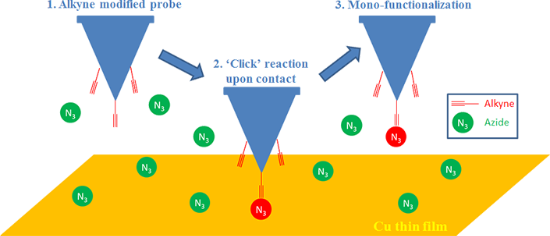
- . When the probe is retracted, the force to break the hydrogen bonds should be detectable. The force spectroscopy experiments were carried out in contact mode at room temperature in isopropanol. The spring constant of the AFM probes were calibrated by using the thermal noise method [30]. The measured


Unlocking higher harmonics in atomic force microscopy with gentle interactions
Beilstein J. Nanotechnol. 2014, 5, 268–277, doi:10.3762/bjnano.5.29
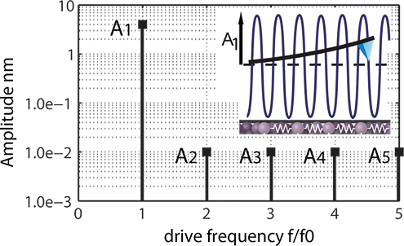
- to apparent topography induced by chemistry or other compositional variations. Thermal noise and higher harmonic external drives As stated in the introduction, it has long been known that under ambient conditions higher harmonic amplitudes might be too small to be detected [3][15][42]. This is
- phase shifts Δ have been employed to map the composition through variations in the tip–sample Hamaker constant, H, in Equation 10. In this section, the presence of thermal noise is discussed with respect to the contrast in amplitude ΔAn and phase Δ in the presence and absence of external drive forces at
- their effects on amplitude and phase shifts. This should provide a measure of the impact of thermal noise on the enhanced contrast reported in this work (Figure 2 and Figure 3). Other technical issues such as tilt and probe geometry have also been ignored for simplicity since these typically involve a

![[Graphic 7]](/bjnano/content/inline/2190-4286-5-29-i27.png?max-width=637&scale=1.18182) of higher harmonics, including the fundamental shift
of higher harmonics, including the fundamental shift ![[Graphic 8]](/bjnano/content/inline/2190-4286-5-29-i28.png?max-width=637&scale=1.18182) , when N = 10 external harmonic ...
, when N = 10 external harmonic ...


Manipulation of nanoparticles of different shapes inside a scanning electron microscope
Beilstein J. Nanotechnol. 2014, 5, 133–140, doi:10.3762/bjnano.5.13
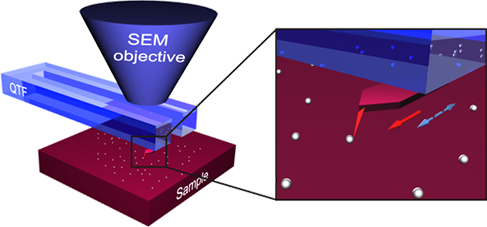
- by the thermal noise method. A detailed description of calibration procedure is given in Supporting Information File 1. Each manipulation experiment started with a displacement of the NP from its initial position by an abrupt tip motion in the step regime to reduce the initial adhesion, which is


Noise performance of frequency modulation Kelvin force microscopy
Beilstein J. Nanotechnol. 2014, 5, 1–18, doi:10.3762/bjnano.5.1
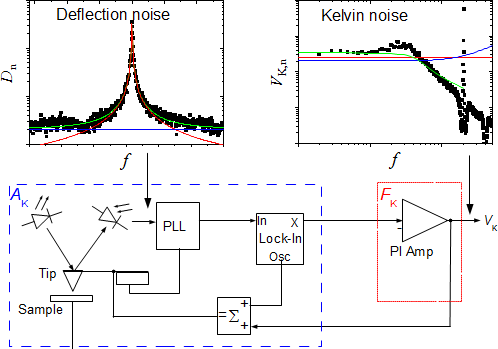
- PSD decomposed into thermal noise (red) and sensor noise (blue) is computed according to the approximation of Equation 17 (see Equation 20 below). Regarding the approximation of Equation 17, we note that it is valid in the range in which the closed loop gain is unity and |APLLFPLL| >> 1. Hence, the
- voltage noise PSD The thermal noise PSD of the PLL frequency noise Equation 20 is constant and hence invariant under the frequency translation, yielding as Kelvin noise PSD, by dividing through the Kelvin gain Equation 26, indicated as red curve in Figure 14. The integrated noise is while the sensor noise
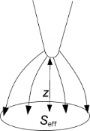
- temperature above which at a given bandwidth, the integrated thermal noise of Equation 38 exceeds the integrated sensor noise Equation 40, while the design rule is respected: Regarding the effective probed surface Seff, its absolute value is not known, but the relation between tip–sample distance and probed





Dynamic nanoindentation by instrumented nanoindentation and force microscopy: a comparative review
Beilstein J. Nanotechnol. 2013, 4, 815–833, doi:10.3762/bjnano.4.93
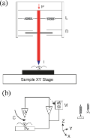
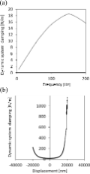
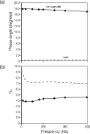
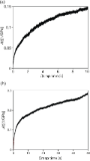
- the sample in the AFM (Bruker, multimode). Prior to the experiment, the cantilever spring constant and the deflection sensitivity were determined with the Nanoscope software (former from the thermal noise and the latter by measuring the deflection of the cantilever with the displacement on a hard


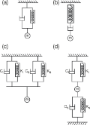
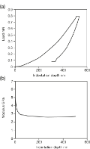


Determining cantilever stiffness from thermal noise
Beilstein J. Nanotechnol. 2013, 4, 227–233, doi:10.3762/bjnano.4.23
- oscillation mode from thermal noise by an analysis of the power spectral density of displacement fluctuations of the cantilever in contact with a thermal bath. The practical applicability of this approach is demonstrated for several cantilevers with eigenfrequencies ranging from 50 kHz to 2 MHz. As such an
- excited near their fundamental eigenfrequency f0, higher eigenmodes [7] have been investigated in the context of noise analysis [8], and it has been debated whether the thermal noise limitations in NC-AFM measurements could be reduced by operating cantilevers at higher eigenmodes [9]. It has further been
- known temperature [10]. A practical implementation of this notion, focused on the determination of cantilever stiffness from thermal noise, demonstrated the validity of the approach by a critical comparison of the results against corresponding results from other methods [11]. While the properties fn and
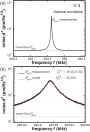
![[Graphic 34]](/bjnano/content/inline/2190-4286-4-23-i40.png?max-width=637&scale=1.18182) measured for the fundamental mode of cantilever V 4. Measureme...
measured for the fundamental mode of cantilever V 4. Measureme...
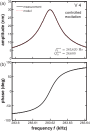
![[Graphic 23]](/bjnano/content/inline/2190-4286-4-23-i29.png?max-width=637&scale=1.18182) measured for cantilever V 4 (A0 = 16.8 nm, demodulator band...
measured for cantilever V 4 (A0 = 16.8 nm, demodulator band...
High-resolution dynamic atomic force microscopy in liquids with different feedback architectures
Beilstein J. Nanotechnol. 2013, 4, 153–163, doi:10.3762/bjnano.4.15
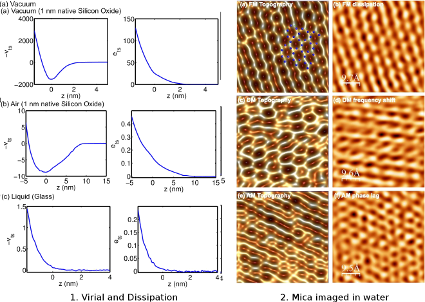
- resolution we must also obtain some estimate of the resolution of the amplitude measurement δa. Two important noise sources that contribute to δa are the thermal noise and deflection-sensor noise. In light of recent efforts to reduce the deflection-sensor noise [42], we will focus on the thermodynamic lower


Thermal noise limit for ultra-high vacuum noncontact atomic force microscopy
Beilstein J. Nanotechnol. 2013, 4, 32–44, doi:10.3762/bjnano.4.4
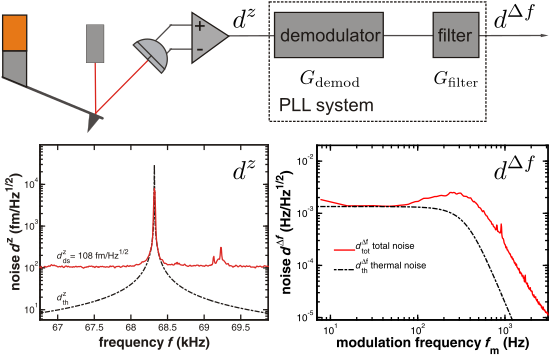
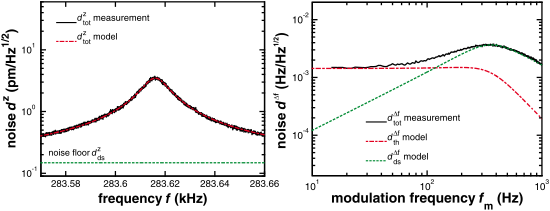
- ) consists of cantilever thermal noise, tip–surface-interaction noise and instrumental noise from the detection and signal processing systems. We investigate how the displacement-noise spectral density dz at the input of the frequency demodulator propagates to the frequency-shift-noise spectral density dΔf
- displacement signal and determine the transfer function of the signal-processing electronics. From the transfer function and the measured dz, we predict dΔf for specific filter settings, a given level of detection-system noise spectral density dzds and the cantilever-thermal-noise spectral density dzth. We
- find an excellent agreement between the calculated and measured values for dΔf. Furthermore, we demonstrate that thermal noise in dΔf, defining the ultimate limit in NC-AFM signal detection, can be kept low by a proper choice of the cantilever whereby its Q-factor should be given most attention. A


![[Graphic 53]](/bjnano/content/inline/2190-4286-4-4-i64.png?max-width=637&scale=1.18182) =
= ![[Graphic 32]](/bjnano/content/inline/2190-4286-4-4-i43.png?max-width=637&scale=1.18182) f...
f...


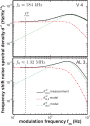
![[Graphic 56]](/bjnano/content/inline/2190-4286-4-4-i67.png?max-width=637&scale=1.18182) using three diff...
using three diff...

Characterization of the mechanical properties of qPlus sensors
Beilstein J. Nanotechnol. 2013, 4, 1–9, doi:10.3762/bjnano.4.1
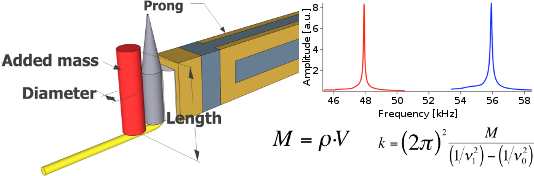
- thermal noise spectrum. We show that all three methods give very similar results. Surprisingly, neither the gold wire nor the gluing give rise to significant changes of the stiffness in the case of our home-built sensors. Furthermore we describe a fast and cost-effective way to perform Cleveland’s method
- . Keywords: AFM; Cleveland’s method; cross talk; force; qPlus; stiffness; STM; thermal noise; tuning fork; Introduction The invention of scanning tunneling microscopy [1] and atomic force microscopy (AFM) [2] opened new horizons in characterization and modification of surfaces and nanostructures. STM is
- determined by using the same PLL as for the ambient measurement. A high-quality PC sound card ASUS Xonar Essence ST in combination with a free FFT software Spectrum Lab (Audio Signal Analyser) was used to record thermal-noise density spectra. Results and Discussion We carried out a series of measurements of


Spring constant of a tuning-fork sensor for dynamic force microscopy
Beilstein J. Nanotechnol. 2012, 3, 809–816, doi:10.3762/bjnano.3.90
- resonance frequency [12][13][14]. By measuring the amplitude of the thermal noise, k can be evaluated in situ, e.g., in a vacuum system prior to the measurement, without any modification of the experimental arrangement [15][16][17][18][19][20]. However, this requires a good signal-to-noise ratio for the
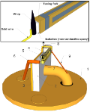
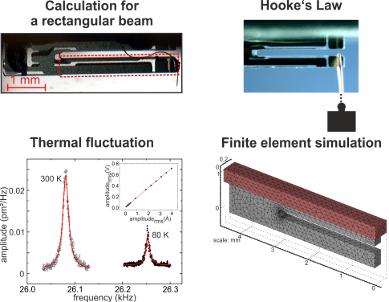
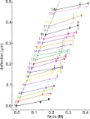
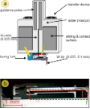
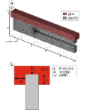
- we compare the results for the determination of the spring constant of tuning fork sensors in the qPlus configuration [1][2] based on the following methods: a simple calculation for a cantilever beam; the measured deflection as a function of the applied force; the thermal noise; and a numerical




Growth behaviour and mechanical properties of PLL/HA multilayer films studied by AFM
Beilstein J. Nanotechnol. 2012, 3, 778–788, doi:10.3762/bjnano.3.87
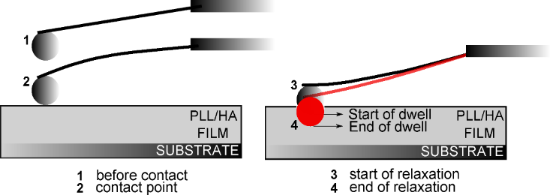
- measurements. Although the spring constant kc was given by the manufacturer as 0.05 N/m (unless stated otherwise), its exact value was determined before each measurement by the thermal noise method, which is a built-in procedure in the MFP-3D instrument (Asylum Research, CA, USA). Thickness measurements Two


Focused electron beam induced deposition: A perspective
Beilstein J. Nanotechnol. 2012, 3, 597–619, doi:10.3762/bjnano.3.70


Mapping mechanical properties of organic thin films by force-modulation microscopy in aqueous media
Beilstein J. Nanotechnol. 2012, 3, 464–474, doi:10.3762/bjnano.3.53
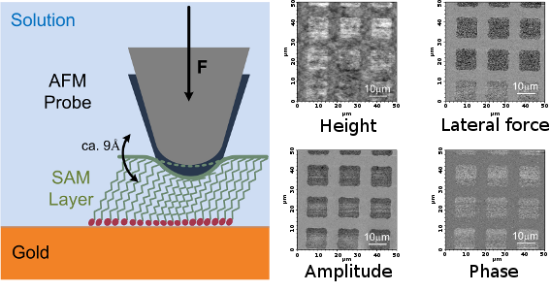
- curve taken before an FMM experiment. The spring constant of each cantilever was calculated from the power spectral density of the thermal noise fluctuations. Since FMM is a modified contact mode AFM method, frictional forces may affect the measurements. Friction leads to lateral twisting of the



Wavelet cross-correlation and phase analysis of a free cantilever subjected to band excitation
Beilstein J. Nanotechnol. 2012, 3, 294–300, doi:10.3762/bjnano.3.33
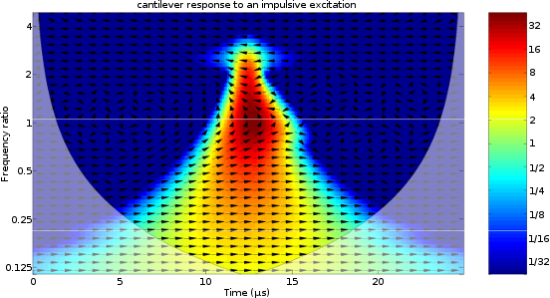
- ], impulsive cantilever excitation [5] or thermal-noise excitation [6][7][8][9]. Thermal noise analysis has been performed, with the aid of wavelet transforms, to characterize the time–frequency response of a thermally excited cantilever in dynamic force spectroscopy [10][11][12]. In these previous works, the
- traditional Fourier spectra. Regarding environmental noise, it has been demonstrated that by using only thermal excitation it is possible to retrieve useful information from force spectroscopy [11] with a single approach curve under standard operating conditions. Regarding the thermal noise, the excitation
- signals must have amplitudes exceeding that of the thermal noise, because averaging is limited or absent. In this case, the choice of the excitation amplitude depends on the type of cantilever, on its quality factor and on the parameters to be measured. We anticipated that only extremely low amplitude


Pulse-response measurement of frequency-resolved water dynamics on a hydrophilic surface using a Q-damped atomic force microscopy cantilever
Beilstein J. Nanotechnol. 2012, 3, 260–266, doi:10.3762/bjnano.3.29
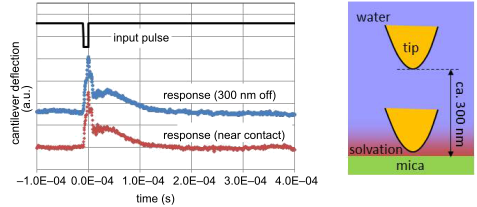
- , resonance-free cantilever with the input waveform [25]. The Q-control gain was fixed to this value throughout the measurement. Figure 4 shows a comparison of the power spectrum density (PSD) of thermal noise in the cantilever-deflection signal before and after Q-control gain optimization. The peaks in the
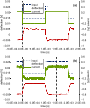
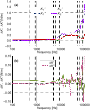
- , thick solid, and fine solid lines indicate the input-voltage signal, current in the electromagnet, and cantilever deflection, respectively. The cantilever swing amplitude corresponds to about 4 nm. Comparison of the power spectrum density (PSD) of thermal noise in the cantilever-deflection signal before




qPlus magnetic force microscopy in frequency-modulation mode with millihertz resolution
Beilstein J. Nanotechnol. 2012, 3, 174–178, doi:10.3762/bjnano.3.18
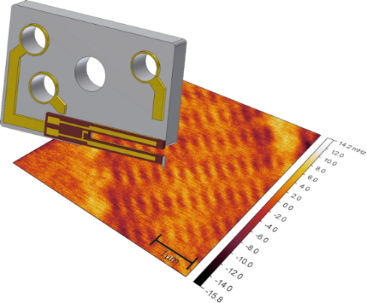
- determine the sensitivity of the experimental setup, and thus the minimum detectable averaged force gradient , one has to calculate the frequency noise of the setup δ(Δf). In FM-AFM setups δ(Δf) is a sum of three uncorrelated noise sources [13][14]: Thermal noise deflection-detector noise and oscillator


Charge transport in a zinc–porphyrin single-molecule junction
Beilstein J. Nanotechnol. 2011, 2, 714–719, doi:10.3762/bjnano.2.77
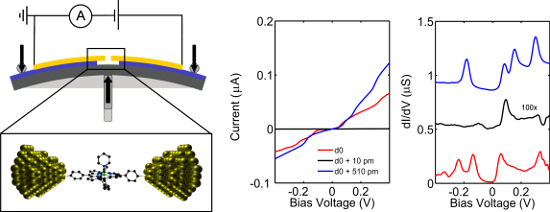
- stability increases, and both the thermal noise and thermal broadening decrease. We therefore cooled down the junctions to cryogenic temperature (6 K) while keeping the zero-bias conductance at a fixed value (around 1∙10−4 G0) with a feedback loop. In Figure 3a and Figure 3b, we present low-temperature I(V


Tip-sample interactions on graphite studied using the wavelet transform
Beilstein J. Nanotechnol. 2010, 1, 172–181, doi:10.3762/bjnano.1.21
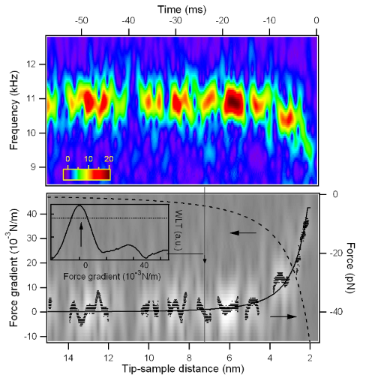
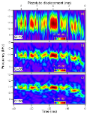
- k = 0.13 N/m [20]. For each cantilever the elastic constant is evaluated both by the Sader method [20] and the thermal noise method applied to the first flexural mode [21][22]. Both methods agree within 5%. The piezoscanning system is based on a single scanner tube with a maximum vertical extension
- of 2 μm. The experiments consisted in acquiring the temporal evolution of the thermal noise as a function of the tip-sample distance. The thermal noise signal measured by the beam deflection system is sampled with the digitizing oscilloscope while the tip moves toward the surface. The piezoscanner is




Sensing surface PEGylation with microcantilevers
Beilstein J. Nanotechnol. 2010, 1, 3–13, doi:10.3762/bjnano.1.2
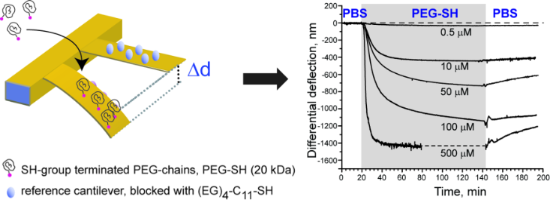
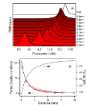
- ± 0.1 nm for L and s, respectively. The data collected beyond a certain D is scattered being less than the minimum detectable force, which is given by the thermal noise of the AFM-cantilever: Fmin = (kBT × kAFM)1/2 ≈ 5 pN. The weak repulsion at ~5 nm in the lower curve indicates that the PEG chains are