


Search results
Search for "trajectory" in Full Text gives 107 result(s) in Beilstein Journal of Nanotechnology.
Optical techniques for cervical neoplasia detection
Beilstein J. Nanotechnol. 2017, 8, 1844–1862, doi:10.3762/bjnano.8.186

- –Chipman decomposition implies a sequential order of elementary polarimetric properties along the trajectory of the probing beam, whereas these polarimetric properties can be mixed within the volume of tissue. Nevertheless, these effective values of depolarization and retardance are found to be the



High-speed dynamic-mode atomic force microscopy imaging of polymers: an adaptive multiloop-mode approach
Beilstein J. Nanotechnol. 2017, 8, 1563–1570, doi:10.3762/bjnano.8.158
- +feedforward) applied to the z-piezo actuator (i.e., Uff+fb,k(jω) = Uff,k(jω) + Ufb,k(jω), see Figure 9), and the z-piezo displacement measured on the k-th scan line, respectively, and Hffd,k+1(·) denotes the desired trajectory that the z-piezo needs to track at the (k+1)-th scanline. Note that the ratio in




Functional dependence of resonant harmonics on nanomechanical parameters in dynamic mode atomic force microscopy
Beilstein J. Nanotechnol. 2017, 8, 883–891, doi:10.3762/bjnano.8.90
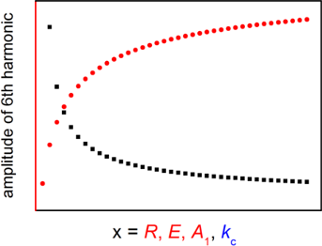
- , represented by the force field Fts, between the cantilever tip and the surface [1]. Thus, the time dependent trajectory a(t) of the cantilever tip, which can be expressed in the harmonic limit by a(t) = A1cos(2πft), is transformed into a Fourier series with harmonic oscillations of amplitudes An and


Measuring adhesion on rough surfaces using atomic force microscopy with a liquid probe
Beilstein J. Nanotechnol. 2017, 8, 813–825, doi:10.3762/bjnano.8.84
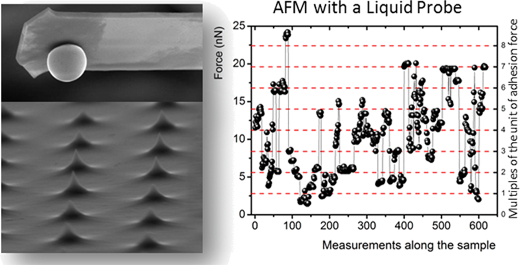
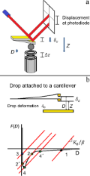
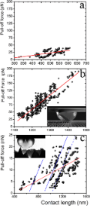
- follows a different trajectory than during the approach (4–4′ in Figure 5b) giving rise to force–displacement curve hysteresis. The two discontinuities in the force values are called jump-to-contact in the approach curve and jump-off-contact in the withdrawal curve. It is important to mention that this

First examples of organosilica-based ionogels: synthesis and electrochemical behavior
Beilstein J. Nanotechnol. 2017, 8, 736–751, doi:10.3762/bjnano.8.77
- thermostats (parameters as in [41]) for 5 ps. After this the simulation was done in an NVT ensemble to provide 2.5 ps production trajectory at 450 K which was analyzed with the software TRAVIS [43]. A forthcoming publication will provide more details and longer simulation times. Figure 1 shows the simulation
- increases the intramolecular bond to approximately 150 pm either a cation SO3 group or one of the tosylate anions is close. A very large O–H distance of a former intramolecular O–H group can correlate with both, a short O–H anion or cation distance. Moreover, inspection of the trajectory clearly shows that








Calculating free energies of organic molecules on insulating substrates
Beilstein J. Nanotechnol. 2017, 8, 667–674, doi:10.3762/bjnano.8.71
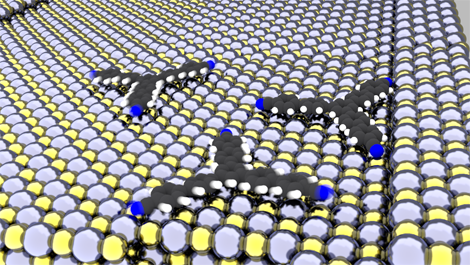
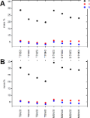
- simulations. Despite this seemingly simple process, calculating free energies is far from trivial. In order to obtain converged results the ergodicity needs to be satisfied. The ergodic principle states that an infinite trajectory (in time) should sample all possible states of a system. However, in practice
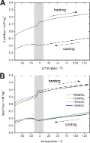
- curves. Increasing the MD trajectory from 50 ns to 100 ns leads to a drop in the free energy of step adhesion from 0.5 eV to 0.35 eV. As MD simulation times are increased, the free energy continues to decrease as more and more of the higher-energy, low-probability configurational space is sampled. This
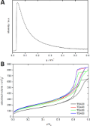
- free energy is plotted as a function of the molecule–step distance as obtained from a 100 ns MD trajectory. As one arm of the molecule attaches to the step edge, a large drop in entropy was observed. However, the free-energy profile seems to suggest a much more favourable interaction. In fact it


Dynamic of cold-atom tips in anharmonic potentials
Beilstein J. Nanotechnol. 2016, 7, 1543–1555, doi:10.3762/bjnano.7.148
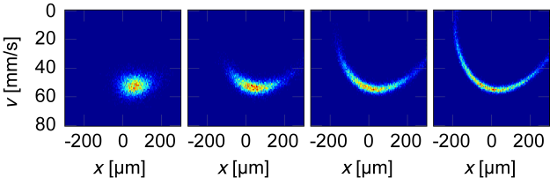
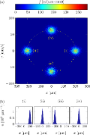
- different times after the initial displacement of A = 200 μm. Figure 2b shows the corresponding density profiles. Depending on the initial energy, each particle follows its own phase-space trajectory and oscillates clockwise around the origin with its own fundamental frequency. Low energetic particles will




Experimental and simulation-based investigation of He, Ne and Ar irradiation of polymers for ion microscopy
Beilstein J. Nanotechnol. 2016, 7, 1113–1128, doi:10.3762/bjnano.7.104
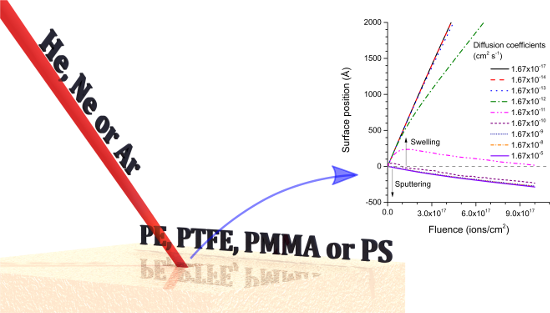
- between. The displacement of the noble gas atoms inside the polymer samples is described using the mean square displacement (MSD). Their trajectories have been recorded with a time step of dt = 0.2 ps, which makes 24000 trajectory points during the last 4.8 ns of the simulation. For each polymer sample
- positions from trajectory file, that is why the maximum displacement for He atom extends above the system size. The trajectories have been selected to reflect the average mobility of the rare gas species in HD-PMMA. Mean square displacement (MSD) of helium, neon and argon at 300 K in a) HD-PE, b) HD-PS, c


Signal enhancement in cantilever magnetometry based on a co-resonantly coupled sensor
Beilstein J. Nanotechnol. 2016, 7, 1033–1043, doi:10.3762/bjnano.7.96
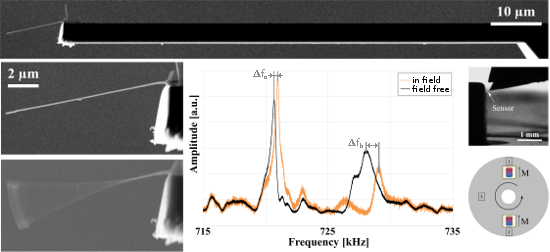
- contribution for several reasons: its oscillation trajectory radius and sensor stiffness are mainly given by the cantilever. In contrast to that the sensor stiffness at the free end of the FeCNT can be described by the soft effective spring constant of the coupled system. Hence, only the monopole at the free


![[Graphic 11]](/bjnano/content/inline/2190-4286-7-96-i21.png?max-width=637&scale=1.18182) on the interaction spring constant k3. Th...
on the interaction spring constant k3. Th...
Generalized Hertz model for bimodal nanomechanical mapping
Beilstein J. Nanotechnol. 2016, 7, 970–982, doi:10.3762/bjnano.7.89
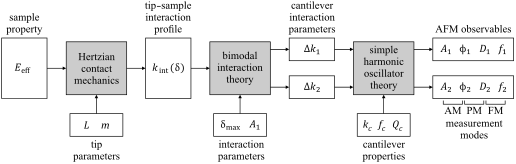
- . However, the instantaneous interaction stiffness experienced by the second eigenmode slowly changes along the trajectory of the first eigenmode. Because the second mode rides along the slower sinusoidal motion of the first mode, its time-averaged change in interaction stiffness Δk2 can be calculated by
- solves to Notably, this integral that determines Δk2 only depends on the trajectory of the first eigenmode because A2 is assumed small. c. Correction factor for power-law force model: β When integrating kint(δ) in Equation 6 and Equation 10 to obtain Δk1 and Δk2, respectively, for a power-law model as


![[Graphic 4]](/bjnano/content/inline/2190-4286-7-89-i40.png?max-width=637&scale=1.18182) approximation applied to Equation 6 i...
approximation applied to Equation 6 i...


Coupled molecular and cantilever dynamics model for frequency-modulated atomic force microscopy
Beilstein J. Nanotechnol. 2016, 7, 708–720, doi:10.3762/bjnano.7.63
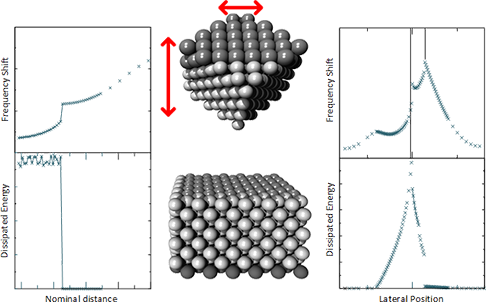
- surface [6]. In these simulations the tip motion is represented in a parametric way, e.g., by prescribing a sinusoidal trajectory normal or parallel to the surface. Recently situations attracted interest, where “the back-action of the tip–sample force on the cantilever can no longer be ignored” [22]. This
- their coupling can be studied. Moreover, the dynamic response of the tip due to its interaction with the substrate allows for the excitation of lateral degrees of freedom, which were suppressed, if the tip trajectory was fixed. They can give rise to a significant contribution to the dissipation signal
- A in Figure 2. The actual minimal distance is smaller than d due to the attractive forces between tip and substrate. The trajectory shows a hysteresis loop with significant displacements in all three dimensions. As the tip starts with zero temperature, the apex coordinates first do not fluctuate


Nanoscale effects in the characterization of viscoelastic materials with atomic force microscopy: coupling of a quasi-three-dimensional standard linear solid model with in-plane surface interactions
Beilstein J. Nanotechnol. 2016, 7, 554–571, doi:10.3762/bjnano.7.49


Molecular machines operating on the nanoscale: from classical to quantum
Beilstein J. Nanotechnol. 2016, 7, 328–350, doi:10.3762/bjnano.7.31
- by f(x,t) or by boundary conditions. Hence, time-irreversibility within dissipative Langevin dynamics is a statistical effect due to averaging over many trajectories. Such an averaging cannot be undone, i.e., there is no way to restore a single trajectory from their ensemble average. Considering a
- as a force balance equation. The net heat exchange with the environment is [23], where denotes an ensemble average over many trajectory realizations. Furthermore, is the energy pumped into the motor turnovers, and is the useful work done against external torque. The fluctuations of the motor
- ψ = π/2, as shown in Figure 4a. Here, there are two cases that differ by V2 = 0, in one case, and V2≠ 0, in another one. Moreover, when dissipation is present within the corresponding Langevin dynamics, each and every trajectory remains time-reversal symmetric for ψ = 0. However, for strongly

![[Graphic 40]](/bjnano/content/inline/2190-4286-7-31-i86.png?max-width=637&scale=1.18182) with depth ε. Bias Δμ < 0 per one rotation tur...
with depth ε. Bias Δμ < 0 per one rotation tur...

![[Graphic 48]](/bjnano/content/inline/2190-4286-7-31-i94.png?max-width=637&scale=1.18182) , for the most asymmetric sawtooth mod...
, for the most asymmetric sawtooth mod...


Nanoscale rippling on polymer surfaces induced by AFM manipulation
Beilstein J. Nanotechnol. 2015, 6, 2278–2289, doi:10.3762/bjnano.6.234
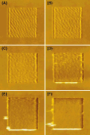
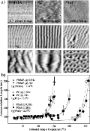
- be described as the parallel movement of a number of tips moving together along the same direction, like a blade. The final pattern could also depend on the number of scans. Tip trajectory: Gnecco et al. have also evidenced that ripple patterns could be obtained via circular or spiral trajectories of




Virtual reality visual feedback for hand-controlled scanning probe microscopy manipulation of single molecules
Beilstein J. Nanotechnol. 2015, 6, 2148–2153, doi:10.3762/bjnano.6.220
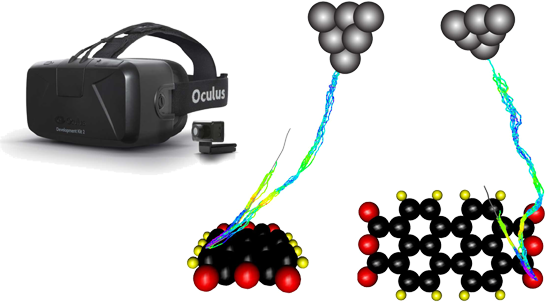
- environment is not fully known. Here we present a further technical development that substantially improves the effectiveness of HCM. By adding Oculus Rift virtual reality goggles to our HCM set-up we provide the experimentalist with 3D visual feedback that displays the currently executed trajectory and the
- the analysis of manipulation trajectory data much simpler. It would also help to transfer knowledge between different users and/or experiments, thus facilitating systematic learning during which manipulation protocols are refined and corrected in multiple steps. Visualization of the manipulation
- trajectory data should therefore greatly increase the effectiveness of HCM and extend the range of its possible applications. Here we introduce a system that visualizes HCM data in real time by displaying the actual tip position as well as the history of its movements in 3D using Oculus Rift DK 2 (ORt


Possibilities and limitations of advanced transmission electron microscopy for carbon-based nanomaterials
Beilstein J. Nanotechnol. 2015, 6, 1541–1557, doi:10.3762/bjnano.6.158
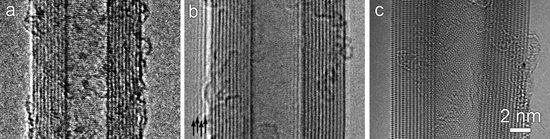
- discussed in the next subsection. The previous discussion of Cs correctors applies to the post-field of the objective lens, which corrects the electron trajectory of the exit electron wave after interaction with the specimen, and provides a more straightforward interpretation of the projected potential of


Continuum models of focused electron beam induced processing
Beilstein J. Nanotechnol. 2015, 6, 1518–1540, doi:10.3762/bjnano.6.157
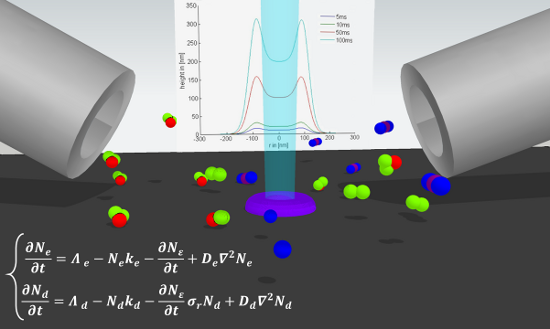
- more detailed discussion on the applicability range can be found in [10]. For high-aspect ratio structures either a full Monte Carlo electron trajectory approach can be chosen [54] or the continuum equations outlined in our present work need to be solved on a curvilinear reference surface, see [13] and


![[Graphic 37]](/bjnano/content/inline/2190-4286-6-157-i117.png?max-width=637&scale=1.18182) and chemisorbed
and chemisorbed ![[Graphic 38]](/bjnano/content/inline/2190-4286-6-157-i118.png?max-width=637&scale=1.18182) adsorbates versus pressure, calcul...
adsorbates versus pressure, calcul...


Surface excitations in the modelling of electron transport for electron-beam-induced deposition experiments
Beilstein J. Nanotechnol. 2015, 6, 1260–1267, doi:10.3762/bjnano.6.129
- of a simple superposition of Drude–Lindhard oscillators [33]. Assuming a projectile that moves with a velocity v along a trajectory r = vt, one can conveniently solve the Maxwell equations in Fourier space to obtain the following expression for the induced electric field [31] where ρ(q,ω) is the
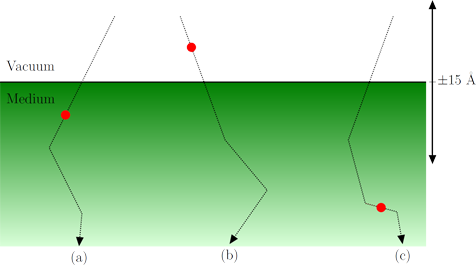
- model for SE emission: every time that the primary electron undergoes an energy loss, a SE trajectory is started with the energy loss as an initial energy (see [55] for the simulation details). Having the experimental data as a guideline, the interaction cross sections described above were used down to


Scanning reflection ion microscopy in a helium ion microscope
Beilstein J. Nanotechnol. 2015, 6, 1125–1137, doi:10.3762/bjnano.6.114
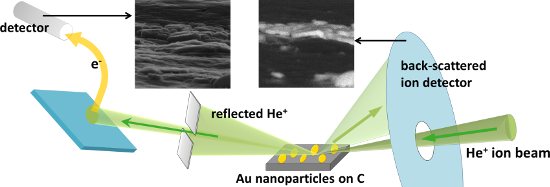
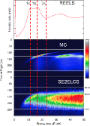
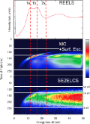
- trajectory with the increasing in the magnification. Accordingly, the simplest test to check for the presence of the effect of beam charge bending is a comparison of results of two scans preformed with different magnifications. Similar results will provide evidence of the accuracy of the lateral size
- obtain sharp images of an insulator surface without the need for charge compensation or a conductive coating. A positive surface charge produced by ions attracts SEs but does not significantly change the RI trajectory and their detection. The changes in trajectory caused by the electric field of the


Superluminescence from an optically pumped molecular tunneling junction by injection of plasmon induced hot electrons
Beilstein J. Nanotechnol. 2015, 6, 1100–1106, doi:10.3762/bjnano.6.111
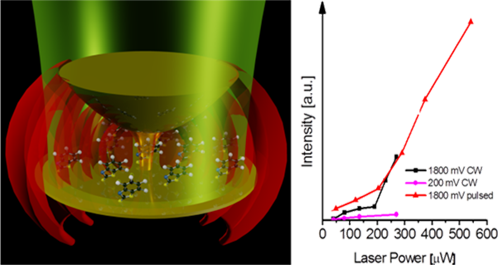
- ) with the respective spectrally integrated intensity trajectory (iii). Electroluminescence spectra excited by inelastic tunneling (b) without laser illumination as a function of the bias voltage (i), (ii). All spectra were recorded with the same tunneling current (1 nA) and are normalized to 1 s


Fabrication of high-resolution nanostructures of complex geometry by the single-spot nanolithography method
Beilstein J. Nanotechnol. 2015, 6, 976–986, doi:10.3762/bjnano.6.101
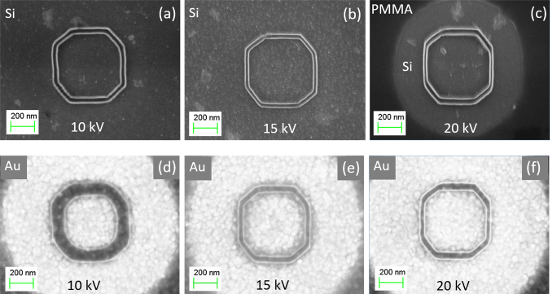
- trajectory distribution of electrons produced by Monte Carlo simulations shows that the upper third part of the pillar is very narrow and can be easily removed by developer (Figure 4). Figure 6 shows the experimental dependence of the outer diameter dout and the core diameter din on the radiation dose for


Manipulation of magnetic vortex parameters in disk-on-disk nanostructures with various geometry
Beilstein J. Nanotechnol. 2015, 6, 697–703, doi:10.3762/bjnano.6.70
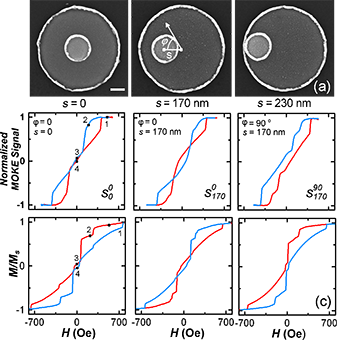
- applied during measurements. It is found that manipulation of the magnetic vortex chirality and the trajectory of the vortex core in the big disk is only possible in asymmetric nanostructures. Experimentally studied peculiarities of a motion path of the vortex core and vortex parameters by the magneto
- . Moreover, the trajectory of a vortex core is distorted and its gyrotropic motion frequency changes significantly. Recently, by using magnetic force microscopy (MFM), we have demonstrated a reliable method to control the vortex parameters in a big disk if a disk with smaller diameter is placed on its top [8
- of the vortex nucleation process as well as the vortex core trajectory under an impact of bias fields have been observed. Experimental findings have been interpreted by micromagnetic simulations [9]. Results and Discussion Figure 1a shows scanning electron microscopy (SEM) images of disk-on-disk


The effect of surface charge on nonspecific uptake and cytotoxicity of CdSe/ZnS core/shell quantum dots
Beilstein J. Nanotechnol. 2015, 6, 281–292, doi:10.3762/bjnano.6.26
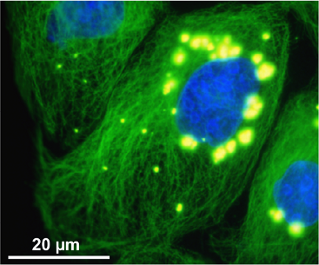
- travelled a significant distance: short (with back-and-forth contour-like movement) and long (directed motion of QDs, supposedly being dragged by motor proteins); random trajectories were assigned to disordered motion. For both trajectory types, we observed two modes of confined motion in the MSD plots of
- ). Each row shows the trajectory and the corresponding displacement vs time representation. (d) Average velocities of CA–QDs, DHLA–QDs and DPA–QDs exhibiting organized movement in different zones of cellular interior after 4 h (top) and 22 h (bottom) of QD incubation. Fluorescent micrographs of untreated



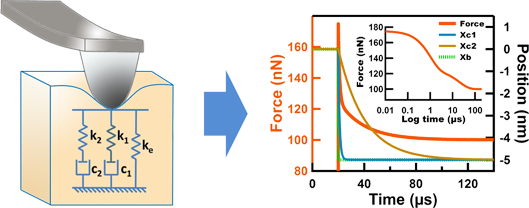
Modeling viscoelasticity through spring–dashpot models in intermittent-contact atomic force microscopy
Beilstein J. Nanotechnol. 2014, 5, 2149–2163, doi:10.3762/bjnano.5.224
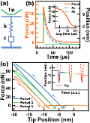
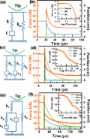
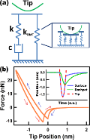
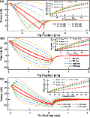
- Linear Maxwell sample has yielded sufficiently to allow the tip to oscillate at its free oscillation amplitude, without any tip–sample interaction). Since we are interested in the response of the Linear Maxwell sample with an intermittent contact probe, we have used a prescribed tip trajectory for the
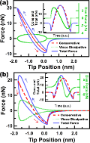
- jump in the FD curve. This is an obvious problem precluding the application of this model to tapping mode AFM. This artifact can also be seen in the inset of Figure 2c which shows the force as a function of time as well as the position of the surface and tip trajectory in time. It can be seen that the
- horizontal axis is intentionally plotted by using a logarithmic scale to show the inflection point corresponding to its single relaxation time. (c) Force–distance tip trajectories (the trajectory proceeds in the counterclockwise direction) for a prescribed sinusoidal tip trajectory given by z(t) = 80 nm


Dissipation signals due to lateral tip oscillations in FM-AFM
Beilstein J. Nanotechnol. 2014, 5, 2048–2057, doi:10.3762/bjnano.5.213
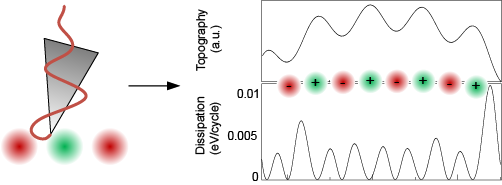
- limited to very narrow ranges of frequency ratios. Quality factor We studied the influence of the quality factor on the energy dissipation rate (Figure 6). For high Q-values, the trajectory of the tip in the strong interaction region is nearly unaffected by the damping in the lateral degree of freedom
- . Therefore, the approximation leading to Equation 5 is applicable, which explains the Q−1-dependence shown in Figure 6. At lower Q-values, the effect on the trajectory becomes stronger. The energy transfer into the lateral degree of freedom slows down and, being limited in time by the normal cantilever





