


Search results
Search for "π-stacking" in Full Text gives 82 result(s) in Beilstein Journal of Nanotechnology.
An NC-AFM and KPFM study of the adsorption of a triphenylene derivative on KBr(001)
Beilstein J. Nanotechnol. 2012, 3, 221–229, doi:10.3762/bjnano.3.25
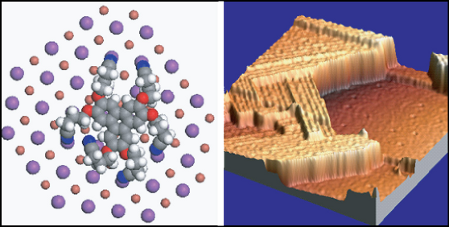
- strong intermolecular interaction due to π-stacking. Keywords: atomic force microscopy; insulating surfaces; Kelvin force probe microscopy; molecular adsorption; Introduction The study of molecular adsorption on atomically clean, well-defined surfaces of bulk insulators is progressing rapidly due to
- energy, which should exceed 1.8 − 0.4 = 1.4 eV. This is indeed the case. The interaction energy between two free HCPTP, calculated with the COMPASS force field when the triphenylene cores are in a π-stacking configuration, is on the order of 2.5 eV, well above this threshold. MLv is then more stable than




Molecular-resolution imaging of pentacene on KCl(001)
Beilstein J. Nanotechnol. 2012, 3, 186–191, doi:10.3762/bjnano.3.20
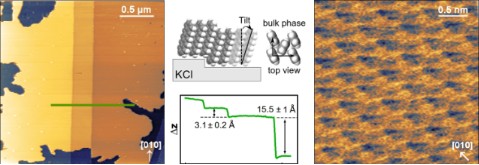
- interaction is indeed weak compared to the intermolecular interaction. Figure 1c illustrates the upright ordering of the molecules. For comparison we have added a top-view sketch of the well-known bulk phase, showing the herringbone arrangement that the molecules assume to optimize the π-stacking (Figure 1d


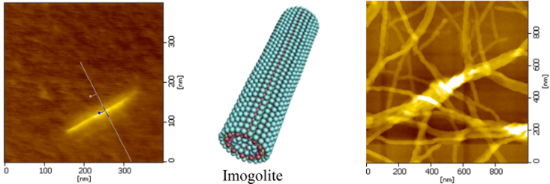
Surface functionalization of aluminosilicate nanotubes with organic molecules
Beilstein J. Nanotechnol. 2012, 3, 82–100, doi:10.3762/bjnano.3.10
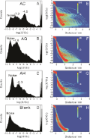
- . For the in-plane GIWAXD pattern, one noticeable diffraction peak associated with the (010) diffraction was observed. The diffraction peak corresponds to the π–π* stacking of the P3HT thiophene ring and was parallel to the y-axis, i.e., the nanofiber direction. Again, the (010) peak was diminished when


An MCBJ case study: The influence of π-conjugation on the single-molecule conductance at a solid/liquid interface
Beilstein J. Nanotechnol. 2011, 2, 699–713, doi:10.3762/bjnano.2.76
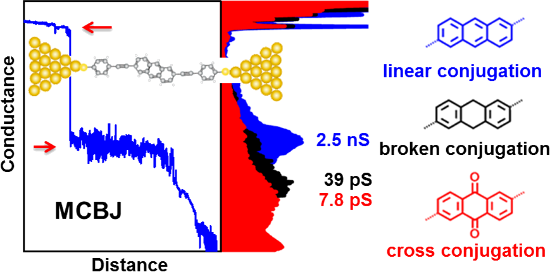
- slightly higher than the molecular length of AC (2.7 nm). We propose that the strong gold–thiole bond leads to the “pulling-out” of surface gold atoms just before the breaking of the molecular junction. The low-conductance feature is attributed to π-stacking interactions between two molecules attached only




Self-organizing bioinspired oligothiophene–oligopeptide hybrids
Beilstein J. Nanotechnol. 2011, 2, 525–544, doi:10.3762/bjnano.2.57
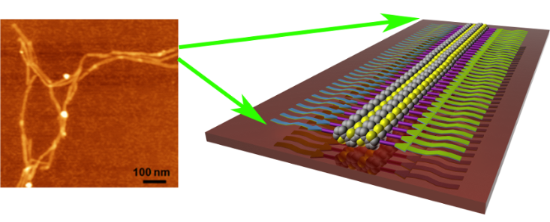
- der Waals interactions of the interdigitating long alkyl side chains. Furthermore, the planar conjugated thiophene backbone is well known to interact by π–π stacking to form larger crystalline structures. With respect to the peptide part, the L-valine-L-threonine (Val–Thr)3 sequence effectively forms
- twisted short fibers of 1' on the mica substrate. Due to the hybrid nature of 1', two opposing intermolecular interactions could dominate the self-assembly process, namely H-bonding and π–π stacking. Thus, a solvent-guided strategy was employed in order to gain control over the self-assembly process
- various technological applications, the most important question concerns the arrangement of the conjugated thiophene moieties and the interplay between π−π stacking and β-sheet formation. As spacing between the molecules implied by the β-sheet structure corresponds to 4.8−5 Å, whereas the spacing between




Novel acridone-modified MCM-41 type silica: Synthesis, characterization and fluorescence tuning
Beilstein J. Nanotechnol. 2011, 2, 284–292, doi:10.3762/bjnano.2.33
- also dependent on the boiling point of the sol–gel solution. Thus, the addition of larger amounts of volatile organic solvents such as THF to the aqueous phase often prevents the formation of highly ordered mesoporous structures [16]. On the other hand, the π-stacking of large aromatics generally


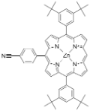
Oriented growth of porphyrin-based molecular wires on ionic crystals analysed by nc-AFM
Beilstein J. Nanotechnol. 2011, 2, 34–39, doi:10.3762/bjnano.2.4
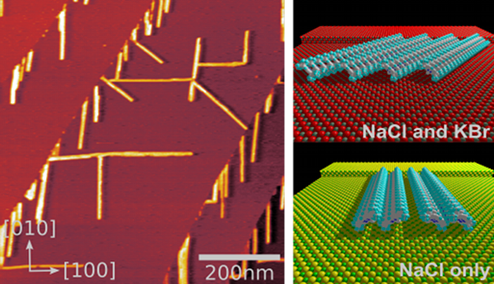
- their intermolecular π–π stacking. Experimental Experiments were performed under ultrahigh vacuum (UHV) conditions with a base pressure below 10−10 mbar using a home built non-contact atomic force microscope operated at rt [39]. In the nc-AFM mode, the tip-sample distance is usually controlled by
- of molecules at those edges. The leftmost molecule (i) in (d) is turned by 45° so that the core is oriented along the [110] direction. This orientation does not allow π–π stacking along the direction of the step edges. The molecule in the middle (ii) is tilted by 45° to the surface, making it fit


Other Beilstein-Institut Open Science Activities



