


Search results
Search for "Anchoring" in Full Text gives 141 result(s) in Beilstein Journal of Nanotechnology.
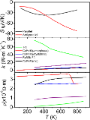
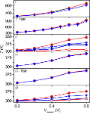
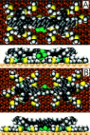
Calculating free energies of organic molecules on insulating substrates
Beilstein J. Nanotechnol. 2017, 8, 667–674, doi:10.3762/bjnano.8.71
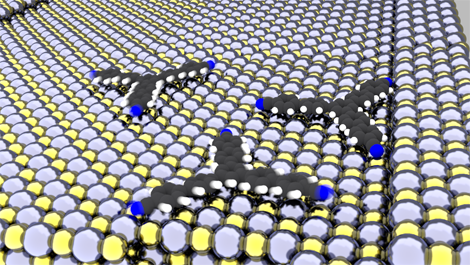
- molecular dynamics. Both molecules contain the same anchoring groups and benzene ring structures, yet differ in their flexibility. Therefore, the entropic contributions to their free energy differ, which affects surface processes. Using potential of mean force and thermodynamic integration techniques, free


α-((4-Cyanobenzoyl)oxy)-ω-methyl poly(ethylene glycol): a new stabilizer for silver nanoparticles
Beilstein J. Nanotechnol. 2017, 8, 627–635, doi:10.3762/bjnano.8.67
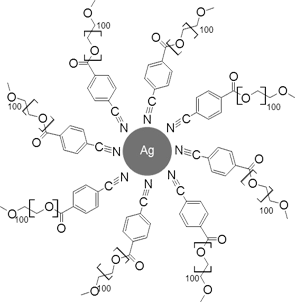
- oligomeric or polymeric stabilizer is attached to the particle surface without a specific anchor group [26][27][28][29][30]. The current gold standard for anchoring an organic moiety on the NP surface is the thiol or thiolate group [3][24][31][32][33]. There are, however, cases where the thiol group may not
- be desirable (such as situations, where thiols may form thiyl radicals leading to protein degradation and cause diseases such as cancer) [34][35]. Hence, there is an interest in alternative anchoring groups with a similar or better anchoring efficiency. Among the possible candidates are the amine and


Performance of natural-dye-sensitized solar cells by ZnO nanorod and nanowall enhanced photoelectrodes
Beilstein J. Nanotechnol. 2017, 8, 287–295, doi:10.3762/bjnano.8.31
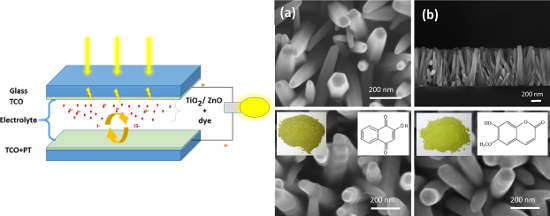
- cells (DSSCs). Fourier transform infrared (FTIR) spectra of the extract revealed the presence of anchoring groups and coloring constituents. Two different structures were prepared by chemical bath deposition (CBD) using zinc oxide (ZnO) layers to obtain ZnO nanowall (NW) or nanorod (NR) layers employed
- semiconductor in DSSCs [2][3][4][5]. Besides, the TiO2 offers high electronic mobility for photogenerated electron collection, a suitable band gap, which adapts to the injection of the electrons of most studied dyes, and high surface area to enhance the dye loading by anchoring the dye [6][7]. Zinc oxide (ZnO
- and mallow plants in different concentrations and at various immersion times. Furthermore, we analyzed the properties of the different used dyes and we reported the most anchoring-dominant molecules. By studying different gases used in the annealing process, we noted that the FG gave the most


Performance of colloidal CdS sensitized solar cells with ZnO nanorods/nanoparticles
Beilstein J. Nanotechnol. 2017, 8, 210–221, doi:10.3762/bjnano.8.23
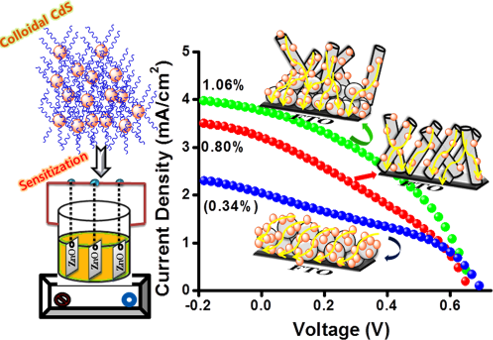
- ; ZnO; Introduction Dye-sensitized solar cells (DSSCs) using inorganic semiconductors are being investigated as a cost-effective and alternative energy source. In DSSCs, a porous electrode made of a wide band gap semiconductor is required for anchoring dye molecules and transporting photo-injected
- nanoparticle aggregation. Various disulfide bonds, thiol residues and other hydroxyl moieties that exist on BSA can serve as effective surface functionalized groups on CdS surfaces [27]. This may further lead to better anchoring with the metal oxide-based photoanode. Among the alternative single oxide
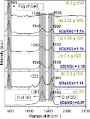
- ]. The surface-functionalized CdS acts as an anchoring moiety, which promotes CdS towards effective sensitization with ZnO. The Raman spectrum was performed as shown in Figure 2b. The peaks located at 294 and 589 cm−1 correspond to the fundamental band (1LO) and corresponding overtone (2LO) of


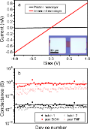
Solvent-mediated conductance increase of dodecanethiol-stabilized gold nanoparticle monolayers
Beilstein J. Nanotechnol. 2016, 7, 2057–2064, doi:10.3762/bjnano.7.196
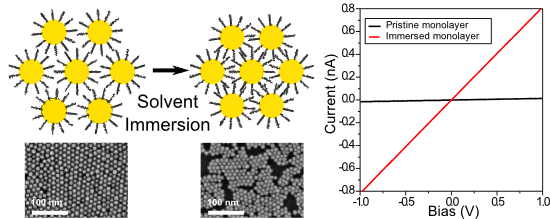
- networks; Self-assembly; Introduction Ordered gold nanoparticle monolayers are increasingly applied as templates for molecular resistor networks [1][2][3][4][5][6][7][8]. Gold nanoparticles serve as conducting nodes and different molecules can bind to the gold nanoparticle using anchoring groups such as



In situ formation of reduced graphene oxide structures in ceria by combined sol–gel and solvothermal processing
Beilstein J. Nanotechnol. 2016, 7, 1815–1821, doi:10.3762/bjnano.7.174
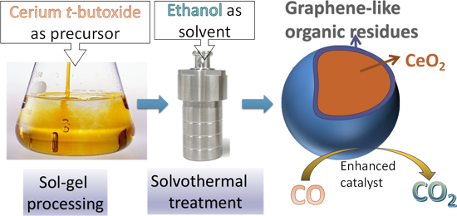
- the intensity ratio I(D)/I(G). I(D)/I(G) values for all rGO–CeO2 composites were larger than that of GO, indicating that the number of defects in the graphene layer increased during the reduction of GO [29][30]. Anchoring of CeO2 on rGO also caused an intensity decrease and up-shifting of the G-band




Morphology of SiO2 films as a key factor in alignment of liquid crystals with negative dielectric anisotropy
Beilstein J. Nanotechnol. 2016, 7, 1743–1748, doi:10.3762/bjnano.7.167
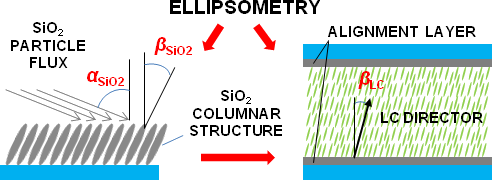
- technique as a reference for such materials. The measure of the optical constants [21], tilt distribution and anchoring strength [22] in nematic LC cells is well reported. The integration of VASE with other techniques [23] has also been investigated to improve the reliability and accuracy of the optical
- < 75° high discrepancy is observed between the data of different authors, as a transition occurs from "pebble dash-like" structures to columnar structure of SiO2 film [2]. We believe that LC anchoring becomes spatially inhomogeneous, unstable and sensitive to the small changes of film deposition


Analysis of self-heating of thermally assisted spin-transfer torque magnetic random access memory
Beilstein J. Nanotechnol. 2016, 7, 1676–1683, doi:10.3762/bjnano.7.160
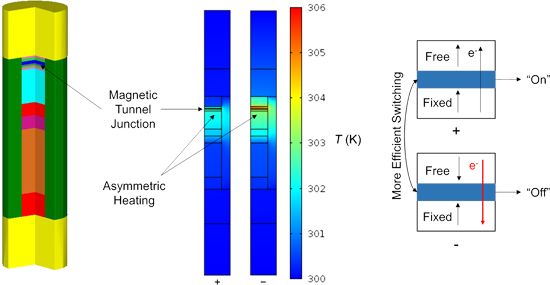
- tunneling junction. We compare self-heating for different common passivation materials, positive and negative electrical current polarity, and different device thermal anchoring and boundaries resistance configurations. The variations considered are found to result in significant differences in maximum
- temperatures reached. Average increases of 3 K, 10 K, and 100 K for different passivation materials, positive and negative polarity, and different thermal anchoring configurations, respectively, are observed. The highest temperatures, up to 424 K, are obtained for silicon dioxide as the passivation material
- , positive polarity, and low thermal anchoring with thermal boundary resistance configurations. Interestingly it is also found that due to the tunneling heat, Peltier effect, device geometry, and numerous interfacial layers around the magnetic tunnel junction (MTJ), most of the heat is dissipated on the





Scanning probe microscopy studies on the adsorption of selected molecular dyes on titania
Beilstein J. Nanotechnol. 2016, 7, 1642–1653, doi:10.3762/bjnano.7.156
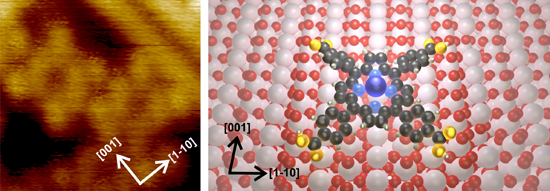
- deposition, or the necessity of some surface pre-treatment), (2) the structure of the deposited molecule (e.g., specific anchoring groups), and (3) a particular balance of the molecule–molecule and molecule–substrate interactions (e.g., different faces of the same bulk material may have distinct properties
- upright as the coverage increases – an effect observed on both (110) and (011) surfaces [55][56]. Let us first review the results for zinc protoporphyrin (ZnPP) adsorbed on a rutile TiO2(110) surface [55]. To chemically anchoring the molecule to the oxide surface, it is important to consider that


Nano- and microstructured materials for in vitro studies of the physiology of vascular cells
Beilstein J. Nanotechnol. 2016, 7, 1620–1641, doi:10.3762/bjnano.7.155
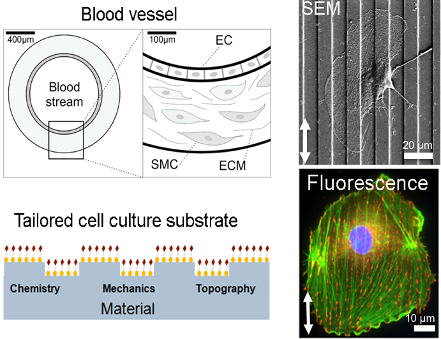
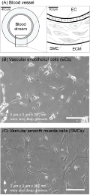
- (i.e., focal adhesions (FAs) that are complexes of proteins anchoring to the substrate and regulating cell adhesion strength, and actin cytoskeleton) have been observed to change and adapt to surface topography. Probably the influence of the topography on these internal structures provokes the



Multiwalled carbon nanotube hybrids as MRI contrast agents
Beilstein J. Nanotechnol. 2016, 7, 1086–1103, doi:10.3762/bjnano.7.102
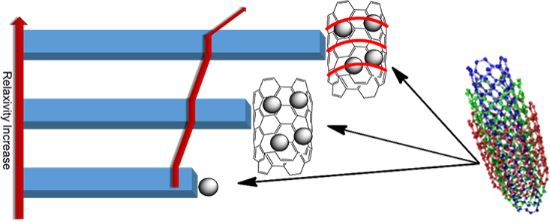
- vivo studies. It is not clear whether the polyether chains of the poloxamer Pluronic® served as a non-ionic wrapping agent securing solid anchoring of the MWCNTs on the cell membrane [23][24]. Alternatively, its role might be more focused on stabilizing a disperse system by preventing the CNTs from
- functionalization of oMWCNT is aimed at introducing specific organic ligands to permanently chelate metal ions or their oxides. This is the manner in which Lamanna prepared an oligoglycol dendron with phosphonic groups responsible for SPIO anchoring. The ligand was introduced on the alkyne-derived oMWCNT by a click
- . Magnetic hysteresis loops close to zero magnetization in a varied magnetic field is typical behavior proving the super- [34][43] or paramagnetic [22] character of the introduced nanoparticles. Initially, the separately produced SPIOs, such as SPIO@Lac-Gly, exhibit higher magnetization, but their anchoring



Photocurrent generation in carbon nanotube/cubic-phase HfO2 nanoparticle hybrid nanocomposites
Beilstein J. Nanotechnol. 2016, 7, 1075–1085, doi:10.3762/bjnano.7.101
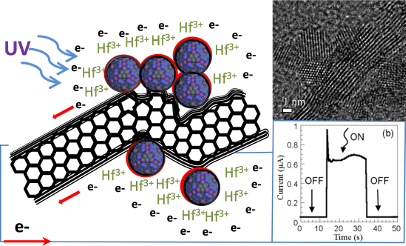
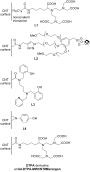
- electronic structure of the C K-edge in the nanocomposites was probed by electron energy loss spectroscopy, highlighting the key role of the MWCNT growth defects in anchoring HfO2 NPs. A combined optical emission and absorption spectroscopy approach illustrated that, in contrast to HfO2 NPs, the metallic
- explanation to this selective anchoring is provided below and also in the EELS section. In Figure 1c, a HAADF-HRSTEM image exhibits small agglomerates of these nanoparticles on the MWCNT, where the diameter of the MWCNT has reduced due to buckling. The nanoparticles remain crystalline as displayed by the
- facilitate the decoration of these nanoparticles to the MWCNT. This mechanism of anchoring to the sidewalls is further probed in the EELS section. On the other hand, the side walls of the MWCNT do not appear to be atomically flat, and the outermost walls are not distinct, indicating damage to the walls of


Reorientation of single-wall carbon nanotubes in negative anisotropy liquid crystals by an electric field
Beilstein J. Nanotechnol. 2016, 7, 825–833, doi:10.3762/bjnano.7.74
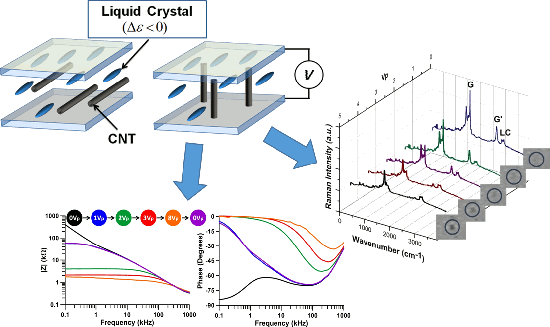
- orientation of the liquid crystal molecules. Moreover, impedance spectroscopy suggests a nonnegligible anchoring force between the CNTs and the liquid crystal molecules. Keywords: Anchoring; carbon nanotubes; impedance; liquid crystal; negative anisotropy; Raman spectroscopy; reorientation; single-wall CNTs
- in thin cells is dictated by the anchoring forces of the conditioned surfaces. However, the orientation may be altered if an external (electric) field above a certain threshold voltage (Vth) is applied. As a result, the effective permittivity of the LC material varies with the applied voltage. The LC
- director reorients to minimize the system energy; this energy depends on the anchoring forces of the substrate, the elastic parameters of the LC, and the applied field [6]. Calamitic LCs – the most commonly used LC in all kinds of applications – are rod-like uniaxial molecules having different properties


Gold nanoparticles covalently assembled onto vesicle structures as possible biosensing platform
Beilstein J. Nanotechnol. 2016, 7, 655–663, doi:10.3762/bjnano.7.58
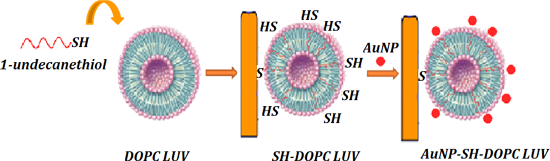
- and the polydispersity index of the SH–DOPC LUVs since these values are within the experimental error. Optimization of the SH/DOPC ratio for electrochemical measurements Different SH/DOPC ratios in the formation of vesicles were explored in order to find the optimal conditions for anchoring the AuNPs
- anchoring of the antibodies in futures studies because a certain spacing of the AuNPs is required for its proper orientation [25]. Figure 7c shows a TEM image of the LUVs decorated with AuNPs formed after 13 min of irradiation. The morphology of the AuNPs anchored on the vesicles shows hollow, nearly


Novel roles for well-known players: from tobacco mosaic virus pests to enzymatically active assemblies
Beilstein J. Nanotechnol. 2016, 7, 613–629, doi:10.3762/bjnano.7.54
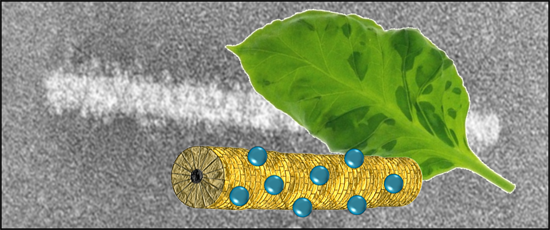
- cells is relatively low [55]. Hence ectopically produced TMV templates are not yet accessible. Finally, an attachment of functional molecules to virus surfaces equipped too densely with anchoring tags may also be inefficient. For these reasons, previous work on elongated viral enzyme carriers succeeded


Invariance of molecular charge transport upon changes of extended molecule size and several related issues
Beilstein J. Nanotechnol. 2016, 7, 418–431, doi:10.3762/bjnano.7.37
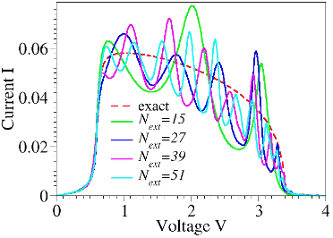
- particularly true in (chemisorption) cases where the anchoring groups form covalent bonds to the electrodes. Within current approaches to molecular charge transport, mostly based on nonequilibrium Keldysh Green’s functions (NEGF) combined with density functional theory (DFT), the molecular device is
- , which quantify the hopping between the left and right molecular ends (“anchoring groups”, denoted by labels 1 and N, respectively) and the adjacent electrode ends (labels l = 1 and r = 1 for left and right electrodes in Equation 9). In Equation 9, the small molecule, which needs not to be one


Rigid multipodal platforms for metal surfaces
Beilstein J. Nanotechnol. 2016, 7, 374–405, doi:10.3762/bjnano.7.34

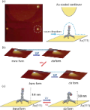
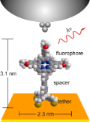
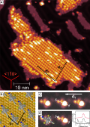
- anchoring units in order to control the spatial arrangement of the protruding molecular subunit. Another interesting feature is the lateral orientation of these foot structures which, depending on the particular application, is equally important as the spatial arrangement of the molecules. The numerous
- approaches towards assembling and organizing functional molecules into specific architectures on metal substrates are reviewed here. Particular attention is paid to variations of both, the core structures and the anchoring groups. Furthermore, the analytical methods enabling the investigation of individual
- molecules as well as monomolecular layers of ordered platform structures are summarized. The presented multipodal platforms bearing several anchoring groups form considerably more stable molecule–metal contacts than corresponding monopodal analogues and exhibit an enlarged separation of the functional










Hemolysin coregulated protein 1 as a molecular gluing unit for the assembly of nanoparticle hybrid structures
Beilstein J. Nanotechnol. 2016, 7, 351–363, doi:10.3762/bjnano.7.32
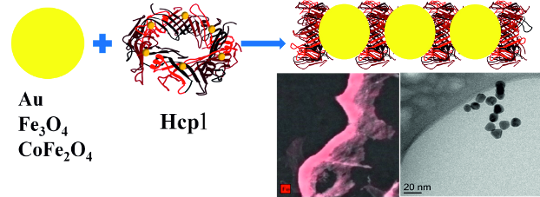
- inorganic material. Here, we use hemolysin coregulated protein 1 (Hcp1) from Pseudomonas aeruginosa as a building and gluing unit for the formation of biohybrid structures by implementing cysteine anchoring points at defined positions on the protein rim (Hcp1_cys3). We successfully apply the Hcp1_cys3




Case studies on the formation of chalcogenide self-assembled monolayers on surfaces and dissociative processes
Beilstein J. Nanotechnol. 2016, 7, 263–277, doi:10.3762/bjnano.7.24
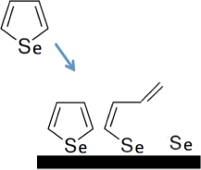
- various applications such as catalysis, sensor development, hydrogen storage, thin films, and molecular electronics has focused on the study of self-assembled monolayers (SAMs) with different combinations of molecular architecture, and in particular, different molecule anchoring head groups. The latter


Controlled graphene oxide assembly on silver nanocube monolayers for SERS detection: dependence on nanocube packing procedure
Beilstein J. Nanotechnol. 2016, 7, 9–21, doi:10.3762/bjnano.7.2
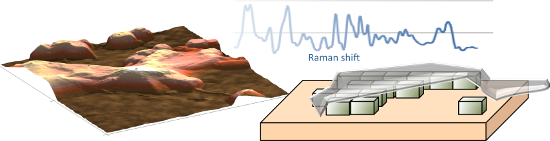
- with procedure B. The larger amount of GO obtained with procedure B (see Table 2) is therefore strictly related to the smaller fraction of bare silicon oxide surface exposed. In both cases GO adsorbs through interactions with the silver surface anchoring exclusively to the outer face of the nanocube
- nm for both procedures. Such high thickness values are in accordance with the formation of folded geometries of single GO sheets after anchoring to the nanoparticle surface. Nevertheless, AFM measurements reveal a smaller thickness compared to QCM for the same samples. This was expected since QCM


High electronic couplings of single mesitylene molecular junctions
Beilstein J. Nanotechnol. 2015, 6, 2431–2437, doi:10.3762/bjnano.6.251
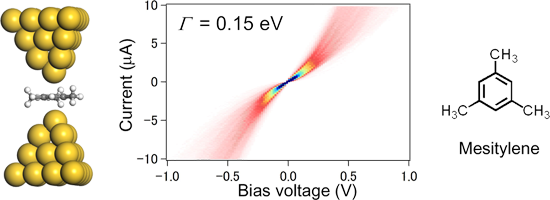
- electronics. To bind a single molecule to metal electrodes, anchoring groups such as –SH [14] and –NH2 or (R)3–N [15][16] have been used. Such anchoring groups form strong chemical bonds with metal electrodes and the anchoring regions act as resistive space, leading to low electronic conductances of the
- single molecular junctions. Recently several groups [17][18][19][20] including ours [17][21][22] developed a direct π-binding technique, where a π-conjugated molecule is directly bound to metal electrodes without anchoring groups. The direct π-binding technique has been applied for various systems such
- experimentally obtained I–V characteristics to the Breit-Wigner model, the metal–molecule coupling Γ, and energy difference between Fermi level and conduction orbital ε0 are obtained. This I–V analysis has been applied for molecular junctions with a variety of anchoring groups. For example Γ = 60 meV and ε0




Nanostructured surfaces by supramolecular self-assembly of linear oligosilsesquioxanes with biocompatible side groups
Beilstein J. Nanotechnol. 2015, 6, 2377–2387, doi:10.3762/bjnano.6.244
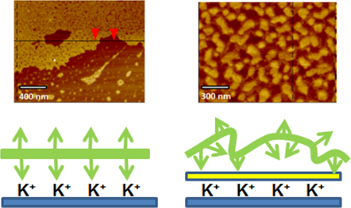
- LPSQ-COOH/X allow for a very efficient polymer anchoring on the surface due to both multipoint ionic substrate–adsorbate interactions and adsorbate–adsorbate hydrogen bonding [37]. The formation of ordered SAMs and PSAMs at the liquid–solid interface can occur only if it is energetically allowed by




Orthogonal chemical functionalization of patterned gold on silica surfaces
Beilstein J. Nanotechnol. 2015, 6, 2272–2277, doi:10.3762/bjnano.6.233
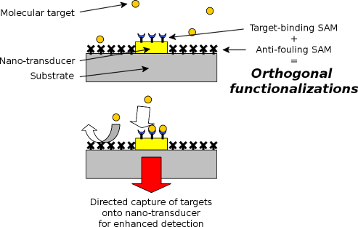
- immobilize proteins onto gold nanostructures on a silica substrate, as demonstrated by atomic force microscopy (AFM). These results are especially promising in the development of future biosensors where the selective anchoring of target molecules onto nanostructured transducers (e.g., nanoplasmonic
- hot spot areas. Orthogonal surface chemical functionalization appears to enable such directed anchoring of target biomolecules (Figure 1) [6][8][9]. Despite the aforementioned publications, there is still much to be investigated regarding the orthogonal functionalization of patterned metal on


Controlled switching of single-molecule junctions by mechanical motion of a phenyl ring
Beilstein J. Nanotechnol. 2015, 6, 2088–2095, doi:10.3762/bjnano.6.213
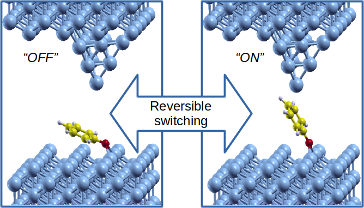
- cleavage of the junction by tip retraction (Figure 1b) provides a well-defined measure of the direct current through the molecule. To investigate the influence of the anchoring group on the conductance, we also prepared PhS on the surface. This molecule is imaged as a protrusion with a tail which is
- retraction were recorded. The height of the plateau, corresponding to the conductance for each molecule, is robust between repeated measurements and is larger by a factor of ≈2 for PhS. This demonstrates that the conductance is modified by chemical substitution of the anchoring atom from oxygen to sulfur. To
- . The role of the anchoring group (O vs S) on the junction geometry was also computed. Figure 5 compares the total energy differences and molecular tilt angles for PhO [12] and PhS junctions in flat and tilted configurations. While the energy difference is rather similar, the tilt angle is generally


Electrospray deposition of organic molecules on bulk insulator surfaces
Beilstein J. Nanotechnol. 2015, 6, 1927–1934, doi:10.3762/bjnano.6.195
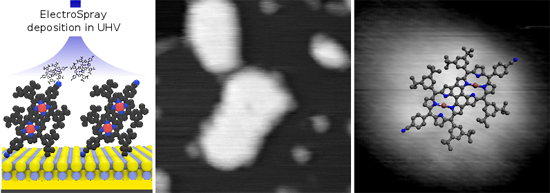
- molecules which are more suitable for future devices and could incorporate additional functions and anchoring groups. In this work we present the adaptation of a UHV-ESI system to deposit triply fused porphyrin molecules on a bulk insulator KBr(001) sample and the analysis of theses deposits by high
- characterized theses islands showing molecular assemblies stabilized by π–π stacking organization and anchoring through the cyano group of the molecules and K+ ions of the surface. To achieve single molecule deposition, we added a pumping chamber in the setup that lowered the number of molecules reaching the





