Search results
Search for "CVD" in Full Text gives 215 result(s) in Beilstein Journal of Nanotechnology. Showing first 200.
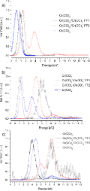
A differential Hall effect measurement method with sub-nanometre resolution for active dopant concentration profiling in ultrathin doped Si1−xGex and Si layers
Beilstein J. Nanotechnol. 2018, 9, 1926–1939, doi:10.3762/bjnano.9.184
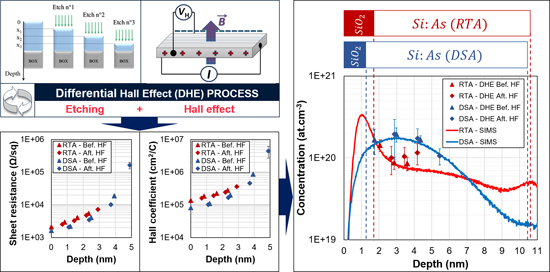
- thick SiGe test structure fabricated by CVD and uniformly doped in situ during growth. The developed method is finally applied to the investigation of dopant activation achieved by advanced annealing methods (including millisecond and nanosecond laser annealing) in two material systems: 6 nm thick
- accuracy of final calculated values. Then, we demonstrate the reliability of a complete DHE procedure on a dedicated SiGe test structure fabricated by CVD and uniformly doped in situ during growth. Finally, we will apply our DHE method to the investigation of dopant activation achieved by advanced
- roughness (by AFM characterization). Our results show a cycle-by-cycle etch rate below 1 nm and a final roughness of 1 Å. DHE procedure validation on SiGe layers fabricated by CVD In this section, we detail a complete DHE procedure using a 20 nm thick boron-doped (1019 cm−3) Si0.77Ge0.23 layer grown by CVD


Synthesis of carbon nanowalls from a single-source metal-organic precursor
Beilstein J. Nanotechnol. 2018, 9, 1895–1905, doi:10.3762/bjnano.9.181
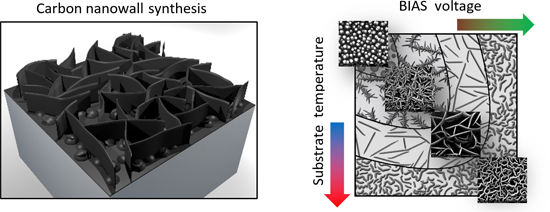
- as shown with aluminium [20]. The ICP-PECVD source features a special antenna design, which provides the possibility to vary particle flow and particle energy independent of each other. Furthermore, energies can be set to very low levels (down to plasma energy) [23]. Experimental PE-CVD of CNWs CNWs


Synthesis of rare-earth metal and rare-earth metal-fluoride nanoparticles in ionic liquids and propylene carbonate
Beilstein J. Nanotechnol. 2018, 9, 1881–1894, doi:10.3762/bjnano.9.180
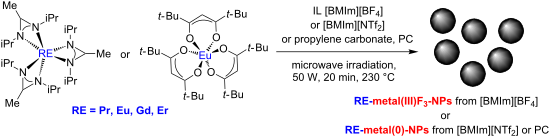
- the polymerization of olefins [15][16] and as precursors in chemical vapor (CVD) processes of rare-earth materials such as oxides and nitrides [17][18][19]. It is especially advantageous that the decomposition products from the amidinate ligand are gaseous so that product contamination is minimized


SO2 gas adsorption on carbon nanomaterials: a comparative study
Beilstein J. Nanotechnol. 2018, 9, 1782–1792, doi:10.3762/bjnano.9.169
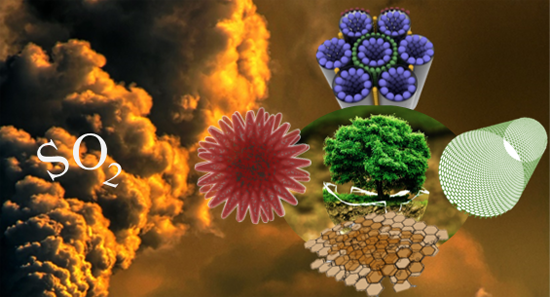
- height of the VACNT structure obtained after 15 min of synthesis is ca. 800 µm. TEM investigations on numerous batches of as-synthesized VACNTs indicate double- to few-walled (number of walls ≤ 5) CNT structures with an average diameter of about 8 nm (Figure 3a). Like MWNTs, SWNTs grown by the CVD
- with a total length of 5–20 μm. SWNTs have a diameter of ca. 1.5 nm, a length of 1–5 µm and were produced by using CVD with a purity of >95%. Vertically aligned carbon nanotubes (VACNTs) were synthesized in our lab over a Si/SiO2 (600 nm) substrate in a quartz furnace using water-assisted chemical


Toward the use of CVD-grown MoS2 nanosheets as field-emission source
Beilstein J. Nanotechnol. 2018, 9, 1686–1694, doi:10.3762/bjnano.9.160
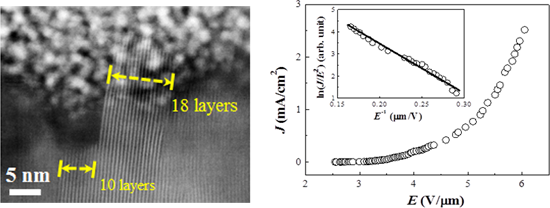
- the fabricated MoS2 NSs could have a great potential as robust high-performance electron-emitter material for various applications such as microelectronics and nanoelectronics, flat-panel displays and electron-microscopy emitter tips. Keywords: chemical vapor deposition (CVD); field emission
- ][16] and the number of layers [16]. Various methods have been used to synthesize vertically aligned MoS2 NSs: liquid-phase exfoliation [17], hydrothermal synthesis [8] or chemical vapor deposition (CVD) [15][17][18]. CVD is regarded as the most promising method to synthesize high-quality MoS2 with
- on the NSs transferred onto a conducting fluorine-tin-oxide (FTO) substrate. Experimental Sample preparation The NSs were grown on SiO2/Si substrates via double sulfurization of a sputter-deposited 50 nm Mo film using an ambient-pressure CVD technique. Flushing of the quartz tube using Ar gas stream



Chemistry for electron-induced nanofabrication
Beilstein J. Nanotechnol. 2018, 9, 1317–1320, doi:10.3762/bjnano.9.124

- chemical vapor deposition (CVD), which is a thermally driven process [6]. Consequently, these precursors are optimized with respect to thermal chemistry and do not necessarily perform well in the electron-driven FEBID process. In fact, they often experience incomplete fragmentation so that material from
Formation mechanisms of boron oxide films fabricated by large-area electron beam-induced deposition of trimethyl borate
Beilstein J. Nanotechnol. 2018, 9, 1282–1287, doi:10.3762/bjnano.9.120
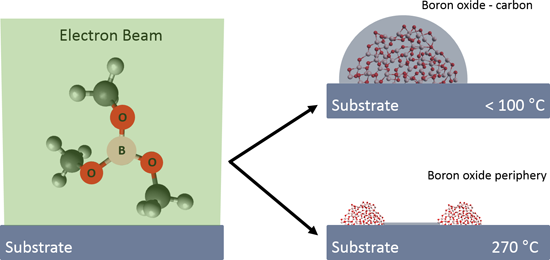
- and undergoes subsequent reaction with an electron beam. The process has major advantages over thermal chemical vapor deposition (CVD) processes one of which being that the substrate is not exposed to the elevated temperatures required for the thermal decomposition of precursor molecules. To date, the



A novel copper precursor for electron beam induced deposition
Beilstein J. Nanotechnol. 2018, 9, 1220–1227, doi:10.3762/bjnano.9.113
- deposition should furthermore provide for conductive deposits with a preferably high copper content. Here, the metal-organic precursor bis(tert-butylacetoacetato)Cu(II) (CAS: 23670-45-3, C16H26CuO6) is introduced as a fluorine-free alternative. This precursor is known from chemical vapor deposition (CVD


Review on nanoparticles and nanostructured materials: history, sources, toxicity and regulations
Beilstein J. Nanotechnol. 2018, 9, 1050–1074, doi:10.3762/bjnano.9.98

- morphologies such as hollow tubes, ellipsoids or spheres. Fullerenes (C60), carbon nanotubes (CNTs), carbon nanofibers, carbon black, graphene (Gr), and carbon onions are included under the carbon-based NMs category. Laser ablation, arc discharge, and chemical vapor deposition (CVD) are the important


Single-crystalline FeCo nanoparticle-filled carbon nanotubes: synthesis, structural characterization and magnetic properties
Beilstein J. Nanotechnol. 2018, 9, 1024–1034, doi:10.3762/bjnano.9.95
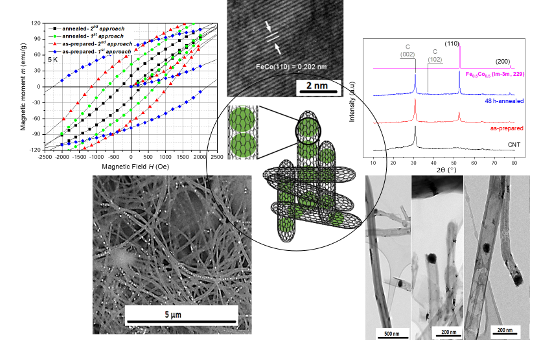
- the filling material due to the confinement of the material within the hollow tubular cavity. Chemical vapor deposition (CVD) is a technique used to fill MNPs into CNTs via in situ filling, in which metallocene precursors are used as a carbon source and MNPs [22][30][37] or hydrocarbons (such as


Effect of annealing treatments on CeO2 grown on TiN and Si substrates by atomic layer deposition
Beilstein J. Nanotechnol. 2018, 9, 890–899, doi:10.3762/bjnano.9.83
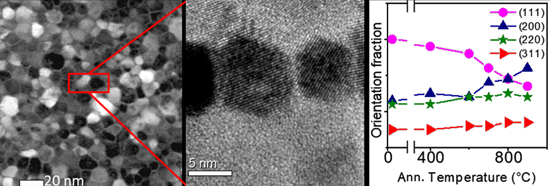
- sputtering [7], e-beam [16], physical vapor deposition [17], chemical vapor deposition (CVD) [18], and atomic layer deposition (ALD). The latter has been explored by using different precursors, e.g., Ce(thd)4, Ce(iPrCp)3 and Ce(mmp)4) [19][20][21][22][23], obtaining as-deposited film with polycrystalline


The effect of atmospheric doping on pressure-dependent Raman scattering in supported graphene
Beilstein J. Nanotechnol. 2018, 9, 704–710, doi:10.3762/bjnano.9.65
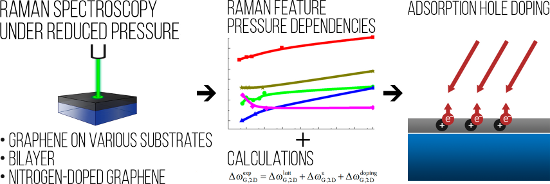
- , graphene functionalization techniques, and taking into account adsorption effects during nanoelectronic device engineering. Experimental Graphene was synthesized on Cu foil at 1020 °C by a chemical vapor deposition (CVD) method using a mixture of CH4 of 40 sccm and H2 of 10 sccm. Cu foil (Alfa Aesar


Engineering of oriented carbon nanotubes in composite materials
Beilstein J. Nanotechnol. 2018, 9, 415–435, doi:10.3762/bjnano.9.41
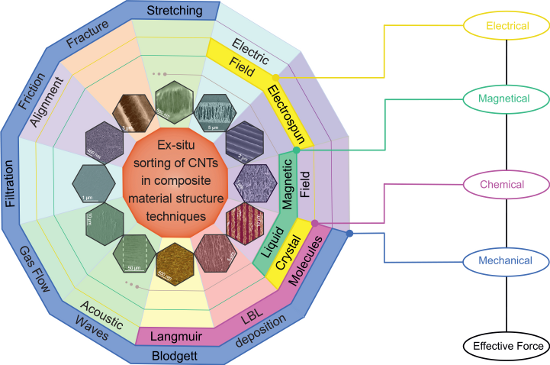
- arrangement of CNTs and sorting of nanofibers are done at the same time, as shown in Figure 9 [70]. Recently, direct spinning to a vertical chemical vapor deposition (CVD) synthesis zone has also been studied and is under development to produce CNT fibers and ribbons [44][71]. In a vertical CVD reactor, the
- of a wide range of materials, spraying can be combined with other methods to fabricate composite materials. In this method, a sheet of CNTs is produced by chemical vapor deposition (CVD) on a SiO2/Si substrate that is coated with a very thin layer of iron as a catalyst. The CNT rows have been grown
- may reduce the required magnetic field [108][109][110]. Aleman et al. have recently reported the ferromagnetism of residual catalysts in CVD growth of CNTs. This work shows that adjustment of the size and shape of the catalyst nanoparticle can control the CNT ferromagnetism behavior. This phenomenon




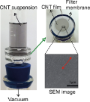


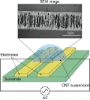


Electron interaction with copper(II) carboxylate compounds
Beilstein J. Nanotechnol. 2018, 9, 384–398, doi:10.3762/bjnano.9.38
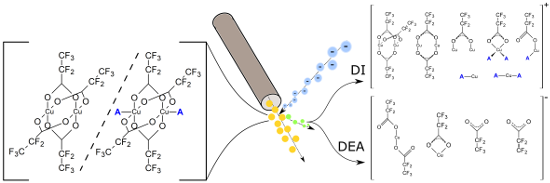
- = CnF2n+1, n = 1–6) were previously applied as Cu CVD precursors [34][38] for the formation of copper nanomaterials. This fact confirms that copper(II) carboxylate compounds can be considered as copper sources in vapor deposition processes. The influence of secondary ligands on the physicochemical


Review: Electrostatically actuated nanobeam-based nanoelectromechanical switches – materials solutions and operational conditions
Beilstein J. Nanotechnol. 2018, 9, 271–300, doi:10.3762/bjnano.9.29
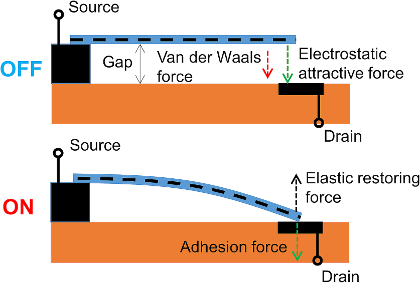
- chemical vapour deposition (CVD)-synthesized or mechanically exfoliated graphene flakes to the desired position on the substrate, and photo- and electron-beam lithography and metal sputtering techniques for fabrication of the electrical contacts. A SiO2 sacrificial layer may be used for the release of
- explained as follows: currently, large area graphene can be prepared by the CVD technique; synthesized by this method, graphene has a polycrystalline nature. Processes occurring at the grain boundaries of polycrystalline graphene as, for example, charge carrier scattering and mechanical stress, result in
- significant degradation of graphene properties and, consequently, poor performance of the CVD-graphene-based NEM switches. Also, the Young’s modulus of CVD graphene is only about 40% of that of exfoliated pristine graphene (0.4 TPa vs 0.98 TPa [128]). CVD graphene NEM switching elements with comparable


BN/Ag hybrid nanomaterials with petal-like surfaces as catalysts and antibacterial agents
Beilstein J. Nanotechnol. 2018, 9, 250–261, doi:10.3762/bjnano.9.27
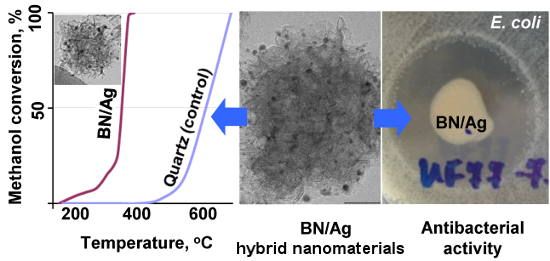
- 10.3762/bjnano.9.27 Abstract BN/Ag hybrid nanomaterials (HNMs) and their possible applications as novel active catalysts and antibacterial agents are investigated. BN/Ag nanoparticle (NP) hybrids were fabricated using two methods: (i) chemical vapour deposition (CVD) of BN NPs in the presence of Ag
- the CVD method. The best catalytic characteristics (100% methanol conversion at 350 °C) were achieved using the UV BN/Ag HNMs without preliminary annealing at 600 °C in an oxidizing atmosphere. Both types of the BN/Ag HNMs possess a profound antibacterial effect against Escherichia coli K-261 bacteria
- of these nanostructures in an amount sufficient for detailed catalytic and biological tests. Therefore, in the present work, we have synthesized BN-based HNMs using two high-throughput methods: (i) chemical vapour deposition (CVD) of BN NPs in the presence of Ag vapors; and (ii) ultraviolet (UV





Gas-assisted silver deposition with a focused electron beam
Beilstein J. Nanotechnol. 2018, 9, 224–232, doi:10.3762/bjnano.9.24
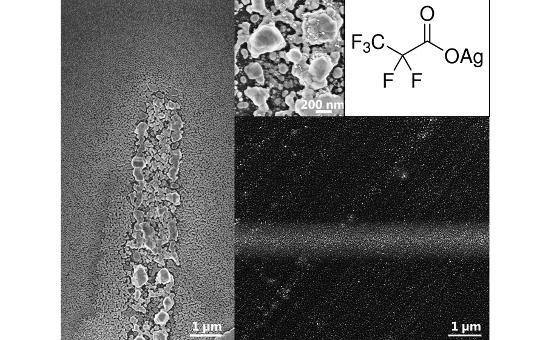
- (AgO2CC2F5), for silver FEBID based on reported successful chemical vapor deposition (CVD) experiments yielding silver films at moderate temperatures of around ≤200 °C [16]. This carboxylate compound showed to be susceptible to electron-induced dissociation, but it requires thermal conditions outside the


Electron-driven and thermal chemistry during water-assisted purification of platinum nanomaterials generated by electron beam induced deposition
Beilstein J. Nanotechnol. 2018, 9, 77–90, doi:10.3762/bjnano.9.10
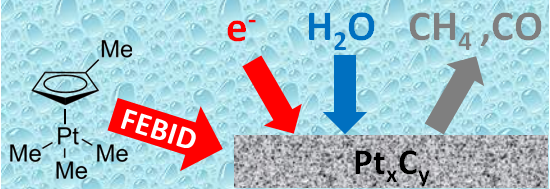
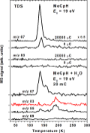
- reduction of MeCpPtMe3 in CVD processes assisted by H2 can be achieved just below 400 K [19]. We conclude that too little material is left at the surface to gain deeper insight in the purification process when only a single multilayer film of MeCpPtMe3 has been decomposed. We note that desorption of MeCpH
- was not observed although proton transfer to the precursor is antipicated when MeCpPtMe3 is irradiated in the presence of H2O. This is obvious from a lack of desorption signal below the precursor desorption temperature in the m/z 39 data shown in Figure 7. Unlike the CVD process in the presence of H2



Response under low-energy electron irradiation of a thin film of a potential copper precursor for focused electron beam induced deposition (FEBID)
Beilstein J. Nanotechnol. 2018, 9, 57–65, doi:10.3762/bjnano.9.8
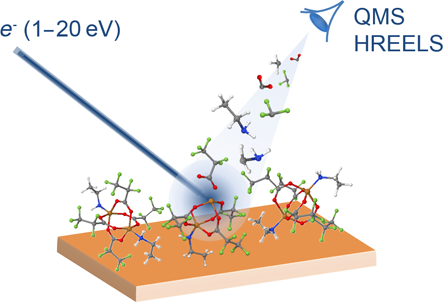
- , Poland, for chemical vapor deposition (CVD) [6][7][8]. Among these complexes, two different compounds, [Cu2(EtNH2)2(μ-O2CC3F7)4] and [Cu2(EtNH2)2(μ-O2CC2F5)4] (Figure 1) will be studied in the present paper and hereafter named as compound A and compound B, respectively. They differ only by the length of
- the four perfluorinated carboxylate ligands. The use of lightly bound amine and carboxylate ligands gives complexes that are stable in gel form under ambient conditions but yield a copper purity from 60% to 80% in CVD. In these CVD studies, the sublimation of the full complexes was observed to be


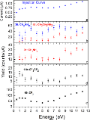

Electro-optical characteristics of a liquid crystal cell with graphene electrodes
Beilstein J. Nanotechnol. 2017, 8, 2802–2806, doi:10.3762/bjnano.8.279
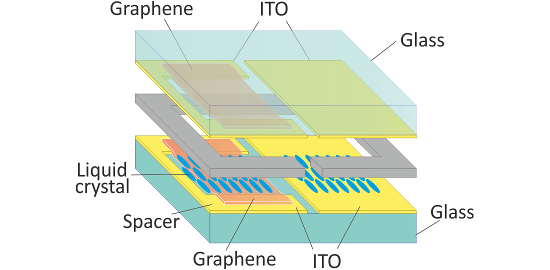
- . Results and Discussion Synthesis of graphene films The graphene was obtained by a chemical vapor deposition (CVD) process. Details of synthesis and extensive characterization of the CVD graphene can be found in prior works [13][14]. The monolayer graphene film was then transferred from the Cu foil to a


The rational design of a Au(I) precursor for focused electron beam induced deposition
Beilstein J. Nanotechnol. 2017, 8, 2753–2765, doi:10.3762/bjnano.8.274
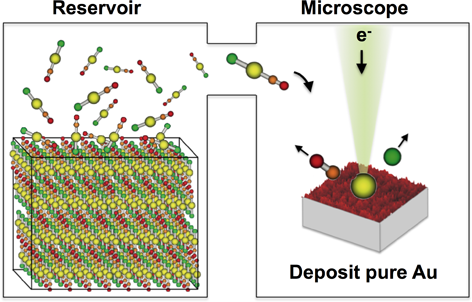
- , but non-volatile [12]. MeAuPMe3 has been used for chemical vapor deposition (CVD) [51][52] and can be used for FEBIP. However, the electron-induced dissociation is incomplete, with just a single methyl ligand being removed [12]. The studies of Au(I) compounds that have been made so far have raised


Dry adhesives from carbon nanofibers grown in an open ethanol flame
Beilstein J. Nanotechnol. 2017, 8, 2719–2728, doi:10.3762/bjnano.8.271
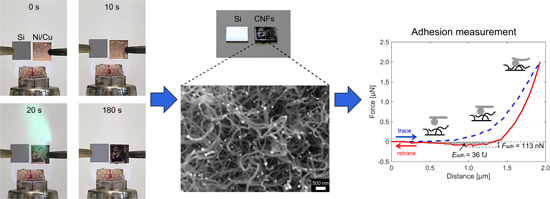
- in a closed chamber. The standard process for their growth is chemical vapor deposition (CVD) [3], which results in randomly oriented structures, whereas a plasma-enhanced CVD (PECVD) [4] allows for the growth of aligned structures. During growth of 1D-CNs, oxidized catalytic centers reduce into
- adhesives is comparably simple and environmentally friendly. Only 1.2 mL ethanol are needed to produce one sample of roughly one square centimeter covered with CNFs with a growing time of 3 min. This is much less than the amount of process gases necessary to grow CNFs with conventional CVD methods. At the


Synthesis of [{AgO2CCH2OMe(PPh3)}n] and theoretical study of its use in focused electron beam induced deposition
Beilstein J. Nanotechnol. 2017, 8, 2615–2624, doi:10.3762/bjnano.8.262
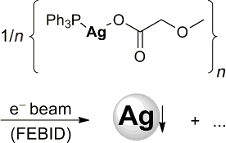
- -domain control [1][2][3]. Up to now, FEBID relies on the chemical availability of chemical vapor deposition (CVD) precursors. However, such precursors are not optimized for the electron-driven FEBID process and hence molecular precursors particularly adapted to its underlying electron-induced
- -bonded PPh3 group could be detected under the measurement conditions applied (Experimental, Figure 5). To show, if 2 is a suitable FEBID or chemical vapor deposition (CVD) precursor for the deposition of silver, vapor pressure measurements of 2 were undertaken (Figure 6). In order to determine the
- , with an evaporation enthalpy of ΔHvap = 126.1 kJ mol−1. These data approve that 2 is confined to be used as CVD precursor. In addition to the mass-spectrometric and vapor pressure measurements (see earlier), it was proven that coordination compound 2 can experimentally brought into the vapor phase


Localized growth of carbon nanotubes via lithographic fabrication of metallic deposits
Beilstein J. Nanotechnol. 2017, 8, 2592–2605, doi:10.3762/bjnano.8.260
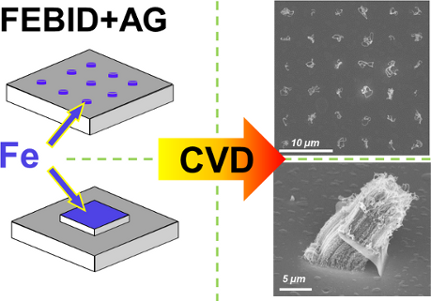
- morphology, for example, as individual nanotubes or as CNT forests. Electron beam induced deposition (EBID) with subsequent autocatalytic growth (AG) was applied to lithographically produce catalytically active seeds for the localized growth of CNTs via chemical vapor deposition (CVD). With the precursor Fe
- though the metal content (Co) of the latter is reduced in comparison to the Fe deposits, effective CNT growth was observed for the Co-containing deposits at lower CVD temperatures than for the corresponding Fe deposits. Keywords: autocatalytic growth; carbon nanotubes; cobalt tricarbonyl nitrosyl
- storage [1][2][3][4]. The most common synthesis method for CNTs is chemical vapor deposition (CVD) [5][6][7][8], in which statistically distributed, metal-containing particles act as catalysts for CNT growth. Thereby, not only does the random position of the catalyst particles determine the position of



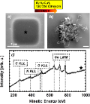

Interactions of low-energy electrons with the FEBID precursor chromium hexacarbonyl (Cr(CO)6)
Beilstein J. Nanotechnol. 2017, 8, 2583–2590, doi:10.3762/bjnano.8.258
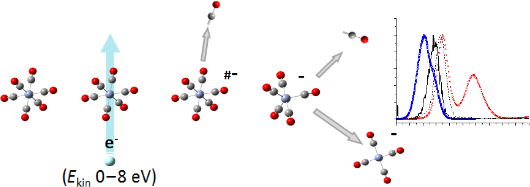
- deposition (FEBID) can be considered an assisted chemical vapour deposition (CVD) technique. However, in the former case the organometallic precursor is not fragmented by thermal energy but instead by a high-energy electron beam. The precursor molecules are delivered to the substrate in the gas phase and
- uneven surfaces. Although FEBID is a promising technique, improvements are still needed in order to get pure and highly resolved deposits. CVD precursors are normally used as FEBID precursors; however, their performance is limited, leading to co-deposition of ligands and ligand fragments together with