Search results
Search for "irradiation" in Full Text gives 590 result(s) in Beilstein Journal of Nanotechnology. Showing first 200.
A low-kiloelectronvolt focused ion beam strategy for processing low-thermal-conductance materials with nanoampere currents
Beilstein J. Nanotechnol. 2024, 15, 1197–1207, doi:10.3762/bjnano.15.97

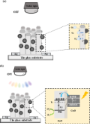
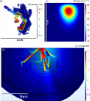
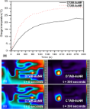
- and a cross section through the middle of the ion beam spot for a simulated sample volume of 600 nm × 600 nm × 400 nm after an irradiation time of 990.0 ns is shown in Figure 3. The simulations for 5 keV in the nanoampere beam current range (Figure 3A) and picoampere beam current range (Figure 3B
- plotted after an irradiation time of 990 ns. The color scales are fixed to 340 K max for better comparison. SEM micrographs showing cross sections that were cut into collagen using (A) 30 keV gallium ions with 1 nA beam current and 1.4 × 10¹³ ions·cm−2 and (B) 5 keV gallium ions with 1.4 nA beam current



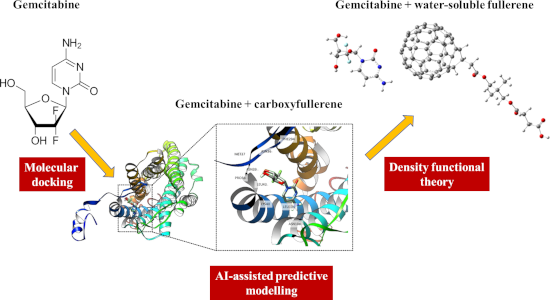
AI-assisted models to predict chemotherapy drugs modified with C60 fullerene derivatives
Beilstein J. Nanotechnol. 2024, 15, 1170–1188, doi:10.3762/bjnano.15.95
- ][10][11]. Besides, in the case of radiotherapy, fibrosis, atrophy, and neuronal damage caused by irradiation can occur [12][13]. Consequently, novel treatments try to reduce the secondary effects while retaining the benefits of standard approaches. Chemotherapy is one of the most extensively applied


Photocatalytic methane oxidation over a TiO2/SiNWs p–n junction catalyst at room temperature
Beilstein J. Nanotechnol. 2024, 15, 1132–1141, doi:10.3762/bjnano.15.92
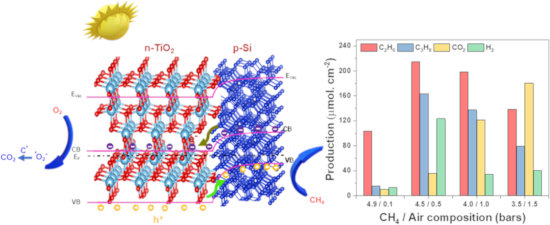
- of TiO2 on p-type SiNWs. The TiO2/SiNWs heterostructure exhibited an outstanding OCM performance under simulated solar light irradiation compared to the single components. This enhanced efficiency was attributed to the intrinsic electrical field formed between n-type TiO2 and p-type SiNWs, which
- activity of TiO2/SiNWs sample under aerobic conditions is described in Figure 5. In a batch reactor, the photocatalytic CH4 oxidation progresses as a function of irradiation time. Besides ethane (C2H6), carbon dioxide (CO2) was detected as a by-product. Moreover, propane (C3H8) and H2 were observed as
- recorded in a batch reactor under different wavelengths of light. As shown in Figure 6b, no products were detected under the visible-light irradiation. The photocatalytic performance under UV illumination was significantly lower than that under full illumination. Figure 7 shows the recyclability of the p–n


Direct electron beam writing of silver using a β-diketonate precursor: first insights
Beilstein J. Nanotechnol. 2024, 15, 1117–1124, doi:10.3762/bjnano.15.90

- injection systems used in any standard scanning electron microscope. Growth of smooth 3D geometries could be demonstrated for tightly focused electron beams, albeit with low silver content in the deposit volume. The electron beam-induced deposition proved sensitive to the irradiation conditions, leading to
- , Figure S5j, and the corresponding explanations). This points to incomplete dissociation in the deposition process, which embeds ligand elements in the deposited material in addition to silver. Upon electron-irradiation, such material can be further dissociated, and the contained silver can form larger
- obtained [34]. For planar deposits, similar microstructures were obtained during platinum deposition using Pt(η5-CpMe)Me3 [35] and ruthenium deposition using (EtCp)2Ru [36], both in combination with post-deposition purification employing electron beam irradiation in a water atmosphere. For the case of


Effect of wavelength and liquid on formation of Ag, Au, Ag/Au nanoparticles via picosecond laser ablation and SERS-based detection of DMMP
Beilstein J. Nanotechnol. 2024, 15, 1054–1069, doi:10.3762/bjnano.15.86

- simulants was observed at a 325 nm Raman excitation. Our findings reveal that a higher ablation yield was observed at IR irradiation than those obtained at the other wavelengths. A size decrease of the NPs was noticed by changing the liquid environment to an electrolyte. These findings have significant
- parameter on NP productivity, shape, and size distribution remains an area of ongoing research [11][12][13][14][15]. Pulsed laser irradiation of liquids (PLIL) can affect the size and shape of NPs. Various approaches are described in the literature, such as (i) laser fragmentation in liquid (LFL), (ii
- ) laser melting in liquid (LML), and (iii) laser defect engineering in liquid (LDL) [16]. In our previous work, we fabricated Ag–Cu alloy NPs using the femtosecond (fs) laser irradiation approach [17]. Similarly, Ag/Au alloy NPs were fabricated by laser ablation of single metal targets in water followed


Intermixing of MoS2 and WS2 photocatalysts toward methylene blue photodegradation
Beilstein J. Nanotechnol. 2024, 15, 817–829, doi:10.3762/bjnano.15.68
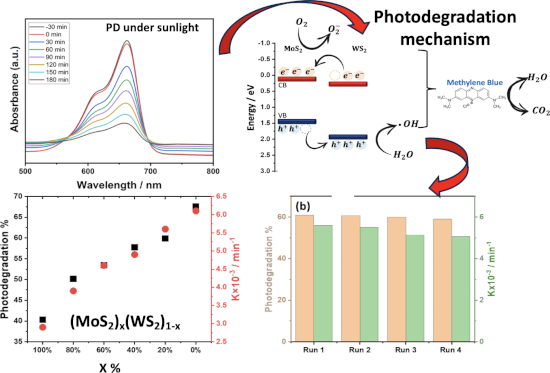
- are evaluated for photodegradation (PD) of methylene blue under solar simulator irradiation. Our findings revealed that WS2 exhibited the highest PD efficiency of 67.6% and achieved an impressive PD rate constant of 6.1 × 10⁻³ min−1. Conversely, MoS2 displayed a somewhat lower PD performance of 43.5
- ]. Typically, semiconductor-based photocatalysts, such as TiO2, ZnO2, and some other high-bandgap transition-metal dichalcogenides (TMD) have shown their ability to efficiently degrade the activated MB by irradiation [10][11]. Recently, TMD such as MoS2 and WS2, have displayed remarkable potential as
- , with over 99% degradation of MB achieved within 60 min under visible light exposure by using 10 mg of the catalyst to degrade 10 mg/L of MB [22]. Other works have shown that the MoS2–ZnO composite achieved 97% of MB photodegradation in ≈30 min under visible irradiation by using 250 mg/L of the catalyst


Electron-induced ligand loss from iron tetracarbonyl methyl acrylate
Beilstein J. Nanotechnol. 2024, 15, 797–807, doi:10.3762/bjnano.15.66
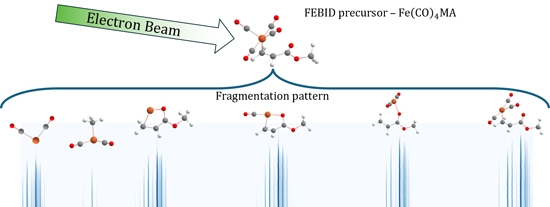
- irradiation efficiently separates the neutral MA ligand from the precursor. This suggests that dissociative ionization plays only a limited role in the deposition process since the Fe(CO)4+ fragment has a very low abundance in the mass spectrum. In contrast, the MA ligand is very efficiently cleaved in the



Green synthesis of biomass-derived carbon quantum dots for photocatalytic degradation of methylene blue
Beilstein J. Nanotechnol. 2024, 15, 755–766, doi:10.3762/bjnano.15.63
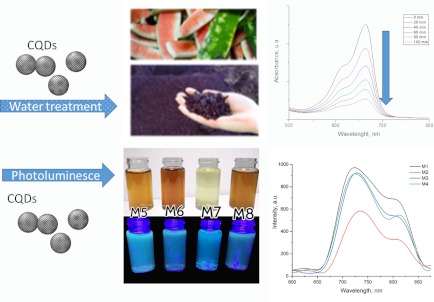
- activity of the CQDs in degrading methylene blue was evaluated under both sunlight and incandescent light irradiation, with measurements taken at 20 min intervals over a 2 h period. The CQDs, with sizes ranging from 1–10 nm, demonstrated notable optical properties, including upconversion and down
- emission when excited at 900 nm and down-conversion emission in the blue region. The photocatalytic activity of CQDs, under sunlight irradiation, in MB degradation has been confirmed by various studies [32][33][34][35][36][37][38]. In this research, samples synthesized with nitric acid exhibited the best
- ) with a 1 cm path length quartz cell. To evaluate the photocatalytic activity of the CQDs, a suspension containing CQDs and MB (10 ppm initial concentration of MB) was placed in a baker under constant stirring. Before initiating the light irradiation, the suspension was stirred for 20 min at 400 rpm in


Level set simulation of focused ion beam sputtering of a multilayer substrate
Beilstein J. Nanotechnol. 2024, 15, 733–742, doi:10.3762/bjnano.15.61
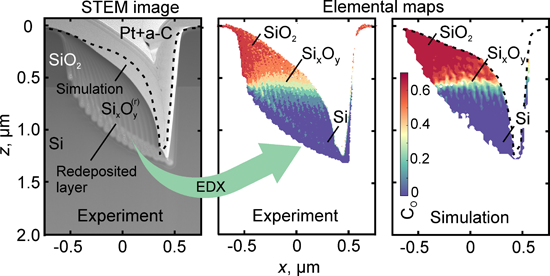
- , the desired properties are achieved by FIB processing of such substrates with different irradiation doses. A low-dose treatment is sufficient for cases that do not require sputtering of large amounts of material. Among such cases are the precise tuning of the magnetic characteristics of thin
- sputtering of a multilayer substrate under FIB irradiation. The results of the calculations for narrow trenches and rectangular boxes with varying aspect ratios were compared with cross-sectional scanning transmission electron microscopy (STEM) images of experimental test structures fabricated in the silicon
- [29] where is a vector with coordinates (x, y, z) and is the displacement rate with which each surface segment moves in the normal direction. The value of the rate depends on different ion and atom fluxes arising from irradiation by the incident gallium ion beam with the flux . The most important

![[Graphic 55]](/bjnano/content/inline/2190-4286-15-61-i68.svg?max-width=637&scale=1.18182)


Simultaneous electrochemical determination of uric acid and hypoxanthine at a TiO2/graphene quantum dot-modified electrode
Beilstein J. Nanotechnol. 2024, 15, 719–732, doi:10.3762/bjnano.15.60
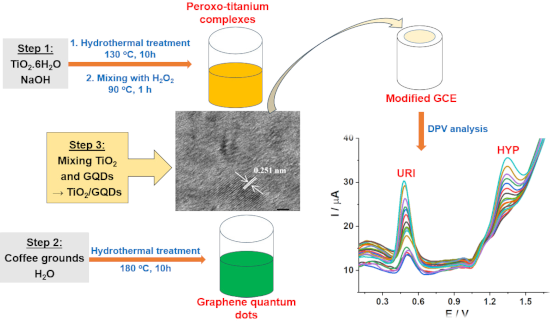
- transparent and brown in color, while the suspension of the peroxo titanium complex is opaque yellow. The prepared TiO2/GQD aqueous suspensions, in contrast, display a light yellow color, which gets darker as the ratio of TiO2/GQD in the complex increases (Figure 1a). Under 365 nm UV irradiation (Figure 1b


Gold nanomakura: nanoarchitectonics and their photothermal response in association with carrageenan hydrogels
Beilstein J. Nanotechnol. 2024, 15, 678–693, doi:10.3762/bjnano.15.56

- gold nanomakura within a 600–700 nm wavelength. The aspect ratio as well as anisotropy of synthesized gold nanomakura can influence photothermal response upon near-infrared irradiation. The role of carbon tail length was evident via absorption peaks obtained from longitudinal surface plasmon resonance
- purposes. Also, gold nanoparticles possess an intrinsic capacity to liberate heat upon irradiation of NIR/IR lasers making them a suitable candidate for photothermal therapy (PTT). Previous studies reported morphology-dependent heat liberation in gold nanoparticles where anisotropic particles (gold
- hydrogels) is shown in Figure 8. The net temperature rise of the gold nanomakura suspension and deionized water during visible broadband irradiation ON (heating) and OFF (cooling) for 1200 seconds each, measured using a “K-type” thermocouple is shown in Figure 8. Figure 8a shows the heating and cooling of






Laser synthesis of nanoparticles in organic solvents – products, reactions, and perspectives
Beilstein J. Nanotechnol. 2024, 15, 638–663, doi:10.3762/bjnano.15.54
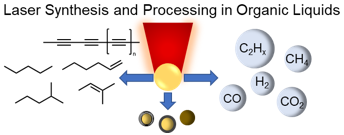
- , and LRL yield nanoparticles as products, whereas LML creates submicrometer spheres. LAL, LFL, and LML process solids, whereas LRL employs solvates as precursors (Figure 1). In detail, LAL describes the laser irradiation of a macroscopic target and the subsequent removal of surface matter, which leads
- utilizes commercial-grade powders or nanoparticles to downsize the particles by laser irradiation with high fluences [7][25]; LML, in contrast, is used to isochorically alter the shape or increase the size of nanoparticles by low-fluence irradiation of nanoparticles [26][27]. A variant of LSPC is reactive
- physical synthesis method. Moreover, the irradiation of pure organic solvents with femtosecond or picosecond radiation led to the formation of numerous products induced by the intense conditions, which can be attributed to laser-induced optical breakdown and/or shockwaves. The optical breakdown of the




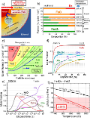

Electron-induced deposition using Fe(CO)4MA and Fe(CO)5 – effect of MA ligand and process conditions
Beilstein J. Nanotechnol. 2024, 15, 500–516, doi:10.3762/bjnano.15.45
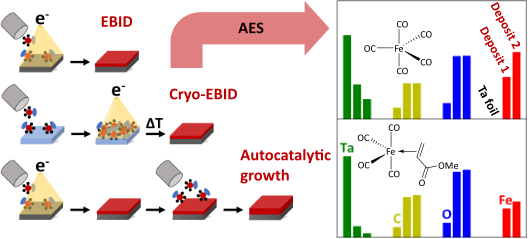
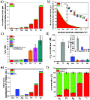
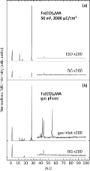
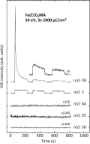
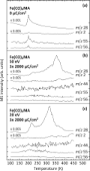
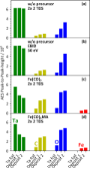
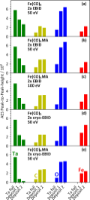
- architecture on the deposit formation in electron irradiation experiments that mimic FEBID and cryo-FEBID processes. Electron-stimulated desorption and post-irradiation thermal desorption spectrometry were used to obtain insight into the fate of the ligands upon electron irradiation. As a key finding, the
- deposits obtained from Fe(CO)4MA and Fe(CO)5 were surprisingly similar, and the relative amount of carbon in deposits prepared from Fe(CO)4MA was considerably less than the amount of carbon in the MA ligand. This demonstrates that electron irradiation efficiently cleaves the neutral MA ligand from the
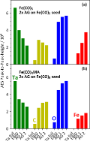
- precursor. In addition to deposit formation by electron irradiation, the thermal decomposition of Fe(CO)4MA and Fe(CO)5 on an Fe seed layer prepared by EBID was compared. While Fe(CO)5 sustains autocatalytic growth of the deposit, the MA ligand hinders the thermal decomposition in the case of Fe(CO)4MA. The



Photocatalytic degradation of methylene blue under visible light by cobalt ferrite nanoparticles/graphene quantum dots
Beilstein J. Nanotechnol. 2024, 15, 475–489, doi:10.3762/bjnano.15.43
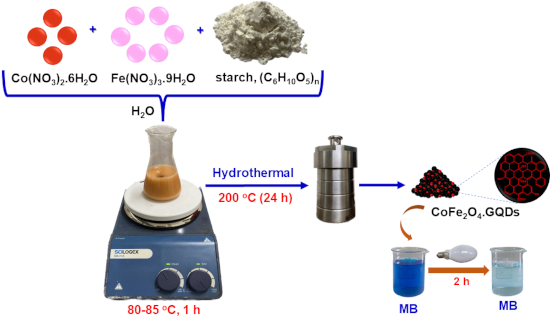
- dispersed in 100 mL of 10 ppm MB solution in a 250 mL Erlenmeyer flask. Before illumination, the solution was placed in the dark for 1 h under stirring to achieve an adsorption–desorption equilibrium. Aliquots of 2 mL were taken at certain time intervals during irradiation and separated by centrifuging. In
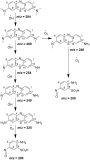
- was added, the peak magnitude for MB at 246, 292, and 664 nm decreased remarkably. The colour disappearance and the cleavage of aromatic rings were completed after 120 min of irradiation (Figure 7c). The decolourisation kinetics of MB over CF/GQDs-200 is shown in Figure 7d. The Langmuir–Hinshelwood
- photocorrosion and exhibits excellent reusability for the degradation process. The mechanism of MB degradation over the CF/GQDs catalyst is illustrated in Scheme 2. Under visible light irradiation, photogenerated holes (h+) are created in the valence bands via the transfer of photogenerated electrons (e−) from




Unveiling the nature of atomic defects in graphene on a metal surface
Beilstein J. Nanotechnol. 2024, 15, 416–425, doi:10.3762/bjnano.15.37
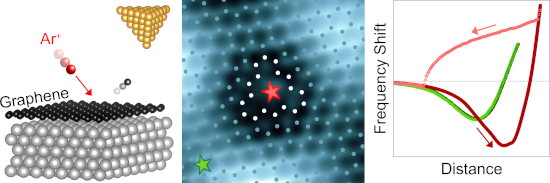
- by noble-gas ion irradiation [6][13][14][17][19][21][24], represents an opportunity for systematic defect studies. The work presented here was stimulated by the lack of experimental data on the actual geometry of atomic-scale defects in graphene. So far, scanning tunneling microscope (STM


Classification and application of metal-based nanoantioxidants in medicine and healthcare
Beilstein J. Nanotechnol. 2024, 15, 396–415, doi:10.3762/bjnano.15.36
- ]. PDA-Ru nanoparticles could degrade Aβ fibrils under low-power laser irradiation because of their great photothermal effect. Moreover, PDA-Ru nanoparticles could decompose H2O2 owing to their strong CAT activity. PDA-Ru nanoparticles effectively improved memory capacity and decreased neuroinflammation
- collaborators synthesized mesoporous carbon nanospheres (PMCSs) derived from a MOF precursor, exhibiting dual photodynamic and photothermal characteristics. Utilizing this framework, concentration and temperature at thrombotic sites were elevated significantly upon local irradiation (808 nm laser), resulting in


Investigating ripple pattern formation and damage profiles in Si and Ge induced by 100 keV Ar+ ion beam: a comparative study
Beilstein J. Nanotechnol. 2024, 15, 367–375, doi:10.3762/bjnano.15.33
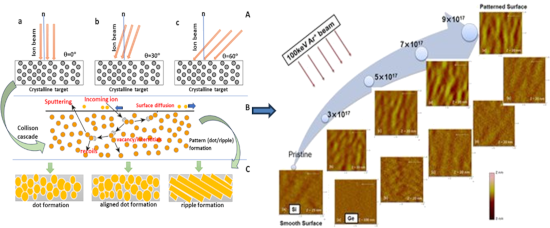
- fabrication on Si and Ge by 100 keV Ar+ ion beam bombardment is discussed. The irradiation was performed in the ion fluence range of ≈3 × 10¹⁷ to 9 × 10¹⁷ ions/cm2 and at an incident angle of θ ≈ 60° with respect to the surface normal. The investigation focuses on topographical studies of pattern formation
- earlier reports suggested that Ge is resistant to structural changes upon Ar+ ion irradiation, in the present case, a ripple pattern is observed on both Si and Ge. The irradiated Si and Ge targets clearly show visible damage peaks between channel numbers (1000–1100) for Si and (1500–1600) for Ge. The
- ., were taken and cut into equal pieces of 0.5 cm × 1 cm. The samples were mounted on an experimental ladder used for irradiation experiments using double-sided tape. Pieces of Si were mounted on the left-hand side and of Ge on the right-hand side of the Cu ladder. This was done to allow them to be


Determining by Raman spectroscopy the average thickness and N-layer-specific surface coverages of MoS2 thin films with domains much smaller than the laser spot size
Beilstein J. Nanotechnol. 2024, 15, 279–296, doi:10.3762/bjnano.15.26
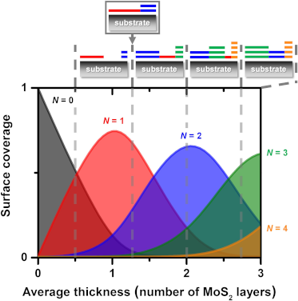
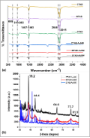
- layers [32][33] and the presence of twist between adjacent layers from the vanishing of the S modes in twisted MoS2 flakes [20][38][39][40][41]. Then, it is essential to determine the limit value of the laser power so that the above measurements are not affected by laser irradiation. Figure 1 shows the


Vinorelbine-loaded multifunctional magnetic nanoparticles as anticancer drug delivery systems: synthesis, characterization, and in vitro release study
Beilstein J. Nanotechnol. 2024, 15, 256–269, doi:10.3762/bjnano.15.24
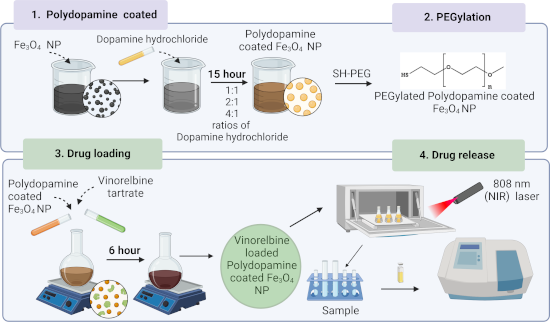
- cancer therapy agent, is included in the nanocomposite structure, and in vitro drug release studies under different pH conditions (pH 5.5 and 7.4) and photothermal activity at 808 nm NIR laser irradiation are investigated. The comprehensive integration of precise multifunctional nanoparticles design
- the heat produced by nanostructures under NIR laser irradiation [17][18]. Compared to traditional treatments, photothermal therapy allows for increased drug release and is less cytotoxic to healthy tissues [19]. It is a minimally invasive technique that offers the advantage of rapid recovery [20
- stability and efficiency Fe3O4 NPs, PDA/Fe3O4 NPs, and VNB/PDA/Fe3O4 NPs (at a concentration of 0.1 mg/mL and in a total volume of 1 mL) were exposed to 808 nm (1 W/cm2) NIR laser irradiation for a duration of 5 min. PBS was used as a control. The temperature changes of the NP solutions were recorded using


Ion beam processing of DNA origami nanostructures
Beilstein J. Nanotechnol. 2024, 15, 207–214, doi:10.3762/bjnano.15.20
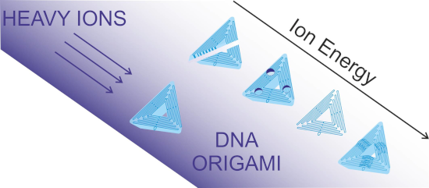
- nanopatterning approach. Direct combination of this approach with top-down nanotechnology, such as ion beams, has not been considered because of the soft nature of the DNA material. Here we demonstrate that the shape of 2D DNA origami nanostructures deposited on Si substrates is well preserved upon irradiation
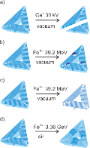
- by ion beams, modeling ion implantation, lithography, and sputtering conditions. Structural changes in 2D DNA origami nanostructures deposited on Si are analyzed using AFM imaging. The observed effects on DNA origami include structure height decrease or increase upon fast heavy ion irradiation in
- vacuum and in air, respectively. Slow- and medium-energy heavy ion irradiation results in the cutting of the nanostructures or crater formation with ion-induced damage in the 10 nm range around the primary ion track. In all these cases, the designed shape of the 2D origami nanostructure remains


Graphene removal by water-assisted focused electron-beam-induced etching – unveiling the dose and dwell time impact on the etch profile and topographical changes in SiO2 substrates
Beilstein J. Nanotechnol. 2024, 15, 190–198, doi:10.3762/bjnano.15.18
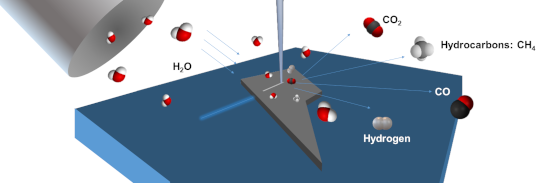
- using electron beams and gas precursors was not widely recognized at the time when earlier studies regarding morphological changes in silica upon the electron irradiation were performed [24]. Therefore, neither of the electron-beam-induced changes into the SiO2 surface during the water purification of
- irradiation. Their findings on the volume decrease or increase of silica crystalline and amorphous phases were explained by the electromigration of oxygen atoms and densification of surface regions. Yet, taking into account the supplied data one cannot exclude the presence of water residues in the SEM chamber


Influence of conductive carbon and MnCo2O4 on morphological and electrical properties of hydrogels for electrochemical energy conversion
Beilstein J. Nanotechnol. 2024, 15, 57–70, doi:10.3762/bjnano.15.6
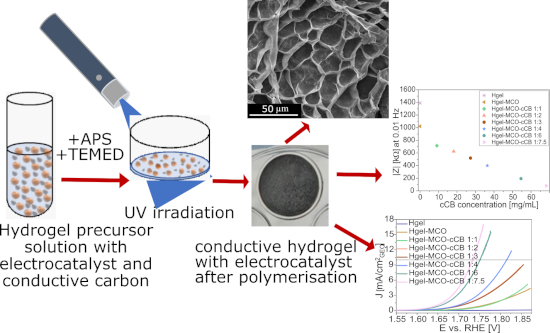
- the hydrogel polymerisation process: 2-hydroxy-4′-(2-hydroxyethoxy)-2-methylpropiophenone (as a photoinitiator used to trigger the hydrogel polymerisation reaction upon UV irradiation) as well as APS and TEMED. The addition of APS and TEMED was necessary as there is a need to quickly increase the
- viscosity of the hydrogel precursor solution to avoid the sedimentation of suspended particles (MCO and cCB). Table 3 presents the amounts of cCB used in the preparation of each conductive hydrogel sample. Ultraviolet irradiation (UV EMITA VP-60, 180 W, 220–240 V AC) in an ice bath lasted 2–4 minutes for
- cooling bath to eliminate the high temperature generated by UV irradiation. In both cases, we protected the PNIPAAm polymer from reaching the lower critical solution temperature (LCST) by cooling. The LCST of PNIPAM in pure water is approx. 32 °C [59][60][61]. Polymerisation reactions performed at a


Fluorescent bioinspired albumin/polydopamine nanoparticles and their interactions with Escherichia coli cells
Beilstein J. Nanotechnol. 2023, 14, 1208–1224, doi:10.3762/bjnano.14.100
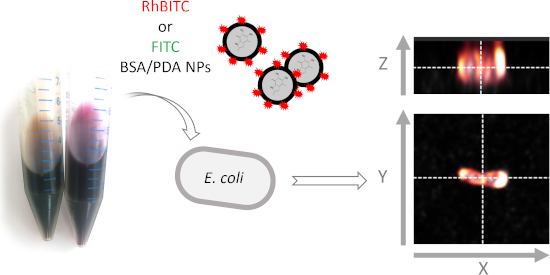
- in the 450–500 nm range under 405 nm light irradiation [21]. FITC-BSA/PDA NPs and RhBITC-BSA/PDA NPs are expected to emit similarly to free FITC (emission in the green range if excited at 488 nm) and RhBITC (emission in the red range if excited at 561 nm), respectively. BSA/PDA NPs can be as small as
- to heat up under irradiation by non-radiative relaxation. This is favorable to minimize the superposition between absorption and emission peaks, but might lead to a low quantum yield and, thus, poor emission intensity. Indeed, the quantum yield of Ox-BSA/PDA NPs in water (Φ) was calculated to be 0.1



A combined gas-phase dissociative ionization, dissociative electron attachment and deposition study on the potential FEBID precursor [Au(CH3)2Cl]2
Beilstein J. Nanotechnol. 2023, 14, 1178–1199, doi:10.3762/bjnano.14.98
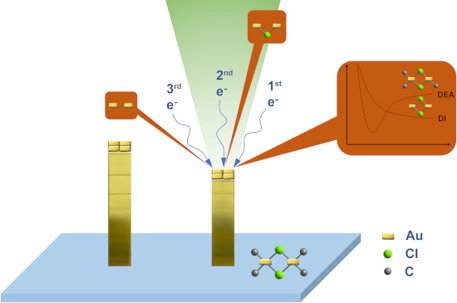
- structures, these precursor molecules are commonly organometallics that adsorb on the substrate and are decomposed by the electron beam irradiation. Ideally, a pure metal is deposited while fragmented volatile ligands are pumped away [11][12][13]. Several parameters affect the FEBID process, including the
- . In FEBID, the irradiation of the substrate with a high-energy focused electron beam results in elastic and inelastic electron scattering, including ionizing events. The latter leads to the production of numerous reactive, low-energy scattered and secondary electrons. These play a significant role in



A visible-light photodetector based on heterojunctions between CuO nanoparticles and ZnO nanorods
Beilstein J. Nanotechnol. 2023, 14, 1018–1027, doi:10.3762/bjnano.14.84
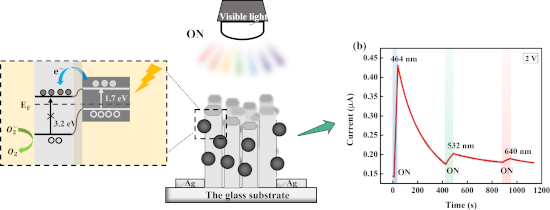
- , exhibiting weaker signals at 464 nm irradiation and the lowest photoresponse to green and red wavelengths. When illuminating with 464 nm blue light, the recorded responsivity is 0.37 mA·W−1; photoconductive gain and detectivity are 9.89 × 10⁻⁴ and 13.4 × 10⁶ Jones, respectively (Figure 6a). The sensitivity