Search results
Search for "seeds" in Full Text gives 98 result(s) in Beilstein Journal of Nanotechnology.
“Sticky invasion” – the physical properties of Plantago lanceolata L. seed mucilage
Beilstein J. Nanotechnol. 2016, 7, 1918–1927, doi:10.3762/bjnano.7.183
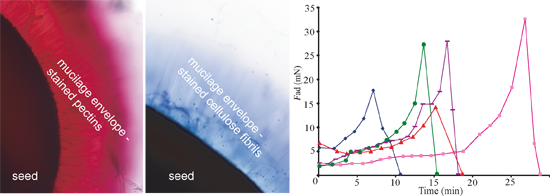
- , D-24118 Kiel, Germany 10.3762/bjnano.7.183 Abstract The mucilage envelope of seeds has various functions including the provision of different ways for the dispersal of diaspores. Chemical composition and water content of the mucilage yield particular adhesive and frictional properties in the
- envelope that also influence the dispersal of seeds. To determine the physical properties of Plantago lanceolata seed mucilage we studied (1) composition, (2) desiccation, (3) adhesion, and (4) friction properties of the mucilage under different hydration conditions. We revealed the presence of cellulose
- mucilage against loss from the seed surface. Keywords: adhesion; cellulose mucilage; desiccation; friction; Plantago lanceolata; Introduction The ability of seeds and fruits (diaspores) to form mucilage after hydration is known as myxospermy [1][2]. The mucilaginous diaspores are particularly


Tunable longitudinal modes in extended silver nanoparticle assemblies
Beilstein J. Nanotechnol. 2016, 7, 1219–1228, doi:10.3762/bjnano.7.113
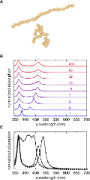
- transparent in the entire visible region using Pd decahedra as seeds [37]. In Luo’s work, the longitudinal band was pushed to the near infra-red region with nanorods of aspect ratios greater than 3.9. This is due to the energy dampening as the plasmon oscillation travels a longer distance on the rod surface


Voltammetric determination of polyphenolic content in pomegranate juice using a poly(gallic acid)/multiwalled carbon nanotube modified electrode
Beilstein J. Nanotechnol. 2016, 7, 1104–1112, doi:10.3762/bjnano.7.103
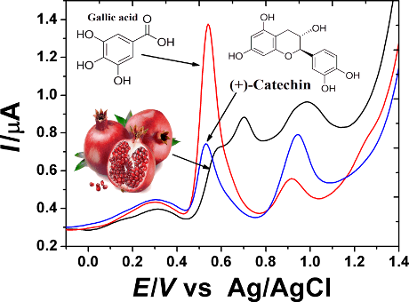
- /s. Preparation of pomegranate juice sample and determination of total phenolic content The pomegranate juice was obtained by peeling the fruits by hand and the seeds were liquefied using a hand press. The obtained juice was filtered off through a Whatman filter paper (No. 1). An aliquot of 10.0 mL


Sandwich-like layer-by-layer assembly of gold nanoparticles with tunable SERS properties
Beilstein J. Nanotechnol. 2016, 7, 1028–1032, doi:10.3762/bjnano.7.95
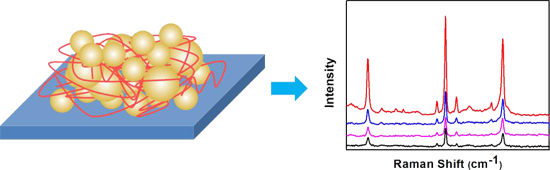
- be assembled onto polyelectrolyte multilayer films and act as seeds for the following NP growth [16]. The grown NP films were demonstrated to be stable and reproducible SERS substrates. In addition to assembling only one type of NPs, Zhang et al. fabricated bimetallic gold–silver multilayer films by


Direct formation of gold nanorods on surfaces using polymer-immobilised gold seeds
Beilstein J. Nanotechnol. 2016, 7, 809–816, doi:10.3762/bjnano.7.72
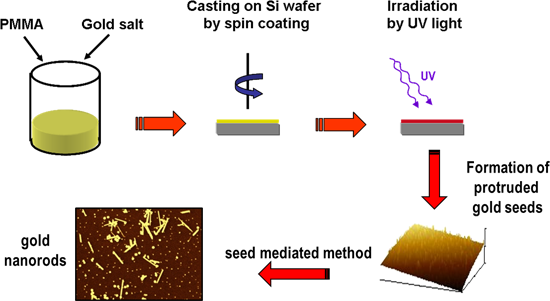
- direct growth on surfaces that were pre-coated with polymer-immobilised gold seeds. A Au–PMMA nanocomposite formed by UV photoreduction has been used as the gold seed. The influence of polymer Mw and gold concentration on the formation of GNRs has been investigated and discussed. The polymer
- nanowires (NWs) occurs directly on the surfaces using small metal nanoparticles as seeds to grow the NRs, similar to the direct growth of carbon nanotubes and semiconductor 1D nanostructures from catalytic seeds [5]. Direct growth of GNRs on surfaces has been reported in many publications [6][7][8]. Au seed
- particles usually bond to the pre-functionalised surfaces using various chemical linkers [9][10]. The substrate is then immersed in a growth solution, which results in the growth of surface-bound seeds into 1D nanostructures, quite similar to seed-mediated growth in solution. Seed-mediated growth is one of


Surface coating affects behavior of metallic nanoparticles in a biological environment
Beilstein J. Nanotechnol. 2016, 7, 246–262, doi:10.3762/bjnano.7.23
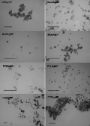
- of seed into nanocrystals. The mechanism behind such a synthesis is extremely complicated, but the type of coating agent proved to be crucial for the final shape of a nanocrystal [66]. The micrographs presented in Figure 8 suggest that our initially small AgNPs appeared as seeds in WhBl or BlPl




Green and energy-efficient methods for the production of metallic nanoparticles
Beilstein J. Nanotechnol. 2015, 6, 2354–2376, doi:10.3762/bjnano.6.243


Morphology control of zinc oxide films via polysaccharide-mediated, low temperature, chemical bath deposition
Beilstein J. Nanotechnol. 2015, 6, 799–808, doi:10.3762/bjnano.6.83
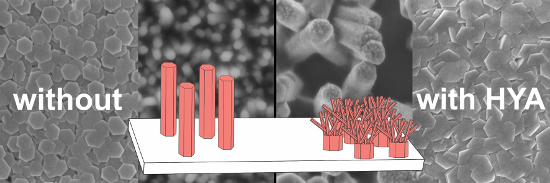
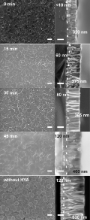
- . Results and Discussion ZnO films were prepared according to the three-step process described in the Experimental section and depicted in Figure 1. Step 1: Seeding The solution-based growth of zincite in general requires prior application of crystalline seeds on the support. In our work, the solution
- originating from the amorphous glass (data not shown). FE-SEM also failed to visualize the seeds on the glass slides, probably due to their small size and the strong electric charging of the substrate. However, indirect evidence of a successful seeding was possible. Contact angle measurements showed that the
- % were observed in the visible range. Combining the results from XRD and FE-SEM investigations to form a cohesive theory, we propose the following mechanism for the film formation, as illustrated in Figure 7. First, the seeds deposited during the first step support the growth of ZnO. On such seeds, an




Nanoparticle shapes by using Wulff constructions and first-principles calculations
Beilstein J. Nanotechnol. 2015, 6, 361–368, doi:10.3762/bjnano.6.35
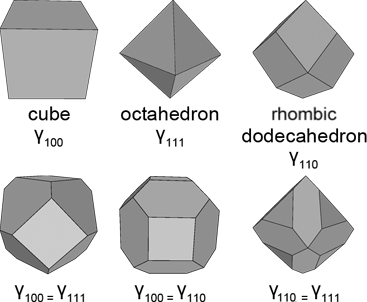
- adsorption of halides to particular facets reduces the surface energy of those facets and typically they are represented more in the equilibrium state of the particle. This has been observed for the appearance of nanocubes of Ag grown on Au seeds in the presence of chlorine [59]. In some cases a symmetry



Mechanical properties of MDCK II cells exposed to gold nanorods
Beilstein J. Nanotechnol. 2015, 6, 223–231, doi:10.3762/bjnano.6.21
- after reaching confluence by washing with PBS, followed by trypsinization and centrifugation at 110g. Particle synthesis and characterization Gold nanorods and nanospheres were prepared as described previously following the seeded growth method [25]. First, seeds were prepared by adding 0.6 mL of ice


Mammalian cell growth on gold nanoparticle-decorated substrates is influenced by the nanoparticle coating
Beilstein J. Nanotechnol. 2014, 5, 2479–2488, doi:10.3762/bjnano.5.257
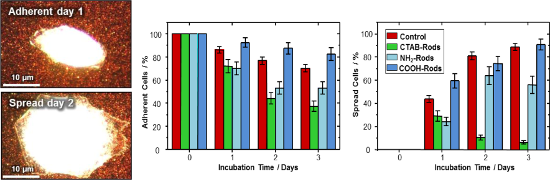
- (>18 MΩ, Milli-Q) was used in all experiments. Suppliers of chemicals are given in the Supporting Information File 1. Particle synthesis Gold nanorods were synthesized according to the seeded growth method published by Nikoobakht [34] as presented in [20]. In a first step, the seeds were prepared by


Synthesis and characterization of fluorescence-labelled silica core-shell and noble metal-decorated ceria nanoparticles
Beilstein J. Nanotechnol. 2014, 5, 2413–2423, doi:10.3762/bjnano.5.251
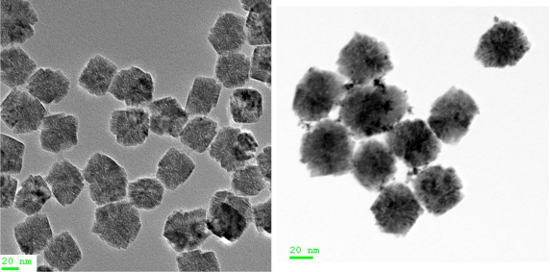
- 120 °C [48]. Under these conditions, nitrate acts as oxidizing agent, and the reaction can be done in closed vessels. The overall reaction is 3Ce3+ + NO3− + 4H2O → 3CeO2 + NO + 8H+. The authors suggest that PVP interacts with the crystal seeds and prevents an increase in size over the limit of 8–10 nm
- reaction time is necessary to allow for attachment of the precursor to the ceria NP by slow ligand exchange at the noble metal, replacing Cl− with the hydroxy groups at the surface, which results in the formation of nucleation seeds directly at ceria. Reduction with KBH4 leads to the desired decorated


Inorganic Janus particles for biomedical applications
Beilstein J. Nanotechnol. 2014, 5, 2346–2362, doi:10.3762/bjnano.5.244
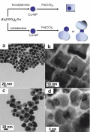
- ]. These inorganic Janus particles consisting of two different core materials are obtained either via a seed-mediated route using performed seeds or as a one-pot synthesis. However, in both cases the heterogeneous nucleation of a second or third component is taking place, limiting these techniques to
- material combinations where epitaxial growth is possible [7][60]. In order to create hetero-nanoparticles, it is crucial to suppress homogeneous nucleation of the second (or third) component as competitive reaction to heterogeneous nucleation on the preformed or in situ formed seeds. Following classical
- theory of heterogeneous nucleation, this can be achieved by decreasing the concentration of the precursor below supersaturation, at which the homogeneous nucleation would be favourable [61]. Furthermore, the additional term of Gibbs free energy for the adhesive energy at the interface between the seeds






Synthesis, characterization, and growth simulations of Cu–Pt bimetallic nanoclusters
Beilstein J. Nanotechnol. 2014, 5, 1371–1379, doi:10.3762/bjnano.5.150
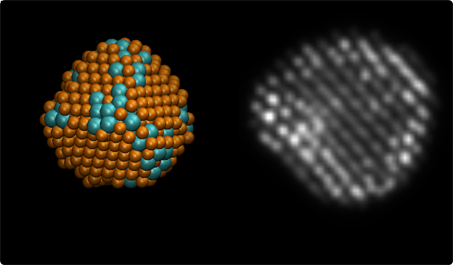
- novel simulation method to study the growth mechanism of CuPt bimetallic nanoclusters; in particular, we explored the attaching of Pt atoms on Cu seeds by using grand-canonical Langevin dynamics (GCLD) simulations, which shows the formation of alloy structures in good agreement with empirical evidence
- order of the metal atoms increases, since atoms inside the NP (higher coordination number) are not expected to interact with the solvent as much as the atoms in the surface (lower coordination). Following the experimental evidence, fcc structures were selected as Cu seeds for Pt growing. In particular
- we have employed the truncated octahedron (TO), the surface of which holds six square (100) faces and eight equilateral hexagonal (111) faces. TO structures of two sizes (n = 201 and n = 586) were used as seeds, which correspond to a diameter of 1.6 and 2.4 nm respectively. The simulations were


Electron-beam induced deposition and autocatalytic decomposition of Co(CO)3NO
Beilstein J. Nanotechnol. 2014, 5, 1175–1185, doi:10.3762/bjnano.5.129
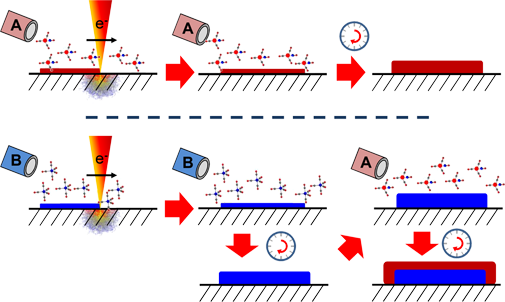
- insight into the underlying reaction(s), chemically more sensitive methods like XPS and IR spectroscopy may be helpful. The apparent cobalt thickness observed on the thick Fe seed layers is 7.4 ± 0.8 nm; the average growth rate is 0.35 ± 0.05 Å/min. It is likely, however, that the growth on Fe seeds




Plasma-assisted synthesis and high-resolution characterization of anisotropic elemental and bimetallic core–shell magnetic nanoparticles
Beilstein J. Nanotechnol. 2014, 5, 466–475, doi:10.3762/bjnano.5.54
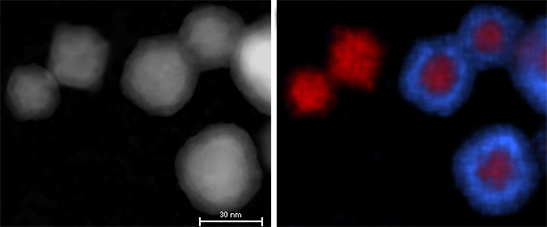
- wet-chemistry synthesis of NPs that the degree of supersaturation can be used to tune particle sizes and size distribution. At high supersaturation ratios, fast nucleation rates are attained and the ensuing rapid consumption of the elemental species (nucleation burst) results in a high number of seeds


En route to controlled catalytic CVD synthesis of densely packed and vertically aligned nitrogen-doped carbon nanotube arrays
Beilstein J. Nanotechnol. 2014, 5, 219–233, doi:10.3762/bjnano.5.24
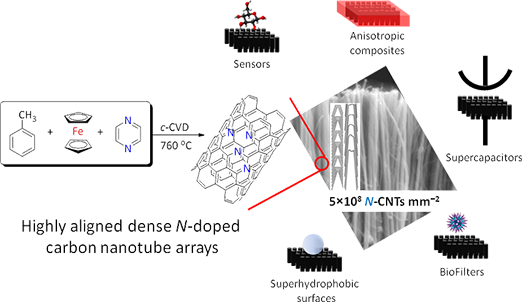
- temperature of the growth process was reduced (Synthesis IX), N-CNTs could not be detected and only catalyst particles of different heights and diameters were found as bright spots (‘seeds’) on the quartz substrate. In conclusion, the highest ‘quality’ of the nanotube arrays, i.e., no waviness, and a high


Cyclic photochemical re-growth of gold nanoparticles: Overcoming the mask-erosion limit during reactive ion etching on the nanoscale
Beilstein J. Nanotechnol. 2013, 4, 886–894, doi:10.3762/bjnano.4.100
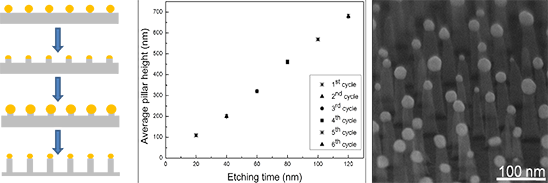
- position of the seeded Au NP. An electroless Au deposition onto already existing Au seeds, which is based on combining a gold salt (HAuCl4) and a reducing agent (NH2OH), has been reported [13][14]. Recently, a direct photochemical re-growth of Au particles without any reducing agents was developed [15][16
- Figure 4. (a) Pillar pattern fabricated on the SiO2 substrates by a short RIE step [pillar height (h) = 25 nm, initial NP diameter = 12 nm, final NP diameter = 9 nm (average values)]. (b) Photochemically grown Au particles on the seeds of panel (a) [final NP diameter = 24 nm (average)]. (c) Seeded Au NP


The morphology of silver nanoparticles prepared by enzyme-induced reduction
Beilstein J. Nanotechnol. 2012, 3, 404–414, doi:10.3762/bjnano.3.47
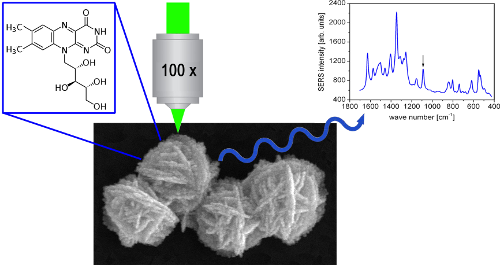
- conductivity of accumulated metal nanoparticles in a gap between two electrodes [6][7]. A further promising application of metal nanoparticles concerning the synthesis of bioanalytically adaptive nanoparticles is the usage as reaction seeds for a specific reductive metal deposition process. The subsequent
- shown in Figure 1. After the preliminary substrate cleaning and preparation, an amino-modified single-strand DNA was bound onto the substrate in order to act as seeds for the silver growth (a). In a second step, the enzyme horseradish peroxidase (HRP) is applied and bound to the DNA (b). Finally, the
- different starting concentrations of DNA between 0.16 µM and 10 µM. The DNA molecules act as seeds for the growth of the silver nanoparticles. In succession, HRP was added as a catalyst to initiate the growth of the silver nanoparticles. The concentration of HRP was 1:1000 for all samples with regard to an


Low-temperature solution growth of ZnO nanotube arrays
Beilstein J. Nanotechnol. 2010, 1, 128–134, doi:10.3762/bjnano.1.15
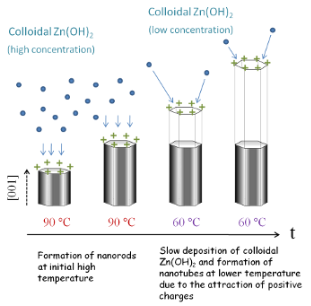
- of tube-shaped ZnO was due to a selective deposition of colloidal Zn(OH)2 at the edge of the (001) plane of ZnO nanorods that were formed in the beginning stage of the reaction. Results and discussion Figure 1 shows the SEM image of the film of ZnO seeds on an indium doped tin oxide (ITO) substrate
- significantly affected by the uniformity and crystal size of the seeds, which act as initial sites for the crystal nucleation [29][30][31][32]. The presented electrophoretic deposition method was effective for making high-quality ZnO nanocrystallite seeds on ITO substrates, as reported previously [33][34][35
- . Experimental ZnO nanorods were grown on an indium doped tin oxide (ITO) glass substrate, on which ZnO nanocrystallites as seeds were pre-prepared via an electrophoretic deposition. Typically, the ITO substrate was immersed in a 0.5 M zinc nitrate (Fisher Scientific Corp., USA), and an electric potential of 2.5


Review and outlook: from single nanoparticles to self-assembled monolayers and granular GMR sensors
Beilstein J. Nanotechnol. 2010, 1, 75–93, doi:10.3762/bjnano.1.10
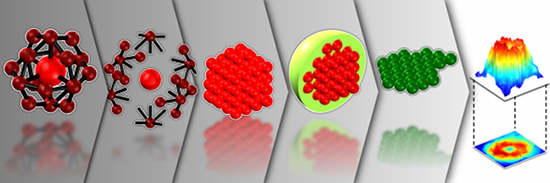
- , the formation of nucleation seeds is initiated. After formation, seeds absorb free metal atoms and continue to grow. The role of the tensides will be discussed below, however at this point, it is sufficient to know that they act as stabilizers for the particles; the resulting nanoobjects have a shell
- of the corresponding molecules. The particle growth dynamics can be explained in the frame of the LaMer model [12] which describes the growth process in two separate steps (Figure 1, blue line): above a critical concentration of free metal atoms, nucleation seeds are formed. Once the concentration
- drops below a critical threshold, the number of seeds remains constant and the existing seeds continue to grow. From a thermodynamic point of view, nucleation seeds are formed once the nucleation energy barrier is exceeded. The free enthalpy ΔG is composed of surface contributions GS and the bulk




Aerosol assisted fabrication of two dimensional ZnO island arrays and honeycomb patterns with identical lattice structures
Beilstein J. Nanotechnol. 2010, 1, 71–74, doi:10.3762/bjnano.1.9
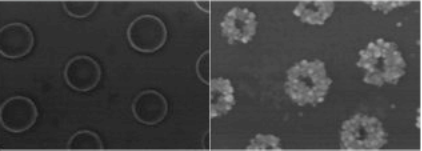
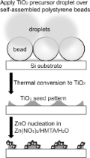
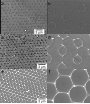
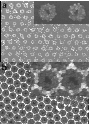
- the ZnO nanocrystals adhered to the TiO2 seeds which revealed that the crystals were hardly removed by the tape applied to the surface with light pressure. The control of the spatial pitch was demonstrated as well by changing the diameter of the polystyrene beads employed in the PSL procedure. Figure

Enhanced visible light photocatalysis through fast crystallization of zinc oxide nanorods
Beilstein J. Nanotechnol. 2010, 1, 14–20, doi:10.3762/bjnano.1.3
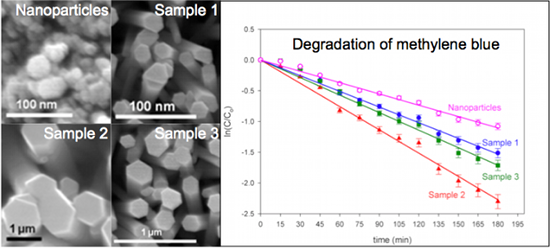
- . Growth of ZnO Nanorods The ZnO nanorods were grown hydrothermally on glass substrates, which were initially thiolated for better attachment of the ZnO nanoparticle seeds [31]. Hydrothermal growth of ZnO nanostructures is a simple and thermally efficient process [27]. Seeding was done by dip coating with
- a colloidal solution of ZnO nanoparticles and annealed at 100 oC for 30 min. The seeds served as nucleation sites and the ZnO nanorods grew preferentially along the c-axis of the wurtzite structure when the seeded substrate was placed in an aqueous chemical bath containing equimolar zinc nitrate