


Search results
Search for "surface topography" in Full Text gives 138 result(s) in Beilstein Journal of Nanotechnology.
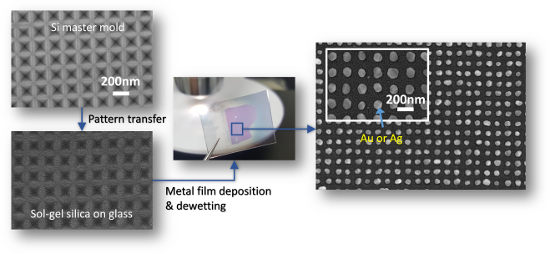
Assembly of metallic nanoparticle arrays on glass via nanoimprinting and thin-film dewetting
Beilstein J. Nanotechnol. 2017, 8, 1049–1055, doi:10.3762/bjnano.8.106
- of the ICSG resists during condensation at 110 °C for different times. SEM images showing the surface topography of the ICSG resist after annealing at 550 °C for 5 h. The inset image shows small surface cracks in the resist at higher magnification. Nanoindentation measurement for the ICSG resists


Relationships between chemical structure, mechanical properties and materials processing in nanopatterned organosilicate fins
Beilstein J. Nanotechnol. 2017, 8, 863–871, doi:10.3762/bjnano.8.88

- phenomena. (a) Cross section schematic of the nanoporous organosilicate glass (OSG) fin structures investigated in this study. (b) AFM image (5 µm × 5 µm) of the surface topography of the actual structures investigated. (c) Schematic diagram of the AFM-IR measurements on the OSG fins. (d) Schematic diagram



Silicon microgrooves for contact guidance of human aortic endothelial cells
Beilstein J. Nanotechnol. 2017, 8, 675–681, doi:10.3762/bjnano.8.72
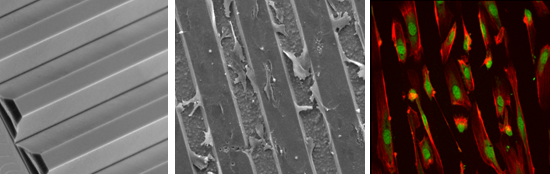
- microscale features to mimic the endothelium in lineal vessels. Keywords: cell morphology; contact guidance; microgrooves; silicon; human aortic endothelial cells (HAECs); Introduction Micro- and nanostructured materials for medical devices have demonstrated that surface topography as well as surface
- aforementioned decrease in cell spreading. Taking all the previously mentioned data, the present work provides evidence of the influence of the silicon surface topography on the cell behaviour. The use of such substrates may be a useful tool for the development of three-dimensional medical devices with


Impact of air exposure and annealing on the chemical and electronic properties of the surface of SnO2 nanolayers deposited by rheotaxial growth and vacuum oxidation
Beilstein J. Nanotechnol. 2017, 8, 514–521, doi:10.3762/bjnano.8.55
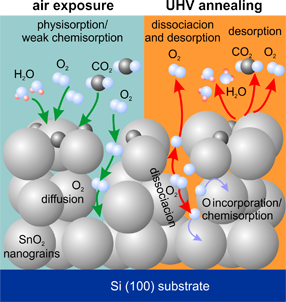
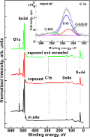
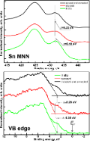
- structure of the layers as well as the post-exposition-related contamination. The studies are augmented with surface topography investigations using atomic force microscopy (AFM) in order to check the porosity of the resulting layer. Experimental The RGVO SnO2 nanolayers (20 nm, quartz microbalance



Multimodal cantilevers with novel piezoelectric layer topology for sensitivity enhancement
Beilstein J. Nanotechnol. 2017, 8, 358–371, doi:10.3762/bjnano.8.38
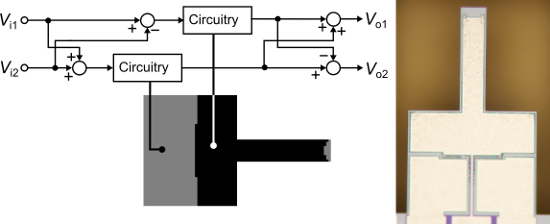
- frequency shift of the cantilever’s motion correlate to properties of the sample [15]. When closing a feedback loop around these observables with the z-axis nanopositioner, the controller output is routinely used to map the surface topography of the sample. Recently, the additional excitation and detection


Impact of surface wettability on S-layer recrystallization: a real-time characterization by QCM-D
Beilstein J. Nanotechnol. 2017, 8, 91–98, doi:10.3762/bjnano.8.10
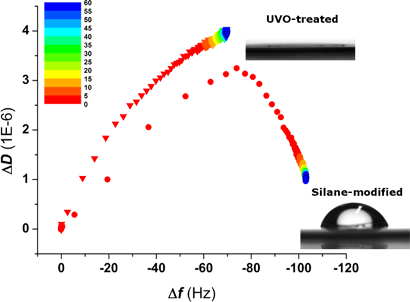
- indicates the transition point. (a) Df plot comparing the binding of SbpA onto SCWP and hydrophobic SiO2 for the initial 10 min. (b) Df slope evolution after achievement of the maximum value of ΔD. Atomic force amplitude micrographs (700 × 700 nm2) showing the surface topography of SbpA recrystallized on (a


Annealing-induced recovery of indents in thin Au(Fe) bilayer films
Beilstein J. Nanotechnol. 2016, 7, 2088–2099, doi:10.3762/bjnano.7.199
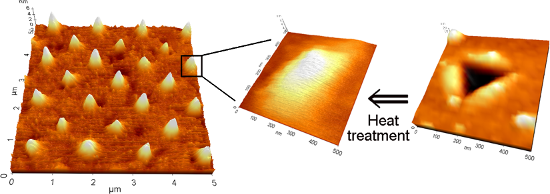
- boundary and the film-substrate interface. Later, the pore absorbs the material from the film surface by grain boundary diffusion, leading to the development of the near-hillock depression. The phenomenon observed in this work can be employed for the design of surface topography of thin metal films. While
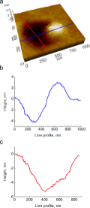
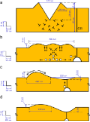
- Au(Fe) film far from the indented regions after annealing for 20 min. The simulated surface topography of the indent evolving by a surface diffusion mechanism, for different annealing times. B and t are the Mullins coefficient and the annealing time, respectively (see Appendix). Schematic





Evolution of the graphite surface in phosphoric acid: an AFM and Raman study
Beilstein J. Nanotechnol. 2016, 7, 1878–1884, doi:10.3762/bjnano.7.180
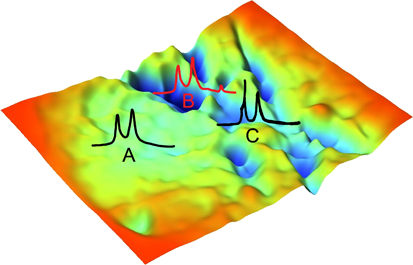
- further insight, we succeeded in following in situ the graphite degradation in these regions during the EC treatment by means of an EC-AFM. Figure 4 compares the surface topography before (panel a) and after (panel b) a single EC potential sweep in the positive potential range. The graphite steps are


Nano- and microstructured materials for in vitro studies of the physiology of vascular cells
Beilstein J. Nanotechnol. 2016, 7, 1620–1641, doi:10.3762/bjnano.7.155
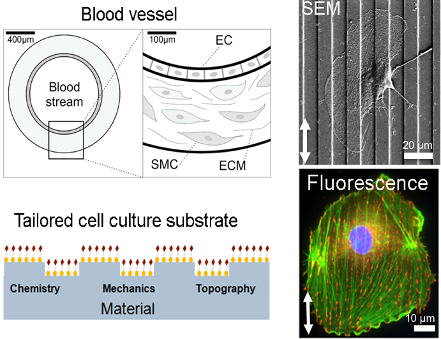
- potential interesting future studies. Keywords: fabrication methods; materials selection; nano- and micro-topography; vascular endothelial cells; vascular smooth muscle cells; Introduction Cells adhering to biomaterials are influenced by the surface topography, the surface chemistry and the mechanical
- properties of the substrate (Figure 1). In particular, the influence of the surface topography on cell behavior has been widely studied, with the motivation to understand the complex cell–substrate interactions and to transfer that knowledge to the design of implant surfaces. This review summarizes and
- -based techniques [55][56][57] and porogen-leaching methods [55]) are described. They often rely on the fabrication of a master with a designed surface topography that subsequently is replicated by a polymer. Most of these techniques have been extensively used and have allowed for novel types of



Surface roughness rather than surface chemistry essentially affects insect adhesion
Beilstein J. Nanotechnol. 2016, 7, 1471–1479, doi:10.3762/bjnano.7.139
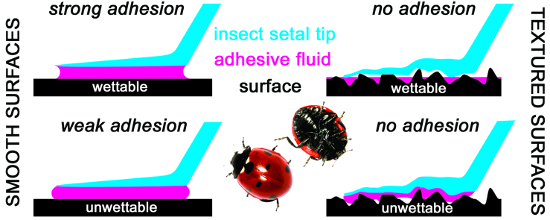
- ladybird beetles were found to be predominantly influenced by the surface topography. Experimental Materials Ethanol, 0.01 M HCl, and n-hexadecane were purchased from Wako Pure Chemical Industries Ltd. (Osaka, Japan). Tetramethoxysilane (TMOS, Si(OCH3)4) and n-octadecyltrimethoxysilane (ODS, CH3(CH2)17Si



Electric field induced structural colour tuning of a silver/titanium dioxide nanoparticle one-dimensional photonic crystal
Beilstein J. Nanotechnol. 2016, 7, 1404–1410, doi:10.3762/bjnano.7.131
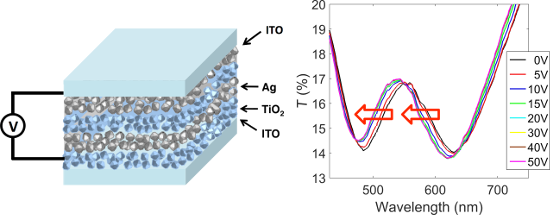
- nanoparticles and titanium dioxide nanoparticles deposited on top of an indium tin oxide (ITO) substrate. A scheme of the photonic crystal is shown in Figure 1. The silver nanoparticles have a diameter of about 50 nm, while the TiO2 nanoparticles are smaller than 15 nm. The surface topography and phase atomic




Three-gradient regular solution model for simple liquids wetting complex surface topologies
Beilstein J. Nanotechnol. 2016, 7, 1377–1396, doi:10.3762/bjnano.7.129

- surfaces is a key feature for many applications. The wetting properties of a surface depend on both the material and the surface topography. A famous example is the surface of a lotus leaf: Although the material of the leaf is hydrophilic (contact angle on a smooth substrate θY < 90°), the structured
- of a hydrophilic material, show an increase in θ, this implies that the droplet in these systems cannot be in the Wenzel state, or that the assumption of this model, namely that the parameter r captures all features of a surface topography relevant for the final droplet shape, is too simplistic. A


![[Graphic 10]](/bjnano/content/inline/2190-4286-7-129-i31.png?max-width=637&scale=1.18182) and standard deviation as a function of the cavity diameter d (in...
and standard deviation as a function of the cavity diameter d (in...

![[Graphic 20]](/bjnano/content/inline/2190-4286-7-129-i41.png?max-width=637&scale=1.18182) and the corresponding fluctuations (measured along the x-direction) indica...
and the corresponding fluctuations (measured along the x-direction) indica...

![[Graphic 28]](/bjnano/content/inline/2190-4286-7-129-i49.png?max-width=637&scale=1.18182) and the corresponding standard deviation as measure of variation in the ...
and the corresponding standard deviation as measure of variation in the ...

![[Graphic 39]](/bjnano/content/inline/2190-4286-7-129-i60.png?max-width=637&scale=1.18182) and standard deviation as function of cut-off fraction c for fixed ...
and standard deviation as function of cut-off fraction c for fixed ...
Dealloying of gold–copper alloy nanowires: From hillocks to ring-shaped nanopores
Beilstein J. Nanotechnol. 2016, 7, 1361–1367, doi:10.3762/bjnano.7.127
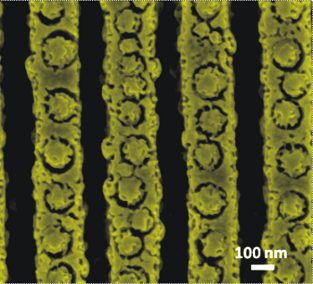
- , the surface topography (roughness, defects, impurities) has a direct impact on the final structure and morphology of the material. As a consequence of the presence of substrate surface defects, the films deposited by a PVD process may contain undesired defects such as hillocks, pinholes, and craters
- because of a non-homogenous surface topography with hills distributed over the surface. During PVD the growth of the material occurs preferredly on the hills acting as nucleation sites [15][16]. The local self-shadowing effect at these nucleation sites is the main driving force promoting the formation of
- substrates with surface defects to grow metal nanowires with complex surface topography, which afterwards can be engineered on the nanoscale. We investigated the influence of the defects size and density on the final morphology of the nanowires. We demonstrated that the deposition time can impact the size of




Functional diversity of resilin in Arthropoda
Beilstein J. Nanotechnol. 2016, 7, 1241–1259, doi:10.3762/bjnano.7.115
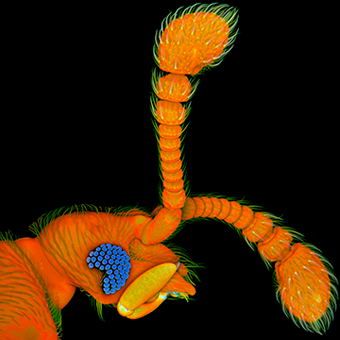
- pads on substrates depends on the ability of the pads to adapt to the surface topography. In this context, specific micro- and nanostructures can enhance the quality of the contact [97][98][99][100][101]. In the case of attachment on rough substrates, multiple contacts, being formed by some adhesive


Manufacturing and investigation of physical properties of polyacrylonitrile nanofibre composites with SiO2, TiO2 and Bi2O3 nanoparticles
Beilstein J. Nanotechnol. 2016, 7, 1141–1155, doi:10.3762/bjnano.7.106
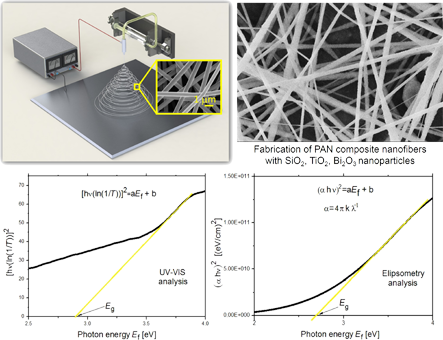
- dedicated database of PAN-ICSD files was used. The resulting polymer composite nanofibres were quantitatively and qualitatively analysed using EDX microanalysis and surface topography imaging using a Zeiss Supra 35 SEM, with a Trident XM4 X-ray spectrometer supplied by EDAX. Based on the SEM micrographs
- 25 nm. The microscopic study for the analysis of TEM images of particles and the analysis of SEM images of the fibrous surface topography of the composite mats allowed us to determine the influence of the diameter of the applied ceramic nanoparticles on the structure and the morphology of the
- the composite fibrous materials, surface topography imaging was applied using the scanning electron microscope. An analysis of the morphology and the structure of PAN nanofibres, obtained from a solution of PAN/DMF with a concentration of 5 wt %, with the distance between the electrodes equal to 20 cm



Characterization of spherical domains at the polystyrene thin film–water interface
Beilstein J. Nanotechnol. 2016, 7, 581–590, doi:10.3762/bjnano.7.51
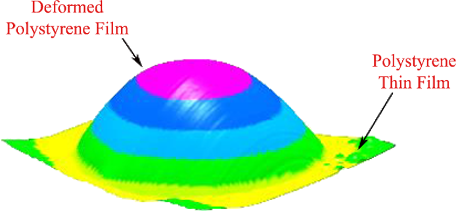
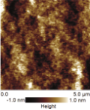
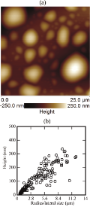
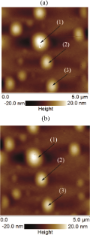
- also studied. Moreover, changes in surface topography, before and after the contact with water, have also been discussed. Experimental Materials and equipment The following materials and equipment were used in this study: deionized water purified with a Milli-Q A10 system, silicon dioxide (Lijing, LLC
- nitride cantilevers with a nominal tip radius of 20 nm and nominal stiffness of 0.05 N/m. The resonance frequency of the cantilever immersed in DI water was 35.0 kHz. Furthermore, an average scan rate of 1 Hz was used to image the surface topography and the micro/nano spherical domains. Moreover, the




Self-organization of gold nanoparticles on silanated surfaces
Beilstein J. Nanotechnol. 2015, 6, 2345–2353, doi:10.3762/bjnano.6.242
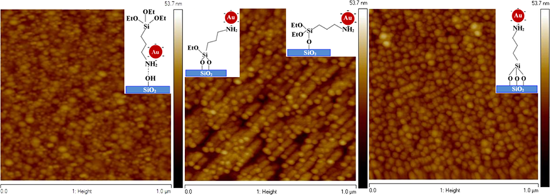
- on APTES-functionalized glass substrate. Surface topography of AuNPs deposited on glass surface was characterized by AFM which revealed the different coverage of AuNPs on self-assembled APTES glass substrates. Energy shift in VBM was also observed on APTES surface as well as AuNPs deposited on APTES


Electrochemical coating of dental implants with anodic porous titania for enhanced osteointegration
Beilstein J. Nanotechnol. 2015, 6, 2183–2192, doi:10.3762/bjnano.6.224
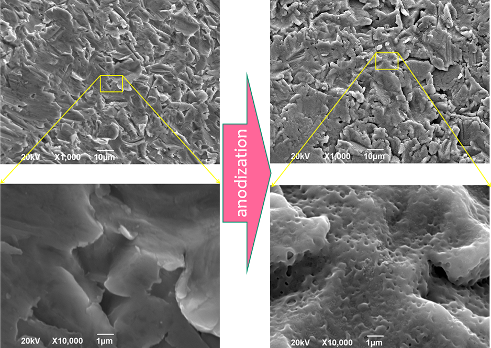
- with most metals, Ti in wet or even ambient air environment develops a thin layer of native oxide, namely TiO2 (titania). While it is generally recognized that surface topography is a major factor for osteointegration of all implants [4], the lower surface energy of titania as compared to that of


Transformations of PTCDA structures on rutile TiO2 induced by thermal annealing and intermolecular forces
Beilstein J. Nanotechnol. 2015, 6, 1498–1507, doi:10.3762/bjnano.6.155
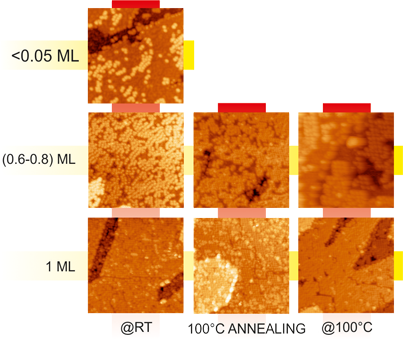
- located in between. The overall STM appearance is much different from the surface topography. Additional bright spots recorded within dark oxygen rows are attributed to oxygen vacancies (fainter spots) or single and double surface hydroxy groups (brighter spots). The oxygen vacancies are created during


Atomic force microscopy as analytical tool to study physico-mechanical properties of intestinal cells
Beilstein J. Nanotechnol. 2015, 6, 1457–1466, doi:10.3762/bjnano.6.151
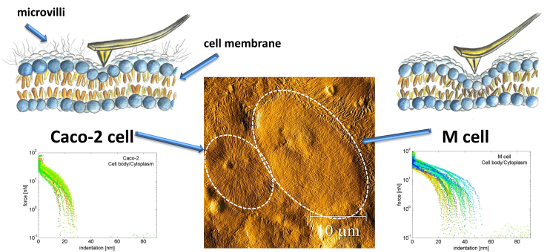
- ., high features on the sample cause the cantilever to deflect more) hence, a map of surface topography can be generated [21][22][24]. Moreover, quantitative analysis of the cell elasticity is possible by analyzing force-distance curves via monitoring the response of a cantilever once the tip is pushed
- surface morphologies, mechanical properties and cytoskeleton organizations, enterocytes (Caco-2 cells) and M cells were studied in an in vitro co-culture model [28]. For this, enterocytes were cultured with Raji B cells to trigger M cell formation. AFM was used as a tool to study surface topography


Tattoo ink nanoparticles in skin tissue and fibroblasts
Beilstein J. Nanotechnol. 2015, 6, 1183–1191, doi:10.3762/bjnano.6.120
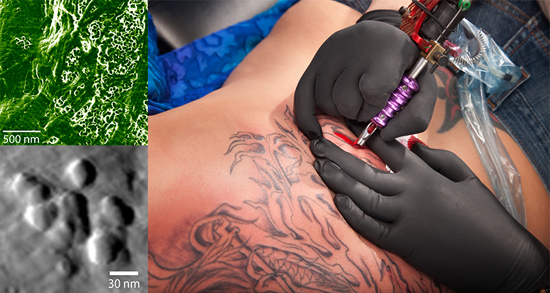
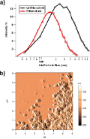
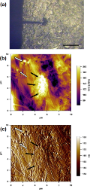
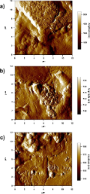
- shows a typical AFM height and corresponding amplitude image (Figure 2c) of a region in the upper dermis that contains tattoo ink particles. These AFM images clearly show the dense collagen fibril network with agglomerates of tattoo ink particles. The surface topography of the dermis is quite undulating


Probing fibronectin–antibody interactions using AFM force spectroscopy and lateral force microscopy
Beilstein J. Nanotechnol. 2015, 6, 1164–1175, doi:10.3762/bjnano.6.118
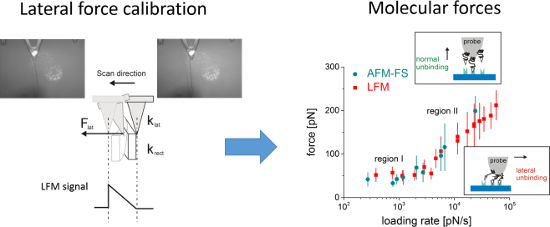
- , giving a ≈19% accuracy. This is also a measure of the reproducibility (33 cantilevers were calibrated in this manner). Surface topography To verify whether the functionalization of a mica surface gave an expected layer of fibronectin molecules, the surface topography was recorded using a bare (non
- monomer [22][32]. The knowledge of the surface topography of the FN molecules deposited on a mica surface enables verification of the quality of protein deposition by direct estimation of single molecule dimensions. Depending on the experimental conditions, fibronectin can be visible either in an
- cantilevers were immediately used in the measurements. Atomic force microscope All measurements were carried out using commercially available devices (PSIA XE100 and XE120, Park Systems, Korea) equipped with a “liquid cell” setup, in 10 mM PBS buffer. The surface topography of a fibronectin-coated mica



High sensitivity and high resolution element 3D analysis by a combined SIMS–SPM instrument
Beilstein J. Nanotechnol. 2015, 6, 1091–1099, doi:10.3762/bjnano.6.110
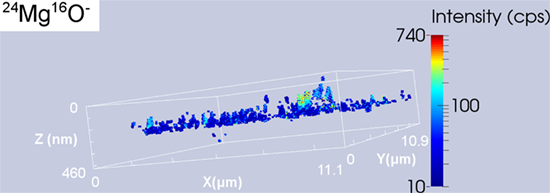
- reconstructions do not consider the sample surface topography, because these protocols and the applied software assume a flat sample surface as well as a cube-like analysed volume [6]. In reality, samples exhibit a surface roughness, which is also changed during the ion bombardment, because parameters such as
- image, the combined 3D SIMS–AFM image of the PS/PVP sample and a linescan presenting the local sample surface topography of PVP as well as the corresponding CN− secondary ion signal. Because PVP contains nitrogen (in contrast to PS) its spatial distribution can be easily imaged in SIMS by tracking the
- created due to differential sputtering, are captured with an apparent pixel position outside the γ′ precipitate phase. This is a consequence of significant field inhomogeneities as a result of distortion of the local electric field arising from the surface topography. As already stated in [20], both the


Mapping of elasticity and damping in an α + β titanium alloy through atomic force acoustic microscopy
Beilstein J. Nanotechnol. 2015, 6, 767–776, doi:10.3762/bjnano.6.79
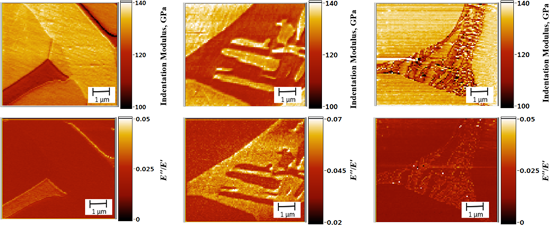
- , Russia was used in the study. A stiff cantilever with a spring constant, kc, of about 30 N/m and the first free resonance frequency f0 of about 171 kHz was used in the study. The surface topography of the specimens was obtained in tapping mode to select an area with sufficient flatness for acquiring the


In situ observation of biotite (001) surface dissolution at pH 1 and 9.5 by advanced optical microscopy
Beilstein J. Nanotechnol. 2015, 6, 665–673, doi:10.3762/bjnano.6.67
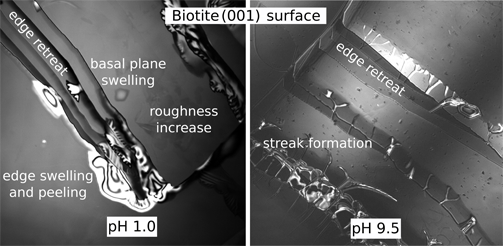
- integration of a micro-Raman spectrometer to the LCM-DIM setup to provide simultaneous acquirement of the surface topography and chemistry during mineral (phyllosilicate) weathering. Experimental In situ flow-through experiments Changes of the biotite (001) cleavage surface topography were monitored in situ





