Search results
Search for "vapor deposition" in Full Text gives 293 result(s) in Beilstein Journal of Nanotechnology. Showing first 200.
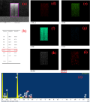
Ultrasensitive detection of cadmium ions using a microcantilever-based piezoresistive sensor for groundwater
Beilstein J. Nanotechnol. 2020, 11, 1242–1253, doi:10.3762/bjnano.11.108
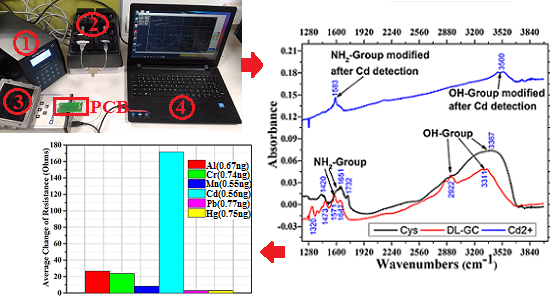
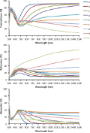
- vapor deposition (LPCVD) furnace at 630 °C and boron doping (1018 per cm3) is carried out using ion implantation at 35 keV. The upper SiO2 layer is formed by re-oxidizing the polysilicon in an oxidation furnace [40]. The stiffness (k) of the fabricated piezoresistive sensor measured using AFM is 131–146




Revealing the local crystallinity of single silicon core–shell nanowires using tip-enhanced Raman spectroscopy
Beilstein J. Nanotechnol. 2020, 11, 1147–1156, doi:10.3762/bjnano.11.99
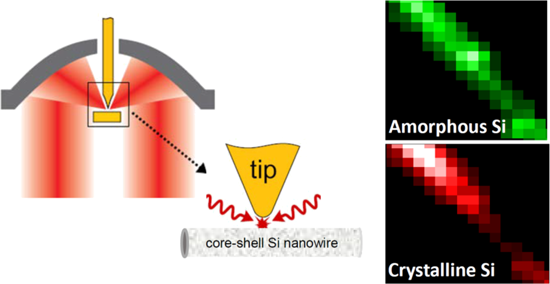
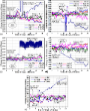
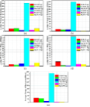
- -catalyzed vapor–liquid–solid growth and silicon overcoating by thermal chemical vapor deposition. Local changes in the fraction of crystallinity in these silicon nanowires are characterized at an optical resolution of about 300 nm. Furthermore, we are able to resolve the variations in the intensity ratios
- to chemical vapor deposition (CVD), and enables direct nanowire growth in a bottom-up manner. The nanowire composition, in particular the doping concentration, can be controlled by an adequate adjustment of the synthesis gas mixture, e.g., by setting the SiH4/B2H6 ratio during the synthesis of boron


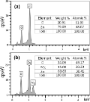
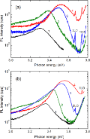
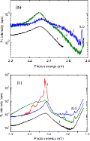
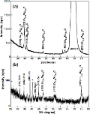
Band tail state related photoluminescence and photoresponse of ZnMgO solid solution nanostructured films
Beilstein J. Nanotechnol. 2020, 11, 899–910, doi:10.3762/bjnano.11.75
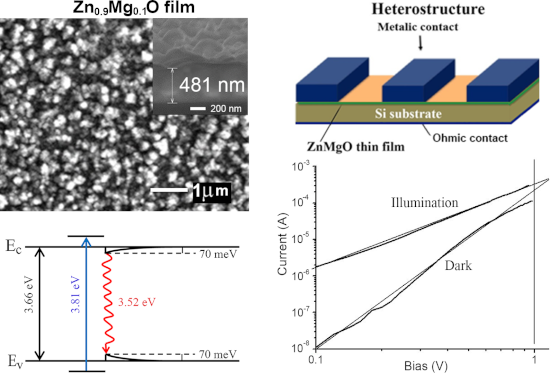
- radio-frequency plasma-assisted molecular beam epitaxy (RF-MBE) [2][7][10][11], DC [12][13] and RF [1][3][6] magnetron sputtering, pulsed laser deposition (PLD) [14][15], plasma-enhanced atomic layer deposition (PE-ALD) [16], chemical vapor deposition (CVD) [17], metal–organic chemical vapor deposition

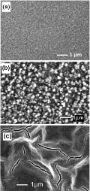
Integrated photonics multi-waveguide devices for optical trapping and Raman spectroscopy: design, fabrication and performance demonstration
Beilstein J. Nanotechnol. 2020, 11, 829–842, doi:10.3762/bjnano.11.68
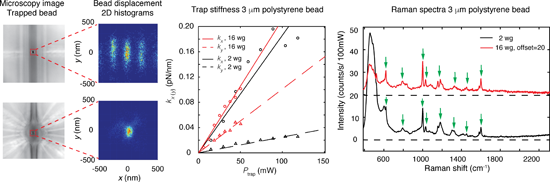
- waveguides is completely decoupled from the silicon substrate. Then, a 100 nm thick layer of Si3N4 is deposited using low pressure chemical vapor deposition (LPCVD, Figure 5b). This layer is patterned using optical lithography and reactive ion etching (RIE) in a fluorine-based plasma, which is followed by


Templating effect of single-layer graphene supported by an insulating substrate on the molecular orientation of lead phthalocyanine
Beilstein J. Nanotechnol. 2020, 11, 814–820, doi:10.3762/bjnano.11.66
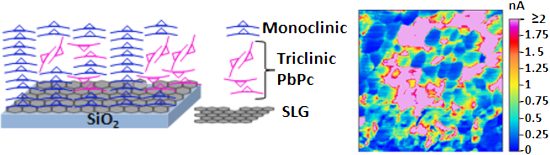
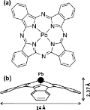
- ) substrate [24]. It will be interesting to explore the molecular orientation of nonplanar PbPc on single-layer graphene supported on a substrate. In this study, we have investigated the molecular orientation of a PbPc film deposited on chemical vapor deposition (CVD)-grown graphene transferred onto a SiO2/Si
- layer. Experimental A 10 nm thin PbPc film on single-layer graphene supported on a SiO2/Si substrate (SLG/SiO2/Si) was deposited using physical vapor deposition. The PbPc film was deposited at a base pressure of 1 × 10⁻⁵ mbar while the substrate was held at 100 °C. The deposition rate was 1–1.5 Å·s−1
- . Single-layer graphene was synthesized by chemical vapor deposition (CVD) on a copper substrate and transferred by a standard technique using poly(methyl methacrylate) (PMMA) onto a SiO2 (300 nm)/Si substrate as reported elsewhere [30]. This process is optimized with regard to minimal PMMA contamination


Light–matter interactions in two-dimensional layered WSe2 for gauging evolution of phonon dynamics
Beilstein J. Nanotechnol. 2020, 11, 782–797, doi:10.3762/bjnano.11.63
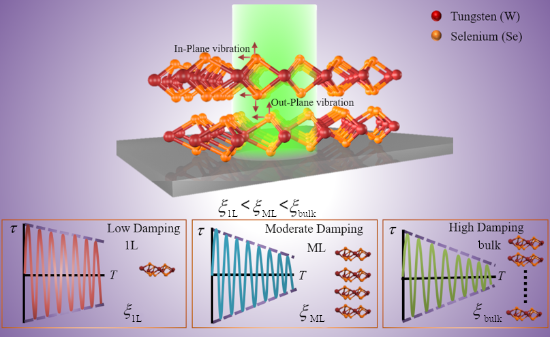
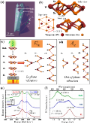
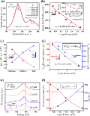
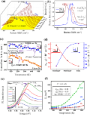
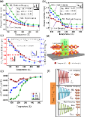
- work reported τ over a range T = 4.4–300 K in naturally abundant and isotopically pure WSe2 grown by the chemical vapor deposition (CVD) method [29]. In one of our recent works, exciton dynamics and phonon lifetimes in CVD-grown and mechanically exfoliated 1L WSe2 nanosheets were analyzed and τ
Hexagonal boron nitride: a review of the emerging material platform for single-photon sources and the spin–photon interface
Beilstein J. Nanotechnol. 2020, 11, 740–769, doi:10.3762/bjnano.11.61
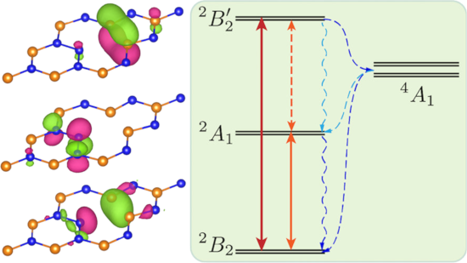
- complexes, it is shown they are low-energy formation defects in h-BN. This suggests that the assignment is presently controversial also considering the successive verification of SPEs as discussed in the following. In [45] h-BN exfoliated flakes, monolayer chemical vapor deposition (CVD) and in-house h-BN


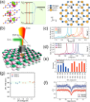


Simple synthesis of nanosheets of rGO and nitrogenated rGO
Beilstein J. Nanotechnol. 2020, 11, 68–75, doi:10.3762/bjnano.11.7
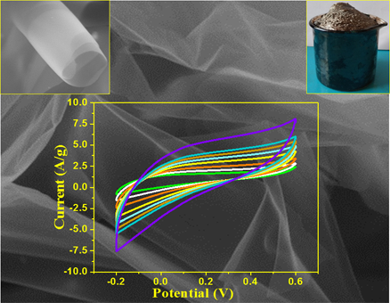
- the carbon sheet, which lead to a disruption of the conjugated network and the flow of charge carriers is reduced by several orders of magnitude [10]. Up to now, several methods including chemical vapor deposition [11][12][13], arc discharge [14], aerosol pyrolysis [15], mechanical exfoliation [1


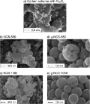
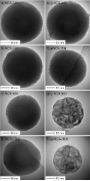
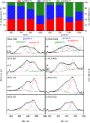
Synthesis of amorphous and graphitized porous nitrogen-doped carbon spheres as oxygen reduction reaction catalysts
Beilstein J. Nanotechnol. 2020, 11, 1–15, doi:10.3762/bjnano.11.1
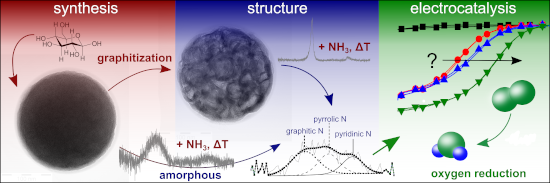
- are chemical vapor deposition (CVD) and arc discharge methods for N-doped graphene, graphite, and carbon nanotubes [9]. Most commonly, the post-synthetic approach is carried out by thermal treatment of carbon in ammonia atmosphere, typically leading to surface N-doping. A variety of N bonding




Advanced hybrid nanomaterials
Beilstein J. Nanotechnol. 2019, 10, 2563–2567, doi:10.3762/bjnano.10.247

- electronic devices” [29]. A combination of deposition techniques was used, chemical vapor deposition for parylene and RF-magnetron sputtering for silver nanoparticles. The content and size of the latter influences the dielectric characteristics of the resulting hybrid films. Such devices may find application
pH-Controlled fluorescence switching in water-dispersed polymer brushes grafted to modified boron nitride nanotubes for cellular imaging
Beilstein J. Nanotechnol. 2019, 10, 2428–2439, doi:10.3762/bjnano.10.233
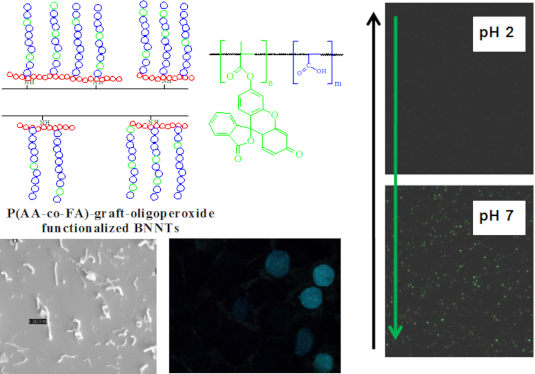
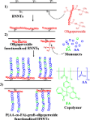
- ); characteristic infrared spectra bands – ν (С=О) in Ar-C(O)Cl, ν (С=О) in ester group at 1760 and 1752 cm−1; doublet at 1390, 1365 cm−1, referred to δ(C(CH3)3) and a band of tert-butoxy group at 848 cm−1. BNNT synthesis and purification The BNNTs were synthesized by chemical vapor deposition from colemanite (2 g



Integration of sharp silicon nitride tips into high-speed SU8 cantilevers in a batch fabrication process
Beilstein J. Nanotechnol. 2019, 10, 2357–2363, doi:10.3762/bjnano.10.226
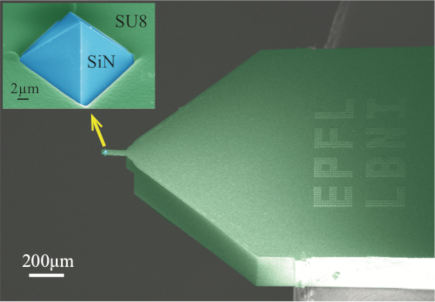
- by low-pressure chemical vapor deposition. Circular openings (20 µm diameter) are then cut into the layer by electron-beam lithography. The LSNT mask is dry-etched before the moulds are structured by anisotropic KOH (40% at 60 °C) etching. The formation of {111} facets results in four-sided pyramidal


Nitrogen-vacancy centers in diamond for nanoscale magnetic resonance imaging applications
Beilstein J. Nanotechnol. 2019, 10, 2128–2151, doi:10.3762/bjnano.10.207


Improved adsorption and degradation performance by S-doping of (001)-TiO2
Beilstein J. Nanotechnol. 2019, 10, 2116–2127, doi:10.3762/bjnano.10.206
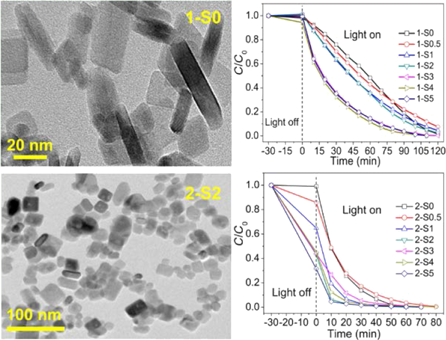
- of Physical Science and Information Technology, Anhui University, Hefei 230039, China 10.3762/bjnano.10.206 Abstract In this work, sulfur-doped (S-doped) TiO2 with the (001) face exposed was synthesized by thermal chemical vapor deposition at 180 or 250 °C using S/Ti molar ratios RS/Ti of 0, 0.5, 1
- increase in the amount of •OH and •O2− radicals. Keywords: anatase; chemical state; degradation; photocatalytic properties; S-doping; thermal chemical vapor deposition; titanium dioxide (TiO2); Introduction Anatase TiO2 with a tetragonal symmetry has widely been used for the degradation of organic
- performed by thermal chemical vapor deposition. We observed that S-doping greatly enhances the photocatalytic performance of (001)-TiO2, and we revealed the related mechanism by a systematic investigation of the material. Experimental Synthesis of nanoparticles 20 mL of tetrabutyl titanate (TBT, 99




Nanostructured and oriented metal–organic framework films enabling extreme surface wetting properties
Beilstein J. Nanotechnol. 2019, 10, 1994–2003, doi:10.3762/bjnano.10.196
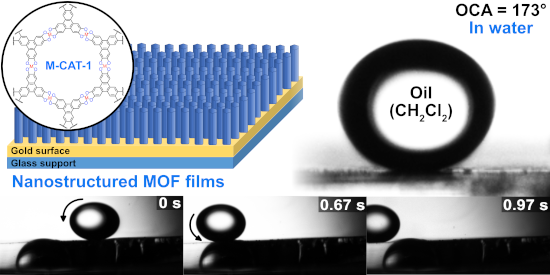
- example, sol–gel synthesis, electrochemical deposition, anodization, electrochemical polymerization, electrospinning, plasma treatment, chemical or hydrothermal methods, vapor deposition, layer-by-layer assembly or laser ablation [19][27][28][29][30][31][32][33][34][35][36][37][38][39]. However, the


Oblique angle deposition of nickel thin films by high-power impulse magnetron sputtering
Beilstein J. Nanotechnol. 2019, 10, 1914–1921, doi:10.3762/bjnano.10.186
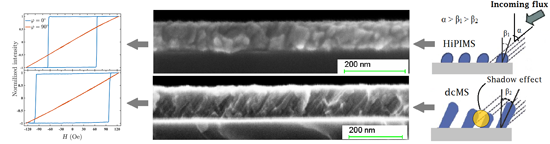
- ][21] and substrate temperature [19], as well as while stacking into superlattices [23][24]. High-power impulse magnetron sputtering (HiPIMS), sometimes referred to as high-power pulsed magnetron sputtering (HPPMS), is a physical vapor deposition (PVD) technique based on pulsed power technology where


Fabrication and characterization of Si1−xGex nanocrystals in as-grown and annealed structures: a comparative study
Beilstein J. Nanotechnol. 2019, 10, 1873–1882, doi:10.3762/bjnano.10.182
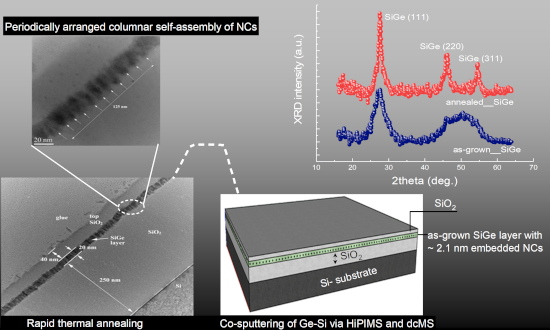
- annealing. A rather recent variation of the magnetron sputtering technique, the so-called high-power impulse magnetron sputtering (HiPIMS), provides an alternative approach. It is an ionized physical vapor deposition method and has shown great promise in thin-film processing [25][26]. During HiPIMS the


Rapid thermal annealing for high-quality ITO thin films deposited by radio-frequency magnetron sputtering
Beilstein J. Nanotechnol. 2019, 10, 1511–1522, doi:10.3762/bjnano.10.149
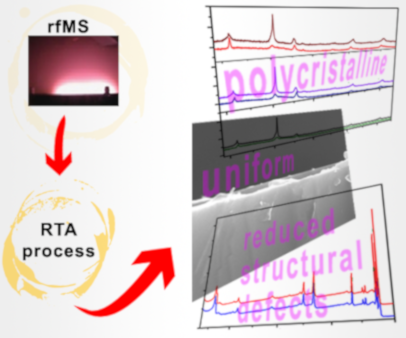
- of ITO in various applications increases when the electrical properties are improved. Various deposition techniques have been used to obtain TCO thin films, such as: vacuum thermal evaporation [15][16], chemical vapor deposition [17], sol–gel [18], pyrolysis spray techniques [5][19], magnetron


Hierarchically structured 3D carbon nanotube electrodes for electrocatalytic applications
Beilstein J. Nanotechnol. 2019, 10, 1475–1487, doi:10.3762/bjnano.10.146
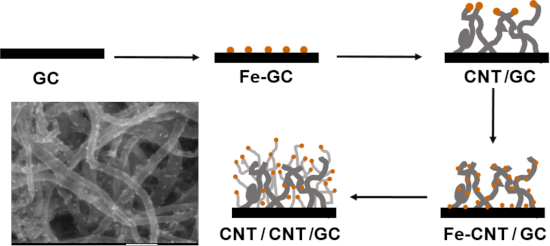
- a glassy carbon (GC) substrate in a sequence of electrodeposition and chemical vapor deposition (CVD) steps as follows: Primary CNTs are grown over electrodeposited iron by CVD followed by a second Fe deposition and finally the CVD growth of secondary CNTs. The prepared 3-dimensional CNT structures
- structures demonstrate an exceptionally high poisoning tolerance. Keywords: chemical vapor deposition; CNTs; CO stripping; hierarchically structured electrodes; methanol oxidation; platinum; poisoning tolerance; Introduction Carbon nanotubes (CNTs) have attracted considerable attention since their
- the preparation of hierarchically structured CNTs on glassy carbon (GC) based on a sequential CNT growth over electrodeposited Fe nanoparticles via chemical vapor deposition (CVD) with cyclohexane as the carbon precursor. Pt electrodeposition onto these hierarchical structures leads to active





A biomimetic nanofluidic diode based on surface-modified polymeric carbon nitride nanotubes
Beilstein J. Nanotechnol. 2019, 10, 1316–1323, doi:10.3762/bjnano.10.130
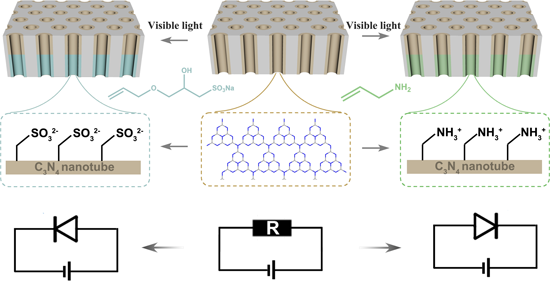
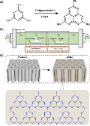
- systems and the generation of blue energy from salinity gradients [23][24]. We fabricated a carbon nitride nanotube membrane (CNNM) via an anodic aluminium oxide (AAO)-templated vapor deposition–polymerization process. Subsequently, the CNNMs were modified with 3-allyloxy-2-hydroxy-1-propanesulfonic acid
- nitrogen. Moreover, it meets our requirements to fabricate negatively charged carbon nitride nanotubes and a fully condensed conjugated structure that stabilizes the π-electron system for a high charge mobility [25]. The g-CN nanotube membrane (CNNM) was fabricated through vapor deposition–polymerization
- and the choice of grafted molecules. Conclusion We fabricated a carbon nitride nanotube membrane by simple vapor deposition–polymerization and modified it via a photo-induced functionalization process to alter the ion transport properties. The carbon nitride nanotube membrane showed ion transport that


Fabrication of phase masks from amorphous carbon thin films for electron-beam shaping
Beilstein J. Nanotechnol. 2019, 10, 1290–1302, doi:10.3762/bjnano.10.128
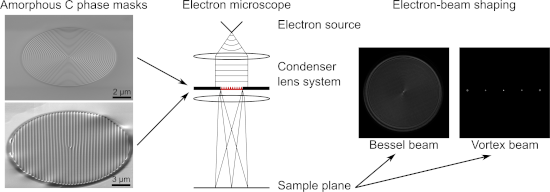
- ) were fabricated with a DWL66 laser lithography system (Heidelberg Instruments). After illumination of the unmasked regions, the resist was developed in AZ 726 MIF (Microchemicals GmbH). To deposit Cr, Pt and aC, electron-beam physical vapor deposition (PVD, PVD75 by Kurt J. Lesker Company) was used



Alloyed Pt3M (M = Co, Ni) nanoparticles supported on S- and N-doped carbon nanotubes for the oxygen reduction reaction
Beilstein J. Nanotechnol. 2019, 10, 1251–1269, doi:10.3762/bjnano.10.125
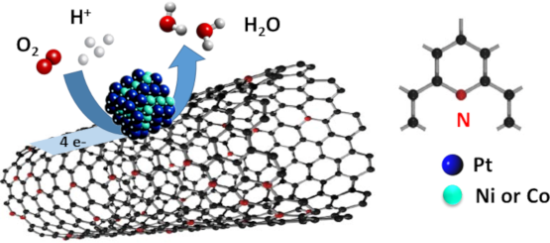
- , 31055 Toulouse Cedex 4, France 10.3762/bjnano.10.125 Abstract Sulfur- (S-CNT) and nitrogen-doped (N-CNT) carbon nanotubes have been produced by catalytic chemical vapor deposition (c-CVD) and were subject to an annealing treatment. These CNTs were used as supports for small (≈2 nm) Pt3M (M = Co or Ni
- performance has been aged following a recommended accelerated stress test (AST) cycle for catalyst support corrosion. Results and Discussion Synthesis and characterization of the CNTs and Pt3M/CNT Three kinds of CNTs have been produced by catalytic chemical vapor deposition (c-CVD): undoped (CNTs), N-doped (N







Electroluminescence and current–voltage measurements of single-(In,Ga)N/GaN-nanowire light-emitting diodes in a nanowire ensemble
Beilstein J. Nanotechnol. 2019, 10, 1177–1187, doi:10.3762/bjnano.10.117
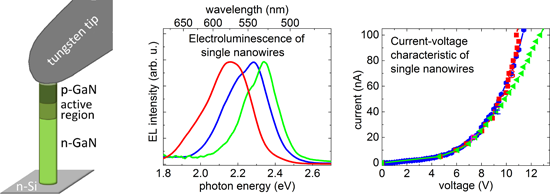
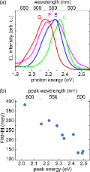
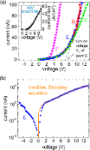
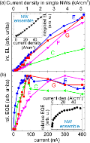
- -based core–shell NW structures grown by metalorganic chemical vapor deposition it was found that the FWHM increases with decreasing emission energy [13]. In order to better understand the charge-carrier transport in single-NW LEDs, in Figure 5a we analyze the I–V curves for the NWs C, E, and G, as well


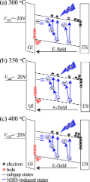
Quantitative analysis of annealing-induced instabilities of photo-leakage current and negative-bias-illumination-stress in a-InGaZnO thin-film transistors
Beilstein J. Nanotechnol. 2019, 10, 1125–1130, doi:10.3762/bjnano.10.112
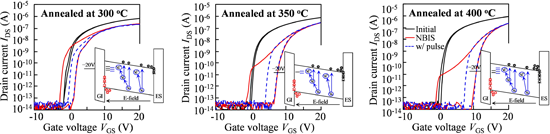
- TFT devices comprise several functional layers and their respective contact interfaces. Generally, the individual layer fabrication process follows a number of thin film deposition and photolithographic patterning steps. During the film growth through plasma-enhanced chemical vapor deposition or


Revisiting semicontinuous silver films as surface-enhanced Raman spectroscopy substrates
Beilstein J. Nanotechnol. 2019, 10, 1048–1055, doi:10.3762/bjnano.10.105
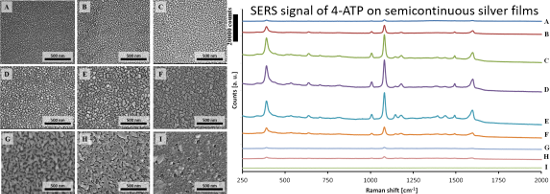
- nanostructures fabricated using physical methods, such as semicontinuous metal films obtained via electron beam physical vapor deposition. In these studies, we investigate the influence of morphology of semicontinuous silver films on their SERS properties. The morphologies studied ranged from isolated particles
- nanostructures can be a source of additional SERS signals [15], which may complicate SERS analysis with their use. Various physical methods may be used to fabricate SERS substrates. Usually in these techniques silver or gold is deposited by physical vapor deposition (PVD) techniques. Nanostructures are obtained