Search results
Search for "viruses" in Full Text gives 85 result(s) in Beilstein Journal of Nanotechnology.
Capillary and van der Waals interactions on CaF2 crystals from amplitude modulation AFM force reconstruction profiles under ambient conditions
Beilstein J. Nanotechnol. 2015, 6, 809–819, doi:10.3762/bjnano.6.84
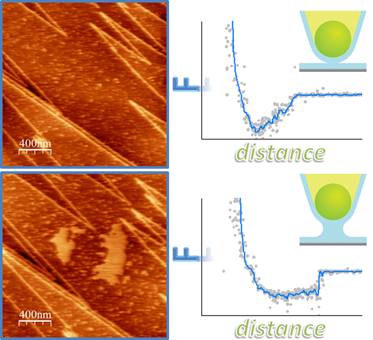
- characterize a variety of nanoscale materials, from soft biomaterials (vesicles, viruses) [16][17], to organic thin films [18][19][20][21] and self-assembled monolayers [22] in liquid and in air, especially at those short separations where breakthrough events and sample mechanical deformations occur. However


Microwave assisted synthesis and characterisation of a zinc oxide/tobacco mosaic virus hybrid material. An active hybrid semiconductor in a field-effect transistor device
Beilstein J. Nanotechnol. 2015, 6, 785–791, doi:10.3762/bjnano.6.81
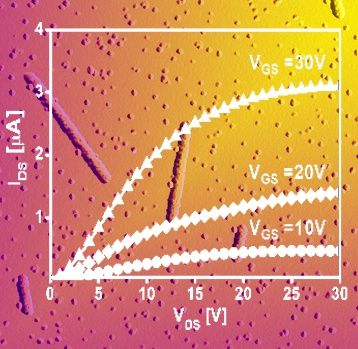
- , bacteriophages and viruses which exhibit diverse properties for the controlled formation of devices with possible application in areas such as sensors, photonics, energy storage as well as electronic transistors [4][5][6][7][8]. Fabrication of necessary functional hybrid materials often require well-defined 1D
- substrate with higher microwave power led to uncontrolled, rapid increase of the solution temperature and boiling of the solvent methanol (bp ≈ 65 °C). This led to a detachment of the viruses as no visible virus structures afterwards could be detected on the substrate surface by AFM analysis after this


Overview of nanoscale NEXAFS performed with soft X-ray microscopes
Beilstein J. Nanotechnol. 2015, 6, 595–604, doi:10.3762/bjnano.6.61
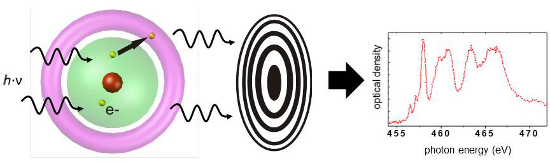
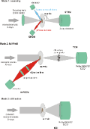
- high productive at synchrotron sources. Macromolecular crystals of proteins, viruses or nuclic acids are studied at the atomic structural level [1]. The development of drugs by understanding the interaction is greatly influenced by this technique. X-ray microscopy techniques enable the study of thick


Filling of carbon nanotubes and nanofibres
Beilstein J. Nanotechnol. 2015, 6, 508–516, doi:10.3762/bjnano.6.53
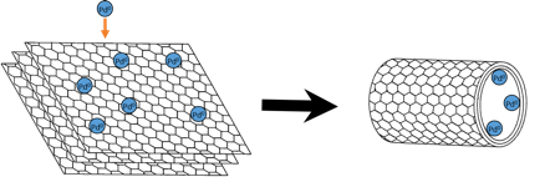
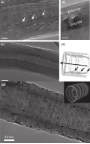
- delivery and medical imaging applications of SWCNT and MWCNTs have been identified, this line of research has only very recently emerged [117][118][119]. Further investigations into the selective binding of functional groups and various viruses or tumours could provide for an effective drug delivery system


Nanoparticle interactions with live cells: Quantitative fluorescence microscopy of nanoparticle size effects
Beilstein J. Nanotechnol. 2014, 5, 2388–2397, doi:10.3762/bjnano.5.248
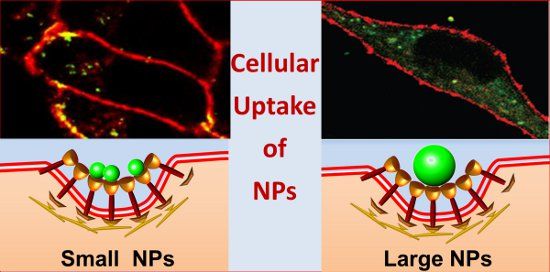
- , especially in view of possible implications regarding biosafety and biomedical applications of nanomaterials [1][2][3][4][5]. Because NPs have sizes similar to those of biological molecules and assemblies such as proteins or viruses, they are able to invade cells by hijacking the cellular endocytosis
- material, e.g., lipoprotein particles, protein assemblies, viruses and NPs, these are typically encapsulated in vesicles and selectively transported into and out of the cells via endocytosis and exocytosis, respectively [9][10]. Depending on the size of the transport vesicle, cargo properties and the


Apertureless scanning near-field optical microscopy of sparsely labeled tobacco mosaic viruses and the intermediate filament desmin
Beilstein J. Nanotechnol. 2013, 4, 510–516, doi:10.3762/bjnano.4.60
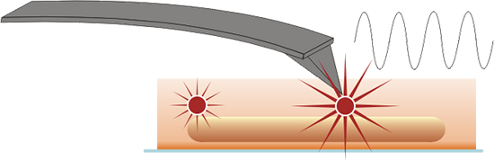
- facilitates an optical resolution down to 20 nm. Furthermore, the use of standard mass-produced AFM cantilevers spares elaborate probe production or modification processes. We investigated tobacco mosaic viruses and the intermediate filament protein desmin. Both are mixed complexes of building blocks, which
- for an adequate signal to noise ratio (SNR). Besides, fluorescence and topography data are inherently aligned allowing easy superposition and localization of single fluorescence peaks within topographic features. Many biological systems from single molecules to cells and viruses are mixed complexes


Photocatalytic antibacterial performance of TiO2 and Ag-doped TiO2 against S. aureus. P. aeruginosa and E. coli
Beilstein J. Nanotechnol. 2013, 4, 345–351, doi:10.3762/bjnano.4.40
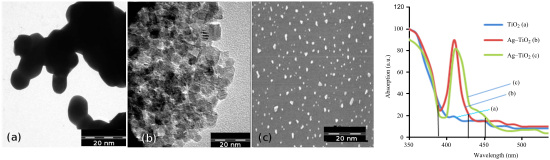
- microorganisms including bacteria, fungi and viruses, because it has high photoreactivity, broad-spectrum antibiosis and chemical stability [1][2][3][4][5][6]. The photocatalytic activity of annealed TiO2 sturdily depends upon its existing phase, i.e., anatase, rutile, brokite. The anatase phase shows an


Paper modified with ZnO nanorods – antimicrobial studies
Beilstein J. Nanotechnol. 2012, 3, 684–691, doi:10.3762/bjnano.3.78
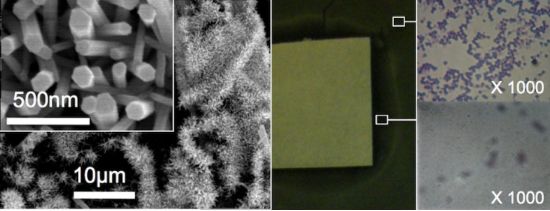
- cause of extensive damage to precious books and manuscripts [1][2]. In relation to this, documents in hospitals and research centers are carriers of infectious agents, such as disease-causing bacteria and viruses. Extreme care needs to be taken especially by people working in such organizations while


Drive-amplitude-modulation atomic force microscopy: From vacuum to liquids
Beilstein J. Nanotechnol. 2012, 3, 336–344, doi:10.3762/bjnano.3.38
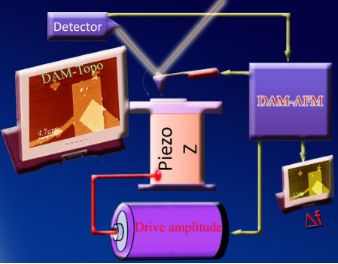
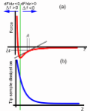
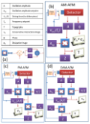
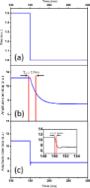
- conditions in both regimes. In liquid, the absence of significant van der Waals forces results in a monotonic interaction [4] and the feedback in both FM and AM is often perfectly stable. However biological samples, such as viruses, tend to contaminate the tip and introduce attractive interactions causing FM
- high resolution. FM is able to overcome the limitations of AM making it possible to obtain high-quality images of the viruses and other biological samples [29][30]. However, FM is only stable while the tip is clean and the conservative interaction is repulsive, but once the tip becomes contaminated
- magnitudes grow monotonically with the tip–sample distance. Figure 7b shows this dependence again with the same tip but this time contaminated after scanning a highly oriented pyrolytic graphite (HOPG) substrate with viruses adsorbed on it. While the dissipation is still monotonic, the frequency shift is not


Magnetic nanoparticles for biomedical NMR-based diagnostics
Beilstein J. Nanotechnol. 2010, 1, 142–154, doi:10.3762/bjnano.1.17
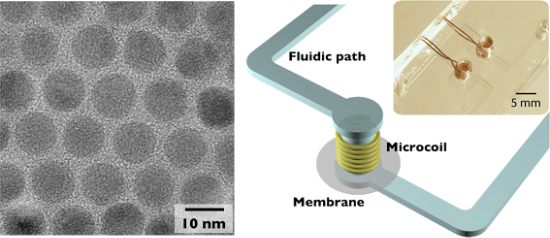
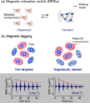
- to sensitively identify and quantify a wide range of biological targets including DNA/mRNA, proteins, enzyme activities, small molecules/drugs, bacteria, viruses and mammalian tumor cells, as summarized in Table 2. As described previously, the detection mode of DMR depends on the size of its target