


Search results
Search for "Anchoring" in Full Text gives 141 result(s) in Beilstein Journal of Nanotechnology.
Conductance through single biphenyl molecules: symmetric and asymmetric coupling to electrodes
Beilstein J. Nanotechnol. 2015, 6, 1690–1697, doi:10.3762/bjnano.6.171
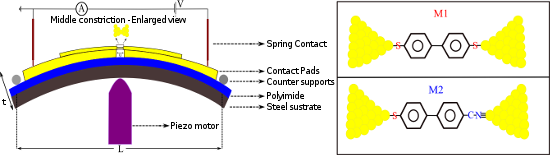
- groups like amine, nitro, nitrile, carboxy, iso cyanate, pyridine. The electron donating group leads to higher conductance while electron withdrawing groups have a smaller conductance. The Au–S thiol is a well known anchoring group due strong covalent bond coupling [15]. The iso cyano group has been


Electrical properties and mechanical stability of anchoring groups for single-molecule electronics
Beilstein J. Nanotechnol. 2015, 6, 1558–1567, doi:10.3762/bjnano.6.159
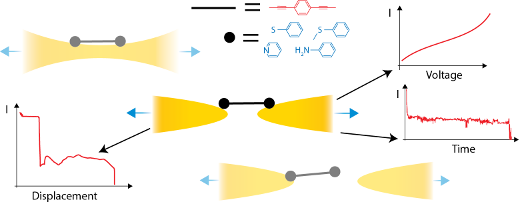
- mechanically controlled break junction (MCBJ) technique. The four molecules studied share the same core structure, namely oligo(phenylene ethynylene) (OPE3), while having different aurophilic anchoring groups: thiol (SAc), methyl sulfide (SMe), pyridyl (Py) and amine (NH2). The focus of this paper is on the
- combined characterization of the electrical and mechanical properties determined by the anchoring groups. From conductance histograms we find that thiol anchored molecules provide the highest conductance; a single-level model fit to current–voltage characteristics suggests that SAc groups exhibit a higher
- theory combined with non-equlibrium Green’s function calculations help in elucidating the experimental findings. Keywords: anchoring groups; coherent transport; current–voltage; molecular electronics; single molecule; Introduction Molecular-scale electronics is a field that in recent years experienced


Possibilities and limitations of advanced transmission electron microscopy for carbon-based nanomaterials
Beilstein J. Nanotechnol. 2015, 6, 1541–1557, doi:10.3762/bjnano.6.158
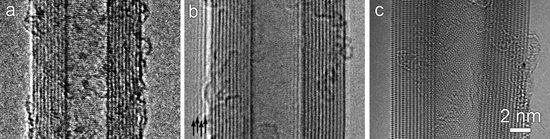
- electrons, and therefore provide the anchoring points with a certain degree of flexibility allowing for the movement of the Ru4POM molecules. Additionally, a continuous deformation of the molecular structure is noticed throughout the imaging. A typical example is demonstrated in Figure 8c–i. The acquired


Enhanced fullerene–Au(111) coupling in (2√3 × 2√3)R30° superstructures with intermolecular interactions
Beilstein J. Nanotechnol. 2015, 6, 1421–1431, doi:10.3762/bjnano.6.147
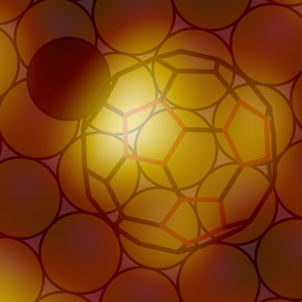
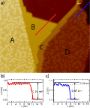
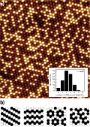
- extensively studied self-assembled systems due to their rich structural and electronic properties [1]. A considerable interest in C60 films arises from their use in photovoltaic cells [2][3] and potential applications in molecular electronics [4]. Likewise, C60 molecules can be used as chemical anchoring


Heterometal nanoparticles from Ru-based molecular clusters covalently anchored onto functionalized carbon nanotubes and nanofibers
Beilstein J. Nanotechnol. 2015, 6, 1287–1297, doi:10.3762/bjnano.6.133
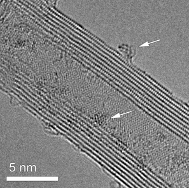
- Scienze 17/A, 43124 Parma, Italy 10.3762/bjnano.6.133 Abstract Heterometal clusters containing Ru and Au, Co and/or Pt are anchored onto carbon nanotubes and nanofibers functionalized with chelating phosphine groups. The cluster anchoring yield is related to the amount of phosphine groups available on
- nanocarbon surface. In the case of Ru–Pt species, anchoring occurs without reorganization through a ligand exchange mechanism. After thermal treatment, ultrasmall (1–3 nm) bimetal Ru–Pt nanoparticles are formed on the surface of the nanocarbons. Characterization by high resolution transmission electron
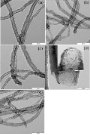
- the presence of additives, binders, etc. Results and Discussion Cluster anchoring Phosphine-functionalized carbon nanofibers and nanotubes were prepared in several steps, as previously reported [38] and shown in Figure 1. We have also successfully applied this methodology to ordered mesoporous carbon




Electrical characterization of single molecule and Langmuir–Blodgett monomolecular films of a pyridine-terminated oligo(phenylene-ethynylene) derivative
Beilstein J. Nanotechnol. 2015, 6, 1145–1157, doi:10.3762/bjnano.6.116
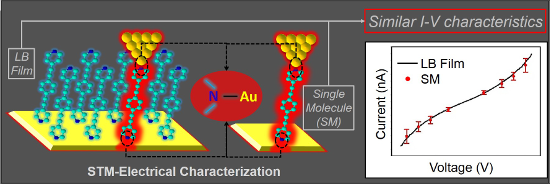
- molecules within the LB film do not strongly influence the molecule conductance. The results presented here complement earlier studies of single molecule conductance of 1 using STM-BJ methods, and support the growing evidence that the pyridyl group is an efficient and effective anchoring group in sandwiched
- molecular electronics have focused attention on this potential linker group as an alternative to solve these problems [87]. Previous studies of pyridyl-functionalized molecules in single molecule conductance studies [19][21][88][89][90][91] have revealed that this moiety can work as an anchoring group
- other LB films), the conductance value for compound 1 is 3–20 times greater than for LB films of other oligo(phenylene-ethynylene) (OPE) derivatives bearing anchoring groups such as thiol (–SH), amine (–NH2), carboxylate (–COO−), trimethylsilylethynyl (–C≡CSiMe3) or acetylide (–C≡C) [23][24][30][45


Self-assembled anchor layers/polysaccharide coatings on titanium surfaces: a study of functionalization and stability
Beilstein J. Nanotechnol. 2015, 6, 617–631, doi:10.3762/bjnano.6.63
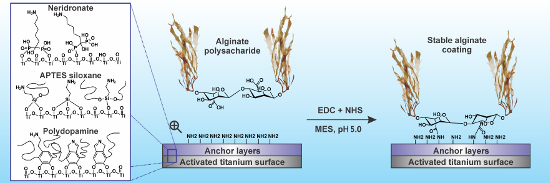
- anchoring layers of self-assembled bisphosphonate neridronate monolayers and polymer films of 3-aminopropyltriethoxysilane and biomimetic poly(dopamine). These were further used to bind a bio-functional alginate coating. The success of the titanium surface activation, anchoring layer formation and alginate
- contribution is to perform and precisely characterize the activation of commercially pure titanium substrates for the realization of reactive titanium surfaces without contaminants. Such activated surfaces can be further functionalized by the covalent immobilization of self-assembled anchoring layers of
- different organic compounds, providing functional groups for further modification. Covalent bonding, which provides a stable fixation of immobilized compounds, is an alternative approach to coatings based on adsorption processes. The most common strategies for the formation of anchoring layers are thiol


Palladium nanoparticles anchored to anatase TiO2 for enhanced surface plasmon resonance-stimulated, visible-light-driven photocatalytic activity
Beilstein J. Nanotechnol. 2015, 6, 428–437, doi:10.3762/bjnano.6.43
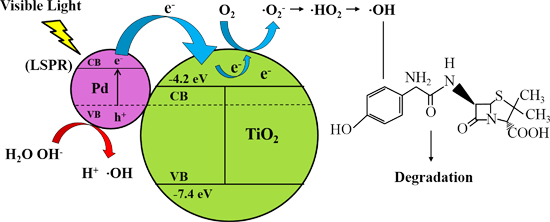
- the TiO2 surface and promotes the application of a non-conventional energy resource. In the present study, a smart, easy and sustainable method for anchoring noble metal onto the surface of TiO2 is reported. Palladium was chosen as the noble metal for the study due to its high reactivity and
- anchoring of Pd NPs onto the surface of TiO2, and the large size of the Pd NPs contributed to the visible-light absorption. Localized surface plasmon resonance (LSPR) and the formation of a Schottky barrier at the TiO2 interface also occured. The prepared heterogeneous photocatalysts exhibited superior


Influence of spurious resonances on the interaction force in dynamic AFM
Beilstein J. Nanotechnol. 2015, 6, 420–427, doi:10.3762/bjnano.6.42
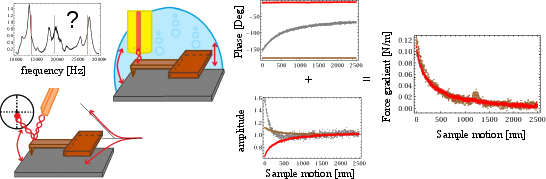
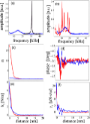
- added to the measured signal. Considering Equation 4 and recomputing both and , the position of the moving mass, given by its deflection plus the motion of the base, is , where Am is the amplitude of the measured signal and Ab the oscillation amplitude of the cantilever anchoring point. To simplify, as


Electrical response of liquid crystal cells doped with multi-walled carbon nanotubes
Beilstein J. Nanotechnol. 2015, 6, 396–403, doi:10.3762/bjnano.6.39
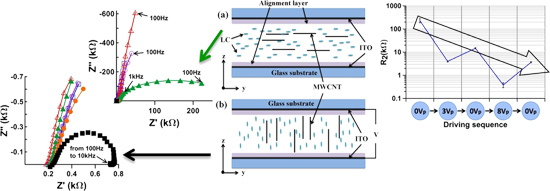
- minimize the energy derived from the electric field and the anchoring elastic forces [13]. These LC properties may be used to induce alignment and reorientation on dispersed CNTs. Using this effect, several photonic and electronic devices have been proposed [5] including electrically controlled switches
- isotropic transition [14]. The authors explain these results by assuming a strong anchoring between the LC molecules and the CNTs. This anchoring keeps the former arranged in pseudo-nematic oriented domains around the latter above the isotropic point. Confirmation of this phenomenon and other features of


Mammalian cell growth on gold nanoparticle-decorated substrates is influenced by the nanoparticle coating
Beilstein J. Nanotechnol. 2014, 5, 2479–2488, doi:10.3762/bjnano.5.257
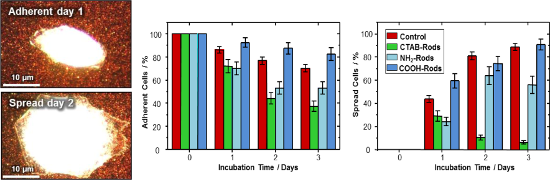
- filamentous residue remains (Figure 1D). However, this residue emerges in control samples without nanoparticle patterning as well (Supporting Information File 1, Figure S1) and corresponds to retracting filopodia [25]. Therefore, no specific anchoring of the membrane to the nanoparticles seems to be necessary
- average, negatively charged. Electrostatic interaction with negatively charged COOH–PEG nanorods should therefore be repulsive, comparable to the bare glass substrates. In contrast, amines are known to interact with the negatively charged cell membrane. It is therefore likely that an anchoring of the


Synthesis and characterization of fluorescence-labelled silica core-shell and noble metal-decorated ceria nanoparticles
Beilstein J. Nanotechnol. 2014, 5, 2413–2423, doi:10.3762/bjnano.5.251
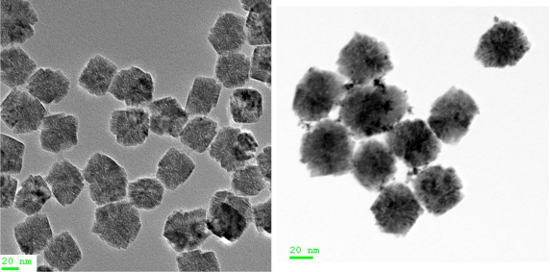
- error in this estimate is probably due to changes in the molar extinction coefficient upon anchoring at the surface (Figure 3 (left) shows two maxima with different absorbance where free MPD has the same). Since the surface coverage is low, we expected that the labelling would not interfere with


Influence of the supramolecular architecture on the magnetic properties of a DyIII single-molecule magnet: an ab initio investigation
Beilstein J. Nanotechnol. 2014, 5, 2267–2274, doi:10.3762/bjnano.5.236
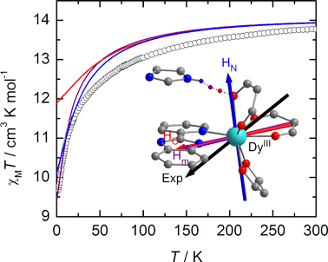
- “averaged” position of the H atom along the N–H…O bond has to be considered. Conclusion The understanding of the subtle mechanisms at the origin of the magnetic properties of molecular materials is a prerequisite before anchoring/grafting these molecular architectures onto surfaces, nanoparticles or


In situ metalation of free base phthalocyanine covalently bonded to silicon surfaces
Beilstein J. Nanotechnol. 2014, 5, 2222–2229, doi:10.3762/bjnano.5.231
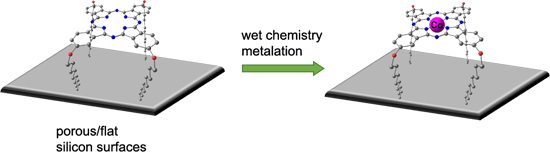
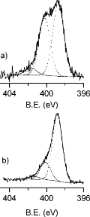
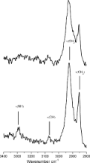
- 17/A, 43124 Parma, Italy 10.3762/bjnano.5.231 Abstract Free 4-undecenoxyphthalocyanine molecules were covalently bonded to Si(100) and porous silicon through thermic hydrosilylation of the terminal double bonds of the undecenyl chains. The success of the anchoring strategy on both surfaces was
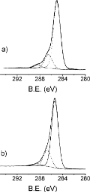
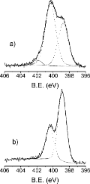
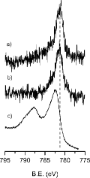
- demonstrated by the combination of X-ray photoelectron spectroscopy with control experiments performed adopting the commercially available 2,3,9,10,16,17,23,24-octakis(octyloxy)-29H,31H-phthalocyanine, which is not suited for silicon anchoring. Moreover, the study of the shape of the XPS N 1s band gave
- synthesized to allow for a silicon grafting by functionalization with four undecenyl chains each having a terminal double bond. Phthalocyanine covalent anchoring was performed through thermic hydrosilylation on flat Si(100) and on porous silicon (Si-1-Pc and PSi-1-Pc, respectively). The success of the

Towards bottom-up nanopatterning of Prussian blue analogues
Beilstein J. Nanotechnol. 2014, 5, 1933–1943, doi:10.3762/bjnano.5.204
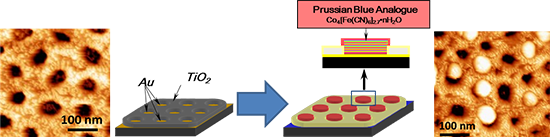
- 2 h. Then, an anchoring layer for PBA was grafted onto the gold bottom of the nanoperforations by dipping the substrate in an ethanolic solution of mercaptohexanoic acid (3·10−3 M), 4-mercaptopyridine (3·10−3 M) or 4-aminothiophenol (3·10−3 M) for 12 h. Mercaptohexanoic acid, 4-mercaptopyridine or 4
- adsorption of PBA precursors. The phosphonate function allows for the selective grafting of the phenyl group on TiO2 [20][21]. Then, MHA, 4-MPy or 4-ATP are used as coupling agents for anchoring a first layer of Co2+ ions at the bottom of the nanoperforations. To evaluate the efficiency of the TiO2
- the nanoperforations are hardly visible. Without hydrophobization of TiO2, PBA precursors interact with the accessible oxide surface leading to the formation of PBA particles everywhere. In order to verify the effectiveness of the gold functionalization through the MHA anchoring function at the bottom


The influence of molecular mobility on the properties of networks of gold nanoparticles and organic ligands
Beilstein J. Nanotechnol. 2014, 5, 1664–1674, doi:10.3762/bjnano.5.177
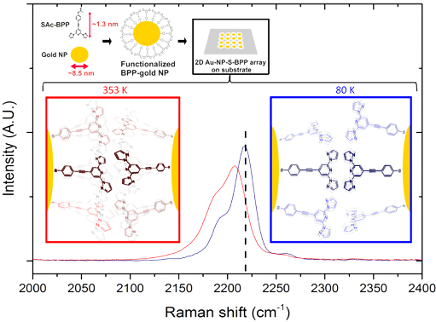
- with acetyl-protected thiol anchoring groups facilitates the contact to noble and coinage metal electrodes [18]. In this study, we report on the fabrication of 2D single-layer ligand–gold nanoparticle arrays (and multilayer ligand–gold nanoparticle networks) formed by gold nanoparticles covered by




Donor–acceptor graphene-based hybrid materials facilitating photo-induced electron-transfer reactions
Beilstein J. Nanotechnol. 2014, 5, 1580–1589, doi:10.3762/bjnano.5.170
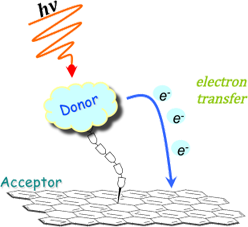
- electronic properties of graphene are of primary importance. Alternatively, wet exfoliation of graphite followed by functionalization is a more efficient strategy. Although functionalization of exfoliated graphene can be achieved by either covalent anchoring of organic molecules onto the graphene lattice [13


Model systems for studying cell adhesion and biomimetic actin networks
Beilstein J. Nanotechnol. 2014, 5, 1193–1202, doi:10.3762/bjnano.5.131
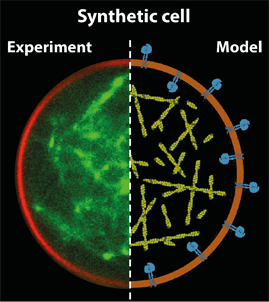
- cluster and recruit the cytoplasmic protein focal adhesion kinase (FAK), which generates stable anchoring cell–matrix junctions, the focal adhesions. These adhesion sites are crucial for the cytoskeleton, environmental sensing and cellular motility [6][21][22]. Besides talin, several other proteins


Enhanced photocatalytic hydrogen evolution by combining water soluble graphene with cobalt salts
Beilstein J. Nanotechnol. 2014, 5, 1167–1174, doi:10.3762/bjnano.5.128
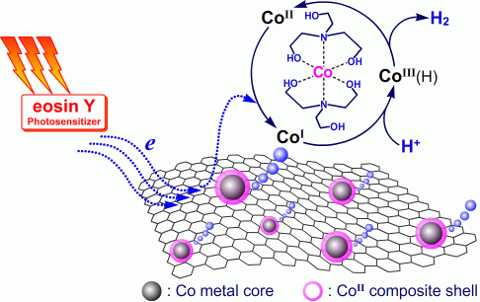
- form metallic cobalt. The obtained metallic cobalt may function as nucleation center anchoring other cobalt-catalysts. Conclusion In summary, we introduce a new water-soluble graphene-cobalt-based hydrogen evolution system. With TEOA as the electron donor, EY as the photosensitizer, Co(TEOA)22+ formed


Template-directed synthesis and characterization of microstructured ceramic Ce/ZrO2@SiO2 composite tubes
Beilstein J. Nanotechnol. 2014, 5, 1152–1159, doi:10.3762/bjnano.5.126
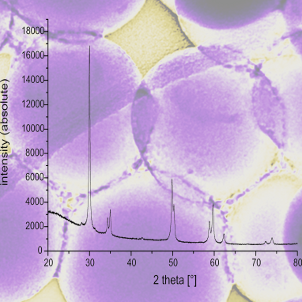
- particles on the PS fiber surface, the as-obtained PS fibers were surface-functionalized in a reactive oxygen plasma atmosphere (rf plasma, 60 W, 20% O2) prior to the addition and anchoring of the silica particles to these surface-functionalized groups. This ensures a dense and covalent linking of the
- almost preferential deposition of the ceria and zirconia sol solutions on the plasma-functionalized silica tubes during the spray-coating process. This is a viable indication for the successful gas phase plasma functionalization of the surface of the SiO2, which facilitates a very effective anchoring of



DFT study of binding and electron transfer from colorless aromatic pollutants to a TiO2 nanocluster: Application to photocatalytic degradation under visible light irradiation
Beilstein J. Nanotechnol. 2014, 5, 1016–1030, doi:10.3762/bjnano.5.115
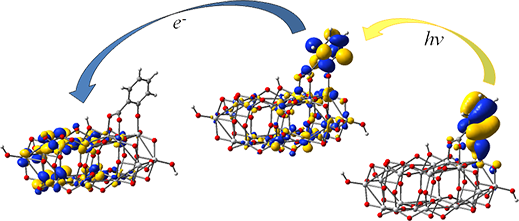
- efficient photocatalytic degradation of pollutants under visible light irradiation has to meet similar requirements to the ones of the dyes in Grätzel cells. In particular, the anchoring mode of the pollutant to the TiO2 surface influences the electron transfer [17]. The most commonly used anchoring group
- is the carboxylic acid group (–COOH) [16]. It ensures strong binding of the dye on the surface and promotes the charge transfer. The anchoring of the salicylate group on TiO2 has also been studied [18][19]. At the surface, both substituent groups of a benzene derivative are involved in the
- ]. Theoretically, density functional theory (DFT) calculations showed [21][22][23] that the binding of the carboxy group to titania is bidentate bridging, with the monodentate anchoring being less stable [24][25][26][27]. The higher performance of the dyes with both carboxy and hydroxy anchoring groups [28] has




Injection of ligand-free gold and silver nanoparticles into murine embryos does not impact pre-implantation development
Beilstein J. Nanotechnol. 2014, 5, 677–688, doi:10.3762/bjnano.5.80
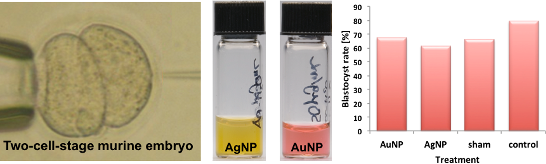
- nanoparticle production – in particular the use of surfactants or stabilizers which may adsorb to the nanoparticle surface – a comparison is difficult and resilient conclusions remain elusive. In this context, it has been recently reported that the ligand type and its anchoring on the nanoparticle surface




Surface assembly and nanofabrication of 1,1,1-tris(mercaptomethyl)heptadecane on Au(111) studied with time-lapse atomic force microscopy
Beilstein J. Nanotechnol. 2014, 5, 26–35, doi:10.3762/bjnano.5.3
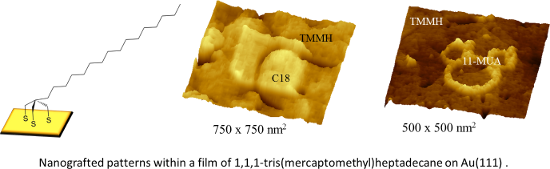
- molecule and the surface [2][23]. Several new classes of multidentate alkanethiols have been synthesized that have two or three legs and a binding moiety at each end of the legs [3][4][5][6][23]. By appropriate design of the anchoring point, multidentate alkanethiols can be engineered to bind to multiple


Kelvin probe force microscopy of nanocrystalline TiO2 photoelectrodes
Beilstein J. Nanotechnol. 2013, 4, 418–428, doi:10.3762/bjnano.4.49
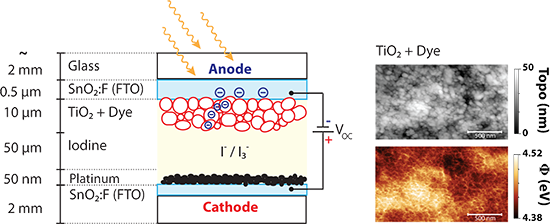
- surface dipole is the result of a combined effect of both anchoring domain and dye molecule. The effective electron affinity, χ*, is affected by the surface dipole formed by adsorbed dye molecules [59]. The detailed anchoring mechanism for the N719 dye on TiO2 is still under debate. It is widely accepted
- standard dye N719. The nc-TiO2 was sensitized with the heteroleptic copper(I) dye shown in Figure 3 by using the procedure previously described, which involves an in situ assembly of the dye starting with the adsorbed anchoring ligand and the hexafluoridophosphate salt of the homoleptic complex [Cu(6-(2


Selective surface modification of lithographic silicon oxide nanostructures by organofunctional silanes
Beilstein J. Nanotechnol. 2013, 4, 218–226, doi:10.3762/bjnano.4.22
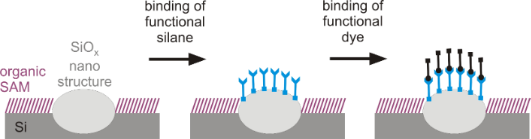
- covalent binding to nanolithographic silicon oxide structures. A direct binding of the functional material to the oxide nanostructure is possible if the material possesses an appropriate anchoring group that binds selectively to silicon oxide surfaces. A standard substance for chemical modification of


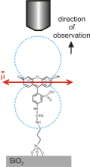
![[Graphic 2]](/bjnano/content/inline/2190-4286-4-22-i2.png?max-width=637&scale=1.18182) (red arrow) of FITC bound to a SiO2 surface.
(red arrow) of FITC bound to a SiO2 surface.



