


Search results
Search for "CdS" in Full Text gives 113 result(s) in Beilstein Journal of Nanotechnology.
Applicability and costs of nanofiltration in combination with photocatalysis for the treatment of dye house effluents
Beilstein J. Nanotechnol. 2014, 5, 476–484, doi:10.3762/bjnano.5.55
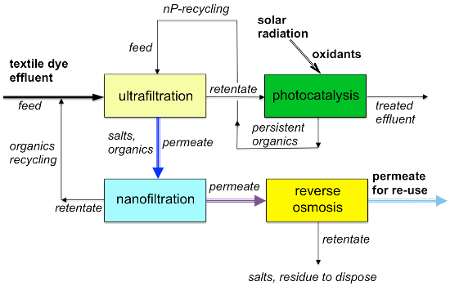
- generated by UV irradiation of photocatalysts in the reaction system. Commonly applied photocatalysts include TiO2, ZnO, Fe2O3, CdS, GaP and ZnS. Among these, titanium dioxide (TiO2) has attracted great interest in research and development because of its mechanical properties, chemical and thermal stability


Photoactivation of luminescence in CdS nanocrystals
Beilstein J. Nanotechnol. 2014, 5, 355–359, doi:10.3762/bjnano.5.40
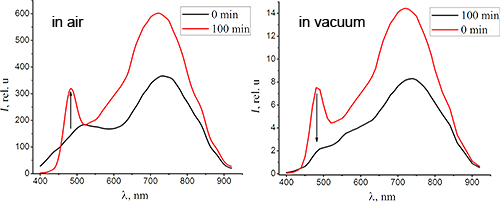
- the surface of NC. The observed effect is explained by the recombination mechanism that is responsible for the short-wavelength emission band. Keywords: cadmium sulfide (CdS); luminescence; nanoparticles; short-wavelength emission band; surface modification; Introduction Semiconductor nanocrystals
- gelatinous polymer matrix, and the processes that occur at the interface boundary during irradiation of the nanocrystals in air and in vacuum. We also study the behavior of the entire spectrum of luminescence nanocrystals, including the long-wavelength band associated with defects. Experimental The CdS
- measured by a differential copper–constantan thermocouple. Results and Discussion The optical absorption spectrum of the investigated NC is shown in Figure 1. The long-wavelength absorption edge that corresponds to the first optical transition in CdS NC is shifted relative to the energy band gap of the


Study of mesoporous CdS-quantum-dot-sensitized TiO2 films by using X-ray photoelectron spectroscopy and AFM
Beilstein J. Nanotechnol. 2014, 5, 68–76, doi:10.3762/bjnano.5.6
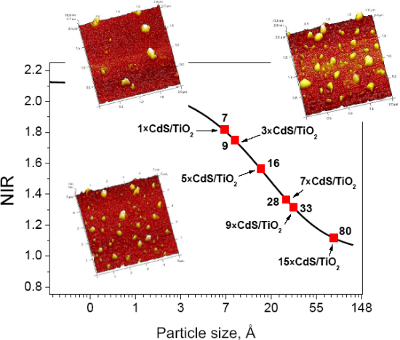
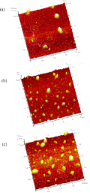
- Bruxelles 61 - 5000 Namur, Belgique Institute of Chemistry, University of Sao Paulo, USP, São Paulo, 05508-000, SP, Brazil 10.3762/bjnano.5.6 Abstract CdS quantum dots were grown on mesoporous TiO2 films by successive ionic layer adsorption and reaction processes in order to obtain CdS particles of various
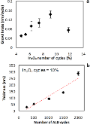
- sizes. AFM analysis shows that the growth of the CdS particles is a two-step process. The first step is the formation of new crystallites at each deposition cycle. In the next step the pre-deposited crystallites grow to form larger aggregates. Special attention is paid to the estimation of the CdS
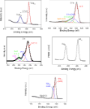
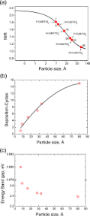
- the CdS nanoparticles as obtained by UV–vis spectroscopy. The results showed that XPS technique is a powerful tool in the estimation of the CdS particle size. In conjunction with these results, a very good correlation has been found between the number of deposition cycles and the particle size


Preparation of NiS/ZnIn2S4 as a superior photocatalyst for hydrogen evolution under visible light irradiation
Beilstein J. Nanotechnol. 2013, 4, 949–955, doi:10.3762/bjnano.4.107
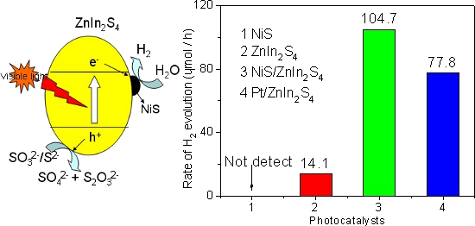
- be used as co-catalyst to enhance the photocatalytic hydrogen evolution over CdS [39]. It was found that NiS/CdS photocatalysts prepared via a simple hydrothermal loading method showed high photocatalytic activity for hydrogen evolution in the presence of lactic acid as sacrificial agent and a high


Template based precursor route for the synthesis of CuInSe2 nanorod arrays for potential solar cell applications
Beilstein J. Nanotechnol. 2013, 4, 868–874, doi:10.3762/bjnano.4.98
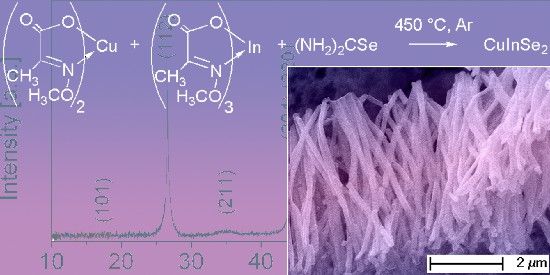
- VLS synthesis of CuInSe2 nanowires (by Cu impregnation of In2Se3 nanowires) and the construction of a single-nanowire CIS/CdS core–shell device [4]. However, the authors estimated the efficiency of their solar cell to be below 1%, and the construction of a larger scale device with this approach still


Synthesis of indium oxi-sulfide films by atomic layer deposition: The essential role of plasma enhancement
Beilstein J. Nanotechnol. 2013, 4, 750–757, doi:10.3762/bjnano.4.85
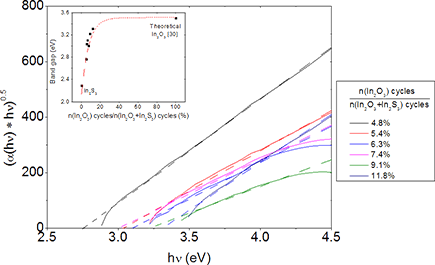
- substrates in 2013. The best efficiencies were obtained by using cadmium sulfide (CdS) as buffer layer in solar cells with a glass/Mo/CIGS/CdS/i-ZnO/ZnO:Al stack. The buffer layer is an n-type semiconductor that forms the p–n junction with the p-type CIGS absorber, and also modifies the CIGS surface
- chemistry, which is usually too sensitive for a direct deposition of the window layers. However, because of the toxicity of cadmium and the low optical band gap of CdS (2.4 eV [3]) that limits the light conversion of CIGS in the UV range of the solar spectrum, alternative materials have been developed. Most



Photoelectrochemical and Raman characterization of In2O3 mesoporous films sensitized by CdS nanoparticles
Beilstein J. Nanotechnol. 2013, 4, 255–261, doi:10.3762/bjnano.4.27
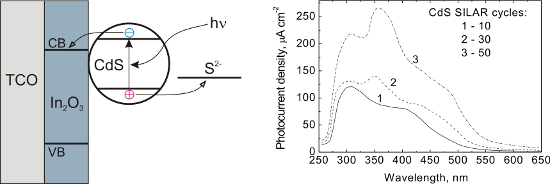
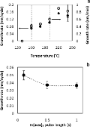
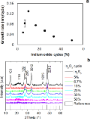
- , Minsk 220072, Belarus 10.3762/bjnano.4.27 Abstract The method of successive ion layer adsorption and reaction was applied for the deposition of CdS nanoparticles onto a mesoporous In2O3 substrate. The filling of the nanopores in In2O3 films with CdS particles mainly occurs during the first 30 cycles of
- the SILAR deposition. The surface modification of In2O3 with CdS nanoparticles leads to the spectral sensitization of photoelectrochemical processes that manifests itself in a red shift of the long-wavelength edge in the photocurrent spectrum by 100–150 nm. Quantum-confinement effects lead to an
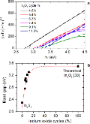
- increase of the bandgap from 2.49 to 2.68 eV when decreasing the number of SILAR cycles from 30 to 10. The spectral shift and the widening of the Raman line belonging to CdS evidences the lattice stress on the CdS/In2O3 interfaces and confirms the formation of a close contact between the nanoparticles


Characterization and properties of micro- and nanowires of controlled size, composition, and geometry fabricated by electrodeposition and ion-track technology
Beilstein J. Nanotechnol. 2012, 3, 860–883, doi:10.3762/bjnano.3.97
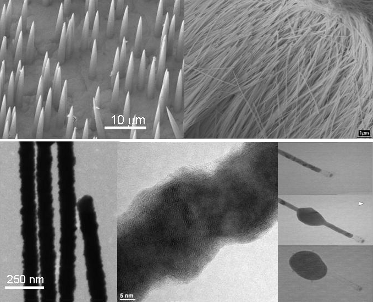
- containing Zn(NO3), Co(NO3), nitric acid, and polyvinylpyrrolidone (PVP) as an additive, 300 nm diameter Zn1−xCoxO nanowires with x ranging from 0.01 to 0.05 were grown [94]. The synthesis and properties of semiconducting CdTe and CdS nanowires are being investigated for their potential in photodetector and
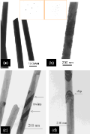
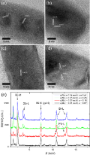
- photovoltaic applications. CdTe and CdS rods are mostly synthesized by chemical vapour deposition, and sol–gel processes. Electrodeposition of stoichiometric CdTe nanowires with diameters between 80 nm and 1 μm was reported by Enculescu et al. [95]. In addition to SEM, TEM, EDX, and XRD characterization, they
- . Polyvinylpyrrolidone (1 g/L) was added as a wetting agent. A Pt foil and a SCE acted as counter and reference electrode, respectively. The potentiostatic electrodeposition of CdS nanowires by using an electrolyte solution containing CdCl2 and thioacetamide, at 70 °C was reported by Mo et al. [99]. Finally, due to its








Junction formation of Cu3BiS3 investigated by Kelvin probe force microscopy and surface photovoltage measurements
Beilstein J. Nanotechnol. 2012, 3, 277–284, doi:10.3762/bjnano.3.31
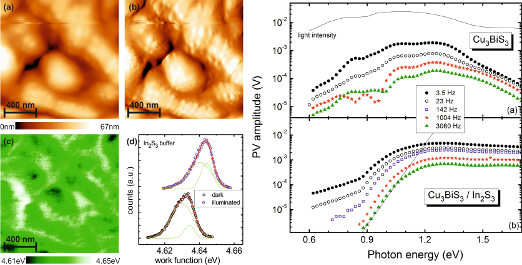
- to be developed. We present an investigation of the Cu3BiS3 absorber layer and the junction formation with CdS, ZnS and In2S3 buffer layers. Kelvin probe force microscopy shows the granular structure of the buffer layers with small grains of 20–100 nm, and a considerably smaller work-function
- distribution for In2S3 compared to that of CdS and ZnS. For In2S3 and CdS buffer layers the KPFM experiments indicate negatively charged Cu3BiS3 grain boundaries resulting from the deposition of the buffer layer. Macroscopic measurements of the surface photovoltage at variable excitation wavelength indicate
- photovoltaic active interface with a SPV of ~130 mV [7]. It is well known from the Cu(In,Ga)Se2 solar cells that a buffer layer is required between the n-ZnO window and the p-type absorber layer to reach high efficiency values [8]. Traditionally, CdS deposited by chemical bath deposition (CBD) has been used as


Self-assembled monolayers and titanium dioxide: From surface patterning to potential applications
Beilstein J. Nanotechnol. 2011, 2, 845–861, doi:10.3762/bjnano.2.94



Extended X-ray absorption fine structure of bimetallic nanoparticles
Beilstein J. Nanotechnol. 2011, 2, 237–251, doi:10.3762/bjnano.2.28
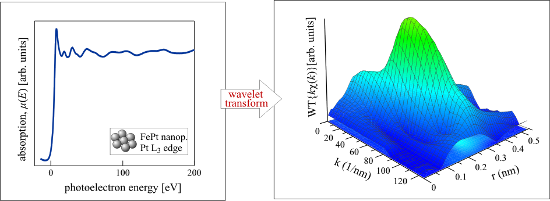
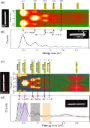
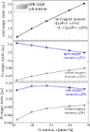
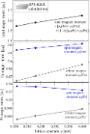
- several examples can be found for EXAFS analysis on nanoparticle systems, e.g., Co [8], CdS [9], CdSe [10], SnO2 [11] and Au [12] nanoparticles, as well as Ag nanoparticles embedded in glass [13][14]. To discuss the advantages and possible drawbacks of EXAFS analysis in nanoparticulate systems, this paper



Schottky junction/ohmic contact behavior of a nanoporous TiO2 thin film photoanode in contact with redox electrolyte solutions
Beilstein J. Nanotechnol. 2011, 2, 127–134, doi:10.3762/bjnano.2.15
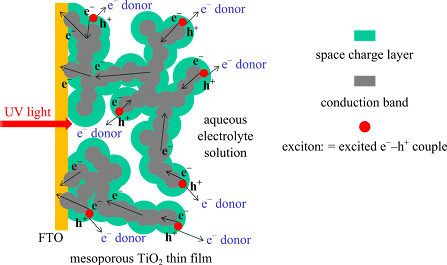
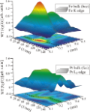
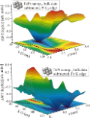
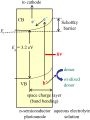
- second band structure whose Efb lies near the redox potential of the iron complex on the TiO2 surface. The photocurrents increased with repeated scans. In a previous paper [14] by one of the present authors (MK), both Schottky junction and ohmic contact behavior were found at a single crystal CdS
- photoanode with RuO2 fine powder attached to the surface and coated with a thin film of polymer-pendant Ru(bpy)32+ on top of the RuO2. It was clear that the CdS formed a Schottky junction with the redox electrolyte solution, and in addition, the RuO2 formed an ohmic contact with the CdS, and the coated




Fabrication and spectroscopic studies on highly luminescent CdSe/CdS nanorod polymer composites
Beilstein J. Nanotechnol. 2010, 1, 94–100, doi:10.3762/bjnano.1.11
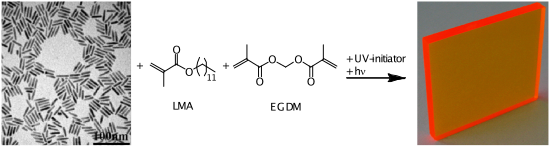
- Society, Copernicus Institute of Sustainable Development and Innovation, Utrecht University, Heidelberglaan 2, 3584 CS Utrecht, the Netherlands 10.3762/bjnano.1.11 Abstract Highly luminescent nanocomposites were prepared by incorporating CdSe/CdS core/shell nanorods into different polymer matrices. The
- thermal stability. It can be obtained from renewable resources such as wood or cotton. Moreover, it has already been found to be a suitable matrix for embedding CdSe/ZnS QDs [11][12][13]. The structure of CTA is shown in Figure 1. We used CdSe/CdS nanorods with two different sizes, longer rods with an
- within these agglomerates is ~2 nm. Conclusion We have prepared highly transparent (>93%) luminescent (QE = 70%) nanocomposites from CdSe/CdS core/shell nanorods in PLMA plates and CTA thin layers. A high QE is observed at low nanorod concentrations (0.008 wt %) in PLMA, corresponding to a concentration





