


Search results
Search for "Fe2O3" in Full Text gives 115 result(s) in Beilstein Journal of Nanotechnology.
Effects of the preparation method on the structure and the visible-light photocatalytic activity of Ag2CrO4
Beilstein J. Nanotechnol. 2014, 5, 658–666, doi:10.3762/bjnano.5.77
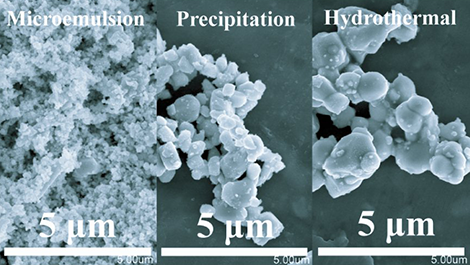
- solar light. Therefore, the development of visible-light-driven photocatalysts has received considerable attention as visible light (400–800 nm) is abundant in the solar spectrum [12][13][14][15][16]. Some semiconductors such as BiVO4 [17][18][19], Bi2O3 [20][21], Fe2O3 [22][23][24][25], and Cu2O [26


Applicability and costs of nanofiltration in combination with photocatalysis for the treatment of dye house effluents
Beilstein J. Nanotechnol. 2014, 5, 476–484, doi:10.3762/bjnano.5.55
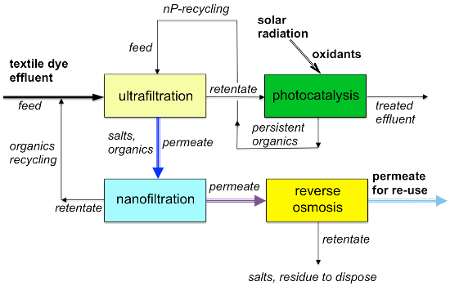
- generated by UV irradiation of photocatalysts in the reaction system. Commonly applied photocatalysts include TiO2, ZnO, Fe2O3, CdS, GaP and ZnS. Among these, titanium dioxide (TiO2) has attracted great interest in research and development because of its mechanical properties, chemical and thermal stability


Thermal stability and reduction of iron oxide nanowires at moderate temperatures
Beilstein J. Nanotechnol. 2014, 5, 323–328, doi:10.3762/bjnano.5.36
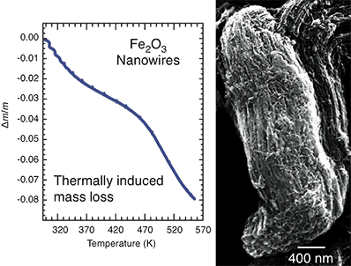
- , infrared and photoemission spectroscopy measurements. Results: The chemical state of the nanowires is typical of the Fe2O3 phase and the stoichiometry changes towards a Fe3O4 phase by annealing above 440 K. The shape and morphology of the nanowires is not modified by moderate thermal treatment, as imaged
- by scanning electron microscopy. Conclusion: This complementary spectroscopy–microscopy study allows to assess the temperature limits of these Fe2O3 nanowires during operation, malfunctioning or abuse in advanced Li-ion based batteries. Keywords: IR spectroscopy; iron oxide; nanowires; scanning
- ][20][21][22][23][24]. Within this context, iron oxide systems are convenient materials because of their low cost and environmental sustainability. One of the important issues in Li-ion batteries is the chemical and thermal stability of the components. Fe2O3 presents a definite chemical phase (Fe3


En route to controlled catalytic CVD synthesis of densely packed and vertically aligned nitrogen-doped carbon nanotube arrays
Beilstein J. Nanotechnol. 2014, 5, 219–233, doi:10.3762/bjnano.5.24
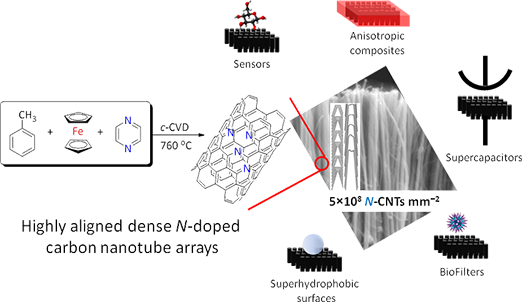
- determined from the amount of Fe2O3, which was found to be the sole residual material after the combustion in air after completion of the TG analysis. The iron content in the N-CNT product was higher than in the MWCNTs, apart from Syntheses I–III. The overall conversion of the initial carbon (in all carbon
- more accessible to air, and therefore a slight increase in weight of the sample could be observed before the oxidation of the C-sp2 atoms has started. The residue left after completion of the analysis was composed of pure red Fe2O3, the weight of which enabled the determination of the Fe content in the
- phases accompanying the nanotubes. The most intensive reflections at 2θ = 42.9, 44.7 and 49.9° could be assigned to α-Fe (110) and γ-Fe (111, 200), respectively. The peak at 2θ = 35°, of the second highest intensity, matches several iron oxides, i.e., FeO, Fe2O3 and Fe3O4. The iron oxides in all of their


3D-nanoarchitectured Pd/Ni catalysts prepared by atomic layer deposition for the electrooxidation of formic acid
Beilstein J. Nanotechnol. 2014, 5, 162–172, doi:10.3762/bjnano.5.16
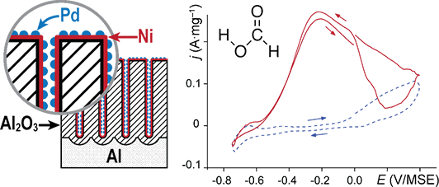
- ). It is difficult to correlate the mass gain and loss measured by the QCM with a reaction mechanism. Thus few data can be found in literature about such chemical processes. However, Martinson et al. proposed a detailed investigation of the Fe2O3 formation from FeCp2 and O3 precursors by using
- reacted with active surface sites seems to occur. The net mass gain detected after the nickelocene pulse, exposure and purging could be attributed to the bonding of a –NiCp group with a surface –OH group. According to the study performed on Fe2O3 [35], the S3 and S4 stages could be associated to a


Quantum size effects in TiO2 thin films grown by atomic layer deposition
Beilstein J. Nanotechnol. 2014, 5, 77–82, doi:10.3762/bjnano.5.7
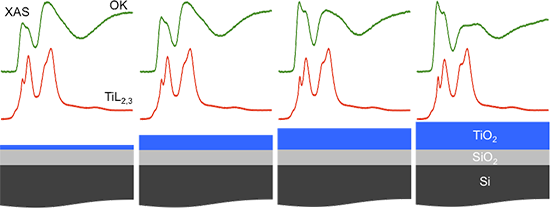
- conduction band states, increases the delocalization of O 2p states, and improves the charge carrier transport. We recently used our TiO2 films grown by ALD on Fe2O3 in order to increase the photoactivated hydrophilic and photocatalytic behavior of Fe oxides. There, it was observed that TiO2 thin films and
- their interface with Fe2O3 substrates result in an improved charge carrier separation and a decrease of recombination [16] that could be ascribed to the electronic properties of the TiO2 thin films. It is important to understand how changes of the line shape (number, position and intensity of peaks and


Cyclic photochemical re-growth of gold nanoparticles: Overcoming the mask-erosion limit during reactive ion etching on the nanoscale
Beilstein J. Nanotechnol. 2013, 4, 886–894, doi:10.3762/bjnano.4.100
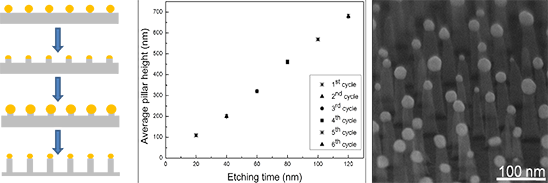
- iron(III) nitrate into the PEO domains and applying a UV/ozone treatment iron oxide is obtained while the organic components are removed. Thus, after an additional annealing, a hexagonal array of Fe2O3 particles is obtained and can be used as mask for a subsequent etching process. Both of the last two


Synthesis of boron nitride nanotubes from unprocessed colemanite
Beilstein J. Nanotechnol. 2013, 4, 843–851, doi:10.3762/bjnano.4.95
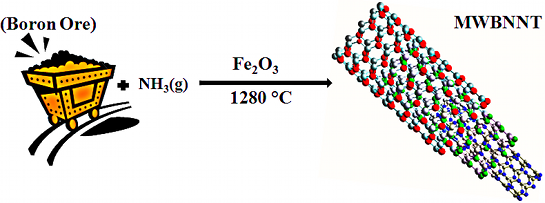
- technique under a N2 atmosphere at 1450 °C for one hour. Okan et al. reported a method based on CVD to produce BNNTs in the Fe2O3/MCM-41 complex-catalyst system from boron powder as a starting material at 600 °C for one hour. In another study, Singhal et al. obtained BNNTs from the mixture of KBH4/NH4Cl
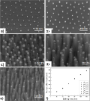
- catalyst. For this purpose Fe, Al or Mg are widely used in the synthesis of BNNT [3][6]. In this study, four types of catalysts, namely ZnO, Al2O3, Fe3O4, and Fe2O3, were investigated for their performances. Figure 1a–d shows 4 SEM images of reaction mixtures under the same experimental conditions but each
- difference, they do not effectively interact with NH3 gas. Therefore, no BNNT formation was observed. However, when iron oxides were used as catalysts, the formation of BNNTs was dramatically improved. The BNNTs synthesized with the use of Fe3O4 (Figure 1c) or Fe2O3 (Figure 1d) are clearly seen in the


Catalytic activity of nanostructured Au: Scale effects versus bimetallic/bifunctional effects in low-temperature CO oxidation on nanoporous Au
Beilstein J. Nanotechnol. 2013, 4, 111–128, doi:10.3762/bjnano.4.13
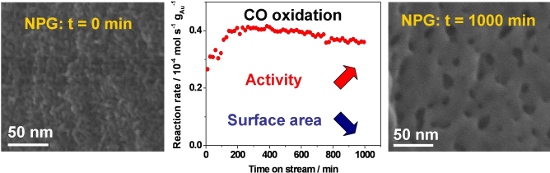
- [14], aerobic oxidation of alcohols [15], and oxidation of organosilanols [16]. Until recently, high activities for the CO oxidation over Au catalysts were only reported for gold nanoparticles of a few nanometers in diameter, which are supported on reducible metal oxides such as TiO2, CeO2 and Fe2O3


Plasmonics-based detection of H2 and CO: discrimination between reducing gases facilitated by material control
Beilstein J. Nanotechnol. 2012, 3, 712–721, doi:10.3762/bjnano.3.81
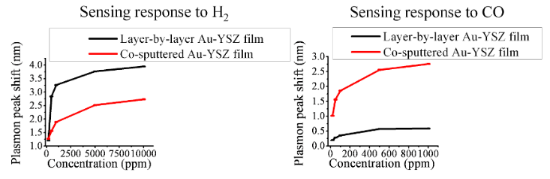
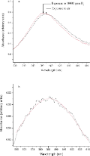
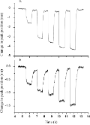
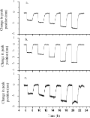
- oxidation also occurs for particle diameters ranging from 12 to 30 nm when the particles are supported on active metal-oxide supports, such as Fe2O3 and YSZ. These supports are able to trap oxygen due to the presence of oxygen vacancies in their lattice. The combined effect of dissociative adsorption of





Zeolites as nanoporous, gas-sensitive materials for in situ monitoring of DeNOx-SCR
Beilstein J. Nanotechnol. 2012, 3, 667–673, doi:10.3762/bjnano.3.76
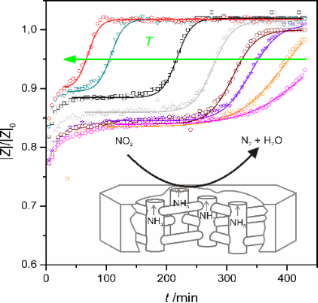
- and EDX. Also the metal loading of the iron-containing material was quantified by EDX and XRF to be 4 wt % in agreement with the manufacturer’s data. According to the manufacturer the iron species are predominantly Fe2O3 nanoparticles (corresponding to the reddish colour of the material). However, the


Magnetic interactions between nanoparticles
Beilstein J. Nanotechnol. 2010, 1, 182–190, doi:10.3762/bjnano.1.22
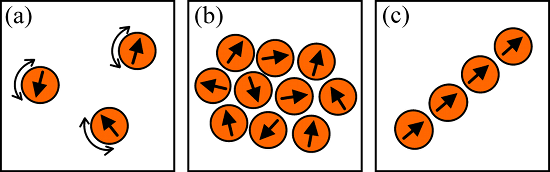
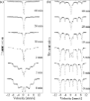
- , including Fe100−xCx [10], ε-Fe3N [11], γ-Fe2O3 [12][13][14] and Fe3O4 [15] have been investigated. If the particles are randomly distributed and have a random orientation of the easy axes, the magnetic properties can have similarities to those of spin glasses [10][11][14], and therefore these interacting
- , however, remarkable that weak dipole interactions can result in faster superparamagnetic relaxation. This has been observed in Mössbauer studies of maghemite (γ-Fe2O3) nanoparticles [12][28], and the effect has been explained by a lowering of the energy barriers between the two minima of the magnetic
- , hematite (α-Fe2O3) [35][36][37][38] and ferrihydrite [39] nanoparticles have shown that the superparamagnetic relaxation of antiferromagnetic nanoparticles can be significantly suppressed if the particles are in close proximity. This has been explained by exchange interaction between surface atoms of



Magnetic nanoparticles for biomedical NMR-based diagnostics
Beilstein J. Nanotechnol. 2010, 1, 142–154, doi:10.3762/bjnano.1.17
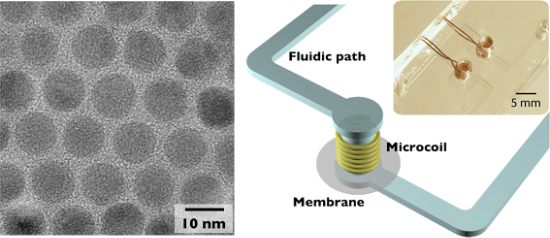
- ][37][38][39][40][41][42]. CLIO nanoparticles contain a superparamagnetic iron oxide core (3–5 nm monocrystalline iron oxide) composed of ferrimagnetic magnetite (Fe3O4) and/or maghemite (γ-Fe2O3). The metallic core is subsequently coated with biocompatible dextran, before being cross-linked with


Magnetic coupling mechanisms in particle/thin film composite systems
Beilstein J. Nanotechnol. 2010, 1, 101–107, doi:10.3762/bjnano.1.12
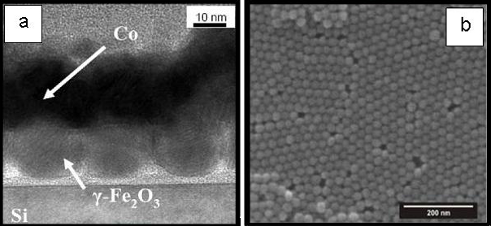
- Kohlenforschung, D-45470 Mülheim an der Ruhr, Germany Institut für Werkstoffe, Ruhr-Universität Bochum, D-44780 Bochum, Germany 10.3762/bjnano.1.12 Abstract Magnetic γ-Fe2O3 nanoparticles with a mean diameter of 20 nm and size distribution of 7% were chemically synthesized and spin-coated on top of a Si
- magnetic force microscopy. Moreover, an exchange bias effect was found, which is likely to be due to oxygen exchange between the iron oxide and the Co layer, and thus forming of an antiferromagnetic CoO layer at the γ-Fe2O3/Co interface. Keywords: exchange bias; iron oxide nanoparticles; nanoparticle self
- samples were annealed at 170 °C for 20 min in air in order to obtain mainly single phase maghemite (γ-Fe2O3) NPs as reported in Ref. [41]. After heat treatment, the NP monolayer was ion-milled with neutralized Ar-ions for 4 min in order to flatten the NP array and remove the oleic acid layer. Finally, a


Uniform excitations in magnetic nanoparticles
Beilstein J. Nanotechnol. 2010, 1, 48–54, doi:10.3762/bjnano.1.6
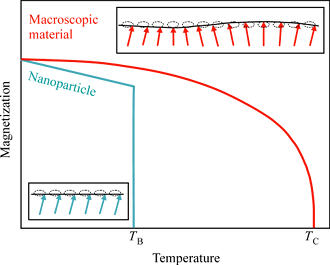
- magnetic anisotropy [14]. A similar size dependence of the magnetic anisotropy constant has been found by Mössbauer studies in other nanoparticles, for example, maghemite (γ-Fe2O3) [15], hematite (α-Fe2O3) [16] and metallic iron (α-Fe) [17]. If a sufficiently large magnetic field B is applied, such that B
- from a sample of 15 nm α-Fe2O3 nanoparticles. The data were obtained from neutrons, scattered at the scattering vector with Q = 1.50 Å−1, corresponding to the purely magnetic hexagonal (101) peak [21]. Data obtained in zero applied field as a function of temperature are shown in Figure 6a, whereas


![[Graphic 3]](/bjnano/content/inline/2190-4286-1-6-i22.png?max-width=637&scale=1.18182) as a function of temperature for particles of magneti...
as a function of temperature for particles of magneti...





