Search results
Search for "absorption coefficient" in Full Text gives 114 result(s) in Beilstein Journal of Nanotechnology.
Effects of the preparation method on the structure and the visible-light photocatalytic activity of Ag2CrO4
Beilstein J. Nanotechnol. 2014, 5, 658–666, doi:10.3762/bjnano.5.77
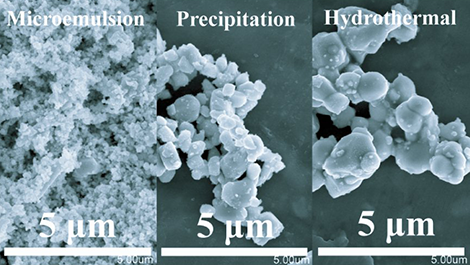
- particle size among the three samples. The indirect band gaps of the Ag2CrO4 samples are calculated according to the Kubelka–Munk (KM) method by the following equation [62]: where α is the absorption coefficient, hν is the photon energy, Eg is the indirect band gap, and A is a constant. As shown in the


One-step synthesis of high quality kesterite Cu2ZnSnS4 nanocrystals – a hydrothermal approach
Beilstein J. Nanotechnol. 2014, 5, 438–446, doi:10.3762/bjnano.5.51
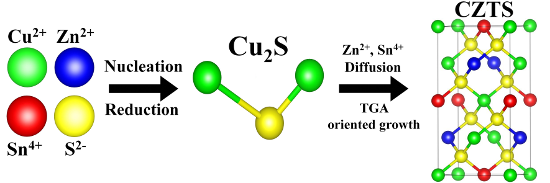
- has a theoretical band gap of 1.5 eV and has high light absorption coefficient (>104 cm−1) in the range of visible and near infrared irradiation of solar spectrum [2][3][4]. Shockley–Queisser balanced calculations have predicted that the theoretical efficiency of PVs using light absorbers like CZTS is




Extracellular biosynthesis of gadolinium oxide (Gd2O3) nanoparticles, their biodistribution and bioconjugation with the chemically modified anticancer drug taxol
Beilstein J. Nanotechnol. 2014, 5, 249–257, doi:10.3762/bjnano.5.27

- , air-dried and dissolved in 1 mL of 100 mM NaOH. The number of nitrotyrosyl groups was determined spectrophotometrically at 430 nm by using a molar absorption coefficient of 4600 M−1 cm−1. 2’-Glutarylhexanediamine taxol (400 µg) was dissolved in anhydrous DMF (300 µL), and EDC (1.2 µmol, 1.1 equiv


Study of mesoporous CdS-quantum-dot-sensitized TiO2 films by using X-ray photoelectron spectroscopy and AFM
Beilstein J. Nanotechnol. 2014, 5, 68–76, doi:10.3762/bjnano.5.6
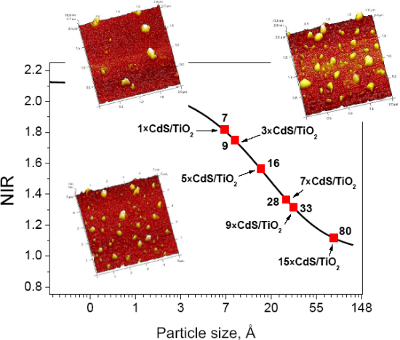
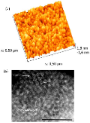
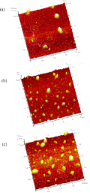
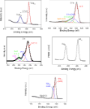
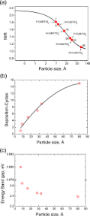
- . We have assumed that the sensitivity α·d (with α being the absorption coefficient and d being the film thickness) should be of the order of unity or d ≈ 1/α and that the scattering was negligible. The band gap of the TiO2 film is 3.08 eV, which is larger than that of bulk CdS (Eg = 2.4 eV) [1


Template based precursor route for the synthesis of CuInSe2 nanorod arrays for potential solar cell applications
Beilstein J. Nanotechnol. 2013, 4, 868–874, doi:10.3762/bjnano.4.98
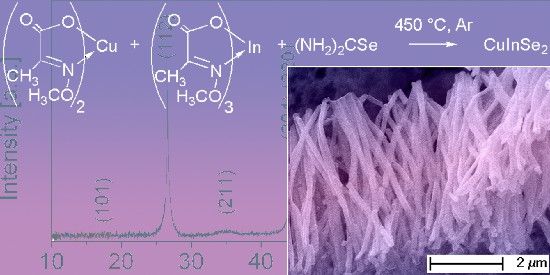
- indium selenide is characterised by a large absorption coefficient, and incident light can reach penetration depths only up to 100–200 nm, which results in a low signal intensity [22][23]. However, the penetration depth corresponds well with the nanorod diameter, and reliable information about the


Synthesis of indium oxi-sulfide films by atomic layer deposition: The essential role of plasma enhancement
Beilstein J. Nanotechnol. 2013, 4, 750–757, doi:10.3762/bjnano.4.85
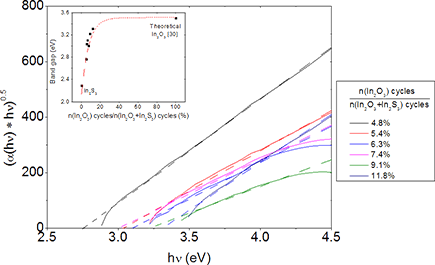
- [29] where α is the absorption coefficient and t is the film thickness. Figure 3 shows absorption spectra of the thin films. They are presented in the form of (α)0.5 = f(E), which is linear for indirect band gap materials and allows for the determination of the optical transition. The optical band



Kelvin probe force microscopy of nanocrystalline TiO2 photoelectrodes
Beilstein J. Nanotechnol. 2013, 4, 418–428, doi:10.3762/bjnano.4.49
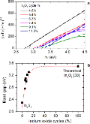
- spectroscopy (SPS) is a common method for measuring the bandgap, Eg, of a semiconductor by determining its dependency on the absorption coefficient, α. The obtained bandgap for nc-TiO2 (Figure 5a) is in accordance with the literature value for bulk TiO2, Eg = 3.2 eV [46] and validates the SPS setup. The
- absorption coefficient, implying a maximum SPV for super-bandgap illumination. Depending on the bandgap type, either direct or indirect, the SPV curve is fitted with the corresponding relation [18][47]: where h is the Planck constant and ν is the frequency of the light. For anatase TiO2, an indirect bandgap


Photocatalytic antibacterial performance of TiO2 and Ag-doped TiO2 against S. aureus. P. aeruginosa and E. coli
Beilstein J. Nanotechnol. 2013, 4, 345–351, doi:10.3762/bjnano.4.40
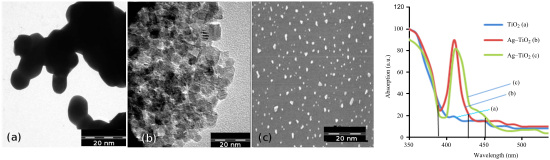
- nanoparticles to visible light was increased and showed red shift (towards increased wavelength). The red shift of the absorption curve results in a reduction of the band gap energy and also the recombination rate, and hence, enhanced photocatalytic activity. The optical absorption coefficient α of a
- semiconductor is expressed by the following equation: Here α is the absorption coefficient, Eg is the absorption band gap, A is a constant depending on the transition probability, n depends on the nature of the transition, i.e., allowed direct, allowed indirect, forbidden direct and forbidden indirect. In our


Substrate-mediated effects in photothermal patterning of alkanethiol self-assembled monolayers with microfocused continuous-wave lasers
Beilstein J. Nanotechnol. 2012, 3, 65–74, doi:10.3762/bjnano.3.8
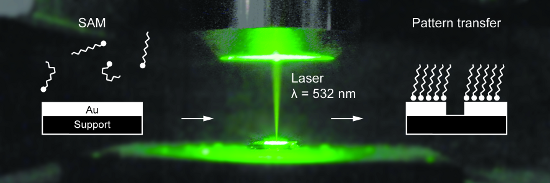
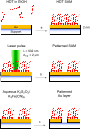
- transmittance T and reflectance R at a wavelength of 532 nm and normal incidence was determined. The respective data are summarized in Table 1. Taking into account the transmittance and reflectance data allows one to calculate the absorbance A and the effective absorption coefficient αAu of the films from [12




Investigation on structural, thermal, optical and sensing properties of meta-stable hexagonal MoO3 nanocrystals of one dimensional structure
Beilstein J. Nanotechnol. 2011, 2, 585–592, doi:10.3762/bjnano.2.62
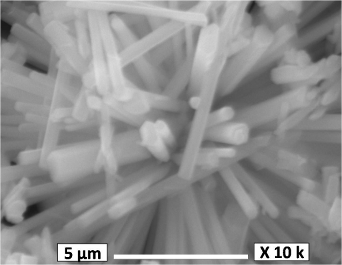
- band gap is evaluated using K–M function as follows [27]: where F(R∞) is the K–M function or re-emission function, R∞ is the diffuse reflectance of an infinitely thick sample, K(λ) is the absorption coefficient, s(λ) is the scattering coefficient, hν is the photon energy and Eg is the band gap energy


Extended X-ray absorption fine structure of bimetallic nanoparticles
Beilstein J. Nanotechnol. 2011, 2, 237–251, doi:10.3762/bjnano.2.28
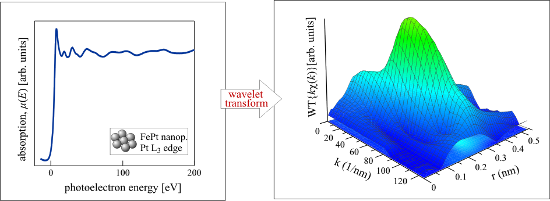
- (energy dependent) intensity of incident X-rays and μ is the absorption coefficient. Since for photon energies below 20 keV the photoeffect dominates over Raleigh and Compton scattering, μ can be approximated by the photoabsorption coefficient, which is proportional to the absorption cross-section. The



Infrared receptors in pyrophilous (“fire loving”) insects as model for new un-cooled infrared sensors
Beilstein J. Nanotechnol. 2011, 2, 186–197, doi:10.3762/bjnano.2.22
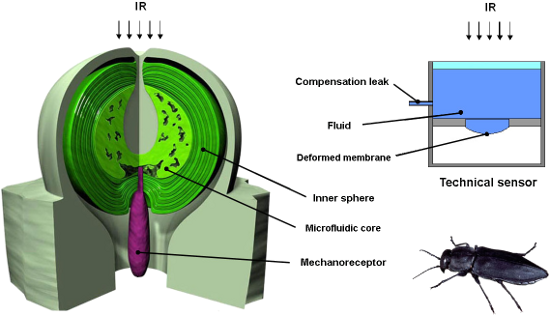
- reality the heat loss cannot be neglected. The heat loss through the IR window can be calculated for defined boundary conditions. A high IR absorption coefficient of the liquid in the cavity causes the absorption of the IR energy within a very small absorption zone. For water as a liquid with a very high
- IR absorption coefficient, a formula for the temperature profile ΔT(z) could be derived [27] on the assumption of a infinitely thin boundary layer between the glass window and the water. This allows a numerical solution of the mean temperature increase in Equation 4 taking into account the heat loss
- have a significant lower absorption coefficient which requires the application of an additional absorber such as plastic, aluminium, antimony or lead [21]. When the absorbing film is directly on the inner surface of the window, the assumption of a boundary layer as in the case of water is valid


Electrochemical behavior of dye-linked L-proline dehydrogenase on glassy carbon electrodes modified by multi-walled carbon nanotubes
Beilstein J. Nanotechnol. 2010, 1, 135–141, doi:10.3762/bjnano.1.16
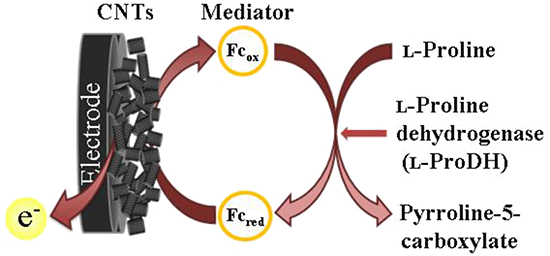
- reduction rate of DCPIP at 595 nm in accord with the previously described procedures [33][34]. The reaction mixture was composed of 0.1 mM DCPIP, 100 mM L-proline and enzyme in Tris-HCl buffer (0.3 M, pH 7.5) with a total volume of 3.0 ml. The molar absorption coefficient of 2.15 × 10⁴ M−1 cm−1 was used to


Preparation and characterization of supported magnetic nanoparticles prepared by reverse micelles
Beilstein J. Nanotechnol. 2010, 1, 24–47, doi:10.3762/bjnano.1.5