


Search results
Search for "chemical reactions" in Full Text gives 153 result(s) in Beilstein Journal of Nanotechnology.
Numerical investigation of depth profiling capabilities of helium and neon ions in ion microscopy
Beilstein J. Nanotechnol. 2016, 7, 1749–1760, doi:10.3762/bjnano.7.168
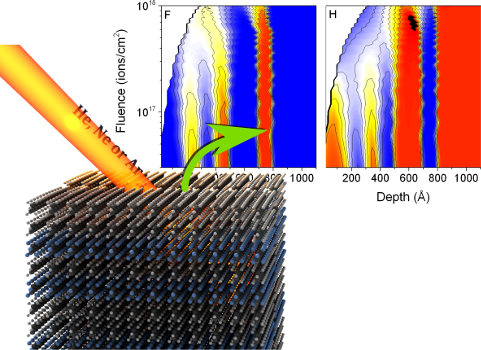
- dynamics (MD) simulations, possible changes in the sample upon irradiation due to chemical reactions, as they are included in reactive force fields [27][28][29], are not contained in the model, but SD_TRIM_SP has the advantage to allow for the simulation of high fluences up in the 1018 ions/cm2 range, i.e


Enhanced detection of nitrogen dioxide via combined heating and pulsed UV operation of indium oxide nano-octahedra
Beilstein J. Nanotechnol. 2016, 7, 1507–1518, doi:10.3762/bjnano.7.144
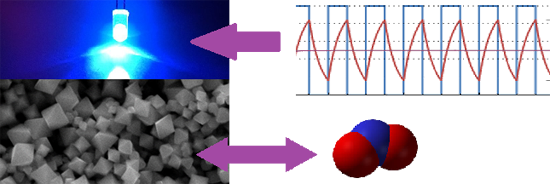
- sensors using ultraviolet (UV) activated metal oxides [13][14][15][16]. These works employ UV light as an energy efficient alternative to heating for activating chemical reactions occurring at the surface of metal oxides during gas detection. This approach could significantly cut power consumption in


Viability and proliferation of endothelial cells upon exposure to GaN nanoparticles
Beilstein J. Nanotechnol. 2016, 7, 1330–1337, doi:10.3762/bjnano.7.124
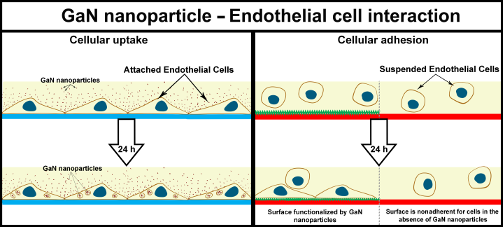
- epitaxy (HVPE) in two stages, as previously described [29]. Metallic gallium, ammonia (NH3) gas, hydrogen chloride (HCl) gas, and hydrogen (H2) were used as source materials and carrier gases. In the source zone, GaCl was formed as a result of chemical reactions between gaseous HCl and liquid Ga. GaCl and



Functional diversity of resilin in Arthropoda
Beilstein J. Nanotechnol. 2016, 7, 1241–1259, doi:10.3762/bjnano.7.115
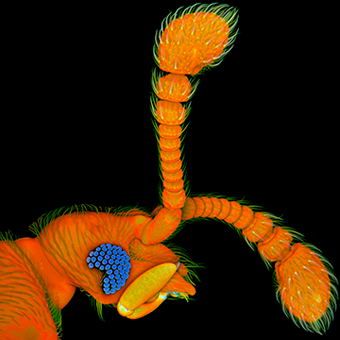
- by single conventional dyes. Chemical reactions with the Masson and Mallory dyes were mentioned to stain resilin red. Staining of resilin with aqueous solutions of methylene blue and toluidine blue is a common method and can provide good information about the presence and distribution of resilin


Influence of synthesis conditions on microstructure and phase transformations of annealed Sr2FeMoO6−x nanopowders formed by the citrate–gel method
Beilstein J. Nanotechnol. 2016, 7, 1202–1207, doi:10.3762/bjnano.7.111
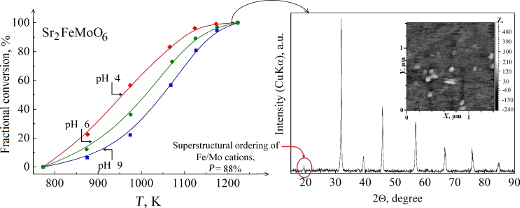
- , independent of the pH of the initial solutions. It can be seen that the synthesis of the solid solution of strontium ferromolybdate proceeds through a number of parallel chemical reactions that leads to several phase transformation processes. It can be seen in the XRD data presented in Figure 2 that during
- through a series of parallel chemical reactions with the formation of intermediate phases SrMoO4, SrCO3 and Fe3O4, and its relative amount is reduced with increasing temperature. This leads to an increased amount of Sr2FeMoO6−x phase. Therefore, the lowest amount of strontium molybdate was observed for T



Reasons and remedies for the agglomeration of multilayered graphene and carbon nanotubes in polymers
Beilstein J. Nanotechnol. 2016, 7, 1174–1196, doi:10.3762/bjnano.7.109
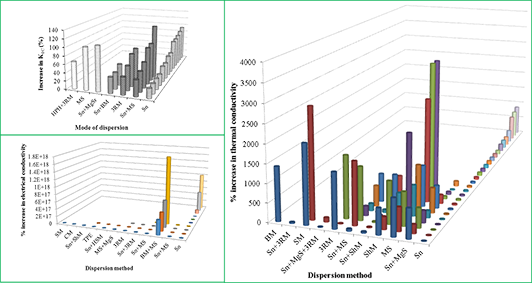
- reactive plasma. The functional groups attached at the defect sites of MLG and CNTs can undergo further chemical reactions including but not limited to silanation, thiolation, esterification, polymer grafting, alkylation and arylation. Functionalization changes the nature of the CNTs from hydrophobic to


Experimental and simulation-based investigation of He, Ne and Ar irradiation of polymers for ion microscopy
Beilstein J. Nanotechnol. 2016, 7, 1113–1128, doi:10.3762/bjnano.7.104
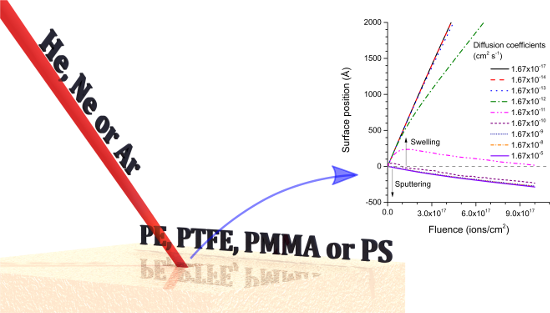
- depending on sample composition, but the emission of volatile compounds and chemical reactions taking place in the sample under ion irradiation are not taken into account. The latter include reactions between oxygen and carbon as well as the change of hybridisation for carbon. These different aspects can


Advanced atomic force microscopy techniques III
Beilstein J. Nanotechnol. 2016, 7, 1052–1054, doi:10.3762/bjnano.7.98

- and compared with theoretical predictions [12][13], and local charges within single molecules can be measured [14][15], however, the quantification is still under intense discussion. Chemical reactions are triggered and imaged by the AFM tip [16][17] and of course the technique is not limited to
NO gas sensing at room temperature using single titanium oxide nanodot sensors created by atomic force microscopy nanolithography
Beilstein J. Nanotechnol. 2016, 7, 1044–1051, doi:10.3762/bjnano.7.97
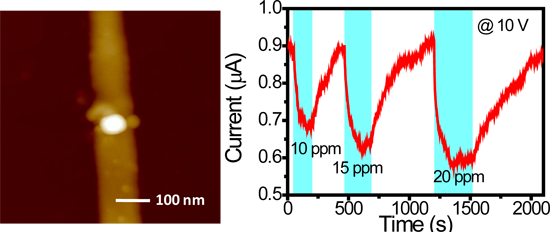
- chemisorbed oxygen ions (O2−(ads)) and nitric oxide ions (NO−(ads)) prior to UV irradiation, which are shown in Figure 7a and Figure 7b. The chemical reactions for NO are described by [20][38]: Without UV illumination, the chemisorbed ions are too stable to be removed by pumping. Under UV illumination, the
- ions are first neutralized by photogenerated holes and then react again with photogenerated electrons [13], which is shown in Figure 7c. The chemical reactions for NO can be similarly described by: Unlike the chemisorbed ions, the photoinduced ions (O2−(hν) and NO−(hν)) are only weakly bound to the ND


Assembling semiconducting molecules by covalent attachment to a lamellar crystalline polymer substrate
Beilstein J. Nanotechnol. 2016, 7, 784–798, doi:10.3762/bjnano.7.70
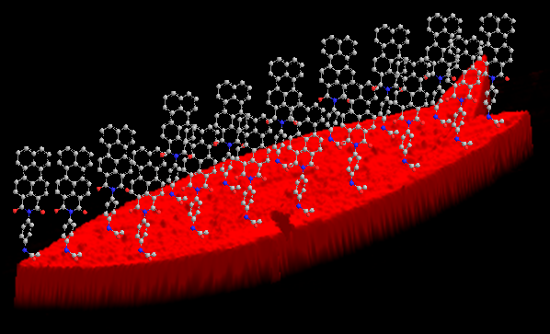
- lamellar crystal. Thus, the surfaces of these crystals were covered by side-branches. By using carboxyl groups as side-branches, which allow for chemical reactions, we could functionalize the crystal with semiconducting molecules. Here, we compare properties of crystals differing in size: small
- . Consequently, the surface of such lamellar crystals will be covered by side-groups. With an appropriate choice of these groups, chemical reactions may be performed at such surfaces. Thus, such lamellae covered with side-groups represent smooth surfaces with functional groups, which allow for a covalent
- chemical reactions. From the analysis of AFM height images of CPE45 nanocrystal films, we found that most nanocrystals were actually considerably thicker than 5 nm. Therefore, we concluded that surfaces of nanocrystals were not covered by carboxyl groups only, but contained also a significant amount of


Microwave solvothermal synthesis and characterization of manganese-doped ZnO nanoparticles
Beilstein J. Nanotechnol. 2016, 7, 721–732, doi:10.3762/bjnano.7.64
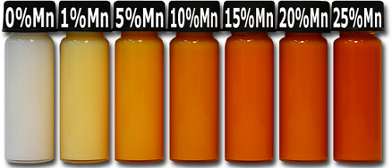
- properties proves a very complex and problematic task. Obtaining Zn1−xMnxO nanomaterials with reproducible optoelectronic and magnetic properties remains an unsolved issue. Differing properties of the obtained Zn1−xMnxO result from the complexity of chemical reactions and the limitations of the currently
- properties in the case of Zn1−xMnxO is the lack of control over the doping impact on the formation of oxygen vacancies, crystalline lattice defects and dopant clusters [48]. It is presumed that there are several competitive chemical reactions in the reaction of Zn1−xMnxO synthesis, such as the oxidisation of


Green and energy-efficient methods for the production of metallic nanoparticles
Beilstein J. Nanotechnol. 2015, 6, 2354–2376, doi:10.3762/bjnano.6.243
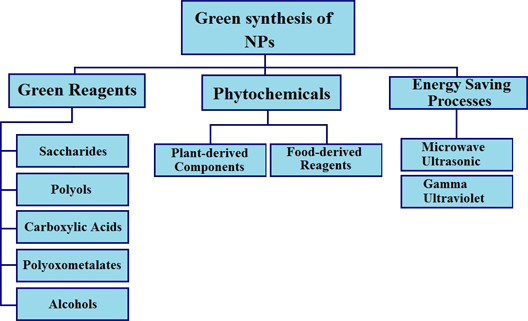
- , surface-enhanced Raman scattering (SERS) detection and catalysis of chemical reactions. Furthermore, biocompatible and functionalized NPs have applications in diagnosis and treatment of cancer. For these two purposes, fluorescent and magnetic nanocrystals for detection of tumors and also nanosystems for


Light-powered, artificial molecular pumps: a minimalistic approach
Beilstein J. Nanotechnol. 2015, 6, 2096–2104, doi:10.3762/bjnano.6.214
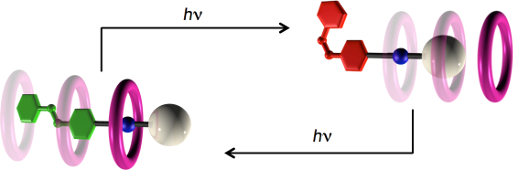
- closed path of chemical reactions, the cycling probability is the same in both directions, unless energy is introduced into the system, as it happens in the present case in the form of light [33]. The supply of energy, however, is not a sufficient condition to bring the system out of equilibrium. In the
- energy maxima and minima, induced by light, enables the directionally controlled threading and dethreading of the molecular components. Structure formula and schematic representation of the examined molecular components. Self-assembly chemical reactions (horizontal processes) and photochemical


Materials for sustainable energy production, storage, and conversion
Beilstein J. Nanotechnol. 2015, 6, 1601–1602, doi:10.3762/bjnano.6.163
- well as their function when integrated into a battery electrode. Not only can a better understanding of the transport processes and chemical reactions at the microscale be gathered, but also the development of strategies for optimizing the electrode. Such a multiscale modeling approach is presented
Possibilities and limitations of advanced transmission electron microscopy for carbon-based nanomaterials
Beilstein J. Nanotechnol. 2015, 6, 1541–1557, doi:10.3762/bjnano.6.158
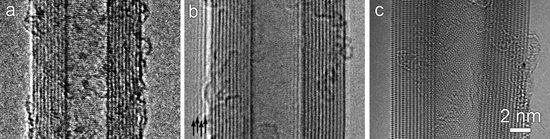
- being introduced into in situ TEM, include mechanical stress [106][107], electrical stimuli [108], and chemical reactions in the gas phase or in liquid cells [50]. Although only a few studies using in situ TEM on carbon-based nanomaterials have been reported, an increase can certainly be expected. For


Improved optical limiting performance of laser-ablation-generated metal nanoparticles due to silica-microsphere-induced local field enhancement
Beilstein J. Nanotechnol. 2015, 6, 1199–1204, doi:10.3762/bjnano.6.122
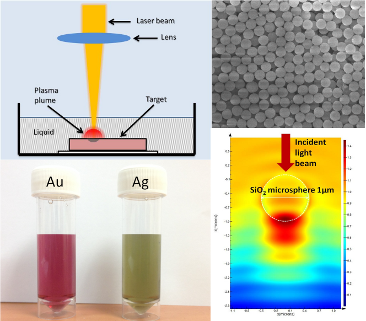
- the nanoparticle dispersion. Keywords: laser ablation; local field enhancement; microspheres; nanoparticles; optical limiting; Introduction Laser ablation in liquid (LAL) is a versatile technique to fabricate nanoparticles. Conventional synthesis of nanoparticles by chemical reactions is usually


The convenient preparation of stable aryl-coated zerovalent iron nanoparticles
Beilstein J. Nanotechnol. 2015, 6, 1192–1198, doi:10.3762/bjnano.6.121
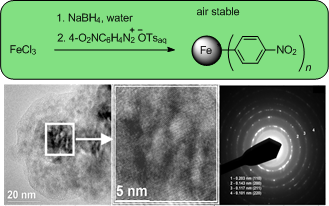
- borohydride were purchased from Aldrich and were used without further purification. Deionized water was used for all chemical reactions. All the solvents were obtained from Aldrich and used as received. Powder X-ray diffraction data were collected on a Shimadzu XRD-7000 diffractometer (30 min) using Cu Kα


Multiscale modeling of lithium ion batteries: thermal aspects
Beilstein J. Nanotechnol. 2015, 6, 987–1007, doi:10.3762/bjnano.6.102
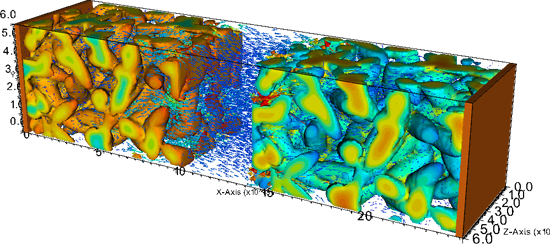
- interface of electrolyte and active particles or the complex chemical reactions leading to the growth of the SEI, plating and electrochemical reactions initiated in the bulk of the electrolyte at high potentials. A successful strategy for the development of predictive theories and simulation tools has


Simple approach for the fabrication of PEDOT-coated Si nanowires
Beilstein J. Nanotechnol. 2015, 6, 640–650, doi:10.3762/bjnano.6.65
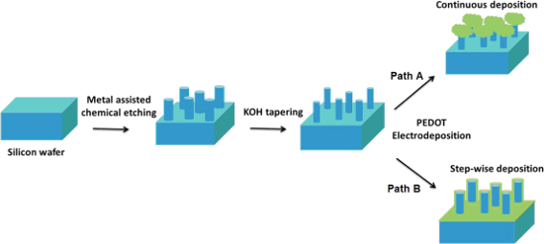
- as a catalyst for the SiNWs etching, which was carried out for 2 min. The Ag catalyst was finally (Step 3) dissolved by immersion into 69% HNO3 for 30 min. The chemical reactions associated to each step are the following: Step 1: 4Ag+ + Si + 6F− → 4Ag + SiF62− Step 2: 2H2O2 + 4H+ + Si + 6F− → 4H2O




Conformal SiO2 coating of sub-100 nm diameter channels of polycarbonate etched ion-track channels by atomic layer deposition
Beilstein J. Nanotechnol. 2015, 6, 472–479, doi:10.3762/bjnano.6.48
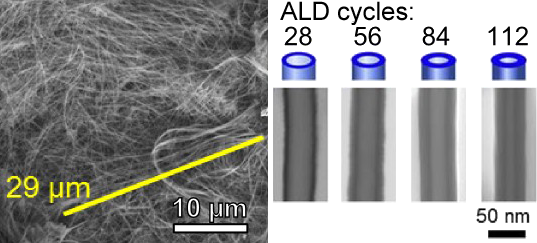
- interesting to study water and ion transport in confinement [15][16]. Coated templates are also attractive to synthesize extremely thin nanowires for the investigation of finite size and quantum size effects [17]. Atomic layer deposition is based on cycles of self-limiting chemical reactions between the gas


Liquid-phase exfoliated graphene: functionalization, characterization, and applications
Beilstein J. Nanotechnol. 2014, 5, 2328–2338, doi:10.3762/bjnano.5.242
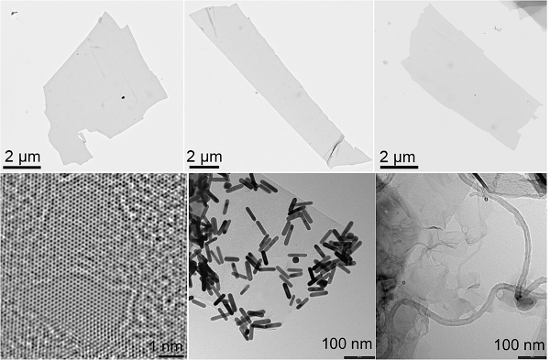
- also describe some of the chemical protocols that have provided insight into the vast organic chemistry of the single atomic plane of graphite. Controlled chemical reactions applied to graphene are expected to significantly improve the design of hierarchical, functional platforms, driving the inclusion
- [19]. The physical and chemical phenomena associated with ultrasonic waves are cavitation and nebulization. Cavitation induces extreme conditions by collapsing air bubbles which initiates chemical reactions, while nebulization furthers the reaction within the heated droplets. These processes induce
- to pure DMF. In this process, carbon nanofibers (CNFs) are formed revealing the occurrence of chemical reactions. During the ultrasonication process, graphene sheets were cut close to the edges, producing small fragments which later aggregate into CNFs. To verify the mechanism of CNF formation, gold


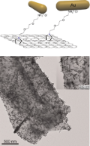


Donor–acceptor graphene-based hybrid materials facilitating photo-induced electron-transfer reactions
Beilstein J. Nanotechnol. 2014, 5, 1580–1589, doi:10.3762/bjnano.5.170
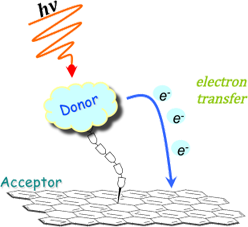
- chemical reactions leading to the covalent modification of a graphene framework are displayed. Briefly, after the exfoliation of graphite, the following reactions can be performed to modify the graphene sheet (summarized in Scheme 1): [3 + 2] 1,3-Dipolar cycloaddition of in situ generated azomethine ylides


Current state of laser synthesis of metal and alloy nanoparticles as ligand-free reference materials for nano-toxicological assays
Beilstein J. Nanotechnol. 2014, 5, 1523–1541, doi:10.3762/bjnano.5.165
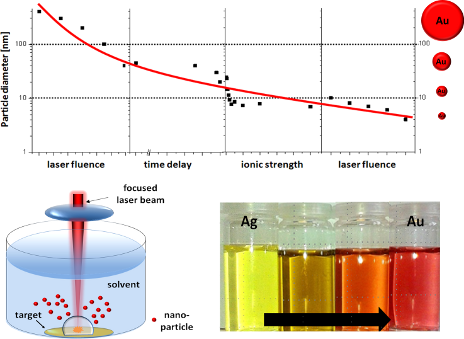
- addition to ion release, the surface chemistry of the nanoparticle itself may also be directly associated with nanotoxicological effects, e.g., the formation of reactive oxygen species [33]. Here, surface atoms may trigger chemical reactions with biomolecules which are possibly harmful to the organism


Protein-coated pH-responsive gold nanoparticles: Microwave-assisted synthesis and surface charge-dependent anticancer activity
Beilstein J. Nanotechnol. 2014, 5, 1452–1462, doi:10.3762/bjnano.5.158
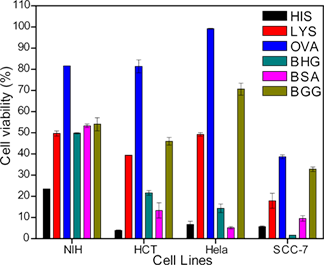
- observed a red color that is characteristic for the formation of AuNPs. Several experiments were carried out by varying the thermal conditions but the AuNP formation took several hours. Hence, we used microwave irradiation with an aim to reduce the reaction time, as it is known to accelerate chemical
- reactions. To standardize the microwave reaction conditions, several experiments were conducted in which the irradiation power, temperature and time were varied, and the products were analyzed by UV–vis spectroscopy. A microwave power of 250 W and a temperature of 120 °C were found to be optimum conditions


Near-field photochemical and radiation-induced chemical fabrication of nanopatterns of a self-assembled silane monolayer
Beilstein J. Nanotechnol. 2014, 5, 1441–1449, doi:10.3762/bjnano.5.156
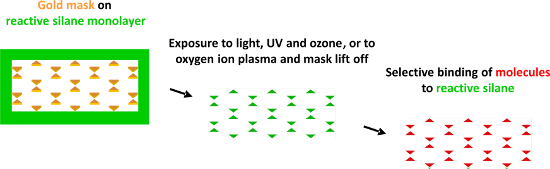
- lithography (CL), which is either exposed to visible light, oxygen plasma or an UV–ozone atmosphere. The gold mask has the function to inhibit the photochemical reactions by highly localized near-field interactions between metal mask and SAM and to inhibit the radiation-induced chemical reactions by casting a
- the potentially high resolution of the near-field photochemical process. Here we explore an extension of this near-field concept by using metal masks as a strongly localized barrier for the destruction of a silane monolayer by chemical reactions induced by oxygen ions, reactive ozone, or by
- . The gold mask has the function to inhibit the photochemical reactions of the SAM by highly localized near-field interactions between mask and SAM and to inhibit the radiation-induced chemical reactions by casting a highly localized shadow. Removal of the gold mask reveals the SAM nanopattern. As a





