


Search results
Search for "composite materials" in Full Text gives 130 result(s) in Beilstein Journal of Nanotechnology.
Characterisation of thin films of graphene–surfactant composites produced through a novel semi-automated method
Beilstein J. Nanotechnol. 2016, 7, 209–219, doi:10.3762/bjnano.7.19
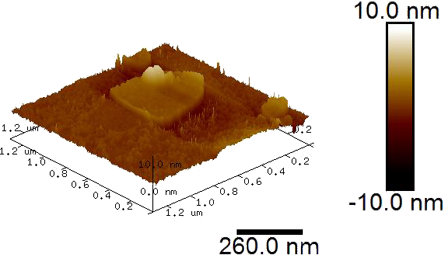
- -by-layer (LbL) deposition. Films composed of these new graphene composite materials were then characterised using SEM, AFM, and spectroscopic ellipsometry. The study of SPR in gold films coated with graphene using total internal reflection ellipsometry was carried out for the first time. Experimental
- films of graphene-surfactant composites Langmuir–Blodgett and Langmuir–Schaefer deposition Both composite materials obtained, e.g., graphene(+)CTAB and graphene(−)SDS, appeared to be soluble in water due to the presence of ionic groups, NMe3+ and SO3−, respectively. Yet, the presence of alkyl chains and


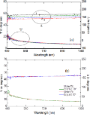


Linear and nonlinear optical properties of hybrid metallic–dielectric plasmonic nanoantennas
Beilstein J. Nanotechnol. 2016, 7, 111–120, doi:10.3762/bjnano.7.13
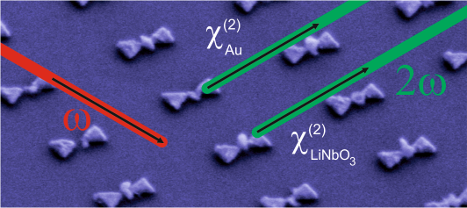
- properties of such composite materials can be modelled by nonlinear extension of the Maxwell–Garnett [31] and effective-medium theories [32][33]. Additionally, difference frequency mixing [34], four wave mixing, second harmonic generation, and other nonlinear optical processes were reported. In recent years


Fabrication of hybrid nanocomposite scaffolds by incorporating ligand-free hydroxyapatite nanoparticles into biodegradable polymer scaffolds and release studies
Beilstein J. Nanotechnol. 2015, 6, 2217–2223, doi:10.3762/bjnano.6.227
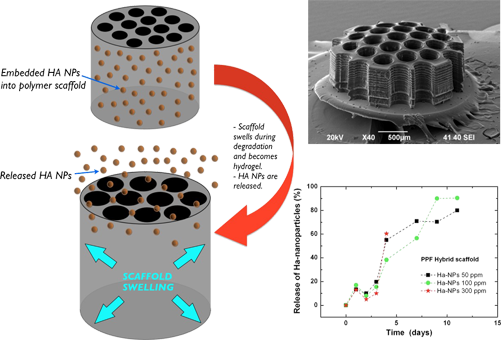
- procedure. With the physical tuning, it is also possible to achieve complex scaffold structures, for instance, mimicking composite materials. The PPF used in this work is not commercially available. The synthesis is reported elsewhere [22]. The PI phenylbis(2,4,6-trimethylbenzoyl)phosphine oxide (BAPO) was


Towards multifunctional inorganic materials: biopolymeric templates
Beilstein J. Nanotechnol. 2015, 6, 1698–1699, doi:10.3762/bjnano.6.172

- engineering. The manufacturing of such materials is usually performed at elevated temperature and/or pressure combined with enormous experimental effort and extensive equipment. Consequently, problems arise due to shrinkage or grain growth. In addition, the production of composite materials with
In situ SU-8 silver nanocomposites
Beilstein J. Nanotechnol. 2015, 6, 1661–1665, doi:10.3762/bjnano.6.168
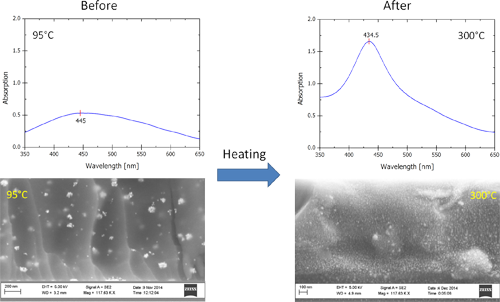
- fabricating homogeneous SU-8-based metal nanocomposite thin films with in situ generated silver nanoparticles. These composite materials can be deposited on wafers by using standard spin coating techniques and subsequently structured with UV lithography. The nanocomposite is prepared by dissolving AgNO3


Formation of pure Cu nanocrystals upon post-growth annealing of Cu–C material obtained from focused electron beam induced deposition: comparison of different methods
Beilstein J. Nanotechnol. 2015, 6, 1508–1517, doi:10.3762/bjnano.6.156
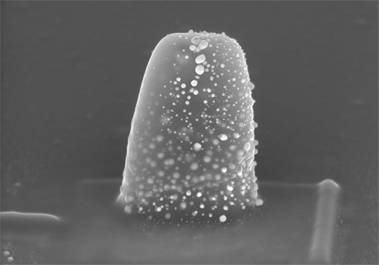
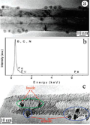
- a polymeric carbonaceous matrix (see below in Figure 7 taken with a Philips EM-430 TEM at 300 keV). This matrix contains all the ligand elements: carbon, oxygen, fluorine, and silicon as well as probably some hydrogen (not detectable by EDX) [42]. The difference between amorphous and nano-composite
- materials obtained for the Cu(II)(hfac)2 and (hfac)Cu(I)VTMS precursor, respectively, can be attributed to the lower thermal stability of (hfac)CuVTMS which is 63 °C compared to 250 °C for Cu(hfac)2. Electrical measurements showed that the as-deposited FEBID lines from Cu(hfac)2 were highly resistive with a




Electronic interaction in composites of a conjugated polymer and carbon nanotubes: first-principles calculation and photophysical approaches
Beilstein J. Nanotechnol. 2015, 6, 1138–1144, doi:10.3762/bjnano.6.115
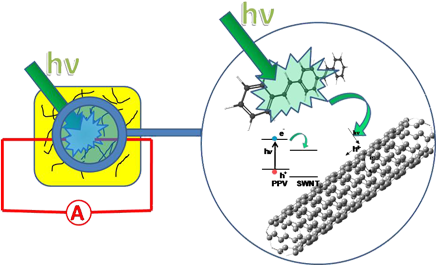
- molecules, and semiconducting nanocrystals have been extensively studied, in order to understand the photophysical changes observed on varying the particles concentration [8][9][10][11]. Notably, polymer-composite materials with different electron affinity have been used to enhance charge separation upon


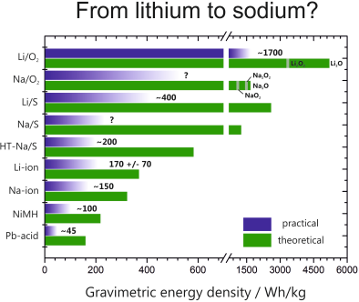
From lithium to sodium: cell chemistry of room temperature sodium–air and sodium–sulfur batteries
Beilstein J. Nanotechnol. 2015, 6, 1016–1055, doi:10.3762/bjnano.6.105


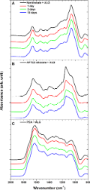
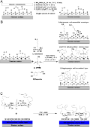
Self-assembled anchor layers/polysaccharide coatings on titanium surfaces: a study of functionalization and stability
Beilstein J. Nanotechnol. 2015, 6, 617–631, doi:10.3762/bjnano.6.63
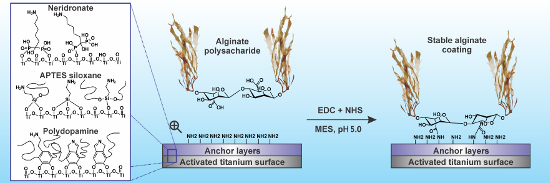
- , Academy of Sciences of the Czech Republic, Cukrovarnicka 10, 16253 Prague 6, Czech Republic Czech Technical University in Prague, Faculty of Nuclear Sciences and Physical Engineering, Trojanova 13, 12000 Prague 2, Czech Republic 10.3762/bjnano.6.63 Abstract Composite materials based on a titanium support



Multifunctional layered magnetic composites
Beilstein J. Nanotechnol. 2015, 6, 134–148, doi:10.3762/bjnano.6.13
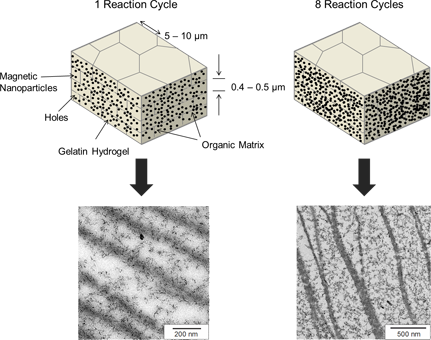
- magnetite [43]. Mechanical characterization To examine the mechanical properties of the composite materials we conducted some preliminary experiments. Force spectroscopy measurements with the colloidal probe technique [46][47] were performed on bare and nanoparticle-loaded gelatin as well as on bare and

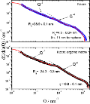


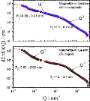


Synthesis of boron nitride nanotubes and their applications
Beilstein J. Nanotechnol. 2015, 6, 84–102, doi:10.3762/bjnano.6.9
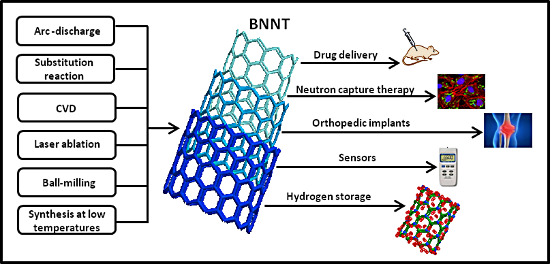
- substrate where the contact angle was found to be more than 170° [8]. The origin of this super hydrophobicity was attributed to the surface morphology and adsorption capacity of BNNTs for airborne molecules [9]. BNNTs were also used to prepare composite materials to enhance their physical properties. Bansal




Liquid-phase exfoliated graphene: functionalization, characterization, and applications
Beilstein J. Nanotechnol. 2014, 5, 2328–2338, doi:10.3762/bjnano.5.242
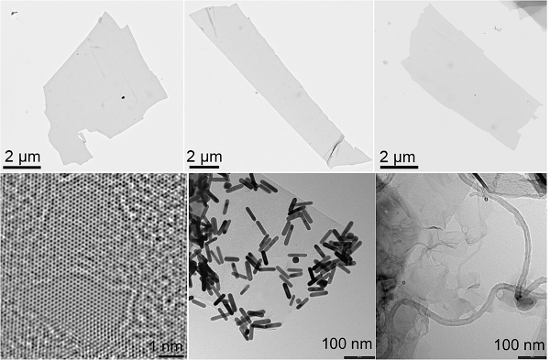
- ]. However, for the development of composite materials in large quantities, good quality graphene dispersions must be produced. In this direction, wet chemistry methodologies are proficient for the mass fabrication of graphene, since the starting material is usually graphite, an inexpensive substance [6]. To




Hybrid spin-crossover nanostructures
Beilstein J. Nanotechnol. 2014, 5, 2230–2239, doi:10.3762/bjnano.5.232
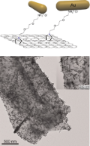
- materials [17]. The properties of these hybrid structures are not only interesting from a fundamental point of view, but are currently envisaged to be applied in various fields of technology. Synthesis of hybrid SCO nanostructures The development of functionalized nano-composite materials with potential



Two-dimensional and tubular structures of misfit compounds: Structural and electronic properties
Beilstein J. Nanotechnol. 2014, 5, 2171–2178, doi:10.3762/bjnano.5.226

- compounds; Review Introduction Sheets of different two-dimensional, layered materials can assemble to form composite materials. As the compounds usually exhibit their own symmetry and space groups, their unit cells differ in most cases in either one, two, or all three directions. The combination of any two


Effect of channel length on the electrical response of carbon nanotube field-effect transistors to deoxyribonucleic acid hybridization
Beilstein J. Nanotechnol. 2014, 5, 2081–2091, doi:10.3762/bjnano.5.217
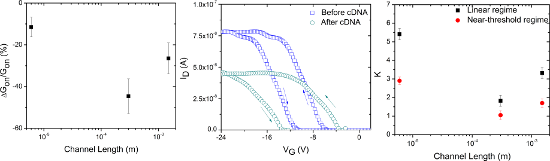
- Science and Technology on Thermostructural Composite Materials Laboratory, Northwestern Polytechnical University, 710072, Xi'an, PR China, Department of Mechanical Engineering, Khalifa University of Science, Technology & Research (KUSTAR), P.O. Box 127788, Abu Dhabi, United Arab Emirates 10.3762/bjnano


Carbon nano-onions (multi-layer fullerenes): chemistry and applications
Beilstein J. Nanotechnol. 2014, 5, 1980–1998, doi:10.3762/bjnano.5.207
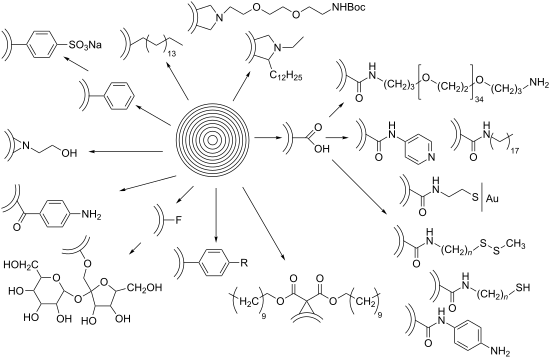
- materials. The following chapter summarizes the published literature regarding the reported methods for the covalent functionalization of CNOs (Scheme 1 and Table 1). In addition, we will give an overview over some CNO-containing composite materials. Except for some of these composites, the non-covalent
- , could be modified with flavonoid compounds, for the example quercitin, a compound known for its anti-inflammatory potential [49], giving rise to future applications in nanomedicine. Some additional metal oxide-containing composite materials were studied for applications as electrode materials in
- properties compared to pristine CNOs with a maximum specific capacitance of 122 F·g−1 (vs 25.8 F·g−1), a power density of 153 kW·kg−1 (vs 123 kW·kg−1) and an energy density of 8.5 Wh·kg−1 (vs 1.5 Wh·kg−1). Composite materials were studied for application in capacitors as well. The group of Echegoyen found


Synthesis of hydrophobic photoluminescent carbon nanodots by using L-tyrosine and citric acid through a thermal oxidation route
Beilstein J. Nanotechnol. 2014, 5, 1513–1522, doi:10.3762/bjnano.5.164
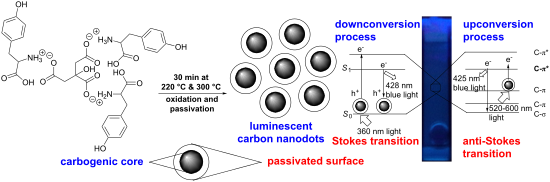
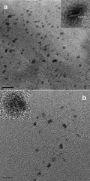
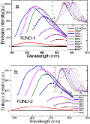
- : composite materials; fluorescence quenching; hydrophobic; luminescence; upconversion; Introduction The synthesis of fluorescent functional materials raised significant interest in order to understand biological processes such as DNA sequencing, detection of DNA-hybridization, protein sensing, single






Nanoporous composites prepared by a combination of SBA-15 with Mg–Al mixed oxides. Water vapor sorption properties
Beilstein J. Nanotechnol. 2014, 5, 1226–1234, doi:10.3762/bjnano.5.136

- ]. However, the design of nanocomposite materials is usually a challenging task, as it is often necessary to employ several steps with complex preparation methods. For instance, composite materials can be prepared by a combination of inorganic with organic moieties or hybrid materials, to obtain a
- composite materials. For example, basic and acidic materials such as hydrotalcite and hydroxyapatite can be combined to produce composite materials whose structure, texture and morphology are unique and determined by the interaction between them [6][7]. More specifically, these interactions determine the
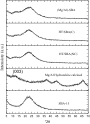
- , washed with distilled water, and dried in an oven at 70 °C. The nanocomposites materials were prepared by combining suitable amounts of SBA-15 with a Mg–Al nitrated hydrotalcite to obtain composite materials with a 80/20 wt % ratio. The first procedure hereafter referred to as the post-synthesis method



Template-directed synthesis and characterization of microstructured ceramic Ce/ZrO2@SiO2 composite tubes
Beilstein J. Nanotechnol. 2014, 5, 1152–1159, doi:10.3762/bjnano.5.126
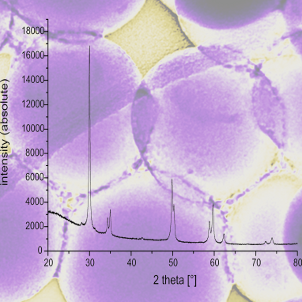
- stability, and oxygen storage capacity [3][4]. Such ceria/zirconia solid composite materials represent solid solutions in which the Ce/Zr ratio can be adjusted over a wide range. It has been shown that CexZr1−xO2 solid solutions have enhanced structural and textural properties, improved thermal stability as
- ., for solid oxide fuel cells), SOFCs [3][5] and electrochromic smart window applications [11]. Adding silica as a support enhances the oxygen storage capacity (OSC) of such ceria–zirconia composite materials [2][4]. Besides synthetic methods such as the thermal decomposition of precursors [12], co




A nanometric cushion for enhancing scratch and wear resistance of hard films
Beilstein J. Nanotechnol. 2014, 5, 1005–1015, doi:10.3762/bjnano.5.114
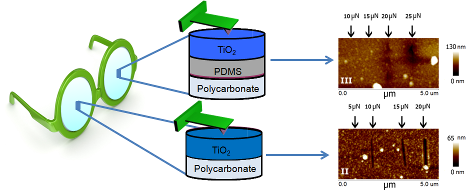
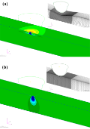
- resistance and friction of the hard thin film on the soft polymeric substrate. The FEA model allows us to understand the contribution of each component to the tribological behavior. This understanding can improve the design of composite materials for optimization of wear and friction. This work, in



Resonance of graphene nanoribbons doped with nitrogen and boron: a molecular dynamics study
Beilstein J. Nanotechnol. 2014, 5, 717–725, doi:10.3762/bjnano.5.84
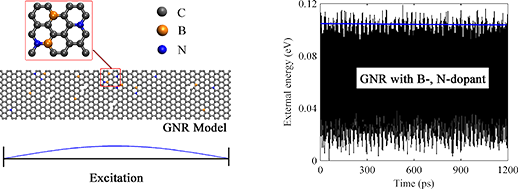
- , photonics, composite materials, energy generation and storage, sensors, and biomedicine or bio-applications [3][4][5]. A great effort has been devoted to modify the properties of graphene to facilitate these promising applications, which leads to a variety of graphene derivatives or hybrid structures


Hole-mask colloidal nanolithography combined with tilted-angle-rotation evaporation: A versatile method for fabrication of low-cost and large-area complex plasmonic nanostructures and metamaterials
Beilstein J. Nanotechnol. 2014, 5, 577–586, doi:10.3762/bjnano.5.68
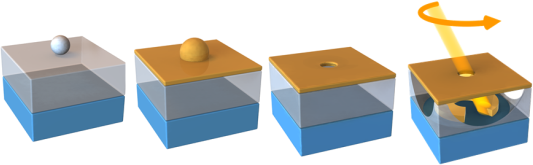
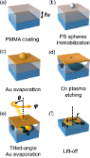
- plasmonic nanostructures as well as metamaterials. In this paper, we describe the fabrication process step by step. We manufacture a variety of different plasmonic structures ranging from simple nano-antennas over complex chiral structures to stacked composite materials for applications such as sensing


Chemi- vs physisorption in the radical functionalization of single-walled carbon nanotubes under microwaves
Beilstein J. Nanotechnol. 2014, 5, 537–545, doi:10.3762/bjnano.5.63
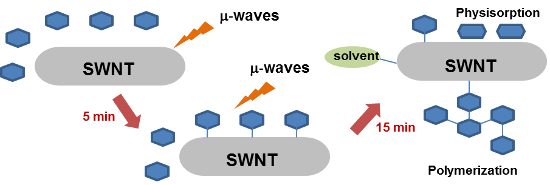
- functionalization; grafting; microwaves; physisorption; Introduction Carbon nanotubes (CNTs) are recognized to have a huge potential in a variety of applications such as electronics, composite materials, energy storage and medicine [1][2][3][4]. From bulk synthesis method, CNTs are often entangled contingent upon




AFM as an analysis tool for high-capacity sulfur cathodes for Li–S batteries
Beilstein J. Nanotechnol. 2013, 4, 611–624, doi:10.3762/bjnano.4.68
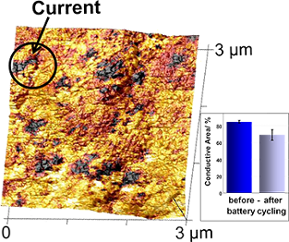
- ]. Capacity fading due to structural and volume changes was reported in several publications [4][9][10][11][12][13]. Therefore, to achieve a high performance Li–S battery, it is necessary to restrict the changes in the morphology and volume of the cathode. Recent advances with graphene–sulfur composite
- materials demonstrated reasonably high and stable specific capacities of up to 600 mA·g(sulfur)−1 over more than 100 cycles [13][14]. One way to suppress the polysulfide shuttle mechanism and to enhance the sulfur retention is to coat the electrodes. This can be performed by physical vapour deposition of a



Conducting composite materials from the biopolymer kappa-carrageenan and carbon nanotubes
Beilstein J. Nanotechnol. 2012, 3, 415–427, doi:10.3762/bjnano.3.48
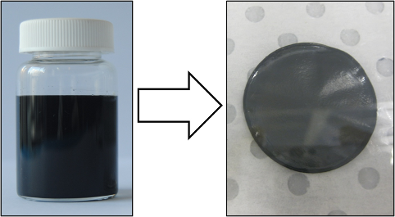
- prepared by evaporative casting. All composite films displayed sensitivity to water vapour, but MWNT films were more sensitive than SWNT films. Keywords: biopolymers; carbon nanotubes; carrageenan; composite materials; conductivity; mechanical; rheology; Introduction Carbon nanotubes (CNTs) have
- . These observations are in agreement with our previous observations for biopolymer composite materials [8]. It was not possible to calculate the CNT mass or volume fractions for buckypapers, as it is unknown what was lost during the filtration process. In our previous work, we showed that the contact
- outperforming SWNT films. This work contributes toward the development of conducting biopolymer composite materials. Experimental Materials The biopolymer iota-carrageenan (KC, molecular weight range 350,000–800,000 g/mol, Genuvisco type CI-102, lot # SKS2500) was donated by CP Kelco (USA). Multiwalled carbon





