Search results
Search for "defects" in Full Text gives 746 result(s) in Beilstein Journal of Nanotechnology. Showing first 200.
Exploring surface charge dynamics: implications for AFM height measurements in 2D materials
Beilstein J. Nanotechnol. 2024, 15, 767–780, doi:10.3762/bjnano.15.64
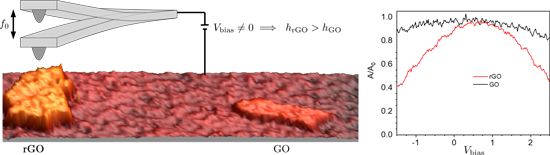
- [23][24], or electrochemical properties [25] is a key topic of research. Factors such as flake size and shape, composition, density of defects, or doping significantly influence the response of 2D materials. Given the nanoscopic scale underlying the functionality of 2D materials, atomic force


Green synthesis of biomass-derived carbon quantum dots for photocatalytic degradation of methylene blue
Beilstein J. Nanotechnol. 2024, 15, 755–766, doi:10.3762/bjnano.15.63
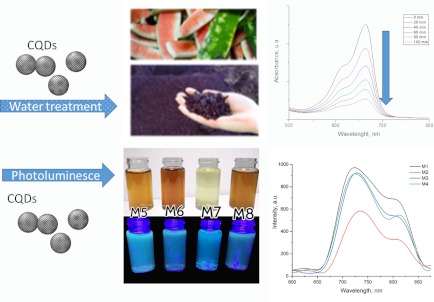
- ) which promotes the inclusion of heteroatoms into the CQDs. All the prepared CQDs samples presented an intensity ratio (ID/IG) around 1.0, which corresponds to a poor crystallinity in the CQDs and, as a consequence, a high relative content of defects. Photoluminescence spectra Investigating the
- fluorescence is intriguing and often associated with the presence of surface defects. Various researchers have highlighted the role of radiative recombination of electron–hole pairs and the influence of functional groups within the carbon network in driving the fluorescence phenomenon [24][30][31]. Furthermore


Effect of repeating hydrothermal growth processes and rapid thermal annealing on CuO thin film properties
Beilstein J. Nanotechnol. 2024, 15, 743–754, doi:10.3762/bjnano.15.62
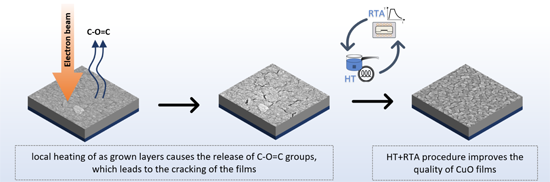
- maximum (FWHM) as well as dislocation density values after annealing the samples at 450 °C indicates a reduction in structural defects and an enhancement in the crystallographic quality of the produced material. The determined parameter values for the 1×, 2×, and 3× samples exhibit only a minor range of
- reduction of defects, contamination of the film, as well as reconstruction of the film surface. Important information is provided by the histograms of the work function values as their shape indicates the non-uniformity of the contact voltage in the analyzed area. On the presented maps, a slight difference
- a lower signal, which means that the electrical properties of some grains had changed. These inhomogeneities may be caused by various factors. One is the effects occurring at grain boundaries or structural defects in the boundaries. The defects disrupt the crystalline order and affect the electronic




Simultaneous electrochemical determination of uric acid and hypoxanthine at a TiO2/graphene quantum dot-modified electrode
Beilstein J. Nanotechnol. 2024, 15, 719–732, doi:10.3762/bjnano.15.60
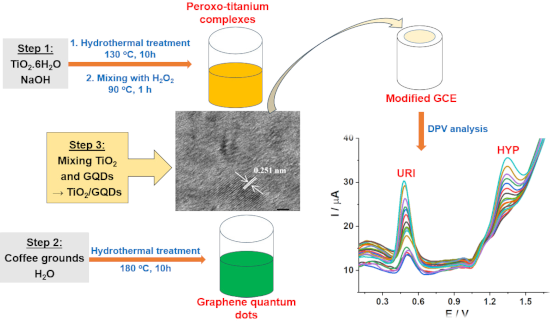
- are seen at 144, 395, 516, and 639 cm−1, respectively [28]. In the Raman spectrum of GQDs, the peak at 1353 cm−1 can be attributed to the D band, which can be assigned to the vibrations of carbon atoms because of the presence of structural defects. The peak at 1576 cm−1 can be assigned to the G band


Elastic modulus of β-Ga2O3 nanowires measured by resonance and three-point bending techniques
Beilstein J. Nanotechnol. 2024, 15, 704–712, doi:10.3762/bjnano.15.58
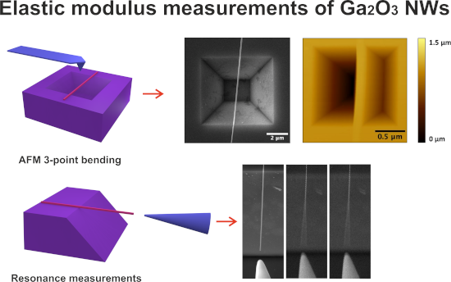
- individual NWs (see Figure 1b and Figure 1c). The as-grown NWs typically are single crystalline without any distinguishable planar structural defects, such as twin boundaries or stacking faults. Fast Fourier transformation (FFT) was performed on the TEM images to ascribe the crystalline planes and determine
- error simulations of the geometry uncertainty indicate that a ±25 nm width error (SEM method) and ±15 nm height error (AFM method) for NWs with 100 nm width/height corresponds to the observed scattering in elastic modulus values in Figure 4. Finally, point defects, such as oxygen vacancies, can increase
- high concentration of such point defects. This could then partially be responsible for their lower elastic modulus values in comparison to that of the bulk material. Furthermore, planar structural defects, such as stacking faults, can also influence the mechanical properties of NWs. However, reports


Aero-ZnS prepared by physical vapor transport on three-dimensional networks of sacrificial ZnO microtetrapods
Beilstein J. Nanotechnol. 2024, 15, 490–499, doi:10.3762/bjnano.15.44
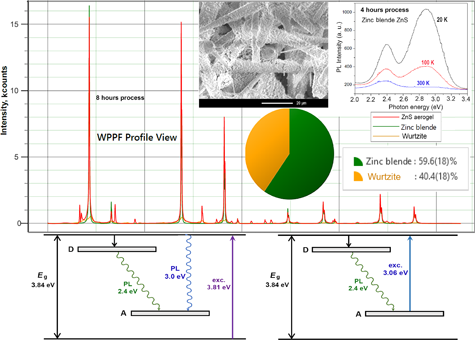
- in vacuum, as shown in Figure 5b. As it has been shown previously, the oxygen vacancy defects in nanocomposite materials can act as active centers during photocatalytic oxidation processes by capturing photoinduced electrons, thus contributing to a substantial improvement of photocatalytic activity



Photocatalytic degradation of methylene blue under visible light by cobalt ferrite nanoparticles/graphene quantum dots
Beilstein J. Nanotechnol. 2024, 15, 475–489, doi:10.3762/bjnano.15.43
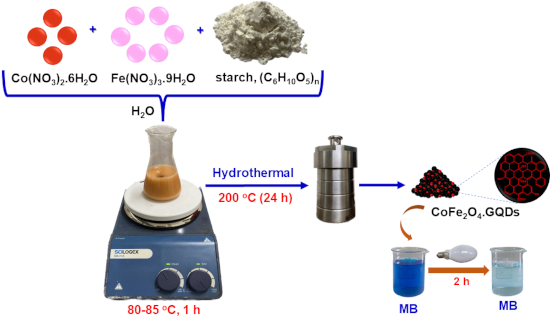
- GQDs is still unclear. It is possible that electron–hole recombination, quantum effects, and surface defects in the functional groups of the GQDs are involved [18]. The XRD pattern of GQDs prepared from starch without iron and cobalt salts is presented in Figure 2c. The diffraction peaks of the GQDs




Heat-induced morphological changes in silver nanowires deposited on a patterned silicon substrate
Beilstein J. Nanotechnol. 2024, 15, 435–446, doi:10.3762/bjnano.15.39
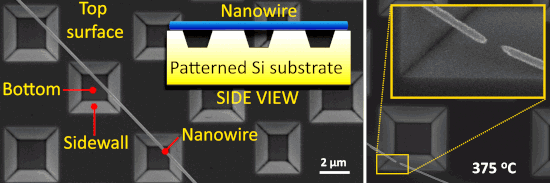
- defects in the middle of the suspended part. This effect should be even more pronounced if we assume that a NW is deformed and stressed only in the early stage of the hot phase followed by a gradual relaxation of the NW by the means of heat-enhanced rearrangement of Ag atoms at the contact with the
- , especially considering the greatly reduced mobility of Ag atoms at lower temperatures preventing slippage of the NW relative to the Si substrate. As a result, defects and necking develop in the middle of the suspended part, which agrees with the experimentally observed necking in scheme 1 (Figure 4). As
- shown above (Figure 3), heat-induced splitting tends to first occur at regions that have significant structural defects, which is also discussed in more detail by Mayoral et al. [46] and Sun et al. [47]. According to the latter, atoms in a NW tend to diffuse away from the regions of critical defects


Unveiling the nature of atomic defects in graphene on a metal surface
Beilstein J. Nanotechnol. 2024, 15, 416–425, doi:10.3762/bjnano.15.37
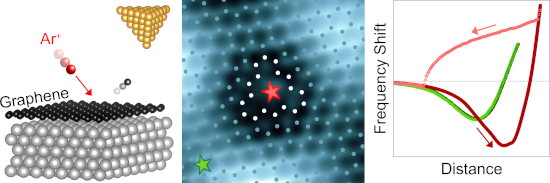
- Karl Rothe Nicolas Neel Jorg Kroger Institut für Physik, Technische Universität Ilmenau, D-98693 Ilmenau, Germany 10.3762/bjnano.15.37 Abstract Low-energy argon ion bombardment of graphene on Ir(111) induces atomic-scale defects at the surface. Using a scanning tunneling microscope, the two
- smallest defects appear as a depression without discernible interior structure suggesting the presence of vacancy sites in the graphene lattice. With an atomic force microscope, however, only one kind can be identified as a vacancy defect with four missing carbon atoms, while the other kind reveals an
- intact graphene sheet. Spatially resolved spectroscopy of the differential conductance and the measurement of total-force variations as a function of the lateral and vertical probe–defect distance corroborate the different character of the defects. The tendency of the vacancy defect to form a chemical


On the mechanism of piezoresistance in nanocrystalline graphite
Beilstein J. Nanotechnol. 2024, 15, 376–384, doi:10.3762/bjnano.15.34
- , and graphene is already in use as a transparent and flexible conductor. However, graphene intrinsically lacks a strong response, and only by engineering defects, such as grain boundaries, one can induce piezoresistivity. Nanocrystalline graphene (NCG), a derivative form of graphene, exhibits a high
- density of defects in the form of grain boundaries. It holds an advantage over graphene in easily achieving wafer-scale growth with controlled thickness. In this study, we explore the piezoresistivity in thin films of nanocrystalline graphite. Simultaneous measurements of sheet resistance and externally
- increase of resistance in amorphous carbon and gold films at large strain is crack formation. Also, in NCG, which is full of GBs and defects, crack formation and propagation have to be considered [36]. Assuming nanocrack formation at the GBs, we could understand the entire piezoresistance curve in the


Investigating ripple pattern formation and damage profiles in Si and Ge induced by 100 keV Ar+ ion beam: a comparative study
Beilstein J. Nanotechnol. 2024, 15, 367–375, doi:10.3762/bjnano.15.33
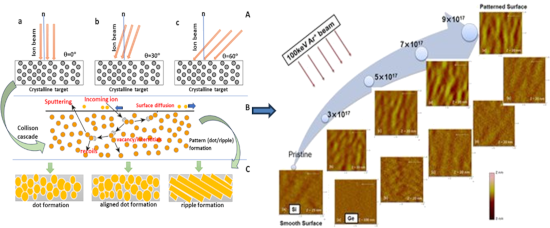
- using atomic force microscopy, and induced damage profiles inside Si and Ge by Rutherford backscattering spectrometry and transmission electron microscopy. The ripple wavelength was found to scale with ion fluence, and energetic ions created more defects inside Si as compared to that of Ge. Although
- clustering of defects leads to a subsequent increase of the damage peak in irradiated samples (for an ion fluence of ≈9 × 10¹⁷ ions/cm2) compared to that in unirradiated samples. Keywords: atomic force microscopy; ion beam; nanopatterns; radiation damage; Rutherford backscattering spectrometry; transmission
- channelling mode have been used to study defects in crystals for more than a few decades now [33][34]. It imparts the useful information about the structure and composition of materials through the damage fraction studies of ion-bombarded crystalline samples by detecting the backscattered beam of high-energy


Controllable physicochemical properties of WOx thin films grown under glancing angle
Beilstein J. Nanotechnol. 2024, 15, 350–359, doi:10.3762/bjnano.15.31
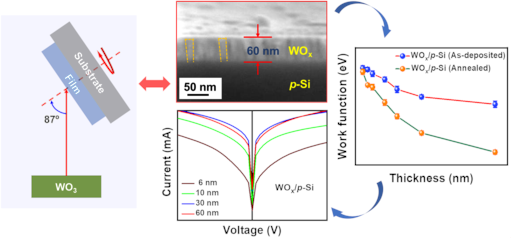
- concentration within a metal oxide film is known to influence its bandgap and work function values. As OV increases, there is a corresponding rise in electron concentration within the bandgap region, which results in the formation of certain localized electronic states associated with these vacancy defects


Determining by Raman spectroscopy the average thickness and N-layer-specific surface coverages of MoS2 thin films with domains much smaller than the laser spot size
Beilstein J. Nanotechnol. 2024, 15, 279–296, doi:10.3762/bjnano.15.26
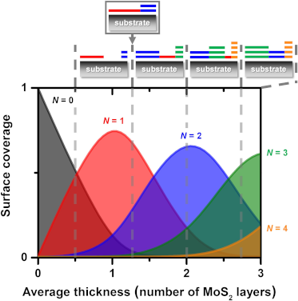
- of MoS2 flakes produced by different methods. Among these techniques, Raman spectroscopy is widely used thanks to its convenience, non-destructiveness, and sensitivity to materials change, including strain, temperature, doping, and defects [26]. Concerning the characterization of MoS2 flakes
- factors (e.g., stacking, strain, doping, and defects), the Raman intensities measured with a single laser wavelength close to exciton energies can be affected by external factors and differ for samples elaborated by different methods. For these reasons and in the aim to use Raman spectroscopy to count the
- domains as well as a higher number of defects. Exfoliated MoS2 flakes as reference samples We performed Raman experiments on mechanically exfoliated MoS2 [1] that will serve as reference samples. The stacking sequence in exfoliated MoS2 flakes is of the 2Hc-type [34]. The common feature of all these


Vinorelbine-loaded multifunctional magnetic nanoparticles as anticancer drug delivery systems: synthesis, characterization, and in vitro release study
Beilstein J. Nanotechnol. 2024, 15, 256–269, doi:10.3762/bjnano.15.24
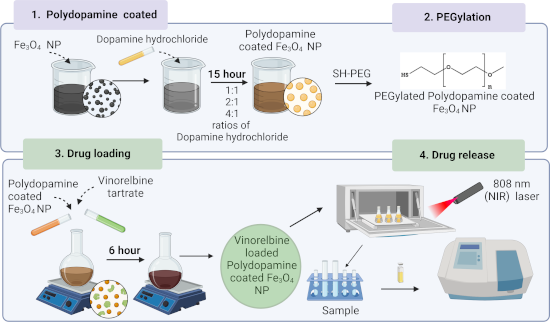
- the Fe3O4 NPs [45]. Various factors such as the crystal structure of the material, dimensions, morphology, and density of crystal defects significantly affect the magnetic properties [46]. The saturation magnetization (Ms) values of NPs measured at 298 K using a VSM are given in Figure 2c. The values


Graphene removal by water-assisted focused electron-beam-induced etching – unveiling the dose and dwell time impact on the etch profile and topographical changes in SiO2 substrates
Beilstein J. Nanotechnol. 2024, 15, 190–198, doi:10.3762/bjnano.15.18
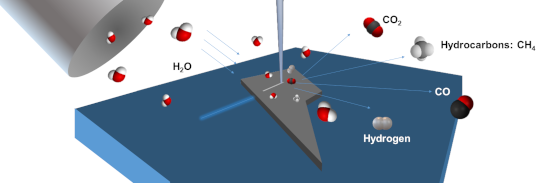
- -beam bombardment, which initially introduces defects into the graphene structure and then knocks out carbon atoms, although the edges of the fabricated nanostructures remain rough after the process [11]. Other direct techniques, such as focused ion beam (FIB) milling with heavy Ga+ ions, are not
- applicable due to the high impact on the underlying substrate. Helium ion milling was believed to be the most suitable tool for structuring graphene [12]. However, it requires expensive equipment, and even this technique introduces a substantial number of defects into the graphene layer, as shown by Kim et
- substrate, which contains a low amount of defects as described elsewhere [27]. In the first part of the present contribution, we demonstrate how the beam parameters and the dose affect the etched profiles and consequently the lateral resolution of water-assisted FEBIE of graphene. The Raman analysis


In situ optical sub-wavelength thickness control of porous anodic aluminum oxide
Beilstein J. Nanotechnol. 2024, 15, 126–133, doi:10.3762/bjnano.15.12
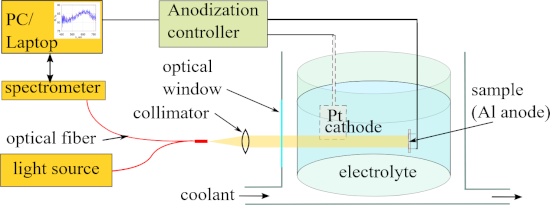
- ] and optical sensors [4][5], require precise control of PAAO layer thickness in the optical sub-wavelength range. Among other examples, by tuning the thickness of PAAO between 200 and 600 nm, it becomes possible to selectively enhance or suppress photoluminescence (PL) bands originating from defects in


Berberine-loaded polylactic acid nanofiber scaffold as a drug delivery system: The relationship between chemical characteristics, drug-release behavior, and antibacterial efficiency
Beilstein J. Nanotechnol. 2024, 15, 71–82, doi:10.3762/bjnano.15.7
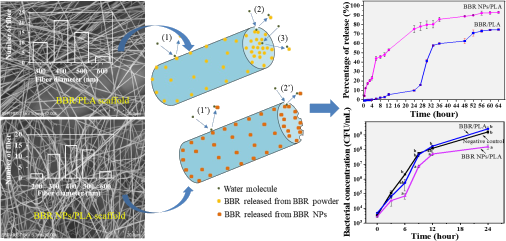
- treatment of bone defects [21]. In dentistry, anti-infective nanofiber-based drug-release systems have been investigated for periodontal disease control, endodontic therapy, cariogenic microorganism control, and tissue reconstruction [25]. Due to the controlled drug release, BBR-loaded nanofiber scaffolds
- exhibited excellent performance in repairing bone defects [3][26], healing diabetic foot ulcers [27], promoting hemostasis [28], acting as anti-leishmanial drugs [29], and inhibiting microbial agents [27][30]. Zhou et al. [31] developed hybrids of nanofibers and microparticles for dual-step controlled


unDrift: A versatile software for fast offline SPM image drift correction
Beilstein J. Nanotechnol. 2023, 14, 1225–1237, doi:10.3762/bjnano.14.101
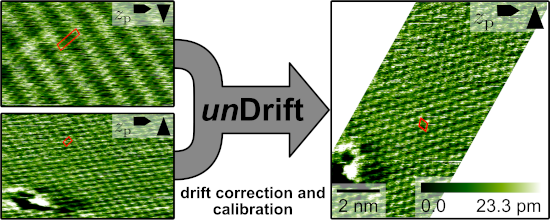
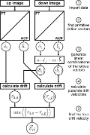
- ]. Offline drift correction strategies, in contrast, correct the effect of drift in SPM images after the measurement. Drift correction has been carried out based on the apparent movement of stationary features (e.g., fixed defects or adsorbates) traceable in consecutive images [5][29][30][31] or images with
- surface features whose positions are actually constant, such as defects and step edges. This is illustrated in Figure 3, where the stationary surface features marked with colored crosses seem to move between Figure 3a and Figure 3b. Here, it is important to note that all stationary features “moved” by the
- optimized lattices as found by unDrift are shown as red lines. Only the centers of the autocorrelations are shown. (a, b) Two consecutive up images recorded with high-resolution AFM on calcite(10.4) in ultrahigh vacuum. The images show several defects, whose positions are marked with colored crosses in both


Spatial variations of conductivity of self-assembled monolayers of dodecanethiol on Au/mica and Au/Si substrates
Beilstein J. Nanotechnol. 2023, 14, 1169–1177, doi:10.3762/bjnano.14.97
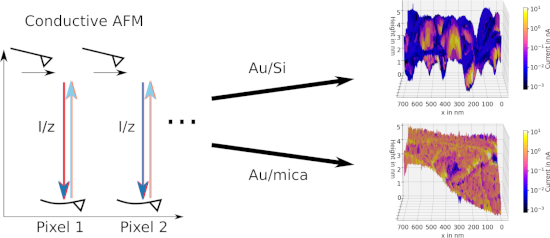
- substrate and the mercury electrode yields the conductivity of the SAM, averaged over the contact area of the mercury droplet. In such studies, one of the crucial problems was mercury filling out defects in the SAMs, which leads to short circuits and unreliable currents running through the microcontact


Density functional theory study of Au-fcc/Ge and Au-hcp/Ge interfaces
Beilstein J. Nanotechnol. 2023, 14, 1093–1105, doi:10.3762/bjnano.14.90
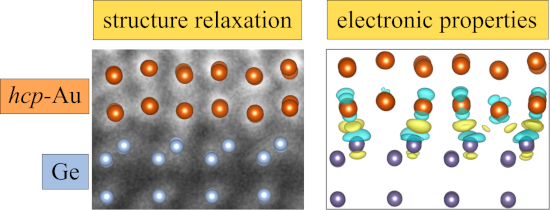
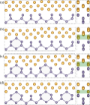
- . Our DFT calculations for the Au-fcc(011)/Ge(001) junction show how the presence of defects in the interface layer can help to stabilize the atomic pattern, consistent with microscopic images. Although the Au-hcp/Ge interface is characterized by a similar interface energy, it reveals large atomic
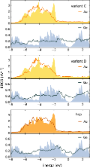
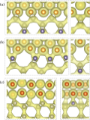
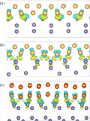
- microscopy image [23] one can identify the Au-hcp plane parallel to Ge substrate as (010). We discuss the optimized structures and defects that could stabilize the interface. Finally, we demonstrate the electronic properties of Au/Ge junctions and the formation of Ge–Au bonds at the interface. The Appendices
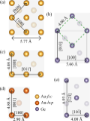
- variant by introducing defects into the interface layer. We investigated three supercells of variant D, in which some pairs of Au atoms in the interface layer were replaced by Ge atoms. Their optimized atomic arrangements are presented in Figure 7b–d. We can observe that while one such defect, shown in





Experimental investigation of usage of POE lubricants with Al2O3, graphene or CNT nanoparticles in a refrigeration compressor
Beilstein J. Nanotechnol. 2023, 14, 1041–1058, doi:10.3762/bjnano.14.86
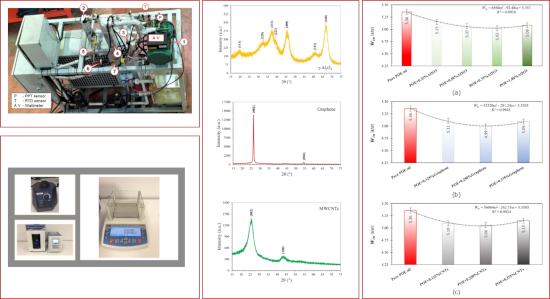
- /(m·K) [39], respectively. On the other hand, graphene has a thermal conductivity coefficient ranging from 4840 to 5300 W/(m·K) [39]. These data on thermal conductivity coefficients are applicable to pristine materials. However, impurities and defects of the materials strongly impact their heat
- transport behaviour. The characterisation of the materials discussed in the Methodology section did not reveal any obvious impurities or defects. Nevertheless, enriching the characterisation of the graphene nanoplatelets may facilitate the understanding of the dominant effect of graphene on compressor power





A visible-light photodetector based on heterojunctions between CuO nanoparticles and ZnO nanorods
Beilstein J. Nanotechnol. 2023, 14, 1018–1027, doi:10.3762/bjnano.14.84
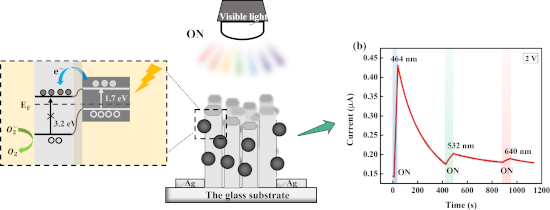
- , these methods still face problems, including the requirements of controlling defects, scale-up for mass production, or troubles relating to decoration uniformity [31][32]. Another method is to form heterojunctions of ZnO and other narrow-bandgap semiconductors (NiO [33], PbS [34], CdS [35], and MoS2[36


Exploring internal structures and properties of terpolymer fibers via real-space characterizations
Beilstein J. Nanotechnol. 2023, 14, 1004–1017, doi:10.3762/bjnano.14.83
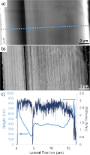
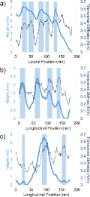
- scans (Figure 5a,b) show that elevated fibrils exhibit high transverse stiffness. This high stiffness suggests that the material within Technora® fibrils is well-ordered, that is, lacking compliant nanoscale subdomains that may arise from voids, mismatched molecules, or other defects. Furthermore, line






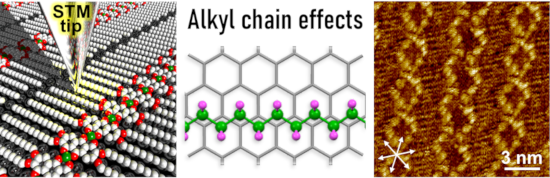
Two-dimensional molecular networks at the solid/liquid interface and the role of alkyl chains in their building blocks
Beilstein J. Nanotechnol. 2023, 14, 872–892, doi:10.3762/bjnano.14.72
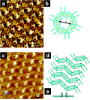
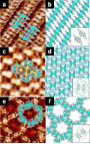
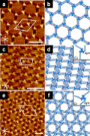
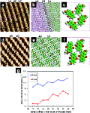
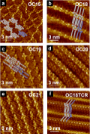
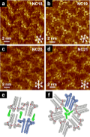
- domains with fewer defects than NDI-Cn (Figure 15a–d). Such large-area ordering due to the interdigitated structure was attributed to the larger dispersion interactions of the unsaturated chains compared to that of the fully saturated ones. The stabilizing effect of unsaturated alkyl chains has been also









Ultralow-energy amorphization of contaminated silicon samples investigated by molecular dynamics
Beilstein J. Nanotechnol. 2023, 14, 834–849, doi:10.3762/bjnano.14.68
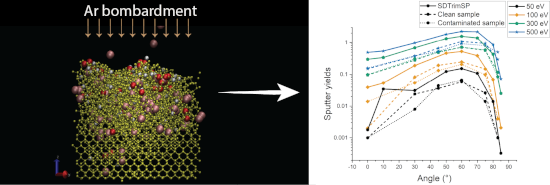
- . The 500 subsequent bombardments with their collision cascades lead to the displacement of target atoms, creating disorder and point defects. Hydrogen and oxygen atoms get mixed into the target and can get trapped at interstitial or vacancy sites. The different kind of defects are not intrinsically