


Search results
Search for "exfoliation" in Full Text gives 114 result(s) in Beilstein Journal of Nanotechnology.
Liquid-phase exfoliated graphene: functionalization, characterization, and applications
Beilstein J. Nanotechnol. 2014, 5, 2328–2338, doi:10.3762/bjnano.5.242
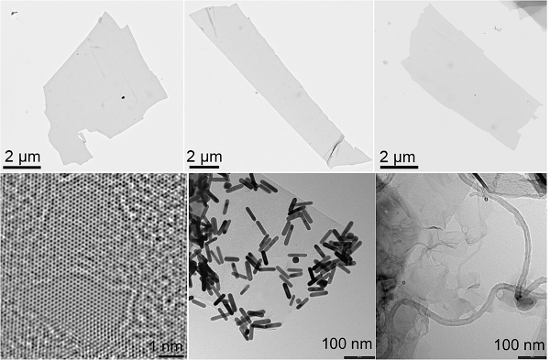
- exfoliation of graphite in water and organic solvents. The challenges involve the production of a large quantity of graphene sheets with tailored distribution in thickness, size, and shape. In this review, we present some of the recent efforts towards the controlled production of graphene in dispersions. We
- ]. Among them, micromechanical exfoliation [2] and metal supported growth [3] produced the best layers in terms of electrical and structural quality. Unfortunately, these strategies are time consuming, expensive or produce low material yield. It is crucial to push these methodologies forward towards the
- graphene layers and the colloidal mechanisms that guide stabilization of graphene sheets possessing diverse physical and chemical features such as charge, size and shape. To date, the exfoliation of graphite in dispersions has been obtained by a number of mechanochemical methods. Each one of these


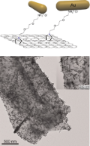


Nanobioarchitectures based on chlorophyll photopigment, artificial lipid bilayers and carbon nanotubes
Beilstein J. Nanotechnol. 2014, 5, 2316–2325, doi:10.3762/bjnano.5.240
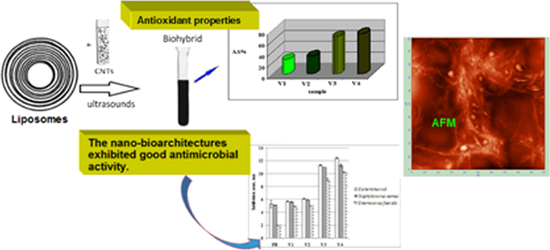
- exfoliation of CNT bundles in the case of free-cholesterol biohybrids (sample V3). On the contrary, the cholesterol-containing, carbon-based biohybrids (sample V4) proved to be more effective in CNT dispersion. In this case, the AFM analysis revealed a lipid coating around the carbon nanotubes that prevents


Two-dimensional and tubular structures of misfit compounds: Structural and electronic properties
Beilstein J. Nanotechnol. 2014, 5, 2171–2178, doi:10.3762/bjnano.5.226

- )1.00MoSe2, and (SnSe)1.03MoSe2 [5][6][7][8], and misfit layer compounds consisting of other elements such as tellurium [9] or lanthanides [10] have been synthesized. Although some misfit compounds occur naturally [1][11], the recent developments in the synthesis, exfoliation, and handling of layered, two
- exfoliation is easily possible [24]. As a consequence of their structure, interaction between the M atoms of the MX layer and the X atoms of the TMX2 layer exists in all misfit compounds. In each unit cell this interaction occurs twice: at the top and the bottom sides of the layers. This can be seen in Figure


Donor–acceptor graphene-based hybrid materials facilitating photo-induced electron-transfer reactions
Beilstein J. Nanotechnol. 2014, 5, 1580–1589, doi:10.3762/bjnano.5.170
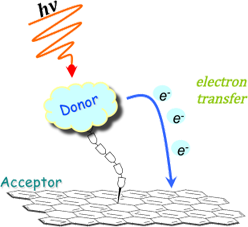
- surfaces [5][6], liquid exfoliation via sonication [7][8], dissolution in superacids such as chlorosulfonic acid [9] and ball milling [10]. However, a major drawback of graphene, likewise of carbon nanotubes, stems from its insolubility in all solvents, which impedes the chemical manipulation toward
- electronic properties of graphene are of primary importance. Alternatively, wet exfoliation of graphite followed by functionalization is a more efficient strategy. Although functionalization of exfoliated graphene can be achieved by either covalent anchoring of organic molecules onto the graphene lattice [13
- chemical reactions leading to the covalent modification of a graphene framework are displayed. Briefly, after the exfoliation of graphite, the following reactions can be performed to modify the graphene sheet (summarized in Scheme 1): [3 + 2] 1,3-Dipolar cycloaddition of in situ generated azomethine ylides


Highly NO2 sensitive caesium doped graphene oxide conductometric sensors
Beilstein J. Nanotechnol. 2014, 5, 1073–1081, doi:10.3762/bjnano.5.120
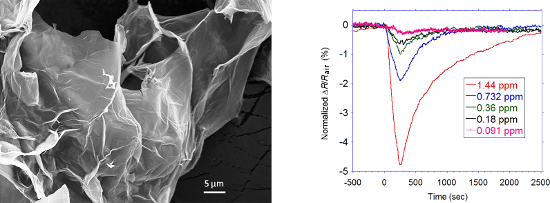
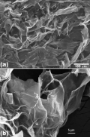
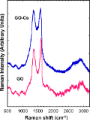
- processes to make pristine graphene sheets, like chemical vapour deposition, epitaxial growth or mechanical exfoliation [30][31][32][33]. By dispersion and sonication of graphite oxide in aqueous solution or organic solvent, a colloidal suspension of GO sheets is produced. The density of oxygen functional




Nanostructure sensitization of transition metal oxides for visible-light photocatalysis
Beilstein J. Nanotechnol. 2014, 5, 696–710, doi:10.3762/bjnano.5.82
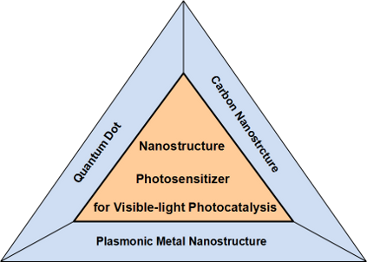
- electron–hole pairs and further improve the photocatalytic ability [145]. The last feature is that an appreciable number of ion-exchangeable semiconductors can be exfoliated into single-layer two-dimensional (2D) nanosheets by the intercalation–exfoliation method, as shown in Figure 10. The thickness of


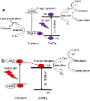


Fullerenes as adhesive layers for mechanical peeling of metallic, molecular and polymer thin films
Beilstein J. Nanotechnol. 2014, 5, 394–401, doi:10.3762/bjnano.5.46
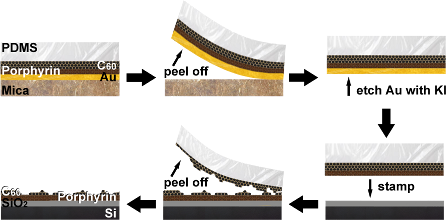
- , the transfer and removal of monolayer films has been widely adopted by graphene researchers through exfoliation [10] and, for samples grown by chemical vapour deposition, by etching the underlying metal thin film or foil used as a growth substrate [11][12][13]. In a complementary strand of research




Routes to rupture and folding of graphene on rough 6H-SiC(0001) and their identification
Beilstein J. Nanotechnol. 2013, 4, 625–631, doi:10.3762/bjnano.4.69
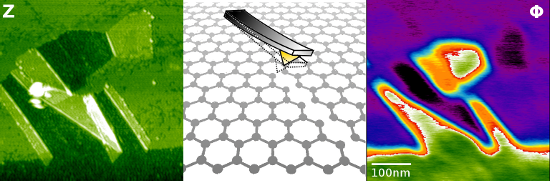
- various ways. The growth of graphene on metals followed by transfer to another substrate as well as epitaxial growth on SiC, both have a potential for mass production if technological shortcomings can be overcome. However, exfoliation from graphite still results in graphene flakes of highest quality [1][2
- ]. Severe heating results in the opening at locations of existing rupture, creating type (iii) structures. For this type of modification, the interfacial layer residing between the substrate and the SLG flake due to its exfoliation in ambient, is anticipated to play a major role. Thin water films resulting
- from exfoliation in ambient have been recognized in literature as an important feature determining the sheet properties [33][34][35][36][37][38][39]. The structures of type (iii) might act as a pressure release for heated water confined at the interface. The dashed box in Figure 3a shows the same


Micro- and nanoscale electrical characterization of large-area graphene transferred to functional substrates
Beilstein J. Nanotechnol. 2013, 4, 234–242, doi:10.3762/bjnano.4.24
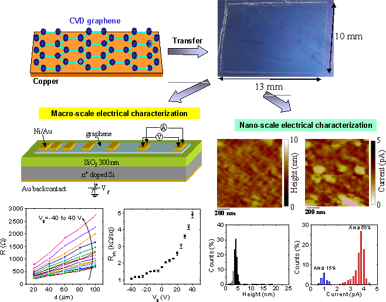
- flexible organic solar cells [9][10]. Currently, the most used method of graphene production for basic studies is the mechanical exfoliation of graphite [1], which was the first method to obtain graphene under ambient laboratory conditions. This method yields graphene fragments of excellent crystalline



Pure hydrogen low-temperature plasma exposure of HOPG and graphene: Graphane formation?
Beilstein J. Nanotechnol. 2012, 3, 852–859, doi:10.3762/bjnano.3.96
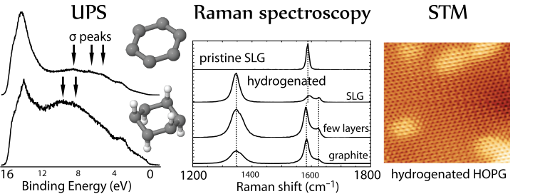
- spectroscopy measurements were prepared by exfoliation of HOPG using a PDMS stamp and transferring them on SiO2 [42]. The number of layers was determined from the 2D peak of the Raman spectra, which was acquired prior to plasma treatment. An intermittent contact-mode AFM experiment was performed by means of a



A facile approach to nanoarchitectured three-dimensional graphene-based Li–Mn–O composite as high-power cathodes for Li-ion batteries
Beilstein J. Nanotechnol. 2012, 3, 513–523, doi:10.3762/bjnano.3.59
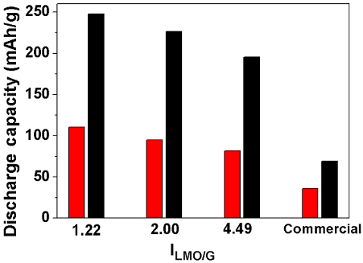
- .3.59 Abstract We report a facile method to prepare a nanoarchitectured lithium manganate/graphene (LMO/G) hybrid as a positive electrode for Li-ion batteries. The Mn2O3/graphene hybrid is synthesized by exfoliation of graphene sheets and deposition of Mn2O3 in a one-step electrochemical process, which
- . There are also some reports on the preparation of LIB anodes using graphene prepared by chemical vapor deposition [33][34]. However, such application will be limited due to cost and scalability. Electrochemical exfoliation is a newly developed method that can be used to prepare highly conductive
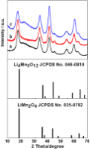
- graphene-based electrode materials, especially for LIB cathodes. In this paper, we report a facile approach to synthesize lithium manganate/graphene (LMO/G) hybrids by combining the exfoliation of graphene sheets with the deposition of Mn2O3 nanowalls in a one-step electrochemical process, followed by




X-ray absorption spectroscopy by full-field X-ray microscopy of a thin graphite flake: Imaging and electronic structure via the carbon K-edge
Beilstein J. Nanotechnol. 2012, 3, 345–350, doi:10.3762/bjnano.3.39
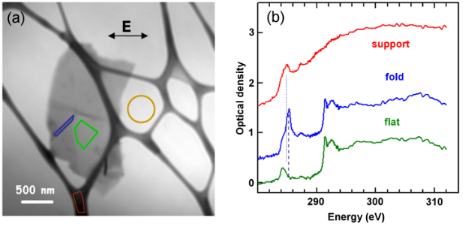
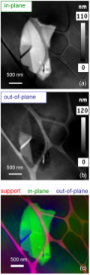
- combined with full-field transmission X-ray microscopy can be used to study the electronic structure of graphite flakes consisting of a few graphene layers. The flake was produced by exfoliation using sodium cholate and then isolated by means of density-gradient ultracentrifugation. An image sequence
- image and to study the electronic structure of a free-standing thin graphite flake produced by means of density-gradient ultracentrifugation (DGU) [20]. In the DGU process the bile salt sodium cholate (C24H39O5Na) is used to promote graphite exfoliation, resulting in graphene–surfactant complexes having
- the spectrum recorded on an amorphous carbon film with the sodium cholate, we suggest that this structure arises instead from metal impurities in the graphite used for exfoliation. A careful examination of the spectrum of the folded region (Figure 2) shows the presence of a shoulder at the same photon


Modeling noncontact atomic force microscopy resolution on corrugated surfaces
Beilstein J. Nanotechnol. 2012, 3, 230–237, doi:10.3762/bjnano.3.26
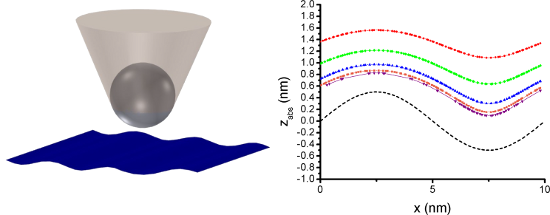
- air to the proper size then quickly transferred into the ultrahigh-vacuum JEOL AFM system (4500A, Nanonis controller). SiO2 samples were baked at 130 °C for cleaning. In order to replicate the experimental substrate preparation often used for graphene exfoliation, no additional cleaning procedures


Surface functionalization of aluminosilicate nanotubes with organic molecules
Beilstein J. Nanotechnol. 2012, 3, 82–100, doi:10.3762/bjnano.3.10
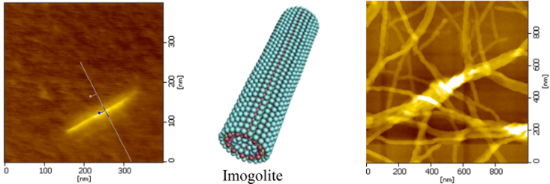
- diffractions at 2.25 and 1.62 nm suggest the presence of imogolite bundles. On the other hand, however, the intensity of the diffractions at 2.25 and 1.62 nm significantly decreased compared with those of the pure imogolite, indicating the exfoliation of the imogolite bundles. Imogolite cylinders may interact





