Search results
Search for "magnetic field" in Full Text gives 325 result(s) in Beilstein Journal of Nanotechnology. Showing first 200.
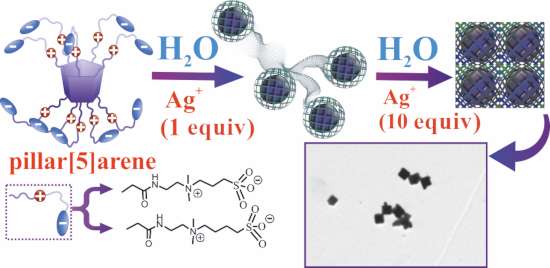
Nanoparticles based on the zwitterionic pillar[5]arene and Ag+: synthesis, self-assembly and cytotoxicity in the human lung cancer cell line A549
Beilstein J. Nanotechnol. 2020, 11, 421–431, doi:10.3762/bjnano.11.33
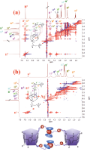
- echo (STE) bipolar gradient pulse pair (stebpgp1s) pulse sequence with 16 scans of 16 data points collected. The maximum gradient strength produced in the z direction was 5.35 G mm−1. The duration of the magnetic field pulse gradients (δ) was optimized for each diffusion time (Δ) in order to obtain a 2




High dynamic resistance elements based on a Josephson junction array
Beilstein J. Nanotechnol. 2020, 11, 417–420, doi:10.3762/bjnano.11.32
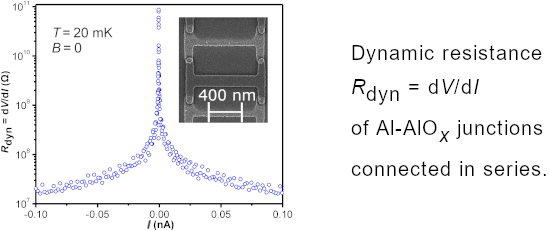
- necessary, a small magnetic field, up to 0.05 T, was applied using small superconducting coils wound directly on the sample holder cap. Results and Discussion The ultimate goal of this work is to study the quantum dynamics of the QPSJ, a system dual to JJ [3], including the observation of Coulomb blockade
- the SQUID-based approach requires application of a finite magnetic field. Given that the electromagnetic horizon of our QPSJ is of the order of ≈100 μm [23][24][25], the corresponding high-impedance current biasing circuit should be of appropriate (small) dimensions. Thus the area of the SQUID is
- small, and hence a magnetic field corresponding to Φ/Φ0 → π/2 can easily reach the ≈10 mT range. At such a magnetic field, two undesirable effects might happen both with the biasing superconducting leads and with the QPSJ. Namely, the formation of Abrikosov vortices and a noticeable suppression of the

Nonequilibrium Kondo effect in a graphene-coupled quantum dot in the presence of a magnetic field
Beilstein J. Nanotechnol. 2020, 11, 225–239, doi:10.3762/bjnano.11.17
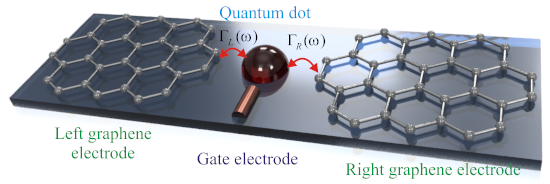
- value even at the Dirac point. The influence of the on-site Coulomb interaction and the magnetic field on the transport properties of the system shows a tendency similar to the previous results obtained for quantum dots connected to metallic electrodes. Most remarkably, we find that the Kondo resonance
- graphene-based quantum dot system provides a platform for potential applications of nanoelectronics. Furthermore, we also propose an experimental setup for performing measurements in order to verify our model. Keywords: graphene; Kondo effect; magnetic field; pseudogap Anderson model; quantum dot
- ][41][42][43][44][45] with the equation of motion (EOM) technique [46][47][48]. In our studies, a magnetic field is applied to the QD causing a Kondo resonance splitting, and a finite on-site Coulomb interaction (U) is considered resulting in a shift of the main QD energy level. Furthermore, an


Plasmonic nanosensor based on multiple independently tunable Fano resonances
Beilstein J. Nanotechnol. 2019, 10, 2527–2537, doi:10.3762/bjnano.10.243
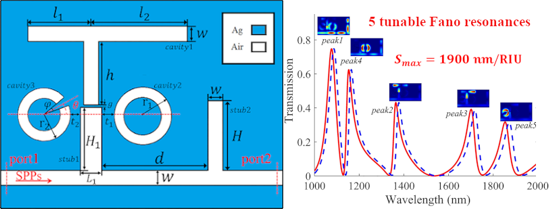
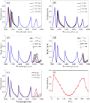
- , the transmittance is almost zero, which is in good agreement with the situation of the dip inset in Figure 2a. Figure 3c–g corresponds to peaks 1–5, respectively. Figure 3c illustrates that the magnetic field energy of peak1 at 1077 nm is mainly concentrated on stub1, stub2 and the middle part of the
- cavity1 (red solid line) in the structure. Transmission spectra of the structure with (red solid line) and without (blue dashed line) cavity3, and (b) the distribution of normalized magnetic field |Hz| at 1320 nm with only stub1 inserted into the bus waveguide. The |Hz| distribution of the total compound
- coupling distance t2 of cavity3 and (e) three specific values of θ. (f) The dependence of the transmission of peak5 on θ. Schematic diagram of cavity3 with different tilt angles θ, (a) θ = 0°, (b) θ = −20°. (c) The distribution of the magnetic field Hz at θ = −20°. (a) Transmission spectra for different




Label-free highly sensitive probe detection with novel hierarchical SERS substrates fabricated by nanoindentation and chemical reaction methods
Beilstein J. Nanotechnol. 2019, 10, 2483–2496, doi:10.3762/bjnano.10.239
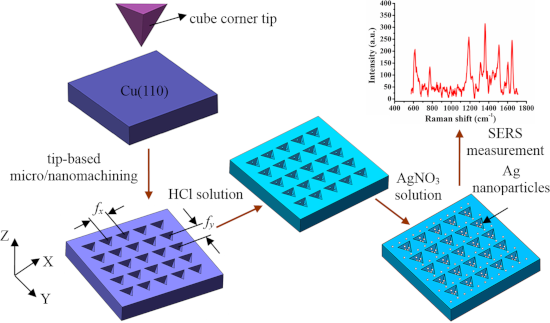
- . The definitions of the geometrical parameters are provided, where E(x), H(y) and K(z) are the electric field, magnetic field, and direction of light propagation, respectively. The electric field intensity is 2.19 V/m, and the radius of the Ag nanoparticle is 100 nm, as computed in air as shown in


Self-assembly of a terbium(III) 1D coordination polymer on mica
Beilstein J. Nanotechnol. 2019, 10, 2440–2448, doi:10.3762/bjnano.10.234
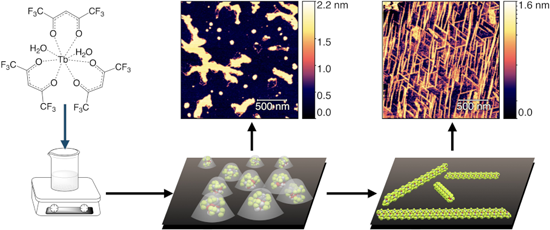
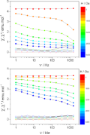
- sample is similar to that of crystalline bulk [Tb(hfac)3·2H2O]n. Namely, two maxima of X″ are observed, which however differently depend on the static magnetic field applied (Figure S3 and Figure S4, Supporting Information File 1) probably due to a partial loss of the magnetic anisotropy of TbIII upon




pH-Controlled fluorescence switching in water-dispersed polymer brushes grafted to modified boron nitride nanotubes for cellular imaging
Beilstein J. Nanotechnol. 2019, 10, 2428–2439, doi:10.3762/bjnano.10.233
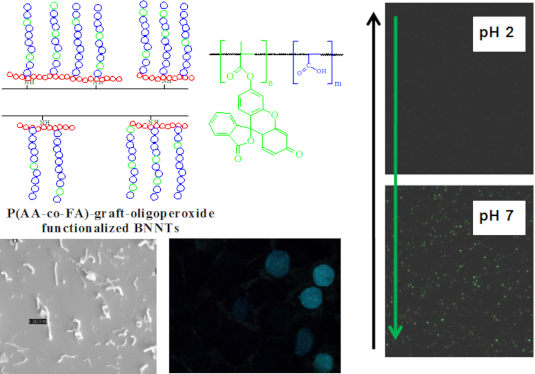
- nanomaterials [1][2][3][4][5] to generate novel structures with tunable properties through external stimuli such as pH, temperature, light, and magnetic field [6][7][8][9][10]. Among other nanomaterials, significant research effort has been dedicated to the use of nanotubes [1][2][3][4][6][7][11][12][13][14][15


Deterministic placement of ultra-bright near-infrared color centers in arrays of silicon carbide micropillars
Beilstein J. Nanotechnol. 2019, 10, 2383–2395, doi:10.3762/bjnano.10.229
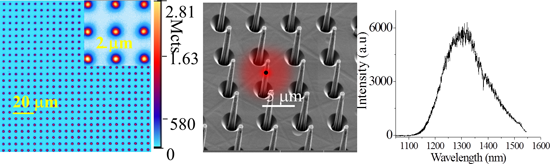
- isotopically pure SiC to δB ≈ 10nT/√Hz [51][52]. By increasing the photoemission collection efficiency (C) of the color centers and the number of emitters (N), as for example in micropillars, the magnetic field sensitivity can be dramatically improved to reach magnetic sensing resolution of δB ≈ 10nT/√(C·N·Hz
- attenuation of X-ray or coherent neutron scattering [23][24]. The DWF can be estimated as the ratio of the ZPL PL emission, compared to the total PL emission, which is the combination of the ZPL PL emission and the phonon-broadened PL. The ZFS refers to the lifting of degeneracy in the absence of a magnetic
- field. Unpaired electrons interact to give two or more energy states [25]. ODMR is a technique to optically pump the electron spin state of a crystal defect for spin initialization and readout [26]. There are over 200 polymorphs of SiC, and the most relevant are cubic SiC (3C) and hexagonal (4H and 6H


Dynamics of superparamagnetic nanoparticles in viscous liquids in rotating magnetic fields
Beilstein J. Nanotechnol. 2019, 10, 2294–2303, doi:10.3762/bjnano.10.221
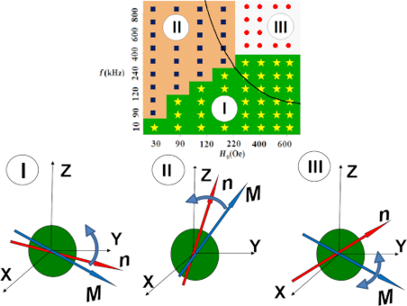
- .10.221 Abstract The dynamics of magnetic nanoparticles in a viscous liquid in a rotating magnetic field has been studied by means of numerical simulations and analytical calculations. In the magneto-dynamics approximation three different modes of motion of the unit magnetization vector and particle
- director are distinguished depending on frequency and amplitude of the rotating magnetic field. The specific absorption rate of a dilute assembly of superparamagnetic nanoparticles in rotating magnetic field is calculated by solving the Landau–Lifshitz stochastic equation for the unit magnetization vector
- and the stochastic equation for the particle director. At elevated frequencies an optimal range of particle diameters is found where the specific absorption rate of an assembly in a rotating magnetic field has a maximum. It is shown that with an optimal choice of the particle sizes sufficiently large


Targeted therapeutic effect against the breast cancer cell line MCF-7 with a CuFe2O4/silica/cisplatin nanocomposite formulation
Beilstein J. Nanotechnol. 2019, 10, 2217–2228, doi:10.3762/bjnano.10.214
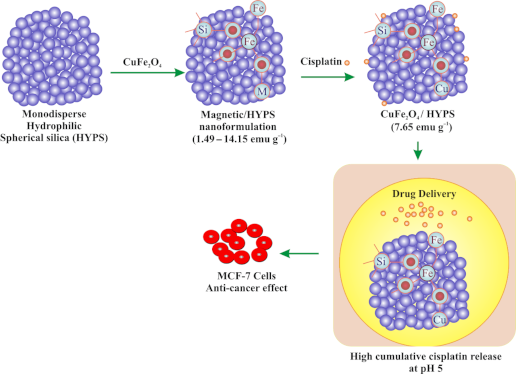
- expected health crisis [1]. However, the single modal drug delivery system is hampered by low bioavailability (about 5–10%), burst release, and lower target efficiency. Multifunctional theranostic nanoparticles that can respond to an external magnetic field for drug release and assist in bioimaging
- external magnetic field [18]. In the case of CuFe2O4 with x value between 0.08 and 0.15, a lower saturated magnetization value was observed (≤1.0 emu/g), while increasing the x value to 0.17 showed a high magnetization of 7.65 emu/g. In order to understand the cisplatin coordination environment of CuFe2O4


Nitrogen-vacancy centers in diamond for nanoscale magnetic resonance imaging applications
Beilstein J. Nanotechnol. 2019, 10, 2128–2151, doi:10.3762/bjnano.10.207
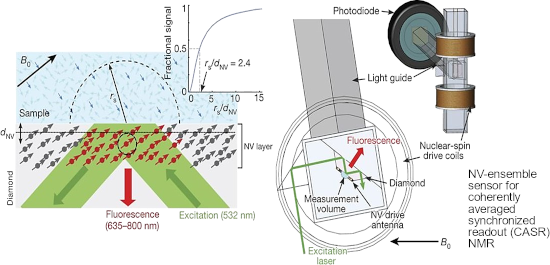
- MRI as a medical technique, with the purpose of imaging soft body tissues and organs through the excitation of their atomic nuclei with high-frequency radio pulses and the measurement of the response in a strong magnetic field. Recent research has included using MRI for nanoscale imaging, enabling
- hyperpolarized. The large-sized particles were hyperpolarized at 25 mK using the brute force polarization method based on the application of a high magnetic field (4T) to increase the Boltzmann population difference in the nuclear spins. In this case, the spin system thermalizes (loses polarization) on
- detectable by conventional EPR methods. The procedure involves an AC RF magnetic field in resonance with the EPR spin frequency, driving the ND electron spin polarization which is then transferred to the interacting 1H nuclei in the water containing the ND. 1H nuclei resonance is then detected by using a


Improved adsorption and degradation performance by S-doping of (001)-TiO2
Beilstein J. Nanotechnol. 2019, 10, 2116–2127, doi:10.3762/bjnano.10.206
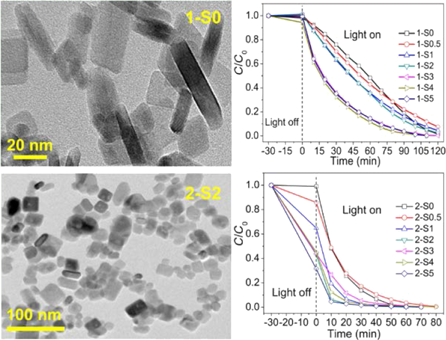
- (De), and the apparent reaction rate constant Kapp for the samples prepared at 250 °C and for P25 TiO2. Textural parameters of all samples. Acknowledgements Part of this work was performed at the Steady High Magnetic Field Facilities, High Magnetic Field Laboratory, CAS. This work was supported by




Review of advanced sensor devices employing nanoarchitectonics concepts
Beilstein J. Nanotechnol. 2019, 10, 2014–2030, doi:10.3762/bjnano.10.198
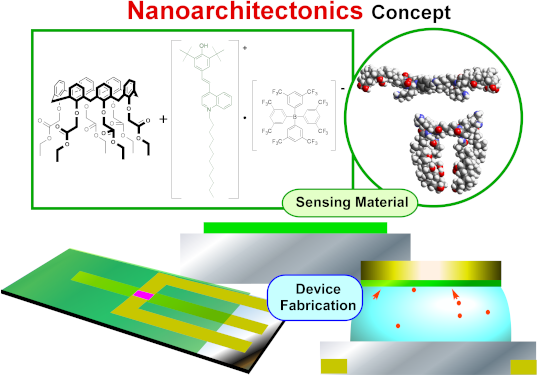
- sensing of general external environments such as pH, humidity, pressure, and magnetic field is undoubtedly important. Spanu et al. reported sensitive pH sensors based on organic charge-modulated field-effect transistor structures with 6,13-bis(triisopropylsilylethynyl)pentacene [95]. The fabricated





Porous silver-coated pNIPAM-co-AAc hydrogel nanocapsules
Beilstein J. Nanotechnol. 2019, 10, 1973–1982, doi:10.3762/bjnano.10.194
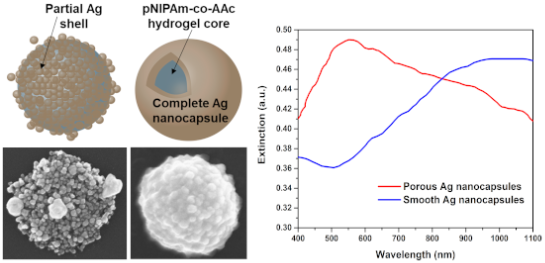
- polymers to create a nanocomposite system in which the outer polymer shell can be thermally activated by absorption of light or by a magnetic field [41][61]. By combining the optical properties of nanoshells and the thermo-responsive activity of hydrogel polymers, the present study seeks to develop a


Magnetic properties of biofunctionalized iron oxide nanoparticles as magnetic resonance imaging contrast agents
Beilstein J. Nanotechnol. 2019, 10, 1964–1972, doi:10.3762/bjnano.10.193
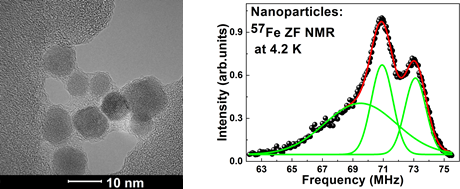
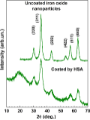
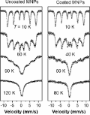
- nanoparticles, has been repeatedly emphasized, and the exact composition of the MNPs is usually determined using X-ray diffraction (XRD) or Mössbauer spectroscopy with and without magnetic field [12][13][14]. In this work, we show other options for solving this problem using Raman and nuclear magnetic resonance
- . Another method that makes it possible to evaluate the magnetic structure of the sample is solid-state 57Fe NMR. This method avoids the use of ionizing radiation and allows data on the structure of the magnetic sample to be obtained under a magnetic field similar to that used in MRI. The purpose of this
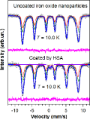
- NMR spectra of 57Fe nuclei in uncoated and HSA-coated samples measured at zero external magnetic field at 4.2 K are shown in Figure 9. The spectra demonstrate a very broad intensity distribution in the range from approximately 62–76 MHz and contain two distinct peaks at 70.9 and 73.0 MHz and a broad




Oblique angle deposition of nickel thin films by high-power impulse magnetron sputtering
Beilstein J. Nanotechnol. 2019, 10, 1914–1921, doi:10.3762/bjnano.10.186
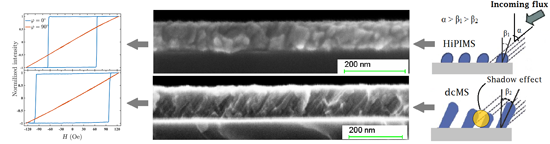
- that a small decrease in the magnetic field strength in the HiPIMS process can lead to a significant increase in the deposition rate in that case [28][29]. We have recently reported an increase by a factor of 2 and 2.6 of the HiPIMS deposition rate by 83% and 53% weakening of the magnetic field
- valve located between the chamber and a turbomolecular pump. The nickel target was 75 mm in diameter, of 99.95% purity, and 1.59 mm thick but almost 40% eroded at the racetrack center. The magnetic field measured at the target surface over the racetrack shows the value of 39 and 0 mT parallel and
- incoming flux to the substrate in those discharges. There have been a few investigations on this matter that all agree that the magnetic field plays a significant role in the profile of deposition. We have recently shown that, depending on the stationary magnetic field configuration, HiPIMS deposition may


Fabrication and characterization of Si1−xGex nanocrystals in as-grown and annealed structures: a comparative study
Beilstein J. Nanotechnol. 2019, 10, 1873–1882, doi:10.3762/bjnano.10.182
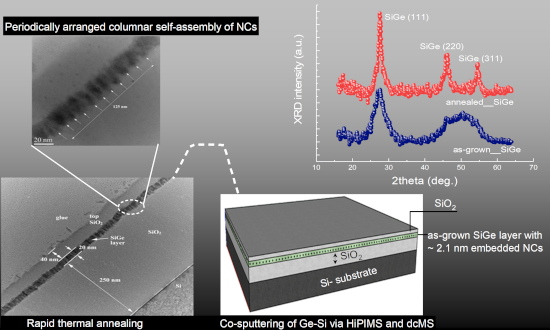
- employed. The Ge target experienced a stronger magnetic field strength |B| than the Si target, opposite to our previous study [22]. Since the deposition rate of Ge is usually higher than that of Si, the |B| is selected accordingly. It has been acknowledged for both dcMS and HiPIMS that the increase in |B


Unipolar magnetic field pulses as an advantageous tool for ultrafast operations in superconducting Josephson “atoms”
Beilstein J. Nanotechnol. 2019, 10, 1548–1558, doi:10.3762/bjnano.10.152
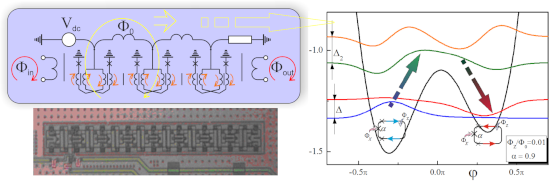
- reversal in superconducting meta-atoms induced by picosecond unipolar pulses of a magnetic field is developed. A promising scheme based on the regime of stimulated Raman Λ-type transitions between qubit states via upper-lying levels is suggested in order to provide ultrafast quantum operations on the
- a magnetic field with picosecond duration and almost rectangular envelopes. Such pulses seem to be very attractive due to their broad frequency spectrum with pronounced near-zero components. The possibilities to control (as well as to read out the states of) either “charge” (including transmons) or
- interaction of a multilevel superconducting meta-atom with unipolar magnetic field pulse. The considered model seems to be fairly general since it takes into account the multilevel structure of a real superconducting system and can be applied to describe the dynamics of qubit states in different types of


Magnetic segregation effect in liquid crystals doped with carbon nanotubes
Beilstein J. Nanotechnol. 2019, 10, 1464–1474, doi:10.3762/bjnano.10.145
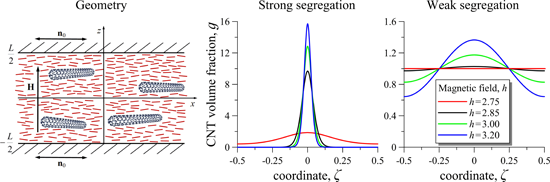
- study the orientational transitions in a suspension of carbon nanotubes in a nematic liquid crystal induced by an external magnetic field. The case of a finite orientational anchoring of liquid crystal molecules at the surface of doped carbon nanotubes is considered. It is shown that in a magnetic field
- the initial homogeneous planar texture of the liquid crystal–carbon nanotubes mixture is disturbed in a threshold manner (Fréedericksz transition). The orientational and concentration distributions of the suspension are studied for different values of the magnetic field strength and segregation
- tricritical behavior is related to the redistribution of the carbon nanotubes (segregation effect) inside the layer. Keywords: carbon nanotubes; liquid crystal; magnetic field; orientational transitions; segregation effect; Introduction Composites of liquid crystals (LCs) and nanoparticles are actively


Superconducting switching due to a triplet component in the Pb/Cu/Ni/Cu/Co2Cr1−xFexAly spin-valve structure
Beilstein J. Nanotechnol. 2019, 10, 1458–1463, doi:10.3762/bjnano.10.144
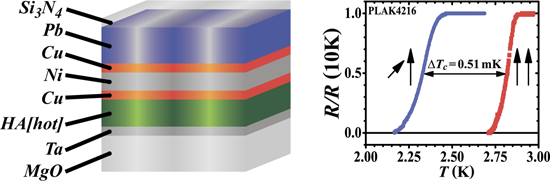
- magnetic field of 3 kOe possibly due to some magnetic inhomogeneity of the HA layer. We note that the magnetic response from the Ni layer cannot be resolved here due to its small value. The electrical resistivity was measured using the standard four-point method. The top insulating layer (Si3N4) was
- width in zero magnetic field varied from 20 to 50 mK depending on the particular series of the samples and increased with the applied field up to ca. 250 mK (see Figure 2 below). The narrow SC transition is a characteristic feature of the high-quality Pb layer. For the optimal operation of the SSV it is
- parameter of the S/F2 interface . For the measurements of the angular dependence of Tc in the prepared SSV multilayers we have fixed the magnetization of the F2 layer (Ni) in a certain direction by cooling the sample in a magnetic field down to the operational temperatures of the SSV. The magnetization of



The effect of magneto-crystalline anisotropy on the properties of hard and soft magnetic ferrite nanoparticles
Beilstein J. Nanotechnol. 2019, 10, 1348–1359, doi:10.3762/bjnano.10.133
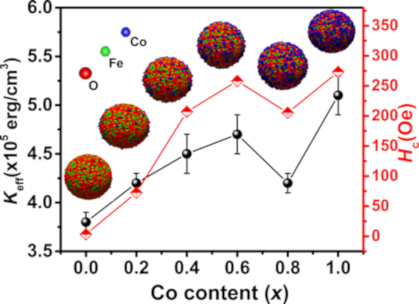
- ) and especially magnetic hyperthermia therapy, which is one of the efficient and new approaches for cancer treatment [4][15]. When magnetic NPs concentrated in tumor tissue are exposed to an ac magnetic field, the electromagnetic energy is converted into thermal energy, and the generated heat is used
- strengths. Barrera et al. prepared Co1−xZnxFe2O4 NPs and studied the dynamic energy losses of nanoparticles under an extended range of applied magnetic field strengths. They show that NPs with a larger anisotropy reveal smaller energy losses [22]. For a more systematic study of the effect of magnetic
- anisotropy in the cubic spinel structure. The effective anisotropy constant (Keff) of particles was estimated using the law of approach to saturation (LAS), which describes the dependence of the magnetization (M) on the applied magnetic field (H) at high field strengths (H ≫ Hc). According to the LAS, the


On the relaxation time of interacting superparamagnetic nanoparticles and implications for magnetic fluid hyperthermia
Beilstein J. Nanotechnol. 2019, 10, 1280–1289, doi:10.3762/bjnano.10.127
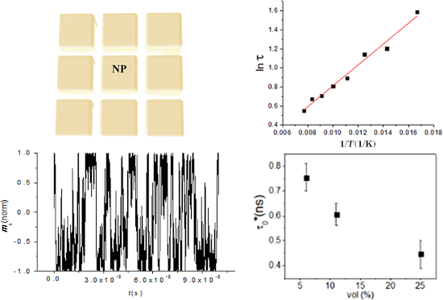
- , with the only effect of the perturbation reflected in the expression of the relaxation time. Accordingly, the dissipated power is where τ is the effective relaxation time (only the Néel component), f and H are the frequency and the amplitude of the applied AC magnetic field, µ0 is the permittivity of
- evaluated versus parameters specific to P* by the numerical integration of the last part of Equation 6. On the other hand, T(t) can be also experimentally obtained by heating the ferrofluid under a completely characterized AC magnetic field and using specific methodologies to minimize the heat losses [16
- samples were magnetically excited by a radiofrequency magnetic field with a constant frequency of 235 kHz (single radiofrequency inductor) and at four amplitude values: 14 kA m−1, 21 kA m−1, 28 kA m−1 and 35 kA m−1. As expected, the experimental SAR values increase with the volume fraction (in a more


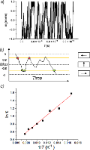

Molecular attachment to a microscope tip: inelastic tunneling, Kondo screening, and thermopower
Beilstein J. Nanotechnol. 2019, 10, 1243–1250, doi:10.3762/bjnano.10.124
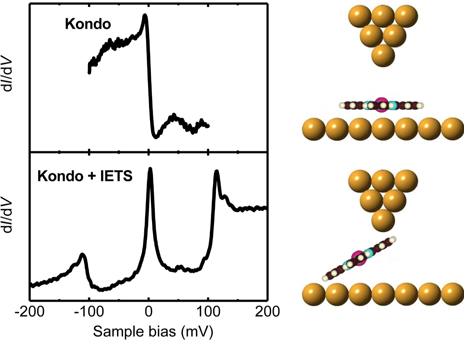
- tunneling microscope (Modified Createc LT-STM) equipped with a vector magnetic field of 1 T. As described in [21], the Au(111) single crystal was cleaned by repeated cycles of Ne+ ion bombardment followed by thermal annealing at 800 K. The MnPc molecules were evaporated from an Al2O3 crucible heated by


Tailoring the magnetic properties of cobalt ferrite nanoparticles using the polyol process
Beilstein J. Nanotechnol. 2019, 10, 1166–1176, doi:10.3762/bjnano.10.116
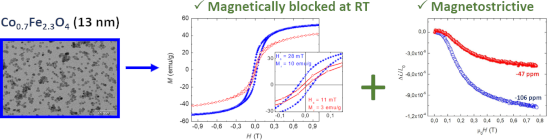
- shape change of the magnetostrictive component under an external magnetic field. Here, the size of the interface between the two components plays a crucial role. Therefore, the development of nanomaterials exhibiting large surface-to-volume ratios can help to respond to such a requirement. However, the
- magnetometry. To measure the magnetostrictive response of the particles, the particles were sintered to dense pellets on which strain gauges were bonded, measuring the size variation radially, as a function of a dc magnetic field. Findings: We found two samples, the first one being stoichiometric and
- viewpoint paper about the current limits of such nanostructures [4]. In these materials, the ME coupling arises from a mechanical transmission of strain originating from the shape change of the magnetostrictive component under an external magnetic field, or of the piezoelectric component under an external


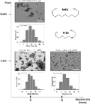


Scavenging of reactive oxygen species by phenolic compound-modified maghemite nanoparticles
Beilstein J. Nanotechnol. 2019, 10, 1073–1088, doi:10.3762/bjnano.10.108
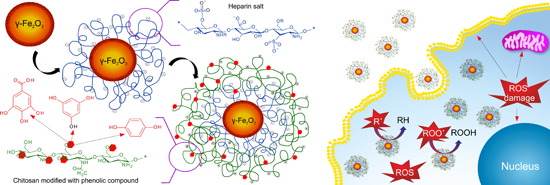
- , because superparamagnetic particles behave as nonmagnetic materials in the absence of a magnetic field, and consequently, aggregation of the nanoparticles induced by magnetic forces is minimized. Heparin-coated γ-Fe2O3 nanoparticles The role of the heparin layer is to isolate the inorganic core from the
- nanoparticles (MNPcell) and cell viability were determined after incubation of γ-Fe2O3, γ-Fe2O3@Hep, γ-Fe2O3@Hep-CS-G, γ-Fe2O3@Hep-CS-H, or γ-Fe2O3@Hep-CS-P nanoparticles (100 μg/mL) with L-929 or LN-229 cells for 3 h (Figure 5a,b). In the absence of a magnetic field, the heparin coating enhanced the MNPcell
- enhance nanoparticle internalization [34]. The application of a magnetic field during incubation with γ-Fe2O3 increased the MNPcell level by 2.7-fold compared with that without the magnet in L-929 cells. The γ-Fe2O3@Hep uptake in LN-229 cells was increased by 1.8-fold compared with that without magnetic