


Search results
Search for "magnetic moment" in Full Text gives 112 result(s) in Beilstein Journal of Nanotechnology.
Effect of large mechanical stress on the magnetic properties of embedded Fe nanoparticles
Beilstein J. Nanotechnol. 2011, 2, 268–275, doi:10.3762/bjnano.2.31
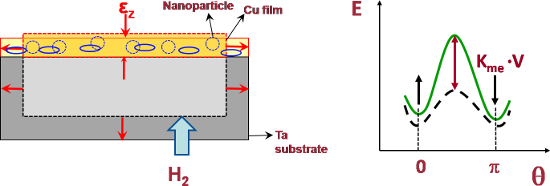
- magnetization of the particle can be represented by one single magnetic moment which adjusts its direction under the influence of local anisotropies, such as the magneto-crystalline anisotropy field, and external fields. In addition, thermal fluctuations may lead to instability of the magnetization over time


Extended X-ray absorption fine structure of bimetallic nanoparticles
Beilstein J. Nanotechnol. 2011, 2, 237–251, doi:10.3762/bjnano.2.28
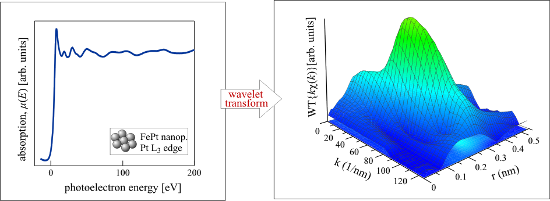
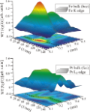
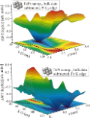
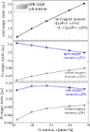
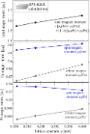
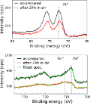
- moment at the Fe sites. Changes of the orbital magnetic moment and the Pt moments are negligible with respect to the strong decrease of the Fe spin magnetic moment. The results from SPR-KKR calculations are shown in Figure 8. For the lattice constants, the experimentally determined values were used [68
- ] as input for the calculations. It can clearly be seen that the spin magnetic moments at the Pt sites remained largely unchanged around μS(Pt) ≈ 0.22 μB for different compositions between x = 32 atom % and x = 68 atom %, the orbital magnetic moment increased slightly with increasing Fe content from μl
- (Pt) ≈ 0.042 μB to 0.048 μB. The orbital magnetic moment at the Fe sites showed a similar behaviour and increased from μl(Fe) ≈ 0.06 μB to 0.078 μB in the composition range investigated in this work. The Fe spin magnetic moment decreased with increasing Fe content from about 3.0 μB at x = 32 atom % to



Structural and magnetic properties of ternary Fe1–xMnxPt nanoalloys from first principles
Beilstein J. Nanotechnol. 2011, 2, 162–172, doi:10.3762/bjnano.2.20
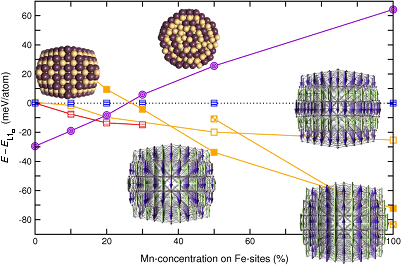
- bias effects originating from uncompensated surface spins has been observed experimentally in annealed binary MnPt nanoparticles with diameters between 2.3 nm and 4.1 nm [76]. The kink of the otherwise linear evolution of the spin magnetic moment of the icosahedral cluster at large Mn content is due to


Structure, morphology, and magnetic properties of Fe nanoparticles deposited onto single-crystalline surfaces
Beilstein J. Nanotechnol. 2011, 2, 47–56, doi:10.3762/bjnano.2.6
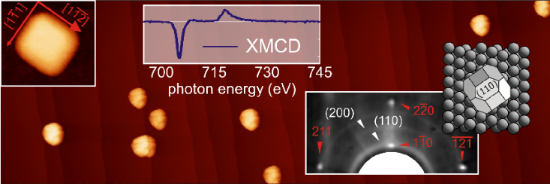
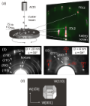
- of the individual anisotropy axis as sketched in Figure 2g. Thus, in the present XMCD experiments we would only probe the averaged projection of the magnetization in the particle ensemble which leads to an apparently reduced magnetic moment in the sum rule analysis. The fact that we observed bulk

Magnetic interactions between nanoparticles
Beilstein J. Nanotechnol. 2010, 1, 182–190, doi:10.3762/bjnano.1.22
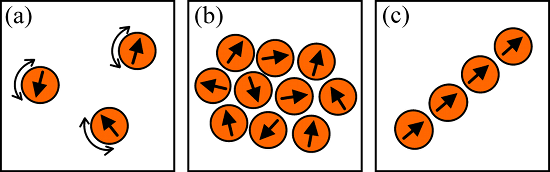
- nanoparticles can have a significant influence on the magnetic properties. In a sample of randomly distributed nanoparticles with average magnetic moment μ and average separation d, the dipole interaction energy of a particle is on the order of [9] where μ0 is the permeability of free space. In samples with
- antiferromagnetic material the net magnetization vanishes because the sublattice magnetizations have identical size but opposite directions. However, in nanoparticles, the finite number of magnetic ions results in a small net magnetic moment because of uncompensated spins in the surface and/or in the interior of
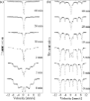
- the particles [34]. This magnetic moment is, however, usually so small that dipole interactions are almost negligible and the influence of dipole interactions on the superparamagnetic relaxation is therefore also expected to be negligible [35]. Nevertheless, several Mössbauer studies of, for example



Magnetic nanoparticles for biomedical NMR-based diagnostics
Beilstein J. Nanotechnol. 2010, 1, 142–154, doi:10.3762/bjnano.1.17
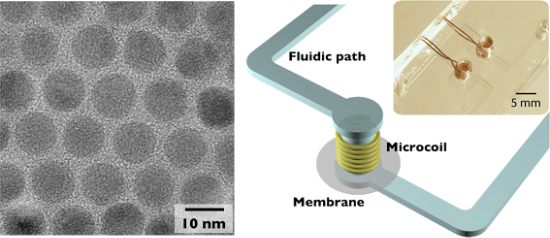
- particular direction defined by magnetic anisotropy. At sufficiently high temperatures (above blocking temperature), thermal energy can induce free rotation of the magnetic moment. Thus, when MNPs are grouped together, they display a form of paramagnetic behavior, known as superparamagnetism: MNPs assume
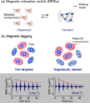
- , targeted MNPs can be used to tag cell surface markers to impart a magnetic moment (Figure 1b). The change of 1/T2 is proportional to the number of MNPs bound, and also indicative of the abundance of relevant surface biomarkers. Unlike MRSw assays, this magnetic tagging strategy requires washing steps to
- magnetization is known to increase with particle size [33]. Ideally, each magnetic spin within a bulk magnetic material would be aligned parallel to the external magnetic field. However, in the nanoscale regime, surface spins tend to be tilted, a feature that reduces the overall magnetic moment. By increasing


Ultrafine metallic Fe nanoparticles: synthesis, structure and magnetism
Beilstein J. Nanotechnol. 2010, 1, 108–118, doi:10.3762/bjnano.1.13
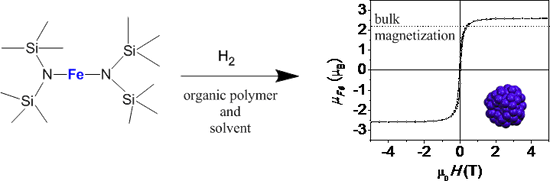
- to that of β-Mn, characterized by a short-range order. The average magnetic moment per Fe atom is raised to 2.59 µB (for comparison, bulk value of metallic Fe: 2.2 µB). Even if the spontaneous magnetization decreases rapidly as compared to bulk materials, it remains enhanced even up to room
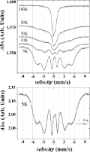
- analysis of the low temperature Mössbauer spectra, show a broad distribution of large hyperfine fields. The largest hyperfine fields display the largest isomer shifts. This indicates a progressive increase of the magnetic moment inside the particle from the core to the outer shell. The components
- past ten years have allowed the development of precise studies on the influence of size reduction on the magnetic properties of nanoparticles (NPs) down to the nanometer scale. A first spectacular result was the observation of the enhancement of the atomic magnetic moment in NPs of classical 3d





Magnetic coupling mechanisms in particle/thin film composite systems
Beilstein J. Nanotechnol. 2010, 1, 101–107, doi:10.3762/bjnano.1.12
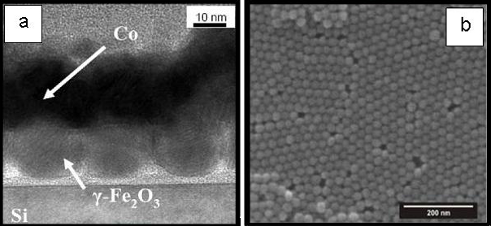
- and the Co layer can be obtained from measurements of the magnetic moment vs temperature (Figure 5) after zero-field cooling (ZFC) and field cooling (FC). Generally, the system is first cooled down from relatively high temperatures (here 380 K) in a zero field, then a magnetic field is applied and the
- is the decrease of the magnetic moment in the FC curve for decreasing temperatures below Tb. This trend has already been recognized as indicating a collective particle behavior, a so-called super-spin glass (SSG) state [21][24][27][36][37]. The peak temperature then marks the 'blocking temperature
- section NPs/thin-film system showing the CoO layer at the interface with NPs. (b) The corresponding diffraction pattern where the following phases are identified: 1) CoO (200), 2) Fe2O3 (311), 3) Si (111), 4) Fe2O3 (111). ZFC/FC magnetic moment vs temperature measured in 500 Oe for a NP monolayer (green


Review and outlook: from single nanoparticles to self-assembled monolayers and granular GMR sensors
Beilstein J. Nanotechnol. 2010, 1, 75–93, doi:10.3762/bjnano.1.10
- chemical, physical and medical fields [1]. A common example is their employment in microfluidic devices: Due to their permanent magnetic moment, they can be controlled via external, inhomogeneous magnetic fields [2] and also be detected by magnetoresistive sensors [3] which allows for the magneto-based
- important area in the field of nanoparticles based on their interesting properties which provide various advantages in comparison to monometallic nanocrystals. An example can be found with CoFe particles which have a strongly increased magnetic moment per atom in comparison to pure Co particles [29
- longer stable magnetization configurations but the magnetic moment permanently switches between different orientations. For uniaxial crystal anisotropy, the superparamagnetic size limit needs to meet where kB is the Boltzmann constant, T the absolute temperature, Kuni the first anisotropy constant and




Uniform excitations in magnetic nanoparticles
Beilstein J. Nanotechnol. 2010, 1, 48–54, doi:10.3762/bjnano.1.6
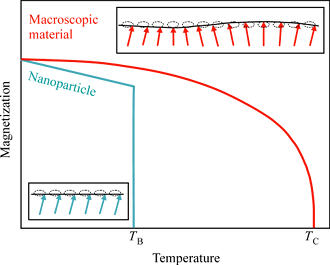
- classical magnetic moment, i.e., it is assumed that the magnetization vector can point in any direction [3][4][5]. Below TB, the magnetization direction remains near one of the minima and the temperature dependence of the magnetization can be calculated by use of Boltzmann statistics: where E(θ) is given by
- nanoparticles (Figure 4). The energy of the uniform excitations in antiferromagnetic materials, Equation 16, was derived assuming that the antiferromagnetic material had zero net magnetization, but nanoparticles of antiferromagnetic materials usually have a magnetic moment because of uncompensated spins, for
- example, in the surface [23][26]. This can have a large influence on the excitation energy [25][27]. For example, an uncompensated magnetic moment of only around 1% of the sublattice magnetic moment can result in a decrease of the excitation energy by a factor of two [27]. Neutron studies of hematite


![[Graphic 3]](/bjnano/content/inline/2190-4286-1-6-i22.png?max-width=637&scale=1.18182) as a function of temperature for particles of magneti...
as a function of temperature for particles of magneti...


Preparation and characterization of supported magnetic nanoparticles prepared by reverse micelles
Beilstein J. Nanotechnol. 2010, 1, 24–47, doi:10.3762/bjnano.1.5
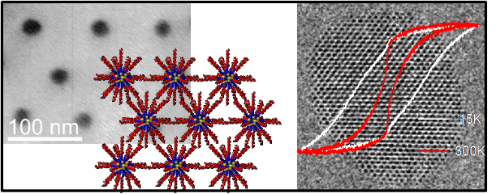
- interparticle distances of 100 nm on a 5 × 5 mm2 substrate produce a total magnetic moment of only 10–9 Am2 (10–6 emu). Although state-of-the-art SQUID-magnetometry is able to detect the related small signals, the response of the diamagnetic substrate has to be taken into account as well delivering for the
- the saturation moment with the considerations mentioned above, we expected a total sample magnetic moment of 2.8∙10–9 Am2 (2.8∙10–6 emu) taking into account the NPs density at an average distance of 60 nm. Although this estimate is 44% lower than the experimental value, this deviation is acceptable






Preparation, properties and applications of magnetic nanoparticles
Beilstein J. Nanotechnol. 2010, 1, 21–23, doi:10.3762/bjnano.1.4

- scale of typically a decade is not at all compatible with superparamagnetism. A natural way out of this problem is to look for materials exhibiting an as high as possible magnetocrystalline anisotropy which suppresses fluctuations of the effective magnetic moment of the NPs [7]. For binary alloys like



