


Search results
Search for "mechanics" in Full Text gives 176 result(s) in Beilstein Journal of Nanotechnology.
Finite-size effect on the dynamic and sensing performances of graphene resonators: the role of edge stress
Beilstein J. Nanotechnol. 2016, 7, 685–696, doi:10.3762/bjnano.7.61
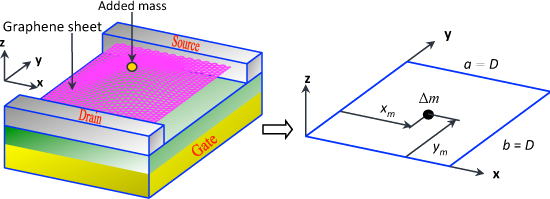
- on the important role of edge stress in designing a graphene resonator for further applications in sensing and actuation. Theory and Model Effect of edge stress on the mechanics of graphene The potential energy of a vibrating graphene sheet is composed of bulk strain energy and edge strain energy
- edge stress and edge elastic modulus are summarized in Table 1. To gain insight into the role of edge stresses on the mechanics of graphene, we consider graphene modeled as a thin plate, which is deformed due to the sole bending of graphene with only a bending strain εxx given as εxx = Cxz, where Cx is
- the bending mechanics of graphene are critically affected by the edge elastic modulus. In general, when graphene is deformed by an in-plane bending strain [31], the bending moments acting on a graphene sheet are represented in the following form. where and are the effective bending rigidities


Comparative kinematical analyses of Venus flytrap (Dionaea muscipula) snap traps
Beilstein J. Nanotechnol. 2016, 7, 664–674, doi:10.3762/bjnano.7.59

- such an early stage of growth. What is more, although it is generally known that growth processes lead to trap opening [2], the lobe movement during this process and possible implications for the underlying opening mechanics has not yet been investigated. For shedding some light on the above mentioned
- and retain large prey favored evolution of snap traps in general, but after Hutchens and Luken [34], Dionaea prey capture is rather opportunistic than selective. Poppinga and Joyeux [13] have hypothesized that the different snap-trap mechanics are adaptations to the respective life form (terrestrial
- . Owing to the small size of the Aldrovanda trap and due to the lower density of the surrounding medium, we may speculate that snapping in air is presumably of comparable (or even higher) speed than under water. So why do Aldrovanda and Dionaea possess two different trap closure mechanics and does there


Nanoscale effects in the characterization of viscoelastic materials with atomic force microscopy: coupling of a quasi-three-dimensional standard linear solid model with in-plane surface interactions
Beilstein J. Nanotechnol. 2016, 7, 554–571, doi:10.3762/bjnano.7.49
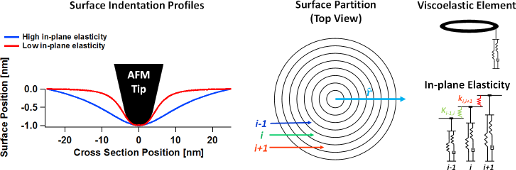
- plates that are displaced with respect to one another while the stress in the material is measured [17][18]. Drawing a connection from continuum mechanics to AFM measurements (where the probe geometry is relatively simple, often assumed spherical) may appear to be straightforward at first glance, but a


Free vibration of functionally graded carbon-nanotube-reinforced composite plates with cutout
Beilstein J. Nanotechnol. 2016, 7, 511–523, doi:10.3762/bjnano.7.45
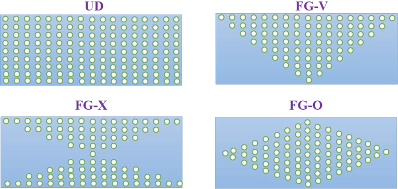
- provided by Liew et al. [2] It has been shown that the bending moment may be significantly alleviated through a functionally graded distribution of CNTs in a polymeric matrix [3]. In the five years following the discovery of this interesting feature, various investigations were reported on the mechanics of
- superscript m. Following the classical solid mechanics notation, E and G are the elastic modulus and shear modulus of the constituents, respectively. In comparison to the conventional rule of mixtures approach, three unknown constants, η1, η2 and η3, are introduced in Equation 1; these are known as efficiency


Rigid multipodal platforms for metal surfaces
Beilstein J. Nanotechnol. 2016, 7, 374–405, doi:10.3762/bjnano.7.34

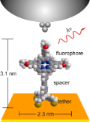
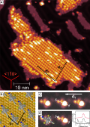
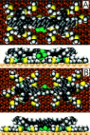
- surface, probably due to heavy steric interactions as suggested by molecular mechanics modelling. Afterwards, Lee et al. introduced and synthetized a series of new tridentate chelating adsorbates 2 (Figure 2) having different alkyl chain lengths ranging from C12 to C18 and used them to prepare loosely











Molecular machines operating on the nanoscale: from classical to quantum
Beilstein J. Nanotechnol. 2016, 7, 328–350, doi:10.3762/bjnano.7.31
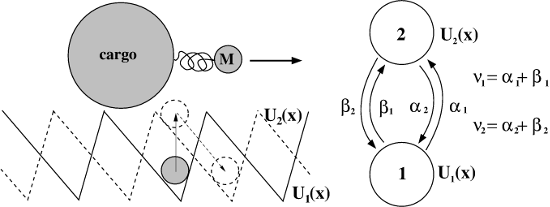
- forever even at thermal equilibrium. The energy necessary for this is supplied by thermal fluctuations. Therefore, friction and thermal noise are intimately related, which is the physical context of the fluctuation–dissipation theorem [10]. Statistical mechanics allows the development of a coherent
- ., heat absorbed from the thermal bath). Here, both processes are balanced at thermal equilibrium, and the averaged kinetic energy of the Brownian particle is kBT/2. This is in accordance with the equipartition theorem in classical equilibrium statistical mechanics. This is a very important point. At

![[Graphic 40]](/bjnano/content/inline/2190-4286-7-31-i86.png?max-width=637&scale=1.18182) with depth ε. Bias Δμ < 0 per one rotation tur...
with depth ε. Bias Δμ < 0 per one rotation tur...

![[Graphic 48]](/bjnano/content/inline/2190-4286-7-31-i94.png?max-width=637&scale=1.18182) , for the most asymmetric sawtooth mod...
, for the most asymmetric sawtooth mod...


Single-molecule mechanics of protein-labelled DNA handles
Beilstein J. Nanotechnol. 2016, 7, 138–148, doi:10.3762/bjnano.7.16
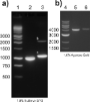
- HEPES, pH 7.5) and in DTT buffer (40 mM HEPES-KOH, pH 7.5, 60 mM NH4Cl, 10 mM magnesium acetate, 1 mM DTT and 3.6 mM 2-mercaptoethanol) (adapted from [12]). Optical force measurements Measurements of the DNA mechanics were performed with a previously described counter-propagating dual-beam OT setup [13
- interactions impeded the study of single molecule mechanics. Ideal experimental conditions with protein–DNA handles allowing for single hook-up experiments were then found with 40:1 handle-to-bead coupling ratio (bead diameter 2.9 µm). For smaller beads (0.84 µm diam.) the optimal ratio of PDHs coupling to



Nanostructured surfaces by supramolecular self-assembly of linear oligosilsesquioxanes with biocompatible side groups
Beilstein J. Nanotechnol. 2015, 6, 2377–2387, doi:10.3762/bjnano.6.244
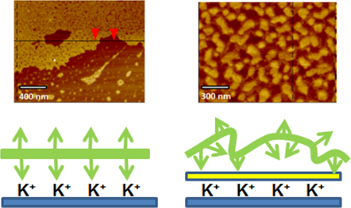
- was estimated to be about 1.6 nm, as calculated for the structure of a LPSQ-COOH oligomer constructed on HyperChem platform and modelled in vacuum using a molecular mechanics force field MM+ method (Polak–Ribiere/conjugate gradient optimization algorithm) and a semi-empirical PM3 method (single point




Controlled switching of single-molecule junctions by mechanical motion of a phenyl ring
Beilstein J. Nanotechnol. 2015, 6, 2088–2095, doi:10.3762/bjnano.6.213
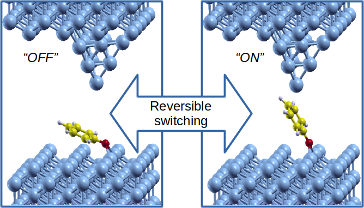
- . The switch can be actuated by dual triggers, either by a voltage pulse or by displacement of the electrode, and electronic manipulation of the ring by chemical substitution enables rational control of the on-state conductance. Owing to its simple mechanics, structural robustness, and chemical
- conductance ratio between PhO and PhS was also reproduced and ascribed to different hybridization strengths with the substrate states. In summary, we propose that phenyl rings are promising as versatile units for molecular electronic devices, whose mechanics can be controlled by different triggers such as


Development of a novel nanoindentation technique by utilizing a dual-probe AFM system
Beilstein J. Nanotechnol. 2015, 6, 2015–2027, doi:10.3762/bjnano.6.205
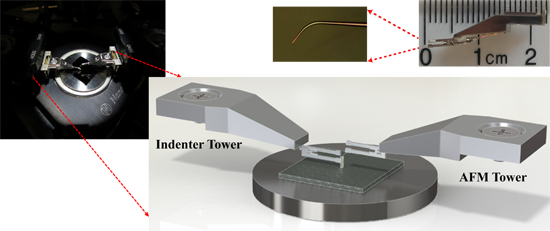
- application of nanoindentation is to determine the mechanical properties of cells which may be of critical importance for progressive diseases such as cancer or vascular diseases [1]. A recently published work by Guz et al. also investigates nanoindentation experiments on cell mechanics and proposes new


Magnetic reversal dynamics of a quantum system on a picosecond timescale
Beilstein J. Nanotechnol. 2015, 6, 1946–1956, doi:10.3762/bjnano.6.199
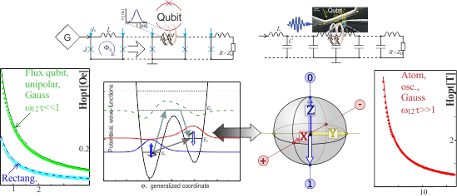
- to a probe on the border between classical and quantum mechanics [1][2][3][4][5][6][7][8][9][10][11][12][13][14][15]. The possible gate and measurement rates estimated in relation to the decoherence processes for these qubits are within the reach of the threshold for fault-tolerant quantum computing




Correction: Formation of pure Cu nanocrystals upon post-growth annealing of Cu–C material obtained from focused electron beam induced deposition: comparison of different methods
Beilstein J. Nanotechnol. 2015, 6, 1935–1936, doi:10.3762/bjnano.6.196

- Aleksandra Szkudlarek Alfredo Rodrigues Vaz Yucheng Zhang Andrzej Rudkowski Czeslaw Kapusta Rolf Erni Stanislav Moshkalev Ivo Utke Empa, Swiss Federal Laboratories for Materials Science and Technology, Laboratory for Mechanics of Materials and Nanostructures, Feuerwerkerstrasse 39, 3602 Thun

Surface engineering of nanoporous substrate for solid oxide fuel cells with atomic layer-deposited electrolyte
Beilstein J. Nanotechnol. 2015, 6, 1805–1810, doi:10.3762/bjnano.6.184
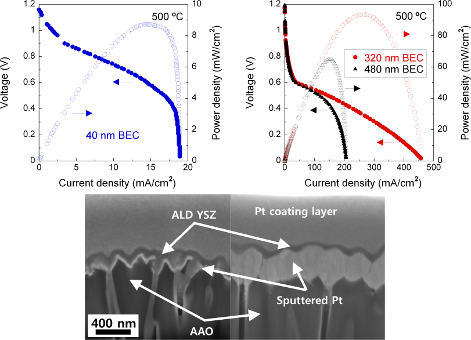
- University, Gwanak-ro, Gwanak-gu, Seoul 151-742, South Korea Department of Mechanical Engineering, Korea Advanced Institute of Science and Technology, Daehak-ro, Yuseong- gu, Daejeon 305-701, South Korea Corporate R&D Institute, Samsung Electro Mechanics, Maeyoung-ro, Yeongtong-gu, Suwon 443-743, South Korea


A simple method for the determination of qPlus sensor spring constants
Beilstein J. Nanotechnol. 2015, 6, 1733–1742, doi:10.3762/bjnano.6.177
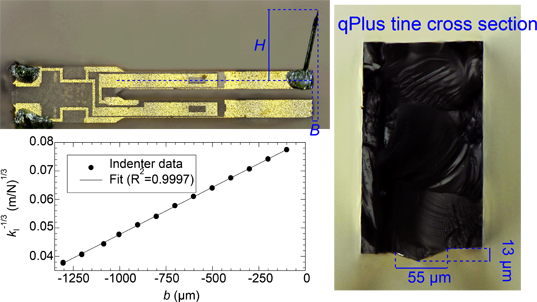
- of the spring constant of the sensor and complications from finite tip heights. Here we combine a numerical investigation of the force reconstruction with an experimental characterization of the flexural mechanics of the qPlus sensor. Numerical studies reveal significant errors in reconstructed force
- accurately characterize the flexural mechanics of the qPlus sensor. The experimental results provide validation of a theoretical model that can be used to predict the spring constant of the qPlus sensor. Results In this section we develop a model for the qPlus sensor with a finite tip that is subjected to a
- limit the tip height to approximately less than 400 μm. Mechanical characterization of qPlus sensors with nanoindentation In this section we characterize the flexural mechanics of qPlus sensors using a nanoindentation method. The nanoindenter, which is calibrated with traceability to the International


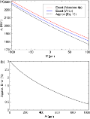


![[Graphic 9]](/bjnano/content/inline/2190-4286-6-177-i28.png?max-width=637&scale=1.18182) vs b is plotted where kI is the spring constan...
vs b is plotted where kI is the spring constan...
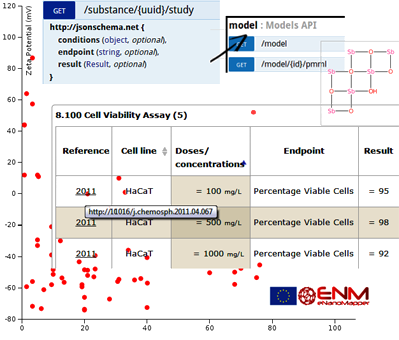
The eNanoMapper database for nanomaterial safety information
Beilstein J. Nanotechnol. 2015, 6, 1609–1634, doi:10.3762/bjnano.6.165


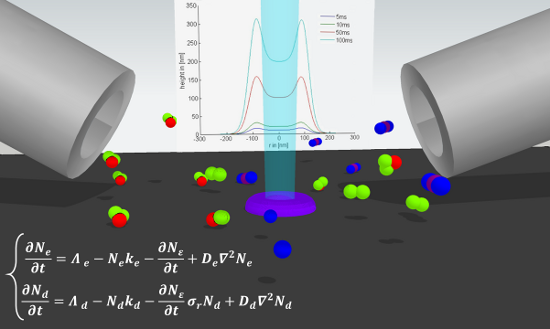
Continuum models of focused electron beam induced processing
Beilstein J. Nanotechnol. 2015, 6, 1518–1540, doi:10.3762/bjnano.6.157
- Milos Toth Charlene Lobo Vinzenz Friedli Aleksandra Szkudlarek Ivo Utke School of Physics and Advanced Materials, University of Technology, Sydney, 15 Broadway, Ultimo, New South Wales 2007, Australia Empa, Swiss Federal Laboratories for Materials Science and Technology, Laboratory for Mechanics


![[Graphic 37]](/bjnano/content/inline/2190-4286-6-157-i117.png?max-width=637&scale=1.18182) and chemisorbed
and chemisorbed ![[Graphic 38]](/bjnano/content/inline/2190-4286-6-157-i118.png?max-width=637&scale=1.18182) adsorbates versus pressure, calcul...
adsorbates versus pressure, calcul...


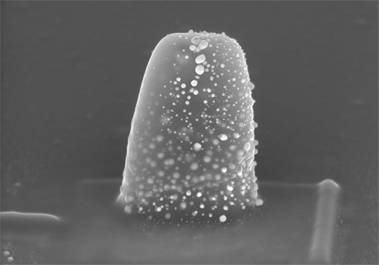
Formation of pure Cu nanocrystals upon post-growth annealing of Cu–C material obtained from focused electron beam induced deposition: comparison of different methods
Beilstein J. Nanotechnol. 2015, 6, 1508–1517, doi:10.3762/bjnano.6.156
- Aleksandra Szkudlarek Alfredo Rodrigues Vaz Yucheng Zhang Andrzej Rudkowski Czeslaw Kapusta Rolf Erni Stanislav Moshkalev Ivo Utke Empa, Swiss Federal Laboratories for Materials Science and Technology, Laboratory for Mechanics of Materials and Nanostructures, Feuerwerkerstrasse 39, 3602 Thun





Atomic force microscopy as analytical tool to study physico-mechanical properties of intestinal cells
Beilstein J. Nanotechnol. 2015, 6, 1457–1466, doi:10.3762/bjnano.6.151
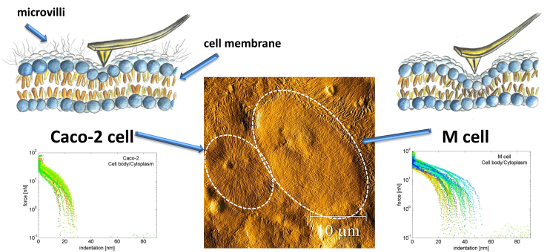
- of the outerleaflets of the membranes of adjacent cells. They are responsible to maintain the integrity of the cell layer, which is likely to be associated with the cell mechanics such as high cell stiffness and reduced cell elasticity at the cell periphery. In contrast, once enterocytes are
- reflected in the cell mechanics, such as a higher elasticity values compared to Caco-2 cells. Moreover, it is reported that the density of epithelial cell monolayers impacts cell mechanics (as well as the dynamics) due to variations of compressive forces [49][50]. To deeper understand the obtained elastic
- fill remaining data gaps on the effects of these parameters on cell mechanics/kinetics and, as a consequence, on cellular uptake processes (e.g., nanoparticulate systems/antigens). Conclusion The current study shows that cytoskeletal structures and the content of F-actin filaments strongly impact


Multiscale modeling of lithium ion batteries: thermal aspects
Beilstein J. Nanotechnol. 2015, 6, 987–1007, doi:10.3762/bjnano.6.102
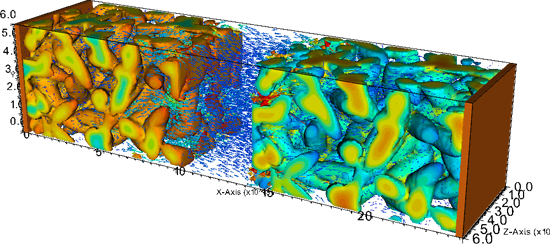
- dependency on composition or atomistic structure is the starting point for a rational design of energy storage materials [3]. Density functional theory with all its approximations [4][5] if combined with statistical mechanics methods is in this context the most successful method to simulate material
- mechanics in order to obtain the Gibbs free energy of bulk and interfaces at finite temperatures. Especially for the calculation of differences of Gibbs free energies, which are relevant for the determination of stable equilibrium configurations, the accuracy is higher than might be expected from the
- ]. Especially the formalism of ab initio atomistic thermodynamics, which combines DFT simulations with strategies from statistical mechanics [3][6][7], allows one in principle to determine Gibbs free energies, reaction rates and relevant transport coefficients for materials used in electrochemical applications


Structure and mechanism of the formation of core–shell nanoparticles obtained through a one-step gas-phase synthesis by electron beam evaporation
Beilstein J. Nanotechnol. 2015, 6, 874–880, doi:10.3762/bjnano.6.89
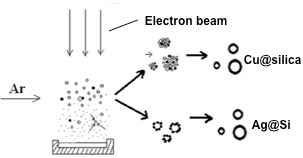
- Science, Siberian Branch of the Russian Academy of Sciences, Sakhyanova str. 6, Ulan-Ude, 670047, Russia Institute of Theoretical and Applied Mechanics, Siberian Branch of the Russian Academy of Sciences, Institutskaya str. 4/1, Novosibirsk, 630090, Russia Department of Physics, Novosibirsk State


Protein corona – from molecular adsorption to physiological complexity
Beilstein J. Nanotechnol. 2015, 6, 857–873, doi:10.3762/bjnano.6.88
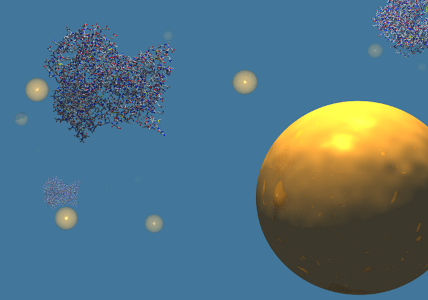
- is of paramount importance, yet, the long and continuing struggle of statistical mechanics in fully explaining the ensemble observations of thermodynamics serves as an impressive reminder of the complexity that can arise from attempting such seemingly trivial links. The fact that the serum corona



Stiffness of sphere–plate contacts at MHz frequencies: dependence on normal load, oscillation amplitude, and ambient medium
Beilstein J. Nanotechnol. 2015, 6, 845–856, doi:10.3762/bjnano.6.87
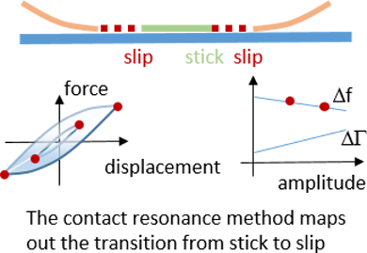
- can be explained by nanoroughness. In other words, contact splitting (i.e., a transport of shear stress across many small contacts, rather than a few large ones) can be exploited to reduce partial slip. Keywords: contact mechanics; contact splitting; contact stiffness; partial slip; quartz crystal
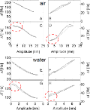
- materials involved, but also to interfacial processes (as long as these obey linear mechanics). Equation 1 can be inverted as As shown in Equation 2, the complex frequency shift is easily converted to a complex contact stiffness. Up to now, linear force–displacement relations were assumed. If linearity does
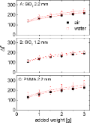
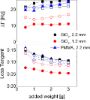
- water, respectively. The fact that Δf0 increases with normal load is easy to understand. With increasing load, the contact radius increases and the contact stiffness increases correspondingly. The dotted lines show an attempt to bring this understanding in line with the known models of contact mechanics




Capillary and van der Waals interactions on CaF2 crystals from amplitude modulation AFM force reconstruction profiles under ambient conditions
Beilstein J. Nanotechnol. 2015, 6, 809–819, doi:10.3762/bjnano.6.84
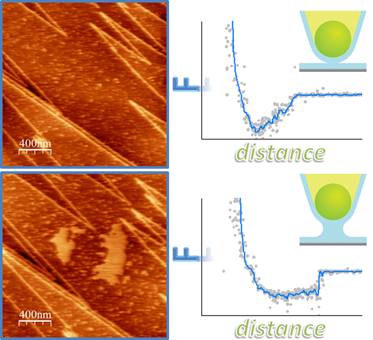
- (DMT) model of contact mechanics [54] has been employed to account for short range repulsion: where E* is the effective Young’s modulus that includes the elastic modulus of the tip and of the sample [14]. This profile is shown in Figure 4b. 2) The second profile corresponds to a linear decay in the


Mapping of elasticity and damping in an α + β titanium alloy through atomic force acoustic microscopy
Beilstein J. Nanotechnol. 2015, 6, 767–776, doi:10.3762/bjnano.6.79
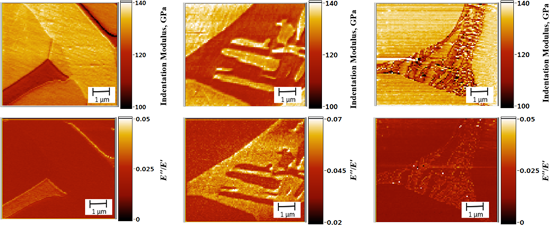
- moment of inertia. By using an appropriate contact mechanics model, one can convert the obtained stiffness values to the reduced elastic modulus E* and then to the indentation modulus M. The contact mechanics for AFM tips is very difficult to model as the exact shape of the tip in contact with the sample
- is usually unknown. The Hertz model is a simplified and the most widely used contact mechanics model for AFM contacts. It assumes each contact to be an elastic half space with relatively small strains at the frictionless contact with elliptical shape [26]. The tip radius and the applied load are


Statistics of work and orthogonality catastrophe in discrete level systems: an application to fullerene molecules and ultra-cold trapped Fermi gases
Beilstein J. Nanotechnol. 2015, 6, 755–766, doi:10.3762/bjnano.6.78
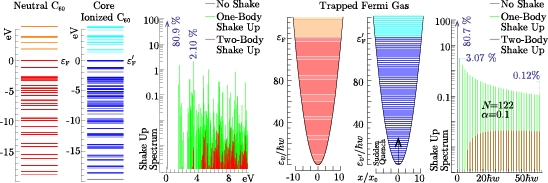
- absorption and emission spectra from noninteracting quantum dots have been interpreted in terms of the quantum work distribution, and linked to the corresponding fluctuation relations in statistical mechanics [36]. To explore more of such a connection, we present here a comparison of the statistics of the

![[Graphic 22]](/bjnano/content/inline/2190-4286-6-78-i30.png?max-width=637&scale=1.18182) ) fullerene molecules, as com...
) fullerene molecules, as com...





