Search results
Search for "surface roughness" in Full Text gives 274 result(s) in Beilstein Journal of Nanotechnology. Showing first 200.
Topochemical engineering of composite hybrid fibers using layered double hydroxides and abietic acid
Beilstein J. Nanotechnol. 2019, 10, 589–605, doi:10.3762/bjnano.10.60
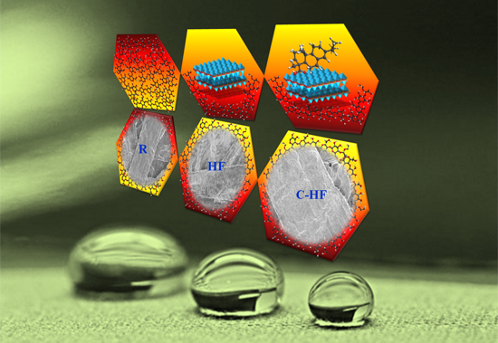
- increase the surface roughness of the fibers and yield good adhesion properties. Bleached and unbleached fibers, refined and unrefined, were used as starting materials to synthesize direct composites (AA + fiber), hybrid fibers (LDH + fiber) and composite hybrid fibers (AA + LDH + fiber). We expect that




Advanced scanning probe lithography using anatase-to-rutile transition to create localized TiO2 nanorods
Beilstein J. Nanotechnol. 2019, 10, 412–418, doi:10.3762/bjnano.10.40
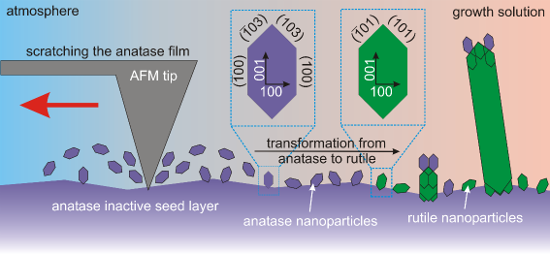
- contrast, local light scattering, high-resolution surface roughness gradients or microchannels. This set of extensions for rutile TiO2 nanorod applications is a valuable toolkit for lab-on-a-chip devices [33][34][35]. Recently, we investigated the influence of rutile seed layers on the growth and shape of
- surface roughness of the anatase TiO2 film causes a dithering movement of the tip that broadens the line width. This effect disconnects the line width from the shape of the tip partly. The density of nanorods is controlled slightly with the number of repetitions. In Figure 4C, the density was increased


Biocompatible organic–inorganic hybrid materials based on nucleobases and titanium developed by molecular layer deposition
Beilstein J. Nanotechnol. 2019, 10, 399–411, doi:10.3762/bjnano.10.39
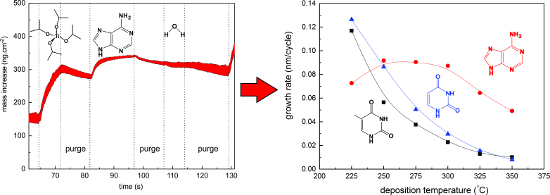
- for 15 minutes was measured by atomic force microscopy (AFM) (Figure 8). All as-deposited films exhibit high surface roughness; however, the roughness of the Ti-adenine film is caused by small islands appearing on an otherwise almost flat surface. After water treatment, the surface roughness decreases
- drastically for all three systems and leaves an almost flat surface, except for the Ti-uracil system, where holes with a distinct pattern were observed. This system was also studied more closely with SEM after water treatment (Figure 9a). This SEM image also shows a low surface roughness; however, there is no




Removal of toxic heavy metals from river water samples using a porous silica surface modified with a new β-ketoenolic host
Beilstein J. Nanotechnol. 2019, 10, 262–273, doi:10.3762/bjnano.10.25
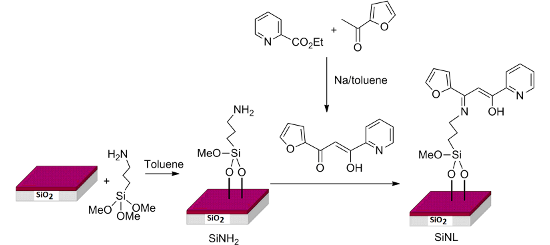
- volume to 0.62 ± 0.01 cm3·g−1 for SiNL. The increase of SBET to 339.84 ± 2.01 m2·g−1 for SiNL is presumably due to the increasing surface roughness, as noticed by SEM imaging (Figure 2), or due to the pore plugging of the support by the ligand. Solid–liquid adsorption of metal ions by SiNL Effect of pH


Interaction of Te and Se interlayers with Ag or Au nanofilms in sandwich structures
Beilstein J. Nanotechnol. 2019, 10, 238–246, doi:10.3762/bjnano.10.22
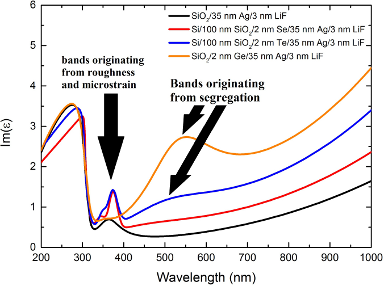
- deposited with a Ge interlayer – they cannot be observed at angles greater than 2° for silver films and 4° for gold films. This indicates a much higher surface roughness than for the Ge-wetted films. Metal layers deposited on Se exhibit an even worse adhesion – there is almost no change in the grain size
- microstrain on metal grains and high surface roughness. This is confirmed by the abnormal ratio of the interband transition peaks in the permittivity spectra of the investigated layers. Despite that, thanks to the XPS measurements, high concentrations of Te and Se on the surface of Ag layers as well as Se on


Sputtering of silicon nanopowders by an argon cluster ion beam
Beilstein J. Nanotechnol. 2019, 10, 135–143, doi:10.3762/bjnano.10.13
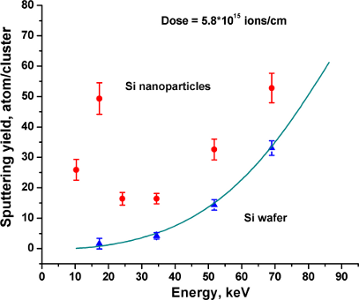
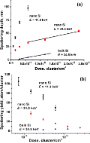
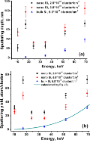
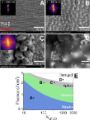
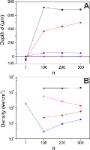
- target density. The energy dependence demonstrated an unusual non-monotonic behavior. At 17.3 keV a maximum of the sputtering yield was observed, which was more than forty times higher than that of the bulk Si. The surface roughness at low energy demonstrates a similar energy dependence with a maximum
- surface, with energy in the range of 10.4–69 keV and dose of 7.2 × 10¹⁴–2.3 × 10¹⁶ cluster/cm2 at room temperature. The sputtering depth and surface roughness RRMS (root mean squared roughness) were monitored by AFM with a Shimadzu SPM-9500 J3 device, operated in tapping mode with a measuring area of 7
- huge increase of the surface roughness after the bombardment, from an initial roughness RRMS = 6.7 nm up to a few hundreds of nanometers, which complicates the depth measurement by AFM. We explain the increase of the sputtering yield of the nanopowder sample, in comparison with the bulk Si, by the





A comparison of tarsal morphology and traction force in the two burying beetles Nicrophorus nepalensis and Nicrophorus vespilloides (Coleoptera, Silphidae)
Beilstein J. Nanotechnol. 2019, 10, 47–61, doi:10.3762/bjnano.10.5
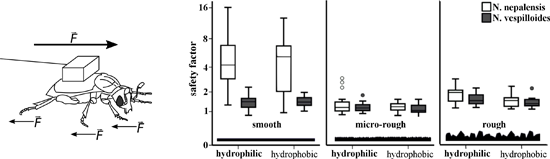
- . nepalensis, have recently been proposed as a potential reason for these observed differences, especially on smooth surfaces [3]. Surface roughness is known to affect attachment performance in insects, spiders and geckos [9][10][11][12][13][14], whereby often so-called critical roughness values have been
- respective surfaces [15][16][17]. Another property that influences insect adhesion is surface polarity, which can be affected by surface roughness, apparently reinforcing hydrophobic or hydrophilic surface characteristics. The testing of both of these surface properties in combination in our experiments has
- in N. vespilloides. The body-size-corrected numbers are almost identical in both species. Surface roughness and contact angle measurements The contact angles (CA) of static droplets of doubly distilled water on the epoxy casts (10 surfaces for each combination) were about 40° on the hydrophilic




Zn/F-doped tin oxide nanoparticles synthesized by laser pyrolysis: structural and optical properties
Beilstein J. Nanotechnol. 2019, 10, 9–21, doi:10.3762/bjnano.10.2
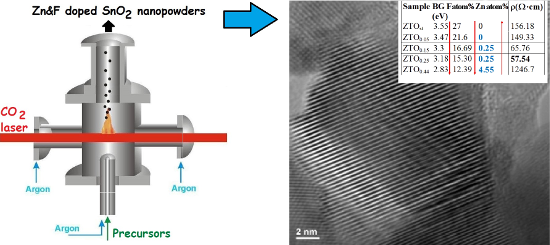
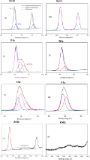
- bandgap, grain size, oxygen deficiency, surface roughness, and impurity centers [21]. The direct bandgaps of the nanoparticles were determined from the Tauc relation [50][51][52] given by: where α is the absorption coefficient, A is a constant, hν is the photon energy, n is an index that can take



Contact splitting in dry adhesion and friction: reducing the influence of roughness
Beilstein J. Nanotechnol. 2019, 10, 1–8, doi:10.3762/bjnano.10.1
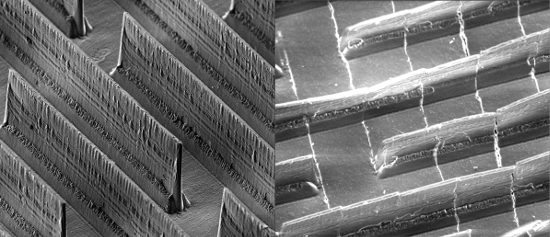
- attachment of the wall-shaped microstructure degrades, regardless of the surface waviness, when the surface roughness increases. Second, splitting the wall-shaped microstructure indeed helps to mitigate the negative effect of the increasing surface unevenness by allowing the split microstructure to adapt
- increases with increasing load. Representing the friction data as a function of parameters characterizing surface topography yields the results shown in Figure 6. Here, in line with the data on pull-off force, we see that changes in friction correlate well with the changes in surface roughness, whereas
- , regardless of the surface waviness, when the surface roughness increases. Second, splitting the wall-shaped microstructure in parallel to the shear direction helps to mitigate the negative effect of the increasing surface unevenness by allowing the split microstructure to adapt more easily to the surface


Electrolyte tuning in dye-sensitized solar cells with N-heterocyclic carbene (NHC) iron(II) sensitizers
Beilstein J. Nanotechnol. 2018, 9, 3069–3078, doi:10.3762/bjnano.9.285
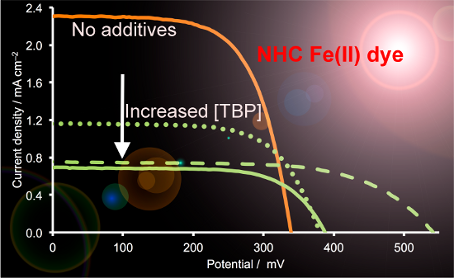
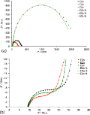
- electrolyte. The constant phase element was employed in this study because of the surface roughness [51][52]. We chose to focus on understanding the observations involving the MBI additive, and EIS studies were conducted for electrolytes E2b, E2c and E2e. Measurements and curve fitting were made for duplicate



Ternary nanocomposites of reduced graphene oxide, polyaniline and hexaniobate: hierarchical architecture and high polaron formation
Beilstein J. Nanotechnol. 2018, 9, 2936–2946, doi:10.3762/bjnano.9.272
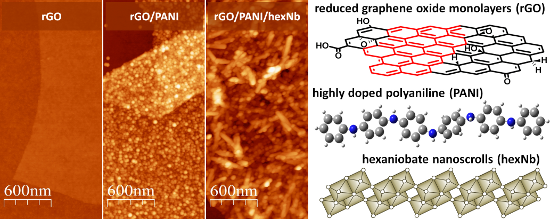
- shown in Figure 2. AFM images of the rGO-25 sample show particles of well-defined edges and size ranging from 5 to 25 μm. The height profile (Figure 2, right column) shows thickness of ca. 1.0 nm and a surface roughness (RMS) of 0.24 nm for the rGO flake. These results clearly indicate the presence of
- hand, this nanocomposite presents several creases and folds and, more interestingly, shows higher flake thickness and higher surface roughness (ca. 10 and ca. 4.0 nm, respectively). These results clearly indicate that the deposition of PANI on rGO flakes induces an increase of the surface heterogeneity
- . Analogously, the AFM images of rGO/PANI/hexNb also indicate the presence of large flakes in the nanocomposite and, as shown by the 5 μm scan-size image (and corresponding height profile), the flake thickness and surface roughness are ca. 19 and ca. 7.2 nm, respectively. These results clearly indicate that the


Controlling surface morphology and sensitivity of granular and porous silver films for surface-enhanced Raman scattering, SERS
Beilstein J. Nanotechnol. 2018, 9, 2813–2831, doi:10.3762/bjnano.9.263
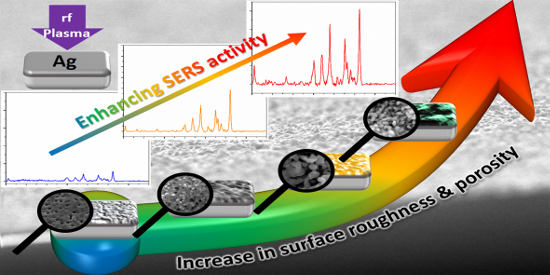
- plasmas on the surface morphology of thin silver films. It was found that different surface structures and different degrees of surface roughness could be obtained by a systematic variation of the plasma type and condition as well as plasma power and treatment time. The differently roughened silver
- investigation of the effect of different rf plasmas on sputtered silver surfaces to determine the potential of plasma treatment in a controlled increase of the surface roughness of silver as well as the formation of hot spots on the silver surface for the use in SERS. To the best of our knowledge this is the
- silver films were characterized using atomic force microscopy (AFM) in contact mode on a CP-II AFM (Bruker-Veeco) with SiC cantilevers to determine the topography and surface roughness (root mean square roughness, Rq). Scanning electron microscopy (SEM) of the silver films was performed on a Philips XL





Biomimetic surface structures in steel fabricated with femtosecond laser pulses: influence of laser rescanning on morphology and wettability
Beilstein J. Nanotechnol. 2018, 9, 2802–2812, doi:10.3762/bjnano.9.262
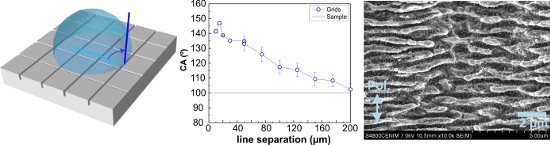
- the laser beam many times over the same sample area, i.e., laser rescanning. From a physical point of view, one fundamental difference between a single scan and multiple rescans is that the incident laser pulse during the second and subsequent scans “sees” not only a higher surface roughness, but in



Low cost tips for tip-enhanced Raman spectroscopy fabricated by two-step electrochemical etching of 125 µm diameter gold wires
Beilstein J. Nanotechnol. 2018, 9, 2718–2729, doi:10.3762/bjnano.9.254
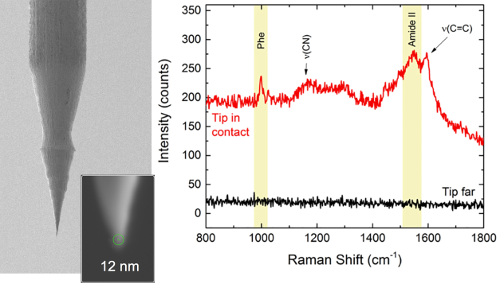
- addition, all the above-cited methods require very expensive lab equipment and skilled operators. Electrochemical etching, although suffering from surface roughness issues (mainly for silver), reproducibility issues and lack of tip dimension control, is a technique that is easy to implement, accessible to


Disorder in H+-irradiated HOPG: effect of impinging energy and dose on Raman D-band splitting and surface topography
Beilstein J. Nanotechnol. 2018, 9, 2708–2717, doi:10.3762/bjnano.9.253
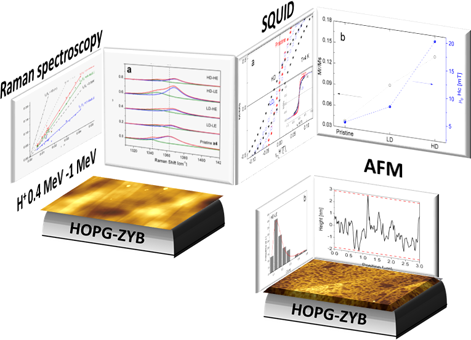
- techniques is advantageous in order to gain a better insight into the origin of defects. Atomic force microscopy (AFM) can help to reveal an increase in the graphene/graphite surface roughness, which has been correlated with the disorder generated by increasing hydrogen irradiation doses [21][22][23


Optimization of Mo/Cr bilayer back contacts for thin-film solar cells
Beilstein J. Nanotechnol. 2018, 9, 2700–2707, doi:10.3762/bjnano.9.252
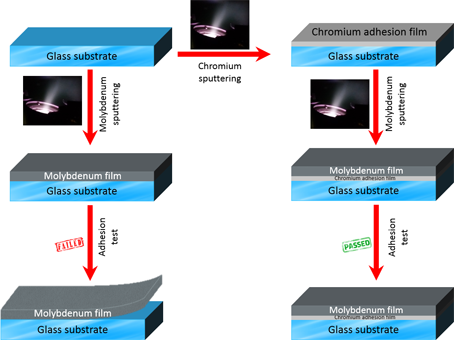
- different deposition powers and working pressures. Good adhesion to the SLG substrate has been achieved by means of an ultra-thin Cr layer under the Mo layer. By optimizing the deposition conditions we achieved low surface roughness, high optical reflectance and low sheet resistivity while we could decrease
- conditions and was set to obtain Mo layers with 600 nm thickness. Film characterization The film thickness measurements were conducted using a Bruker Dektak stylus profiler. Morphology studies and surface roughness measurements were carried out using a JEOL 7001F scanning electron microscope (SEM) and a
- morphology are also confirmed by AFM images (see Supporting Information File 1). AFM roughness analysis (Figure 4) reveals an increase of the surface roughness with the sputtering power. Surface roughness is also directly proportional to the working pressure. The average roughness increases from 1.61 to 3.06


Characterization of the microscopic tribological properties of sandfish (Scincus scincus) scales by atomic force microscopy
Beilstein J. Nanotechnol. 2018, 9, 2618–2627, doi:10.3762/bjnano.9.243
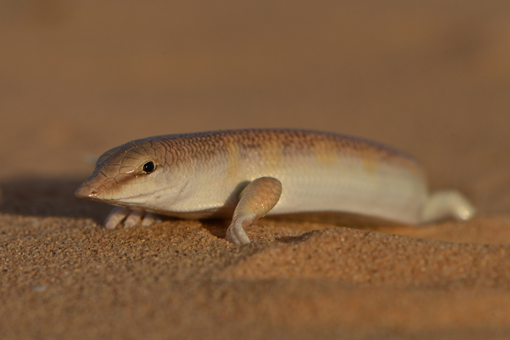
- for 5 min and with a 1 µm diamond suspension for 8 min (DP-suspension M products purchased from Struers, Willich, Germany). This procedure resulted in scratch-free surfaces and a surface roughness of Ra < 0.01 µm, determined by optical profilometry (Sensofar Plµ neox, Barcelona, Spain). The water


Friction reduction through biologically inspired scale-like laser surface textures
Beilstein J. Nanotechnol. 2018, 9, 2561–2572, doi:10.3762/bjnano.9.238
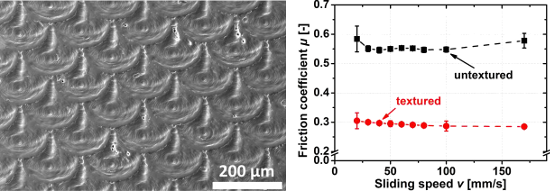
- friction forces encountered for sliding speeds between 40 and 70 mm/s. For even slower sliding, a more classical mixed lubrication contact is formed, as it is also encountered for samples textured with dimples [15]. The surface roughness of the steel discs after the experiments was Ra ≈ 200 nm. The discs
- detrimental effect by introducing a scale-like surface morphology for smaller sliding speeds was observed. Surface profilometry on the discs after the experiments revealed surface roughness values of Ra ≈ 250 nm, demonstrating that the discs became slightly rougher. Occasional signs of adhesive wear events
- friction coefficient for the steel-on-ceramic contact are significantly larger compared to the steel and polymer counter bodies presented above. This might be due to the significantly larger surface roughness of the aluminium oxide discs compared to the PEEK and 100Cr6 ones. Unfortunately, it is


High-temperature magnetism and microstructure of a semiconducting ferromagnetic (GaSb)1−x(MnSb)x alloy
Beilstein J. Nanotechnol. 2018, 9, 2457–2465, doi:10.3762/bjnano.9.230
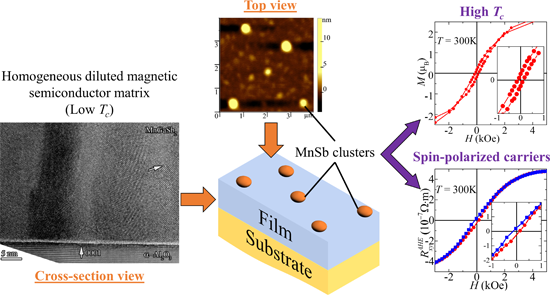
- 150 nm and the surface roughness does not exceed 6 nm. This is in a good agreement with the data presented in Table 1, which were estimated from the duration of the deposition process. The image analysis confirms a homogeneous composition throughout the film thickness without any substantial contrast



Evidence of friction reduction in laterally graded materials
Beilstein J. Nanotechnol. 2018, 9, 2443–2456, doi:10.3762/bjnano.9.229
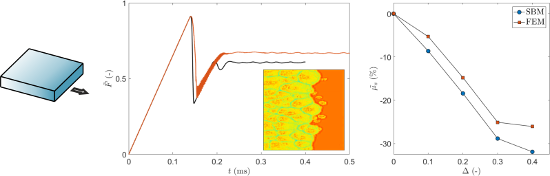
- simulation from a Gaussian statistical distribution (to account for surface roughness) with mean values denoted with µs(m) and µk(m), respectively. The standard deviation on the local coefficients of friction are denoted with σµs and σµk, respectively. If the block i is at rest, the static friction force Ffr


![[Graphic 5]](/bjnano/content/inline/2190-4286-9-229-i10.svg?max-width=637&scale=1.18182) as function of time for the non-graded material: SBM solution for dif...
as function of time for the non-graded material: SBM solution for dif...


Thickness-dependent photoelectrochemical properties of a semitransparent Co3O4 photocathode
Beilstein J. Nanotechnol. 2018, 9, 2432–2442, doi:10.3762/bjnano.9.228
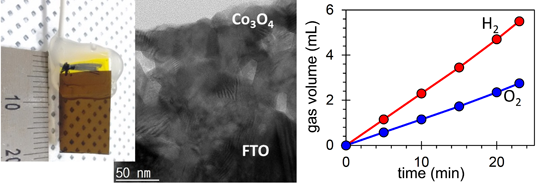
- focused ion beam system (FIB, FEI, Quanta 3D FEG). The elemental compositions in the cross sections of the Co3O4 layers in the working electrode were determined as line profiles by an energy dispersive spectroscopy (EDS) attachment to the FETEM. Thickness and average surface roughness of the deposited




High-throughput micro-nanostructuring by microdroplet inkjet printing
Beilstein J. Nanotechnol. 2018, 9, 2372–2380, doi:10.3762/bjnano.9.222
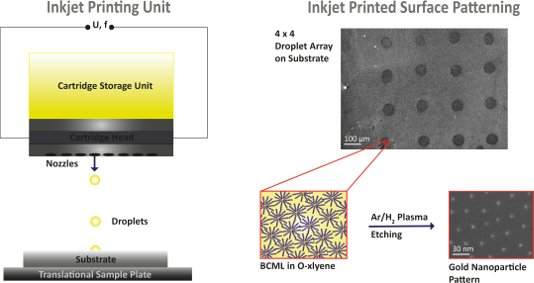
- situated on the grain boundaries. Droplet size is a function of surface roughness Figure 4 presents the diameter distribution of micelle solution droplets for each sample. The droplets on poly-Si have a comparable size with a tight variation range of only about 5 µm. The distribution is symmetric, whereby
- automatically determined average surface roughness, Ra, for each area, sputtered NiTi (sample shown in (E)) has the highest roughness and poly-silicon (A) is the smoothest sample. Boxchart of nanoparticle separation distance in the center of microcircles for each substrate material, as determined by a nearest


Filling nanopipettes with apertures smaller than 50 nm: dynamic microdistillation
Beilstein J. Nanotechnol. 2018, 9, 2181–2187, doi:10.3762/bjnano.9.204
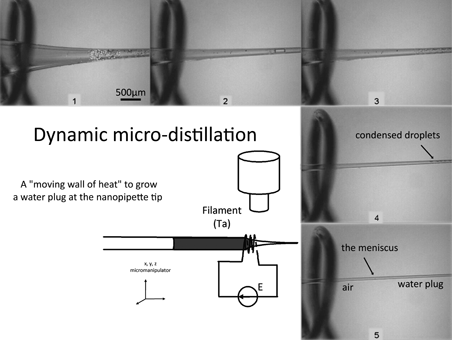
- probably also the surface roughness. Moreover, the very small aperture range, our particular focus, was not explored in this work. When high back-pressure is applied to the filling fluid, we showed in a previous article that the fluid meniscus follows an air-flow Poiseuille law [14] enabling the size of


Recent highlights in nanoscale and mesoscale friction
Beilstein J. Nanotechnol. 2018, 9, 1995–2014, doi:10.3762/bjnano.9.190
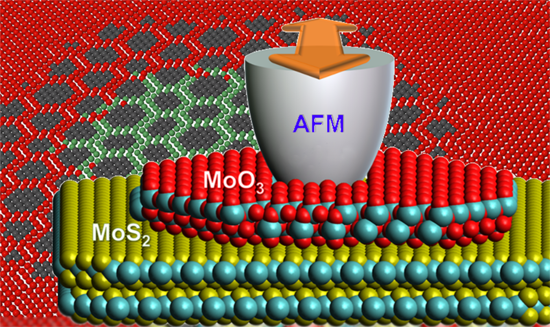
- the relative lateral motion of bodies in contact, and the related dissipation phenomena are being investigated extensively due to their importance in applications, from everyday life to advanced technology. At the macroscopic scale, friction between sliding bodies depends on their surface roughness


Self-assembled quasi-hexagonal arrays of gold nanoparticles with small gaps for surface-enhanced Raman spectroscopy
Beilstein J. Nanotechnol. 2018, 9, 1977–1985, doi:10.3762/bjnano.9.188
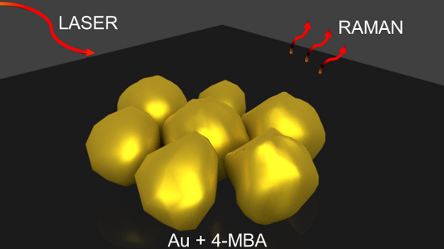
- diameter distribution, which is indicated by the error bars in Figure 3. Since in reality the particles are irregular and exhibit some surface roughness, the equivalent diameters underestimate the maximum outer diameter, and thus the minimum gap sizes to neighbouring particles may be even smaller than