Search results
Search for "contamination" in Full Text gives 325 result(s) in Beilstein Journal of Nanotechnology. Showing first 200.
Current measurements in the intermittent-contact mode of atomic force microscopy using the Fourier method: a feasibility analysis
Beilstein J. Nanotechnol. 2020, 11, 453–465, doi:10.3762/bjnano.11.37
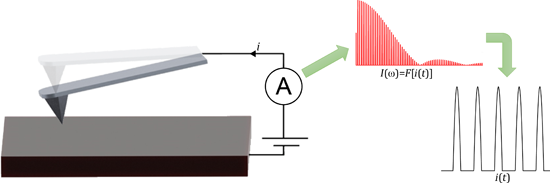
- torsional oscillations in a way that reduced cross-contamination of the signals used to reconstruct the tip–sample force. We have also reported numerical simulations of this method, providing analysis software that enables estimations of the accuracy of the method under different conditions [29]. Fourier




Atomic-resolution imaging of rutile TiO2(110)-(1 × 2) reconstructed surface by non-contact atomic force microscopy
Beilstein J. Nanotechnol. 2020, 11, 443–449, doi:10.3762/bjnano.11.35
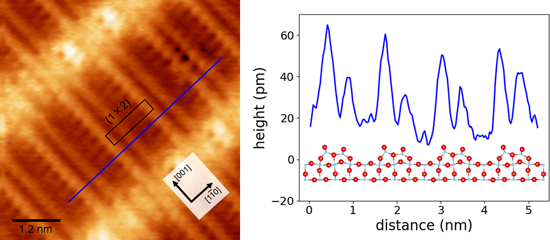
- -AFM and tunneling current for STM), the surface structure sometimes results in different contrasts in both images. In Figure 3, white squares and circles indicate line defects and protrusions, which are considered to be adsorbates or contamination. A line defect was imaged as a likely vacancy by STM


Formation of nanoripples on ZnO flat substrates and nanorods by gas cluster ion bombardment
Beilstein J. Nanotechnol. 2020, 11, 383–390, doi:10.3762/bjnano.11.29
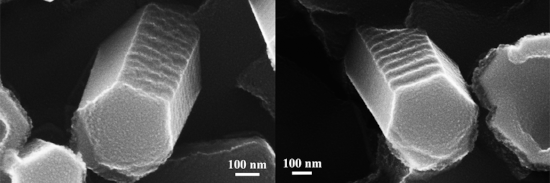
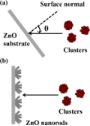
- surface by the ion beam and thermal diffusion of the target atoms. Recently, the gas cluster ion beams (GCIB) technique has been introduced as a mask-free method to produce nanostructures on solid surfaces [11][12]. Among its advantages are the lack of chemical contamination and the low damage to the



Facile biogenic fabrication of hydroxyapatite nanorods using cuttlefish bone and their bactericidal and biocompatibility study
Beilstein J. Nanotechnol. 2020, 11, 285–295, doi:10.3762/bjnano.11.21
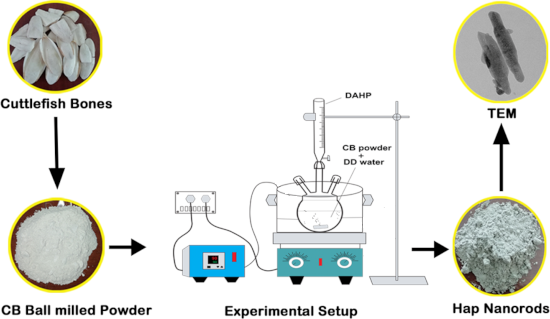
- Department of Chemical Engineering, Curtin University, Miri, Sarawak 98009, Malaysia 10.3762/bjnano.11.21 Abstract Cuttlefish bones are an inexpensive source of calcium carbonate, which are produced in large amounts by the marine food industry, leading to environmental contamination and waste. The
- waste material every day by the marine food industry across the world, resulting in environmental contamination [10]. In ancient times, cuttlefish bone powder was used as biomedicine in China and India for oral health and is proven to be completely suitable for biomedical applications [11]. Further, the


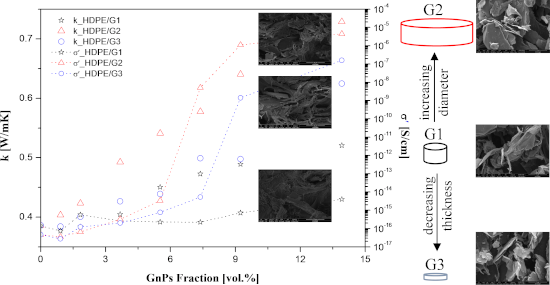
Size effects of graphene nanoplatelets on the properties of high-density polyethylene nanocomposites: morphological, thermal, electrical, and mechanical characterization
Beilstein J. Nanotechnol. 2020, 11, 167–179, doi:10.3762/bjnano.11.14
- was easily indicated by the low amount of carbonyl (C=Oar) in the case of the O 1s signal. There was also a small amount of surface contamination present in the case of G1, with 0.1 atom % of Si 2p at ca. 103.6, corresponding to siloxanes, and 0.1 atom % sodium (Na 1s at ca. 1072.1 eV). For G3, some
- contamination with sulfur was observed (0.3 atom %, S 2p at ≈164–169 eV). However, the small differences in the GnPs’ surfaces’ chemical composition did not affect the properties of the HDPE-based nanocomposites. The results of FTIR analysis are shown in Figure 3a (further details can be found in Figures S1–S7


Synthesis and acetone sensing properties of ZnFe2O4/rGO gas sensors
Beilstein J. Nanotechnol. 2019, 10, 2516–2526, doi:10.3762/bjnano.10.242
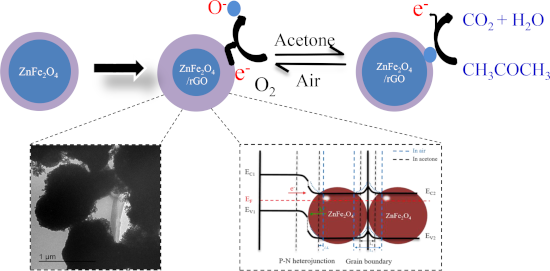
- obtained percentage is higher than theoretically predicted, which may be due to a contamination arising from the carbon-containing electrically conductive adhesive or another source of carbon in the sample stage or on the sample surface. Still, the actual quantities derived by EDX are basically consistent




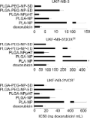
Incorporation of doxorubicin in different polymer nanoparticles and their anticancer activity
Beilstein J. Nanotechnol. 2019, 10, 2062–2072, doi:10.3762/bjnano.10.201

- streptomycin at 37 °C. The drug-adapted sub-lines were continuously cultured in the presence of the indicated drug concentrations. Cells were routinely tested for mycoplasma contamination and authenticated by short tandem repeat profiling. Cell viability assay Cell viability was determined by 3-(4,5





Preservation of rutin nanosuspensions without the use of preservatives
Beilstein J. Nanotechnol. 2019, 10, 1902–1913, doi:10.3762/bjnano.10.185
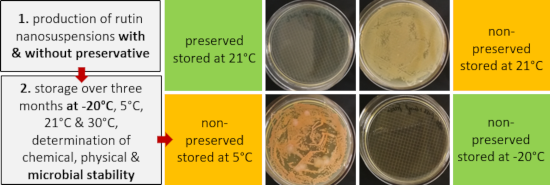
- . They are produced by various techniques, typically yielding aqueous nanosuspensions, which are prone to microbial contamination. Preservation of nanocrystals is possible but might not always be feasible, as preservatives might interfere with other excipients in the formulations or with chemicals used
- need to be stored, which certainly requires a sufficient stability of the nanosuspension. For this, besides chemical and physical stability, also the microbial stability needs to be considered. One method to avoid microbial contamination of aqueous formulations during storage is the use of
- confirmed by this set of data. The same trend was also observed for the growth of fungi. However, there was one exception, which was observed for the Plantacare-stabilized formulation at day 60 of storage. At this time point a slight contamination with fungi was observed for one aliquot (Figure 10 and Table


Novel hollow titanium dioxide nanospheres with antimicrobial activity against resistant bacteria
Beilstein J. Nanotechnol. 2019, 10, 1716–1725, doi:10.3762/bjnano.10.167
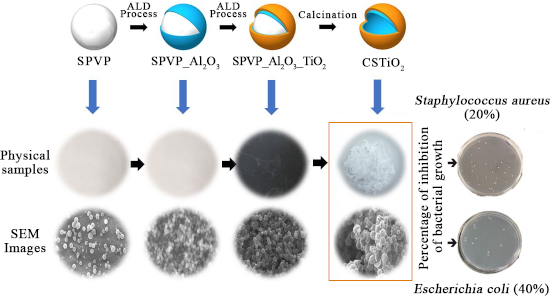
- ; atomic layer deposition; electrospinning; hollow nanospheres; titanium dioxide; Introduction Microbial contamination and the increase of multidrug bacterial resistance have become two major current concerns for food safety and human health due to the number of food-borne diseases and nosocomial


Doxorubicin-loaded human serum albumin nanoparticles overcome transporter-mediated drug resistance in drug-adapted cancer cells
Beilstein J. Nanotechnol. 2019, 10, 1707–1715, doi:10.3762/bjnano.10.166
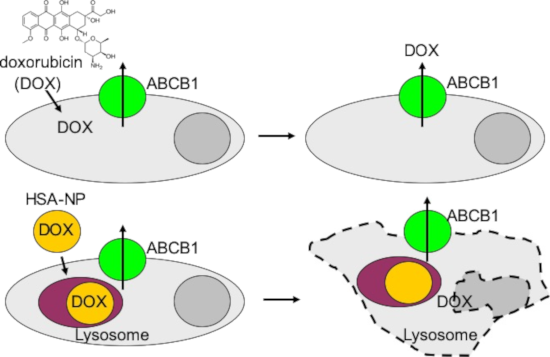
- cultured in the presence of the indicated drug concentrations. The cells were routinely tested for mycoplasma contamination and authenticated by short tandem repeat profiling. Cell viability assay Cell viability was determined by 3-(4,5-dimethylthiazol-2-yl)-2,5-diphenyltetrazolium bromide (MTT) assay


Tuning the performance of vanadium redox flow batteries by modifying the structural defects of the carbon felt electrode
Beilstein J. Nanotechnol. 2019, 10, 1698–1706, doi:10.3762/bjnano.10.165
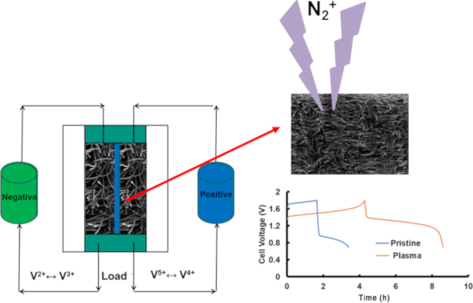
- single redox species, element cross-contamination issues, which are common in other redox flow batteries such as Cr/Fe, are obviously nonexistent [1]. Nevertheless, the system suffers from irreversible capacity fade due to parasitic reactions such as air oxidation of V2+ species and hydrogen evolution


Layered double hydroxide/sepiolite hybrid nanoarchitectures for the controlled release of herbicides
Beilstein J. Nanotechnol. 2019, 10, 1679–1690, doi:10.3762/bjnano.10.163
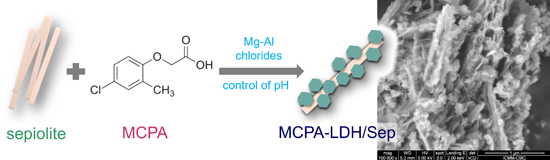
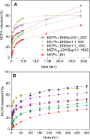
- molecules adsorbed on the inorganic solids that appear at around 1630 cm−1 [40]. In addition around 1360 and 1365 cm−1, in the initial LDH and in the MCPAie-LDH, a possible contamination with carbonate ions during the preparation of the materials is observed (Figure 2B) [41]. The amounts of MCPA present in


Subsurface imaging of flexible circuits via contact resonance atomic force microscopy
Beilstein J. Nanotechnol. 2019, 10, 1636–1647, doi:10.3762/bjnano.10.159
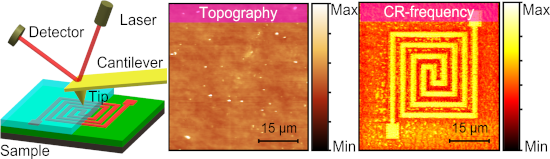
- substrate on which conductive metal circuits are patterned. Another thin polymer coating is employed to protect the circuits from contamination and short circuiting. Such a sandwich structure permits the device to bend and fold flexibly, yet with other advantages including small volume, light weight, and so


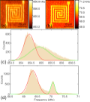

Development of a new hybrid approach combining AFM and SEM for the nanoparticle dimensional metrology
Beilstein J. Nanotechnol. 2019, 10, 1523–1536, doi:10.3762/bjnano.10.150
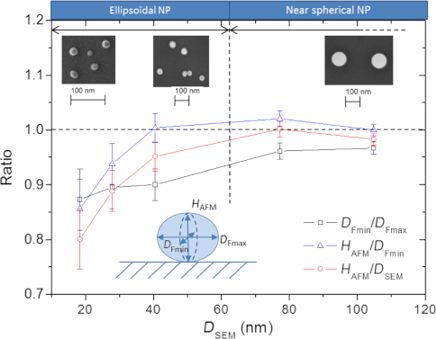
- ]. Precautions Before starting the measurements, several precautions must be taken. During SEM imaging, molecules already existing at the sample surface desorb in the chamber vacuum or diffuse on the substrate and accumulate in the irradiated part of the sample [19] forming a contamination layer at the sample
- surface. This layer modifies the position of the reference plane during the AFM measurement. This is why it is necessary to start with the characterization of the NPs by AFM. Moreover, a contamination layer could form on the substrate during drying of the suspension. In fact, the nanoparticles might be
- located not on the substrate surface but on a deformable contamination layer. This phenomenon has been observed in [19]. As a reminder, the height of a nanoparticle is calculated as the height maximum of the NP minus the mean surface height of the substrate. If this mean surface height cannot be clearly




Flexible freestanding MoS2-based composite paper for energy conversion and storage
Beilstein J. Nanotechnol. 2019, 10, 1488–1496, doi:10.3762/bjnano.10.147
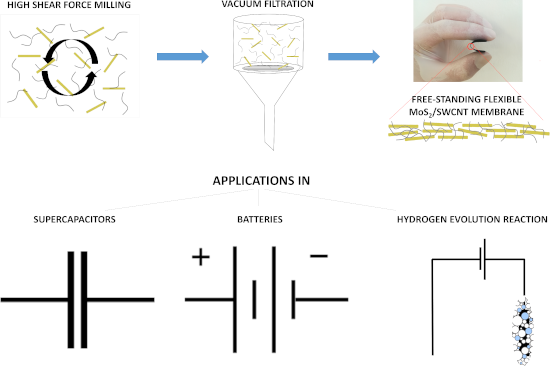
- identified (Supporting Information File 1, Table S1) that there was about 2.1 wt % of iron in the sample. This contamination originates from the carbon nanotubes, where iron usually serves as a catalyst for their growth [36]. X-ray photoelectron spectroscopy (XPS) was used to track the degree of degradation


Growth of lithium hydride thin films from solutions: Towards solution atomic layer deposition of lithiated films
Beilstein J. Nanotechnol. 2019, 10, 1443–1451, doi:10.3762/bjnano.10.142
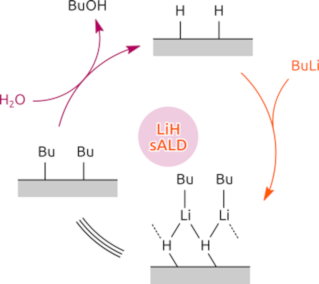
- . Contamination was a major limiting factor in the deposition setup. Examples of difficulties due to contamination include the loss of BuLi precursor when small amounts of air got into the reaction flask, and the repeating failure of the QCM measurement due to clogging and subsequent seal failure. Therefore
- , contamination was avoided as much as reasonably possible. Measures for safe handling of n-butyllithium Due to the pyrophoric nature of n-butyllithium these safety procedures were followed. (i) The n-butyllithium solution was handled in an argon-filled glovebox, set up specifically for precursor handling. (ii
- -butyllithium and atmosphere would be insufficient to ignite the diethyl ether. This approach was tested and confirmed to work. Notably, the last step of this approach increases the sensitivity of the precursor to contamination, which was a major limiting factor, as mentioned before. However, safety was chosen


Gas sensing properties of individual SnO2 nanowires and SnO2 sol–gel nanocomposites
Beilstein J. Nanotechnol. 2019, 10, 1380–1390, doi:10.3762/bjnano.10.136
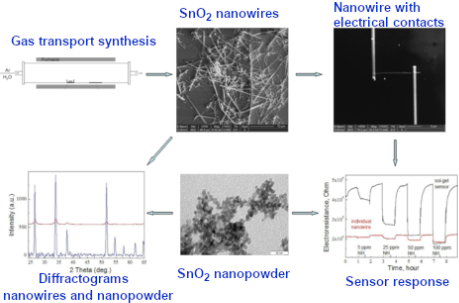
- contamination on the sample surfaces. Device manufacture Manufacture of the device based on a single nanowire Individual nanowires were electrically contacted by direct focused-ion beam (FIB) platinum deposition, using an FEI dual beam Strata 235 instrument combined with a metal–organic injector to deposit
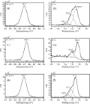
- is confirmed by the absence of impurity element lines. The position and single-component structure of the C 1s line for the nanowire sample is typical of the usual hydrocarbon contamination of ambient-stored samples. On powder samples, the same line exhibits a more complex fine structure as different




Nanoscale spatial mapping of mechanical properties through dynamic atomic force microscopy
Beilstein J. Nanotechnol. 2019, 10, 1332–1347, doi:10.3762/bjnano.10.132
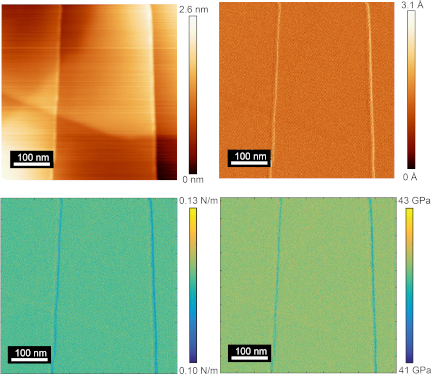
- to surface characterization has resulted in very little water or other contamination of the exposed steps, thus allowing for the measurement of the intrinsic properties of the step edges themselves. The results contained within subsequent sections of this manuscript also showed the same trend in the
- topography, environmental contamination, the Schwoebel–Ehrlich barrier, energy dissipation through viscoelastic energy losses, applied normal force, tip shape, and modulation frequency (both for CR and FMM modes). Each examination will show that the elastic modulus measured in the previous section is
- , shows that the softening of the step is present in both scan directions. Additionally, the trend observed in the lateral forces, where both the forward and reverse scan directions showed a more negative value in the peak lateral force at the uncovered step edge, suggests an absence of contamination at




Fabrication of phase masks from amorphous carbon thin films for electron-beam shaping
Beilstein J. Nanotechnol. 2019, 10, 1290–1302, doi:10.3762/bjnano.10.128
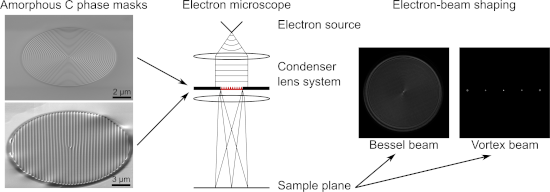
- commonly used in other phase-related techniques in the form of phase plates, e.g., Zernike phase plates in phase-plate TEM [20]. In the latter application, effects such as contamination, beam damage and charging of aC phase plates due to intense electron-beam irradiation in the back focal plane of the
- less robust compared to SixNy. No qualitative degradation of beam shape quality was observed during PM application, which suggests that no charging or contamination was present. Bessel (BBs) and vortex beams (VBs) were successfully generated in transmission electron microscopes. For BBs, we observed



Synthesis and characterization of quaternary La(Sr)S–TaS2 misfit-layered nanotubes
Beilstein J. Nanotechnol. 2019, 10, 1112–1124, doi:10.3762/bjnano.10.111
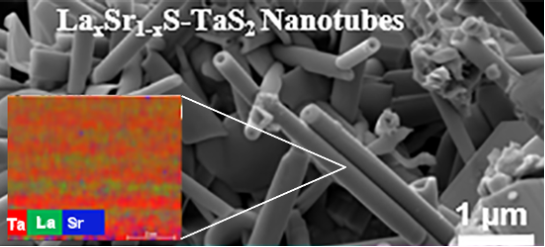
- and drying a drop of this dispersion onto a lacey-carbon-supported Cu/Ni grid. To minimize contamination during imaging, the TEM specimens were heated in a vacuum chamber at 60 °C overnight followed by 3 seconds of oxygen plasma exposure prior to the electron microscopy analysis. Raman spectroscopy


Concurrent nanoscale surface etching and SnO2 loading of carbon fibers for vanadium ion redox enhancement
Beilstein J. Nanotechnol. 2019, 10, 985–992, doi:10.3762/bjnano.10.99
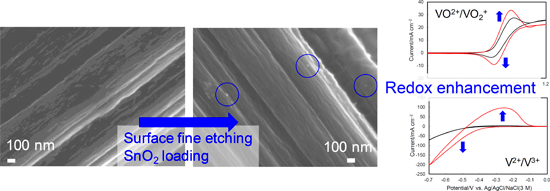
- processes were attained in the full cell with the TGP-CSnPc-550Air electrodes compared to that with the TGP electrodes. A stable coulomb efficiency is demonstrated by the cycling performance, indicating no influence of a potential Sn2+ contamination on the cycling performance. The finely etched surface and



Fabrication of silver nanoisland films by pulsed laser deposition for surface-enhanced Raman spectroscopy
Beilstein J. Nanotechnol. 2019, 10, 882–893, doi:10.3762/bjnano.10.89
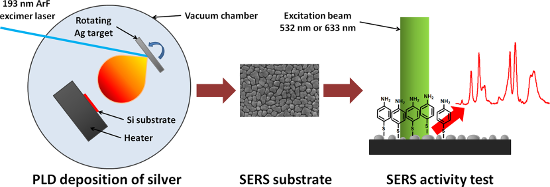
- physical methods include fabrication of nanostructured silver films by electron-beam evaporation [16], gas aggregation [17] and radio-frequency sputtering [18]. The advantages of certain physical methods over chemical methods include that there is no reagent contamination and that the monodispersity of




Periodic Co/Nb pseudo spin valve for cryogenic memory
Beilstein J. Nanotechnol. 2019, 10, 833–839, doi:10.3762/bjnano.10.83
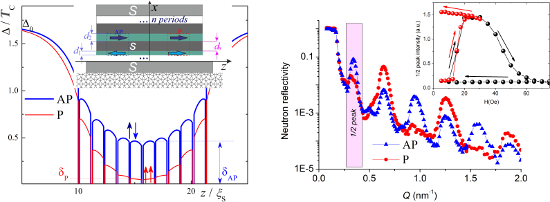
- sapphire (Al2O3) substrate. Before the deposition the substrates were etched by an argon ion beam inside the chamber. The targets Nb(99.99%) and Co(99.99%) were presputtered to remove metallic oxides and contamination absorbed on the surfaces. Additionally, immediately before deposition of the next layer


Outstanding chain-extension effect and high UV resistance of polybutylene succinate containing amino-acid-modified layered double hydroxides
Beilstein J. Nanotechnol. 2019, 10, 684–695, doi:10.3762/bjnano.10.68
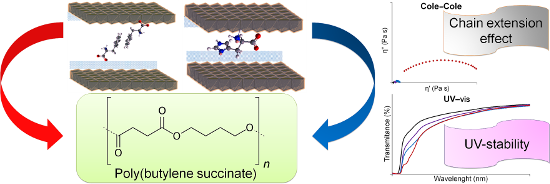
- NaOH solution. When the addition of salts was finished, the reaction mixture was aged for 3.5 h at room temperature. Both the reaction and ageing processes were performed under nitrogen atmosphere to avoid contamination by carbonate. The final products were centrifuged, washed several times with


Topochemical engineering of composite hybrid fibers using layered double hydroxides and abietic acid
Beilstein J. Nanotechnol. 2019, 10, 589–605, doi:10.3762/bjnano.10.60
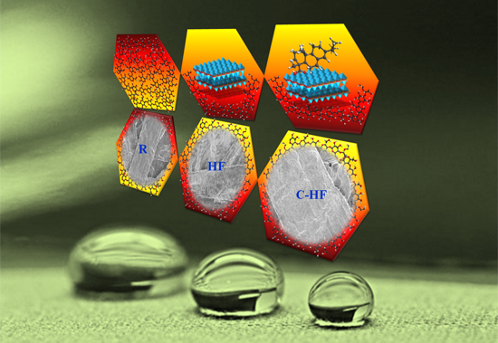
- , causing contamination or reactions with cellulosic –OH groups. AA was only connected to the HF fibers through freely available brucite layers (cations on the top plane) of LDH through hydrogen bonding between –OH groups of LDH and –COOH groups of AA. The –OH groups present in the bottom plane of LDH