Search results
Search for "corrosion" in Full Text gives 137 result(s) in Beilstein Journal of Nanotechnology.
Atomic layer deposition, a unique method for the preparation of energy conversion devices
Beilstein J. Nanotechnol. 2014, 5, 245–248, doi:10.3762/bjnano.5.26

- in batteries; ALD for separation and protection, in particular to prevent erosion or corrosion in electrochemical devices; ALD for interface engineering, for example defect passivation in solar cells or prevention of charge recombination by tunnel barriers, and for influencing the electronic


Confinement dependence of electro-catalysts for hydrogen evolution from water splitting
Beilstein J. Nanotechnol. 2014, 5, 195–201, doi:10.3762/bjnano.5.21
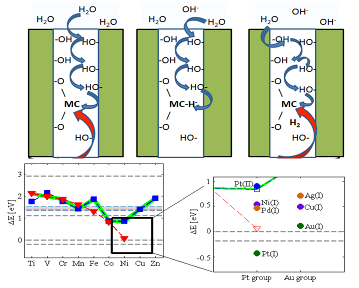
- environment. The latter may be recast into a nominal pressure experienced by the evolving H2 molecule. We arrived at a novel perspective on the uniqueness of oxide supported atomic Pt as a HE catalyst under ambient conditions. Keywords: confinement; corrosion; DFT; electro-catalysis; hydrogen evolution



Design criteria for stable Pt/C fuel cell catalysts
Beilstein J. Nanotechnol. 2014, 5, 44–67, doi:10.3762/bjnano.5.5
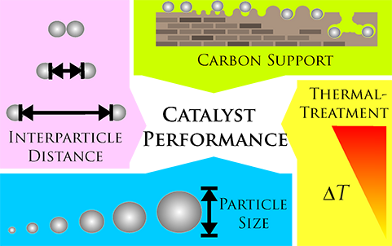
- Ti, W, Mo etc.) exhibit promising corrosion resistances under fuel cell conditions. However, most of these non-carbon materials suffer from low conductivities and/or poor platinum dispersion, thus limiting the efficiency of the fuel cell [17]. Despite the demonstration of an improved stability as
- ]. This may be either due to migration and collision of platinum particles on the surface of the carbon support with successive coalescence, or due to strong carbon corrosion. In the second case, neighboring but initially separated particles come into contact with each other because of a successive
- shrinkage of the carbon support on which they are located [49]. However, also in the first possible case of agglomeration and coalescence due to migration, carbon corrosion may be involved and lead to a weakening of the interactions between platinum particles and support. Alternatively a preferential local





Ellipsometry and XPS comparative studies of thermal and plasma enhanced atomic layer deposited Al2O3-films
Beilstein J. Nanotechnol. 2013, 4, 732–742, doi:10.3762/bjnano.4.83
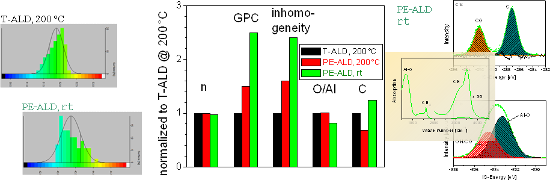
- [8] or corrosion protection [9]. Recently, there is a growing activity in covering photo-electrodes or electrodes by ultra-thin Al2O3 ALD layers for electrochemical energy generation and storage systems [10] in order to enhance the efficiency and durability of such devices. This includes for example


New hybrid materials based on poly(ethyleneoxide)-grafted polysilazane by hydrosilylation and their anti-fouling activities
Beilstein J. Nanotechnol. 2013, 4, 671–677, doi:10.3762/bjnano.4.75
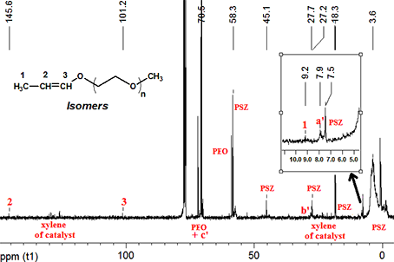
- that could crosslinked by humid air through hydrolysis and condensation reactions [4][5]. This method was used to prepare coatings of thicknesses from 0.3 to 50 micrometers that have an excellent resistance against corrosion and abrasion because of their exceptional adhesion to a variety of substrates


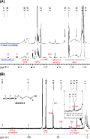


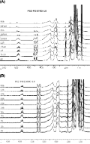

Nanoglasses: a new kind of noncrystalline materials
Beilstein J. Nanotechnol. 2013, 4, 517–533, doi:10.3762/bjnano.4.61
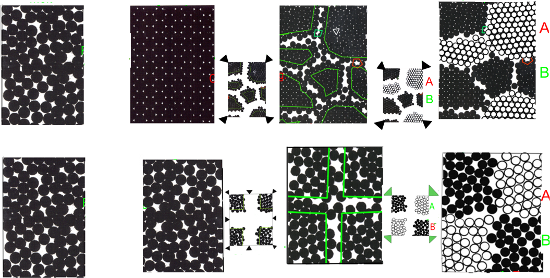
- nanoglasses Due to their high strength, large elastic limit and excellent corrosion resistance, metallic glasses are considered to be promising biomaterials. As one of the most widely used implantable metals, titanium and its alloys have attracted considerable scientific and technological interest. In fact








Grain boundaries and coincidence site lattices in the corneal nanonipple structure of the Mourning Cloak butterfly
Beilstein J. Nanotechnol. 2013, 4, 292–299, doi:10.3762/bjnano.4.32

- ., intergranular corrosion, cracking, segregation) as summarized in several books, e.g., [14][15]. It was further shown that the special properties of grain boundaries were even maintained for small angular deviations (Δθ) from the special misorientations (θ). Several criteria were introduced for permissible


Catalytic activity of nanostructured Au: Scale effects versus bimetallic/bifunctional effects in low-temperature CO oxidation on nanoporous Au
Beilstein J. Nanotechnol. 2013, 4, 111–128, doi:10.3762/bjnano.4.13
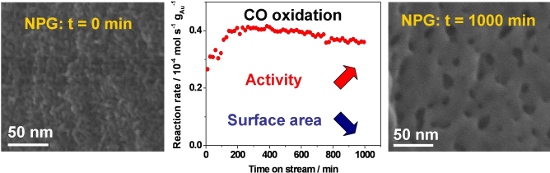
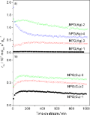
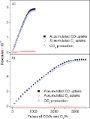
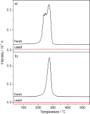
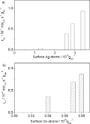
- particular interest for catalysis research in view of its self-supporting nature [3][4][5][6][7]. This kind of material is generally synthesized by corrosion techniques, either by chemical corrosion in acidic solutions [3][4][5][6][7] or by electrochemical etching at anodic potentials [8][9][10]. Using the


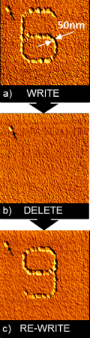
Reversible mechano-electrochemical writing of metallic nanostructures with the tip of an atomic force microscope
Beilstein J. Nanotechnol. 2012, 3, 824–830, doi:10.3762/bjnano.3.92
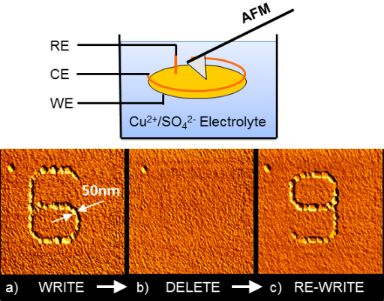
- nanolithography, the results also help in understanding microscopic mechanisms of mechanically activated or mechanically assisted electrochemical processes on metallic surfaces, e.g., during electropolishing or in combined mechanical wear and corrosion processes. Experimental The experimental setup was described


Noncontact atomic force microscopy study of the spinel MgAl2O4(111) surface
Beilstein J. Nanotechnol. 2012, 3, 192–197, doi:10.3762/bjnano.3.21
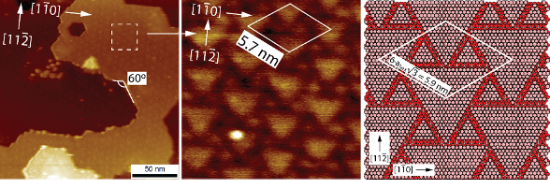
- ); polar surfaces; reconstructions; spinel; Introduction While the application of metal oxides in, e.g., catalysis, gas sensors, fuel cells, high-k dielectrics and corrosion protection has seen a very strong development, fundamental research on the surface properties of metal oxides has been a topic of


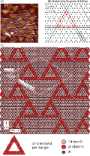
Self-assembled monolayers and titanium dioxide: From surface patterning to potential applications
Beilstein J. Nanotechnol. 2011, 2, 845–861, doi:10.3762/bjnano.2.94
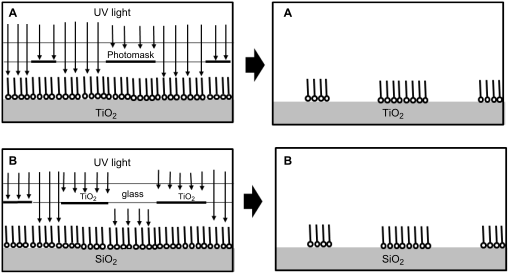
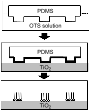
- areas of photovoltaics, microelectronics, microelectromechanics, photocatalysis, corrosion prevention and even biomedicine should be regarded as appetizers paving the way for further studies to be performed. Keywords: photocatalysis; remote degradation; self-assembled monolayers; titanium dioxide



Zirconium nanoparticles prepared by the reduction of zirconium oxide using the RAPET method
Beilstein J. Nanotechnol. 2011, 2, 198–203, doi:10.3762/bjnano.2.23
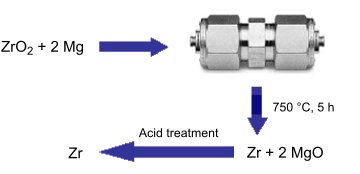
- resistance to corrosion [1], it is used as an alloying agent in materials that are exposed to corrosive agents such as surgical appliances, explosive primers, vacuum tube getters and filaments. Since it has a very negative reduction potential (−1.55 V), it is never found as the native metal. It is obtained