Search results
Search for "density of states" in Full Text gives 195 result(s) in Beilstein Journal of Nanotechnology.
Invariance of molecular charge transport upon changes of extended molecule size and several related issues
Beilstein J. Nanotechnol. 2016, 7, 418–431, doi:10.3762/bjnano.7.37
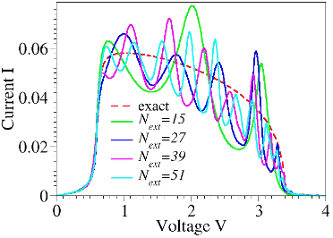
- description based on the small molecule or on an extended molecule, all the physical properties (e.g., transmission, current, local density of states, charge densities) should be identical. The proof that these properties indeed coincide, which represents an important sanity test for theory, will be given
- Equation 27 coincide with the exact one (Equation 15). Via Equation 8 and Equation 2 (see also Table 1), this implies that conductance and local density of states at equilibrium (V = 0) and zero temperature computed within the wide- or flat-band approximations are exact. Therefore, these quantities (as
- density of states at the contacts [21]). Electron correlations, which escape the conventional Landauer framework utilized here, can further enhance the NDR [25][26][27]. Besides finite bandwidth and energy-dependent densities of states, for systems with more than one site, the potential drop across the


Rigid multipodal platforms for metal surfaces
Beilstein J. Nanotechnol. 2016, 7, 374–405, doi:10.3762/bjnano.7.34

- reproducible binding, sufficiently strong anchoring between a molecule and metal surfaces, and should maintain a sufficient electron density of states close to the Fermi level to pass an electron or hole through the molecule (electronically transparent nature with relatively high conductance). Finally, a well










Current-induced runaway vibrations in dehydrogenated graphene nanoribbons
Beilstein J. Nanotechnol. 2016, 7, 68–74, doi:10.3762/bjnano.7.8
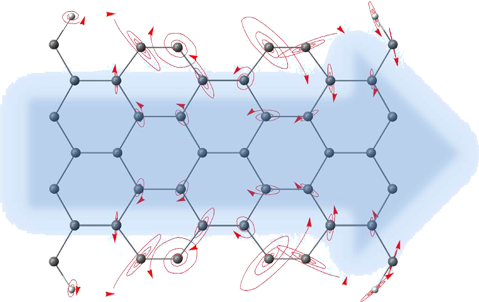
- fluctuating force, f, while the current-induced forces show up in . Here we focus on the latter. The contribution from the electron degrees of freedom including the non-equilibrium effects can be expressed in terms of the coupling-weighted electron–hole pair density of states, Λ, with Λ (including spin
- phonon density of states (DOS) as, where Dr(ω) is the nonequilibrium phonon Greens function obtained from the SCLE, Note that we introduced boldface to underline that these are matrices with mode-index (k,l). Contrary to the equilibrium situation, the DOS given in Equation 8 can take negative values at
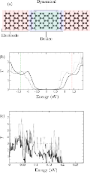
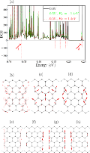
- used below in Figure 2). (c) Solid line is phonon transmission for the structure in (a), dotted line is phonon transmission for a pristine hydrogenated ribbon. (a) The black solid line shows the phonon density of states excluding the self-energy due to the electronic degrees of freedom. The green
Large area scanning probe microscope in ultra-high vacuum demonstrated for electrostatic force measurements on high-voltage devices
Beilstein J. Nanotechnol. 2015, 6, 2485–2497, doi:10.3762/bjnano.6.258
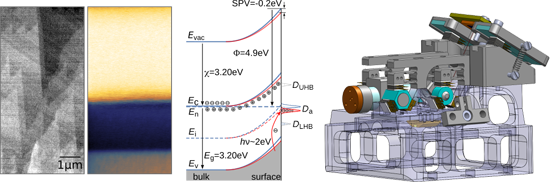
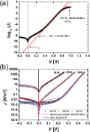
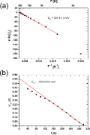
- effective density of states in the conduction (NC = 3.25 × 10¹⁵·T3/2 = 1.69 × 1019 cm−3) and valence band (NV = 4.8 × 10¹⁵·T3/2 = 2.49 × 1019 cm−3) [46]. This leads to Vb = 3.0 eV, which is a reasonable value taking into account the band gap of 4H-SiC. With a theoretically determined electron affinity of χ


Vibration-mediated Kondo transport in molecular junctions: conductance evolution during mechanical stretching
Beilstein J. Nanotechnol. 2015, 6, 2417–2422, doi:10.3762/bjnano.6.249
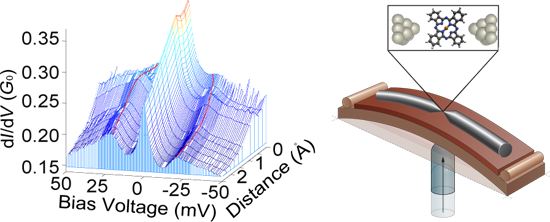
- density of states at the Fermi energy, which is expressed as a peak in the conductance at zero voltage (Figure 1a). At a finite voltage and in the absence of inelastic effects, the injected electrons are transmitted off-resonance and the Kondo contribution to the conductance is reduced. However, in the


Negative differential electrical resistance of a rotational organic nanomotor
Beilstein J. Nanotechnol. 2015, 6, 2332–2337, doi:10.3762/bjnano.6.240
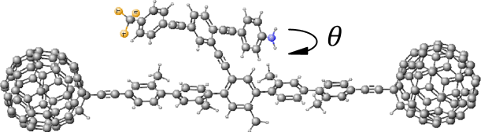
- . Figure 3b shows contour plots of the local density of states (LDOS) around the HOMO of the isolated molecule for two different rotation angles. These plots show that the HOMO is extended, but not symmetric. This demonstrates why the transmission coefficient does not approach unity on resonance, because
- –angle curves, the pendant group was artificially rotated to a chosen angle and then the molecule was allowed to relax to a local energy minimum. (a) The molecular structure within the junction. (b) A contour plot of the local density of states of the gas-phase molecule at θ = 60° (right) and θ = 0


Plasma fluorination of vertically aligned carbon nanotubes: functionalization and thermal stability
Beilstein J. Nanotechnol. 2015, 6, 2263–2271, doi:10.3762/bjnano.6.232
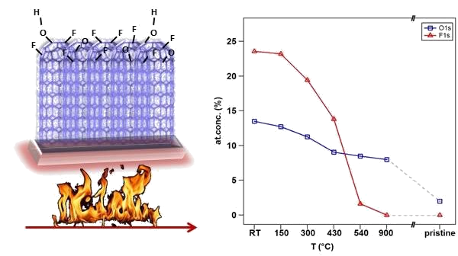
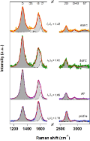
- eV, respectively. The strong modification in the intensity ratio of the structures in the UPS spectrum is due to the fluorine grafting that also drastically reduces the relative intensity associated with the density of states just below the Fermi level. This is a signature of a drastic change in the
- more intense. Moreover, the relative intensity related to the density of states near the Fermi level increases again. This shows that the oxygen effect in the electronic properties is less pronounced at this concentration. This is in contrast to the presence of fluorine, which induces a semiconducting
- completely at around 540 °C, the oxygen atoms were strongly bound to the carbon lattice through single and double C–O covalent bonds. This illustrated its electronic states also in the valence band, where we observed a fine tuning of the density of states near the Fermi level by the desorption of fluorine


Nonconservative current-driven dynamics: beyond the nanoscale
Beilstein J. Nanotechnol. 2015, 6, 2140–2147, doi:10.3762/bjnano.6.219
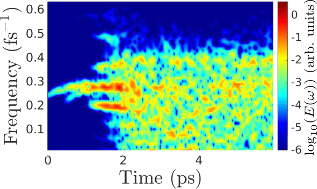
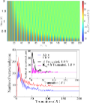
- density of states operators are generated by Green’s function techniques. We can now calculate the forces on ions about a chosen reference geometry, . Under small displacements, d, where Knm = −∂ Fn()/∂ Rm are the elements of the dynamical response matrix. The dynamical response matrix determines the




Thermoelectricity in molecular junctions with harmonic and anharmonic modes
Beilstein J. Nanotechnol. 2015, 6, 2129–2139, doi:10.3762/bjnano.6.218
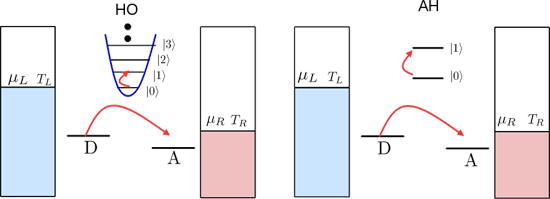
- de-excitation/excitation of an “impurity” (vibrational mode). The left and right reservoirs defining Hel in Equation 2 are characterized by a structured density of states since we had absorbed the D state in the L terminal, and similarly, the A level in the R metal. These electronic reservoirs are
- temperature T = 300 K. We assumed flat bands with a constant density of states. Linear response behavior of the donor–acceptor junction as a function of gate voltage. (a) Electrical conductance, (b) Seebeck coefficient, (c) electronic thermal conductance, and (d) figure of merit ZT. Parameters are the same as


Controlled switching of single-molecule junctions by mechanical motion of a phenyl ring
Beilstein J. Nanotechnol. 2015, 6, 2088–2095, doi:10.3762/bjnano.6.213
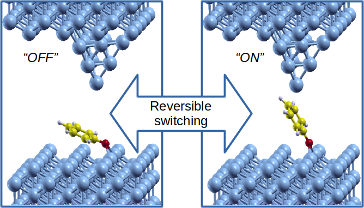
- ascribed to a stronger hybridization with the substrate states as revealed by the increased projected density of states (PDOS) onto the chalcogen atom near EF (Figure 6b,d; more extended atomic orbitals of S than of O) as well as by the larger width of the lowest unoccupied molecular orbital (LUMO
- and (b) projected density of states (PDOS) onto the Cu apex atom as well as onto the atoms in the PhO molecule (adapted from [12]). (c,d) Similar results for the PhS molecule. The tip height was h = 13.9 Å (solid lines) or h = 14.4 Å (dashed lines) and the lateral position was x = 1.4 Å. The


Simple and efficient way of speeding up transmission calculations with k-point sampling
Beilstein J. Nanotechnol. 2015, 6, 1603–1608, doi:10.3762/bjnano.6.164
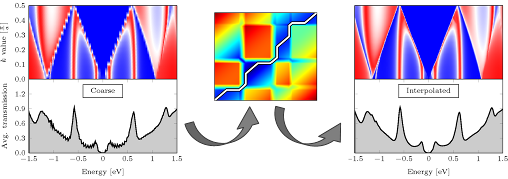
- diverging density of states and discontinuities in the transmission function at energies corresponding to band on-sets/channel openings. It is well known that often in order to obtain smooth, well-converged density of states and transmissions as a function of energy, a substantial number of transverse k
- convergence due to its vanishing density of states at the Fermi level. In the remaining parts of the paper we first explain the workings of the interpolation scheme in section Results and Discussion, while we investigate various test cases in section Example cases, and finally discuss limitations to the
- illustrated the method using electron transport through graphene nano-structures and k-point averaging of transmission functions. However, the method is generally applicable also to phonon transport and to other functions such as density of states or other types of interpolation parameters such as


Possibilities and limitations of advanced transmission electron microscopy for carbon-based nanomaterials
Beilstein J. Nanotechnol. 2015, 6, 1541–1557, doi:10.3762/bjnano.6.158
- the low-loss or valence region of an EELS spectrum (<50 eV) allows one to study the band structure and in particular the dielectric function of a material. In addition to the collective electron excitation modes marked by characteristic plasmon peaks, the joint density of states above the Fermi level


Current–voltage characteristics of manganite–titanite perovskite junctions
Beilstein J. Nanotechnol. 2015, 6, 1467–1484, doi:10.3762/bjnano.6.152
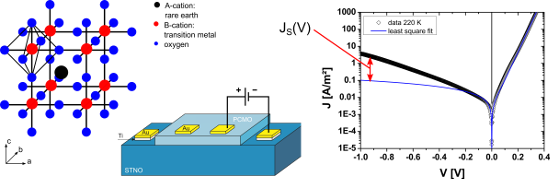
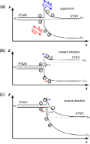
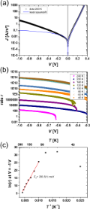
- the assumption is made that the current is limited by the rate at which holes can diffuse in the narrow band gap material. X is the fraction of those carriers having sufficient energy to cross the barrier, a is the junction area and NV,2 is the effective density of states of the valence band for the





Electron and heat transport in porphyrin-based single-molecule transistors with electro-burnt graphene electrodes
Beilstein J. Nanotechnol. 2015, 6, 1413–1420, doi:10.3762/bjnano.6.146
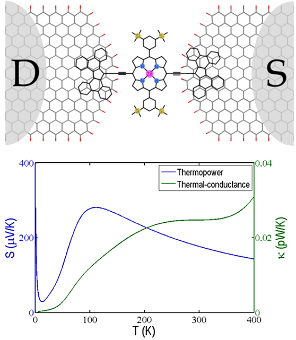
- the high electronegativity of oxygen atoms, charge is transferred from the carbon atoms to the oxygen atoms. Consequently, oxygen-terminated ribbons show p-type doped behaviour [20][21] and their density of states (DOS) is shifted toward positive energies as shown in Figure 3c (dashed line). Figure 3c
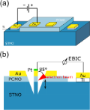
- , resulting in mixed AA and AB stacking with graphene. a) HOMO−1, b) HOMO, c) LUMO and d) LUMO+1 state iso-surfaces. Molecular and electronic structure of the EBG electrodes. a) Molecular orbital iso-surfaces, b) band structure of EBG electrodes, c) density of states and number of open channels in the EBG


Can molecular projected density of states (PDOS) be systematically used in electronic conductance analysis?
Beilstein J. Nanotechnol. 2015, 6, 1247–1259, doi:10.3762/bjnano.6.128
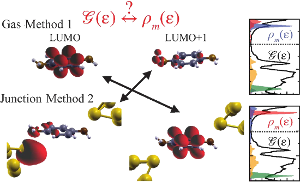
- the quantum transport conductance in terms of the projected density of states (PDOS) onto molecular orbitals (MOs). We first consider two different methods for identifying the relevant MOs: (1) diagonalization of the Hamiltonian of the isolated molecule and (2) diagonalization of a submatrix of the
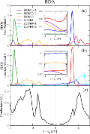
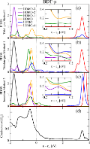
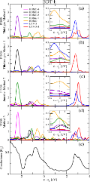
- lowest unoccupied molecular orbital (LUMO), or the next LUMO (LUMO+1), etc.). Then, the total electronic density of states (DOS) is decomposed into the projected density of states (PDOS) associated with each different MO. Finally, by directly comparing the conductance profile, , with the various PDOS
- reason, it is believed that the molecule itself and its electronic structure has a deep influence on the conductance. The interpretation of the conductance profile, , or of the zero-bias conductance, , is often carried out by referring to the projected density of states onto molecular orbitals (see next





Enhancing the thermoelectric figure of merit in engineered graphene nanoribbons
Beilstein J. Nanotechnol. 2015, 6, 1176–1182, doi:10.3762/bjnano.6.119
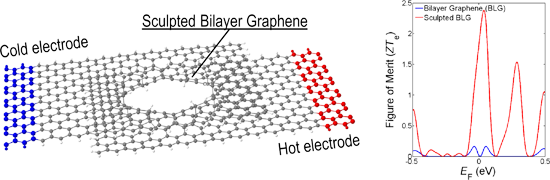
- for this are changes in the phonon density of states, an increased phonon-boundary scattering and the dispersion of the nanostructures in low dimensional semiconductors [2][4][5][6]. The efficiency of thermoelectric materials and devices is determined by their thermoelectric figure of merit (ZT = S2GT
- /κ) where S is the Seebeck coefficient, which depends on the asymmetry of the density of states around the Fermi level, G is the electrical conductance and T is the temperature [7]. Similarly, the electronic thermoelectric figure of merit also is defined as ZTe = S2GT/κe. Since the efficiency of a


Closed-loop conductance scanning tunneling spectroscopy: demonstrating the equivalence to the open-loop alternative
Beilstein J. Nanotechnol. 2015, 6, 1116–1124, doi:10.3762/bjnano.6.113
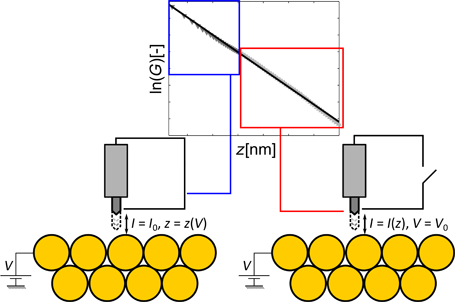
- techniques can be and have been performed on a wide variety of samples, with each different type of measurement yielding information on distinct properties of the probed sample [2]. The local density of states of a sample (LDOS) provides insight into the electronic and chemical properties of a sample. By
- = ρ(V) is the energy-dependent combined density of states of the tip and the sample, V is the applied tip–sample bias voltage, z is the tip–sample distance, is the tunneling barrier and , with m the rest mass of the electron. The product is sometimes referred to as the inverse decay length and
- * on ζ. In order to make a quantitative analysis possible, a numerical method will have to be developed. As a starting point, Equation 5 will have to be rewritten to eliminate as many unknown parameters as possible. By taking the the derivative dI/dz, the density of states ρ can be eliminated from the


Charge carrier mobility and electronic properties of Al(Op)3: impact of excimer formation
Beilstein J. Nanotechnol. 2015, 6, 1107–1115, doi:10.3762/bjnano.6.112
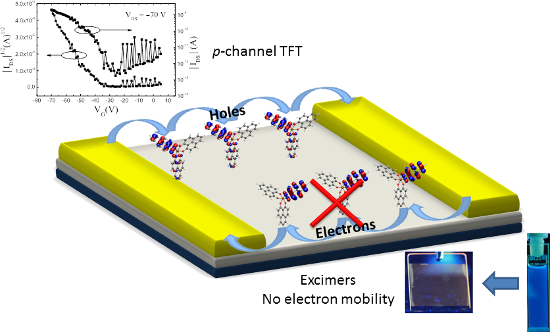
- deviations between the vacuum and matrix dipole moments arise from induction and polarization effects present only in the matrix, which influence the energy disorder. Furthermore, we calculated the width of the local density of states for additional charges (if a Gaussian shape is assumed, this is referred


Statistics of work and orthogonality catastrophe in discrete level systems: an application to fullerene molecules and ultra-cold trapped Fermi gases
Beilstein J. Nanotechnol. 2015, 6, 755–766, doi:10.3762/bjnano.6.78
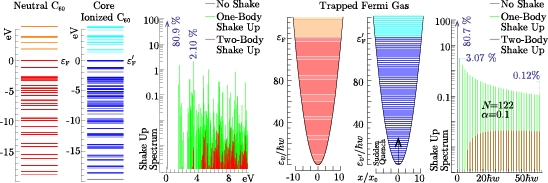
- Fermi level. On the other hand, the lowest- energy unperturbed valence state gets mainly mixed with the first two occupied perturbed valence states (see also Table 1). Energy levels and (broadened) density of states for a trapped gas of spin 1/2 fermions having a number of occupied states (N = 122

![[Graphic 22]](/bjnano/content/inline/2190-4286-6-78-i30.png?max-width=637&scale=1.18182) ) fullerene molecules, as com...
) fullerene molecules, as com...


Graphene quantum interference photodetector
Beilstein J. Nanotechnol. 2015, 6, 726–735, doi:10.3762/bjnano.6.74
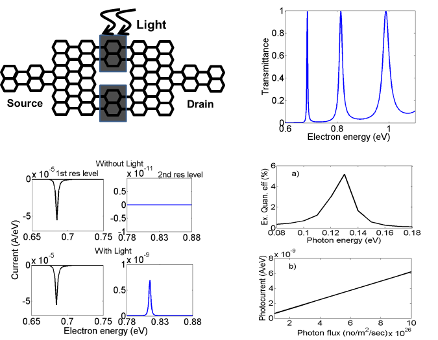
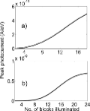
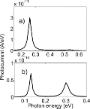
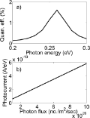
- because the density of states is higher near the resonant energy levels. The external quantum efficiency remains constant with a photon flux of up to approximately 1031 photon/m2/s. The variation of the peak photocurrent with photon flux is shown in Figure 9b and Figure 10b. We should mention here that
- structure as photodetector. In a MZI structure, an electron in the ground, transverse mode goes through the device with a transmittance of one (T = 1) due to constructive interference at energies corresponding to longitudinal resonant modes. At these resonant energies, the electrons have a high density of
- states. In this paper we investigate for the first time the interaction of light in a graphene nanoribbon MZI structure and specifically we study the coupling of light between longitudinal resonant modes for both zigzag and armchair structures. Graphene photodetectors have been studied in detail [2][3




Observation of a photoinduced, resonant tunneling effect in a carbon nanotube–silicon heterojunction
Beilstein J. Nanotechnol. 2015, 6, 704–710, doi:10.3762/bjnano.6.71
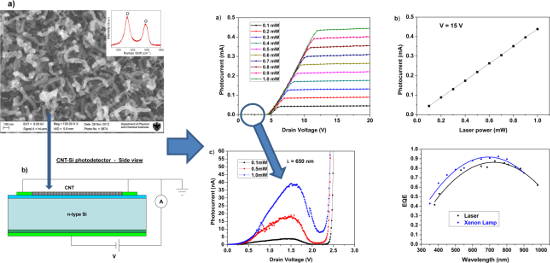
- their density of states shows the same van Hove singularities as the single-walled CNTs. The excitation of electron–hole pairs is the responsible for this effect in each single wall of the multiwall CNT. In the present case, the incident light produces the sizeable absorption band observed around 1.5


Chains of carbon atoms: A vision or a new nanomaterial?
Beilstein J. Nanotechnol. 2015, 6, 559–569, doi:10.3762/bjnano.6.58
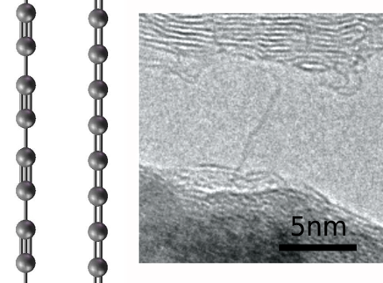
- carbon atoms [49]. By considering cumulene chains between two metal electrodes, Lang and Avouris [46] have found that even-number chains have a lower density of states (DOS) at the Fermi level than odd-number chains. In free chains (no contacts), the highest occupied molecular orbital (HOMO) is half
- of states in the contacting material at low energy is small. Another aspect is the local hybridization of the carbon atoms at the contact. A sp3-hybridized carbon atom (e.g., when the chain is connected to the middle of a graphenic sheet or the wall of a carbon nanotube as shown in Figure 5) leads to
- states in the chain, due to reflections at the interface to the contacts [50]. Close to the Fermi energy of perfect graphene, the transmission T decreases linearly with electron energy. The low transmission results from the vanishing of the DOS in undoped graphene. The reflection is high if the density


Inorganic Janus particles for biomedical applications
Beilstein J. Nanotechnol. 2014, 5, 2346–2362, doi:10.3762/bjnano.5.244
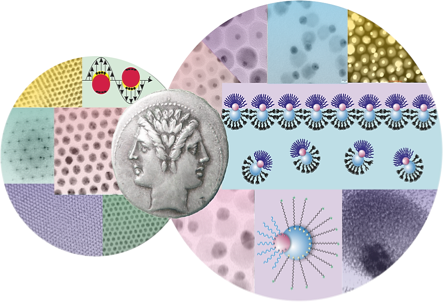
- . attributed this broadening and damping to the tunnelling of conduction band electrons of the Au nanoparticles into the projected density of states of the Fe3O4 domains, the so-called “interface decay channel” [56]. As a metal oxide starts to nucleate heterogeneously on the gold nanoparticles, the induced






Spectroscopic mapping and selective electronic tuning of molecular orbitals in phosphorescent organometallic complexes – a new strategy for OLED materials
Beilstein J. Nanotechnol. 2014, 5, 2248–2258, doi:10.3762/bjnano.5.234
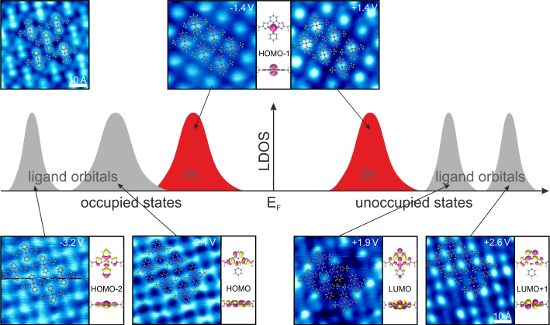
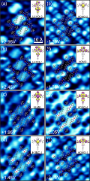
- the local density of states of the sample. Energy-resolved spectral maps (that visualize the spatial distribution of molecular orbitals) were acquired by measuring dI/dV at a fixed bias as a function of lateral position in constant-current mode. For the DFT calculations shown here, Kohn–Sham molecular
- given MOs exhibit a significant contribution at the ligands. We first focus our discussion on the ligands (i.e., excluding the Pt site). The depicted seven dI/dV maps in Figure 3b reveal the local density of states (LDOS) of several MOs between −3.2 V and +3.2 V. Below −3.0 V the dI/dV intensity is most



Hybrid spin-crossover nanostructures
Beilstein J. Nanotechnol. 2014, 5, 2230–2239, doi:10.3762/bjnano.5.232
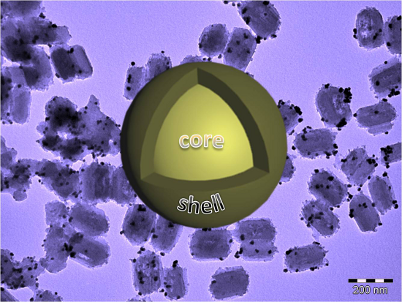
- onto gold substrates as control samples. It was found that there was a shift in the density of unoccupied states during the spin transition that leads to a significant loss in the density of states just above the Fermi energy level in a HS to LS transition. This situation was observed in SCO films