


Search results
Search for "differentiation" in Full Text gives 141 result(s) in Beilstein Journal of Nanotechnology.
Influence of the PDMS substrate stiffness on the adhesion of Acanthamoeba castellanii
Beilstein J. Nanotechnol. 2014, 5, 1393–1398, doi:10.3762/bjnano.5.152
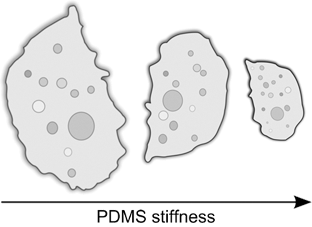
- and position themselves [6]. Once grown on a substrate with defined elasticity, cells adapt their own elasticity to the elasticity of their environment [7]. But not only differentiated cells are influenced by substrate stiffness. For stem cells it has been demonstrated that their differentiation is



Injection of ligand-free gold and silver nanoparticles into murine embryos does not impact pre-implantation development
Beilstein J. Nanotechnol. 2014, 5, 677–688, doi:10.3762/bjnano.5.80
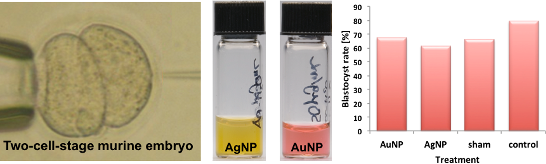
- biocompatibility and differentiation of bio-response related to the particles. Results Characterization of gold and silver nanoparticles Due to surface plasmon resonance (SPR), the fabricated gold nanoparticles exhibited a distinct absorption peak around 525 nm wavelength, while a peak at 400 nm was observed for
- nanoparticle treated blastomeres could facilitate the first steps of differentiation, i.e., into trophoblast and inner cell mass. These findings were confirmed by the results of quantitative real-time PCR measurements. The nanoparticle-injected embryos showed no indication of changes in apoptotic activity
- (based on the expression of the pro-apoptotic genes BAX and TP53, the anti-apoptotic gene BCL2L2), of disturbances undergoing mitosis and differentiation (based on the expression of the ICM-specific genes OCT4 and NANOG) or of epigenetic aberrances (based on the expression of DNMT3A, one of the genes




Constant chemical potential approach for quantum chemical calculations in electrocatalysis
Beilstein J. Nanotechnol. 2014, 5, 668–676, doi:10.3762/bjnano.5.79
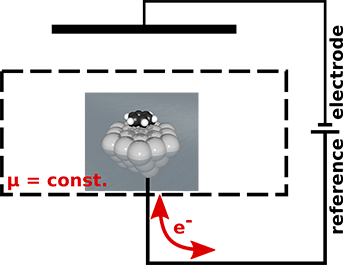
- calculated by using Equation 9. The approximated values of μ were obtained by numerical differentiation and are plotted with dashed lines. As can be seen, the approximation based on the recalculated Fock matrices yields a much better approximation for the exact slope than the approximation based on the Fermi


Biocalcite, a multifunctional inorganic polymer: Building block for calcareous sponge spicules and bioseed for the synthesis of calcium phosphate-based bone
Beilstein J. Nanotechnol. 2014, 5, 610–621, doi:10.3762/bjnano.5.72
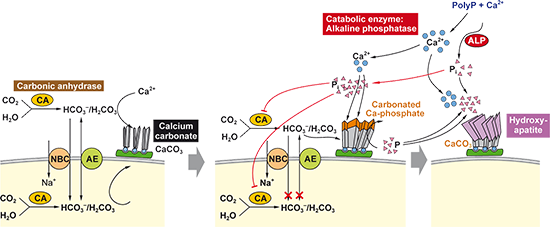
- formation and bone degradation (reviewed in [16]). The molecular triad OPG/RANKL/RANK not only regulates the differentiation of osteoclasts, but also differentiation processes in the vascular system and in the immune system. Addition of biosilica leads to an increased expression of OPG. The consequence is
- an inhibition of the differentiation of osteoclasts from their respective precursor cells (Figure 1B). In addition, after exposure of SaOS-2 cells to biosilica these cells increase the synthesis of the bone morphogenetic protein 2 (BMP2), a cytokine that induces osteoblast differentiation and
- a staining procedure with alizarin red S [7]. The MAC supplement (ascorbic acid, β-glycerophosphate and dexamethasone) stimulates cellular differentiation processes. Importantly, it had been measured that this process is paralleled by an enhanced expression of the CA-II gene, suggesting its



Nanoscale patterning of a self-assembled monolayer by modification of the molecule–substrate bond
Beilstein J. Nanotechnol. 2014, 5, 258–267, doi:10.3762/bjnano.5.28
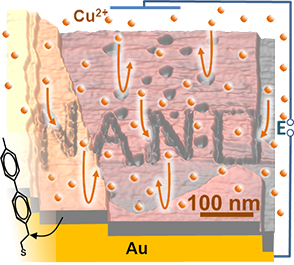
- better visual differentiation between native and UPD modified areas. Templated Cu-UPD illustrating tolerance of the process against substrate dislocations. (a) Native substrate with uniform BP2 SAM. (b) Lithographic pattern formed in air by using a tip bias of 4.2 V and a tip speed of 0.75 μm/s. (c) EC


Atomic force microscopy recognition of protein A on Staphylococcus aureus cell surfaces by labelling with IgG–Au conjugates
Beilstein J. Nanotechnol. 2013, 4, 743–749, doi:10.3762/bjnano.4.84
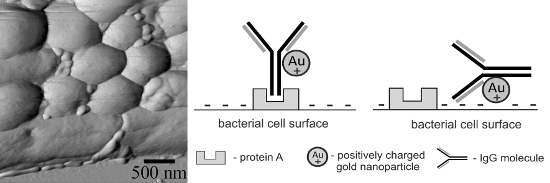
- selectivity of binding was not established, which reduces the efficiency of differentiation and requires further research. Discussion The use of immunogold labels as cell-surface markers for atomic force microscopy was already offered during the early stages of the development of the method [19]. Meanwhile
- positive, which allows them to be processed and investigated in the same conditions; however, they differ in form and size, sufficient for their morphological differentiation. Bacterial strains were cultured on LB agar (Sigma-Aldrich, USA) at 37 °C for 24 h and then washed with distilled water. Cells were


Site-selective growth of surface-anchored metal-organic frameworks on self-assembled monolayer patterns prepared by AFM nanografting
Beilstein J. Nanotechnol. 2013, 4, 638–648, doi:10.3762/bjnano.4.71
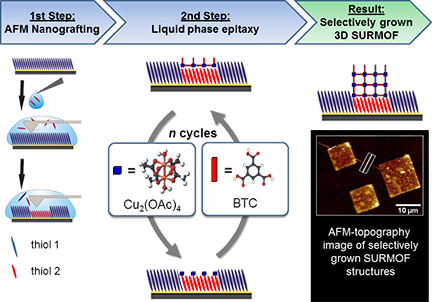
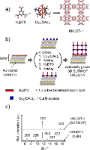
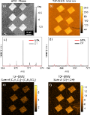
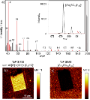
- ]−, and m/z 681, [Au2SC16H31O2]−. Apart from these characteristic pseudo-molecular peaks the comparison of small fragments providing strong SIMS signals allows for differentiation between the two thiols. The results of this investigation are summarized in Figure 7a, in which the ToF-SIMS spectra of the





AFM as an analysis tool for high-capacity sulfur cathodes for Li–S batteries
Beilstein J. Nanotechnol. 2013, 4, 611–624, doi:10.3762/bjnano.4.68
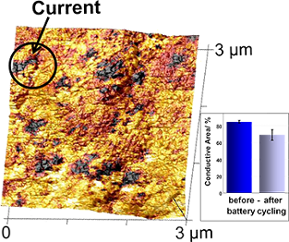
- smaller energy dissipation and a slightly increased adhesion. It is noted, that the measured DMT modulus has values out of the recommended range for this type of tip. Therefore, the accuracy of those values is not very high. However, the large differences allowed a good differentiation from carbon. No
- . Nevertheless, a measurement was possible and delivered a value, although a higher uncertainty can be assumed. For a differentiation of sulfur from the other components it was sufficient. Comparison of the cycling performances of non-optimised Li–S batteries prepared with different binders. The batteries were



Multiple regimes of operation in bimodal AFM: understanding the energy of cantilever eigenmodes
Beilstein J. Nanotechnol. 2013, 4, 385–393, doi:10.3762/bjnano.4.45
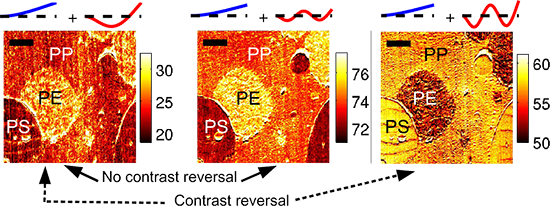
- material are lower than on the softer material. In the right state (higher A2,free), both A2 and on the stiffer material are higher than on the softer material. In the middle state, there is not much differentiation between the materials. Note that the jumps between states happen at a slightly different


![[Graphic 3]](/bjnano/content/inline/2190-4286-4-45-i5.png?max-width=637&scale=1.18182) . In the top row (a, b) the first eigen...
. In the top row (a, b) the first eigen...



Polynomial force approximations and multifrequency atomic force microscopy
Beilstein J. Nanotechnol. 2013, 4, 352–360, doi:10.3762/bjnano.4.41
- drive force and a time-dependent tip–surface force where the dot denotes differentiation with respect to time, ω0, Q and kc are the mode’s resonance frequency, quality factor and spring constant respectively, and h is the static equilibrium position of the tip above the surface. One should note that the

![[Graphic 19]](/bjnano/content/inline/2190-4286-4-41-i45.png?max-width=637&scale=1.18182) matrix (a) and its pseudo-inverse (b). Only rows with non-zero elements are d...
matrix (a) and its pseudo-inverse (b). Only rows with non-zero elements are d...


Pulse-response measurement of frequency-resolved water dynamics on a hydrophilic surface using a Q-damped atomic force microscopy cantilever
Beilstein J. Nanotechnol. 2012, 3, 260–266, doi:10.3762/bjnano.3.29
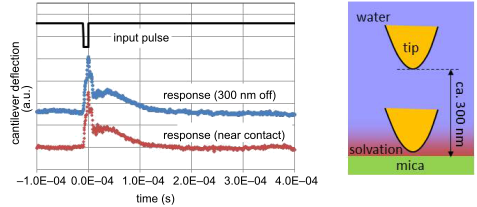
- measurement a step stress is applied to the cantilever and the response signal u(t) is converted to the corresponding frequency response function, i.e., a complex compliance , by Fourier–Laplace transformation as, Actually, the time differentiation of u(t) required prior to Fourier–Laplace transformation is
- disadvantageous with respect to the signal-to-noise ratio. In the previous report of the step-response measurement the inferior signal-to-noise ratio of the signal hindered detailed analysis. In the present report a pulse-response measurement in which differentiation of the response signal can be dispensed with




Modeling noncontact atomic force microscopy resolution on corrugated surfaces
Beilstein J. Nanotechnol. 2012, 3, 230–237, doi:10.3762/bjnano.3.26
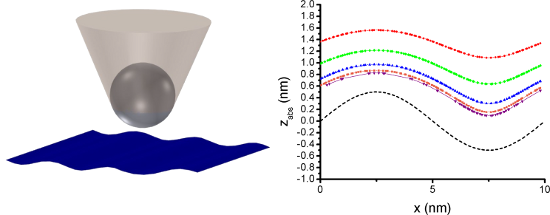
- shifts Once the tip–surface interaction potential Wt–s is obtained, the interaction force Ft–s is found straightforwardly by differentiation with respect to z. We then compute the frequency shift using the following expression [28], which is exact to 1st order in classical perturbation theory: with


Theoretical study of the frequency shift in bimodal FM-AFM by fractional calculus
Beilstein J. Nanotechnol. 2012, 3, 198–206, doi:10.3762/bjnano.3.22
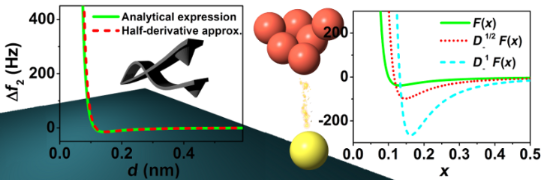
- frequency shift is related to the virial of the force [24][25]. Sader and Jarvis have proposed an alternative interpretation of FM-AFM in terms of fractional calculus [26][27]. They showed that the frequency shift can be interpreted as a fractional differential operator, where the order of differentiation


Terthiophene on Au(111): A scanning tunneling microscopy and spectroscopy study
Beilstein J. Nanotechnol. 2011, 2, 561–568, doi:10.3762/bjnano.2.60
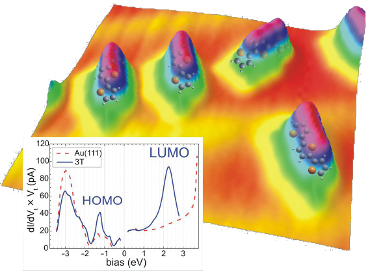
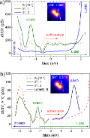
- barrier height defined by Φdiff = (∂z∂VI/∂VI)2 [21] was determined. The differential barrier, Φdiff, may be thought of as similar to the commonly used apparent barrier height defined by Φapp = (∂zI/I)2, which is bias dependent. Due to differentiation, however, Φdiff is much more sensitive to changes in



Fabrication of multi-parametric platforms based on nanocone arrays for determination of cellular response
Beilstein J. Nanotechnol. 2011, 2, 545–551, doi:10.3762/bjnano.2.58
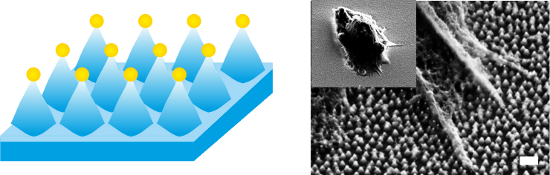
- , multidomain, trimeric glycoprotein, on the differently structured substrates. Laminin is known to support neural cell adhesion, proliferation, and differentiation. The cell adhesion activity of human neuroblastoma cells (SHSY-5Y) was investigated on these substrates and correlated with topographical features


Defects in oxide surfaces studied by atomic force and scanning tunneling microscopy
Beilstein J. Nanotechnol. 2011, 2, 1–14, doi:10.3762/bjnano.2.1
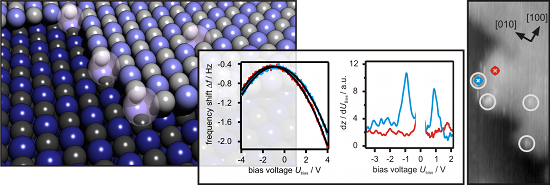
- tunneling spectroscopy (STS). On magnesium oxide, different color centers, i.e., F0, F+, F2+ and divacancies, have different effects on the contact potential. These differences enabled classification and unambiguous differentiation by KPFM. True atomic resolution shows the topography at line defects in





