


Search results
Search for "electron transport" in Full Text gives 138 result(s) in Beilstein Journal of Nanotechnology.
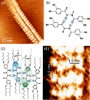
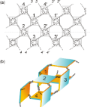
Dimer/tetramer motifs determine amphiphilic hydrazine fibril structures on graphite
Beilstein J. Nanotechnol. 2012, 3, 658–666, doi:10.3762/bjnano.3.75
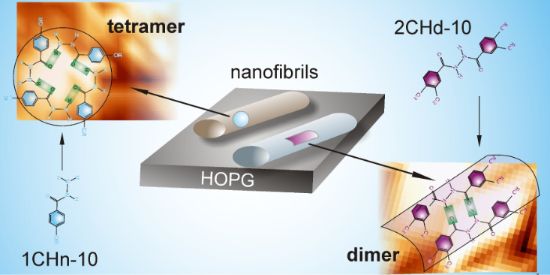
- ; interface; self-assembly; STM; Introduction One-dimensional micro- and nanostructures of organic compounds are important for solution-processable organic electronic devices [1][2][3], and electron transport through organic molecules is also the basis for a large number of biological processes [4




Focused electron beam induced deposition: A perspective
Beilstein J. Nanotechnol. 2012, 3, 597–619, doi:10.3762/bjnano.3.70
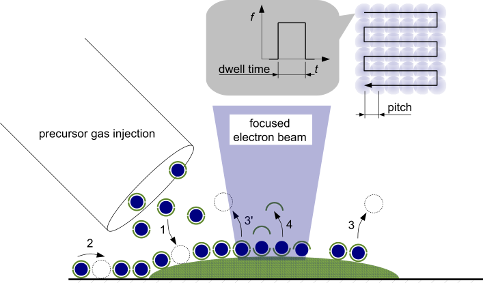
- of the surface-leaving electrons is very important for FEBID, in particular since the dissociation cross sections tend to be larger at low energies, Monte Carlo simulations, describing in detail the electron transport in the substrate and deposit, provide important insights [8][9]. For the purpose of


Strong spin-filtering and spin-valve effects in a molecular V–C60–V contact
Beilstein J. Nanotechnol. 2012, 3, 589–596, doi:10.3762/bjnano.3.69
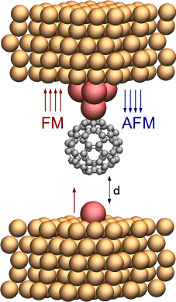
- the conductance is close to 2G0, it can be inferred from this that the transport is carried by two almost perfectly transmitting channels in the FM contact configuration. Conclusion We have performed first-principles spin-polarized density functional calculations and investigated the electron
- transport properties of a C60-molecular junction in a setup relevant for STM experiments. Our results demonstrate how the FM and AFM configurations can be identified due to their markedly different conductance and shot noise. Thus, it may allow for the study of the magnetic coupling between tip and




A facile approach to nanoarchitectured three-dimensional graphene-based Li–Mn–O composite as high-power cathodes for Li-ion batteries
Beilstein J. Nanotechnol. 2012, 3, 513–523, doi:10.3762/bjnano.3.59
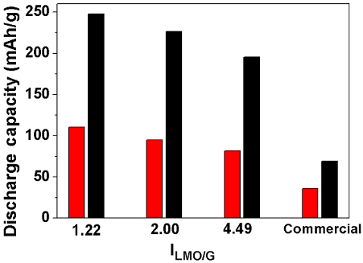
- the practical capacity of the material. On the other hand, promising progress in the modification of micro/nanostructures of LMO has been made [10][11][12][13]. Ordered mesoporous LMO, created by using silica templates, favors rapid kinetics for both lithium ions and electron transport, which show




Reduced electron recombination of dye-sensitized solar cells based on TiO2 spheres consisting of ultrathin nanosheets with [001] facet exposed
Beilstein J. Nanotechnol. 2012, 3, 378–387, doi:10.3762/bjnano.3.44
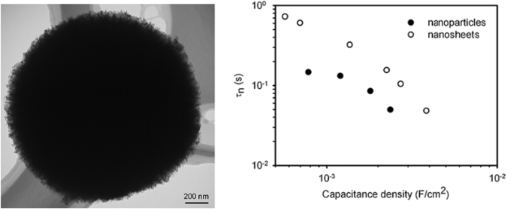
- consisting of ultrathin nanosheets with 100% of the [001] facet exposed was employed to fabricate dye-sensitized solar cells (DSCs). Investigation of the electron transport and back reaction of the DSCs by electrochemical impedance spectroscopy showed that the spheres had a threefold lower electron
- band of the TiO2 spheres and on the kinetics of electron transport and back reactions was also investigated. It was found that the TiCl4 post-treatment caused a downward shift of the TiO2 conduction band edge by 30 meV. Meanwhile, a fourfold increase of the effective electron lifetime of the DSC was
- transfer and back reaction has not been reported. A deep understanding of the role of the TiO2 [001] facet in these key processes of electron transport and recombination of DSCs is of great importance for both practical applications and basic research. In this work, anatase TiO2 spheres with a hierarchical


Simultaneous current, force and dissipation measurements on the Si(111) 7×7 surface with an optimized qPlus AFM/STM technique
Beilstein J. Nanotechnol. 2012, 3, 249–259, doi:10.3762/bjnano.3.28
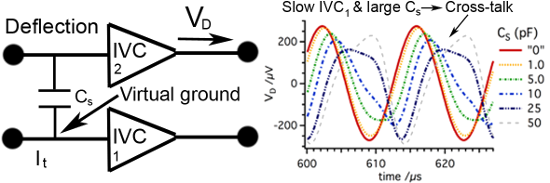
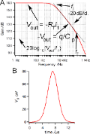
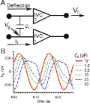
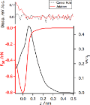
- sample opens a new horizon in the understanding of elemental processes of the electron transport on surfaces [30] and in clarifying the relationship between the short-range force and the tunneling current in metal contacts [31][32]. Unfortunately, in the case of quartz-based sensors with self-sensing
- . reported a so called “phantom force” phenomenon [30], in which an additional force arises due to a limited electron transport of injected charge in samples with low conductance. However, not much is known currently about its impact on the dissipation signal. In this section we analyze the effect of the


![[Graphic 7]](/bjnano/content/inline/2190-4286-3-28-i11.png?max-width=637&scale=1.18182) can...
can...


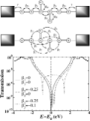
When “small” terms matter: Coupled interference features in the transport properties of cross-conjugated molecules
Beilstein J. Nanotechnol. 2011, 2, 862–871, doi:10.3762/bjnano.2.95
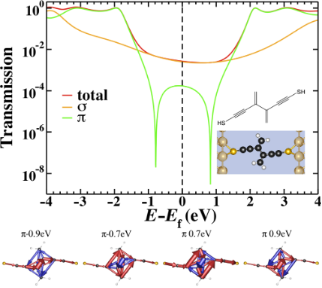
- supernode [16], these results suggest that devices constructed from multiple cyclic units may be preferable. Conclusion The sensitivity of destructive interference features to perturbations can be seen as both a strength and a weakness of these effects for the control of electron transport in molecules. On




Current-induced dynamics in carbon atomic contacts
Beilstein J. Nanotechnol. 2011, 2, 814–823, doi:10.3762/bjnano.2.90
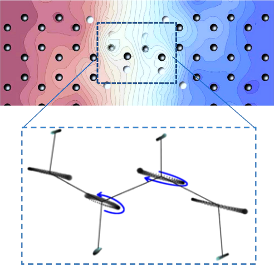
- ][20], their stability [21], and electron-transport properties [22][23][24]. Here we explore the current-induced forces and nanoscale Joule heating of the carbon chain system between electrically gated graphene electrodes. The paper is organized as follows. After a brief outline of the semiclassical
- steady-state electron transport without electron–phonon interaction [33], where AL/R are the density of state matrices for electronic states originating in the left/right electrodes, each with chemical potential μL/R [33], which differ for finite bias voltage, V, as μL − μR = eV, and nF(ω) = 1/(eω/kBT



Effect of the environment on the electrical conductance of the single benzene-1,4-diamine molecule junction
Beilstein J. Nanotechnol. 2011, 2, 755–759, doi:10.3762/bjnano.2.83
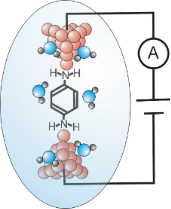
- coverage of the BDA molecule at metal electrodes and atomic and molecular motion of the single-molecule junction. Keywords: benzene-1,4-diamine; electric conductance; single-molecule junction; solvent; Introduction The electron transport properties through a single molecule bridging metal electrodes
- electrodes themselves. Wu et al. demonstrated that the aromatic π–π coupling between adjacent molecules affected the formation of the molecule junction and electron transport through the molecule junction [6]. Venkataraman’s group and our group independently evaluated the electron-transport properties of π
- -stacked systems [7][8]. We showed that the conductance of the π-stacked system decreased with the number of π molecules, and the decrease in conductance per unit of electron-transport distance was comparable to that of the conventional single-molecule junction. Dahlke et al. investigated the effect of the


Towards quantitative accuracy in first-principles transport calculations: The GW method applied to alkane/gold junctions
Beilstein J. Nanotechnol. 2011, 2, 746–754, doi:10.3762/bjnano.2.82
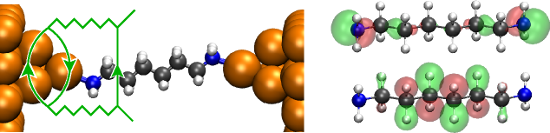
- results cannot be mimicked by DFT calculations employing a simple scissors operator. Keywords: alkanes; density functional theory; electron transport; gold junction; GW; Introduction The conductance of a molecule sandwiched between metallic electrodes is sensitive to the chemical and electronic
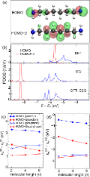
- junction geometry, a quantitatively accurate description of electron transport from first principles remains a formidable task. Numerous studies based on density functional theory (DFT) have shown a significant overestimation of conductance relative to experimental values [3][4][5][6][7][8][9][10][11][12
- approximation to study the role of exchange–correlation effects for the energy-level alignment and electron transport in short alkane chains coupled to gold electrodes through amine linker groups. The gold/alkane junction is a benchmark system for molecular charge transport and has been exhaustively



Interaction of spin and vibrations in transport through single-molecule magnets
Beilstein J. Nanotechnol. 2011, 2, 693–698, doi:10.3762/bjnano.2.75
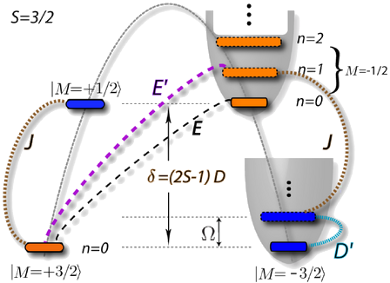
- Grünberg Institut and JARA - Fundamentals of Information Technology, Forschungszentrum Jülich, 52425 Jülich, Germany 10.3762/bjnano.2.75 Abstract We study electron transport through a single-molecule magnet (SMM) and the interplay of its anisotropic spin with quantized vibrational distortions of the


![[Graphic 7]](/bjnano/content/inline/2190-4286-2-75-i10.png?max-width=637&scale=1.18182) and for T ...
and for T ...


Transport through molecular junctions
Beilstein J. Nanotechnol. 2011, 2, 691–692, doi:10.3762/bjnano.2.74

- the problem and inherent to (single) molecular junctions. The study of such junctions requires the gathering of statistics covering many configurations. The field of study of electron transport through molecular junctions requires input from many subdisciplines and this interdisciplinary character
Simple theoretical analysis of the photoemission from quantum confined effective mass superlattices of optoelectronic materials
Beilstein J. Nanotechnol. 2011, 2, 339–362, doi:10.3762/bjnano.2.40
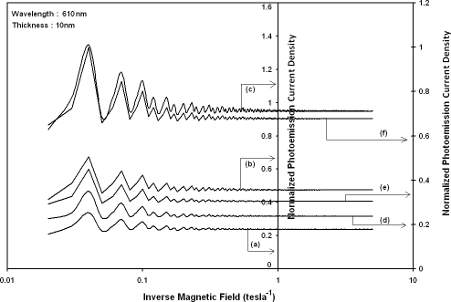
- effective mass when it is energy dependent. Under degenerate conditions, only the electrons at the Fermi surface of n-type semiconductors participate in the conduction process and hence, the effective momentum mass of the electrons (EMM), corresponding to the Fermi level, would be of interest in electron
- transport under such conditions. The Fermi energy is again determined by the carrier energy spectrum and the carrier concentration and therefore, these two features would determine the dependence of the EMM in degenerate materials on the degree of carrier degeneracy. In recent years, the EMM in such





