Search results
Search for "external magnetic field" in Full Text gives 136 result(s) in Beilstein Journal of Nanotechnology.
Highly ordered ultralong magnetic nanowires wrapped in stacked graphene layers
Beilstein J. Nanotechnol. 2012, 3, 846–851, doi:10.3762/bjnano.3.95
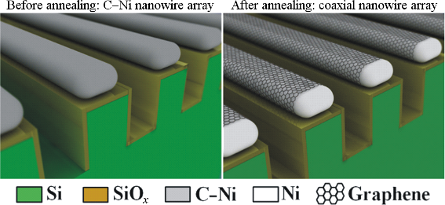
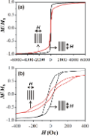
- equal to the ones obtained for the as-grown C–Ni nanowires before annealing (Table 1 and Supporting Information File 1, Figure S3). The smaller saturation field ( = 1500 Oe) and the larger squareness (Mr/Ms = 0.4) when the external magnetic field is applied parallel to the nanowire axis, compared to the
- from the shape anisotropy resulting from the very high aspect ratio of these nanostructures [7][35][36][37][38][39][40][41][42][43]. Concerning the coercive field, it is slightly higher ( = 32 Oe) when the external magnetic field is applied parallel to the nanowire array, than the one measured for the


Tuning the properties of magnetic thin films by interaction with periodic nanostructures
Beilstein J. Nanotechnol. 2012, 3, 831–842, doi:10.3762/bjnano.3.93
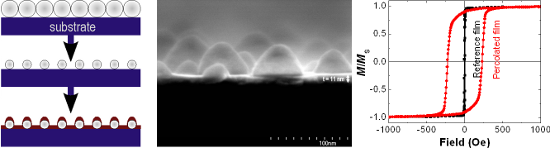
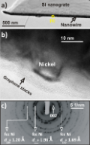
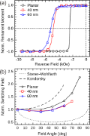
- ferromagnetic at room temperature down to a Co concentration of about 15 atom % [34]. MOKE remanence curves were measured by saturating the sample, subsequently applying a reverse field and recording the remanent magnetization (Figure 9). The angle θ of the external magnetic field with respect to the sample


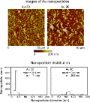
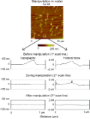
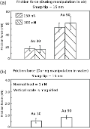
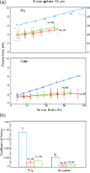
Effect of spherical Au nanoparticles on nanofriction and wear reduction in dry and liquid environments
Beilstein J. Nanotechnol. 2012, 3, 759–772, doi:10.3762/bjnano.3.85
- treatment, nanoparticles are either functionalized with biomolecules that recognize and attach to the cancer cells, [6][7] or in the case of iron-oxide nanoparticles, the nanoparticles are directed by an external magnetic field [9]. The cells are destroyed by drugs that coat the nanoparticles or by
- absorbs the oil by motion of the nanoparticles towards the oil in a magnetic field [12]. Magnetic nanoparticles are also of interest in enhanced oil recovery (EOR) since they can be dispersed in fluid and manipulated and monitored by an external magnetic field [13][14]. In both oil detection and EOR



Analysis of fluid flow around a beating artificial cilium
Beilstein J. Nanotechnol. 2012, 3, 163–171, doi:10.3762/bjnano.3.16
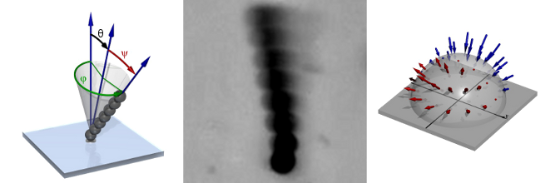
- superparamagnetic particles and driven along a tilted cone by a varying external magnetic field. Nonmagnetic tracer particles were used for monitoring the fluid flow generated by the cilium. The average flow velocity in the pumping direction was obtained as a function of different parameters, such as the rotation
- artificial cilia driven by an external magnetic field and proved that their asymmetric beating generated a directed fluid flow [8][9]. The artificial cilia were formed as stable yet flexible chains of superparamagnetic colloidal particles and were driven along a tilted inverted cone (Figure 1). An array of
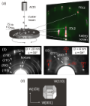
- force between the chain and the anchoring site, and the actuation of the cilium were established with an external magnetic field. The optical tweezers were therefore equipped with a magnetic component that could generate a homogeneous magnetic field at the sample (Figure 5). Three orthogonal pairs of


Enhancement of the critical current density in FeO-coated MgB2 thin films at high magnetic fields
Beilstein J. Nanotechnol. 2011, 2, 809–813, doi:10.3762/bjnano.2.89
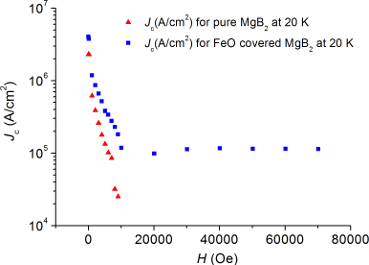
- superconducting parameter makes it a very attractive candidate to replace Nb in various superconducting devices, namely for devices operating at temperatures around 20 K, which are attainable in low-cost cryocoolers. However, the dramatic fall of the critical current in an external magnetic field at temperatures
- around 20 K limits the possible use of magnesium diboride in engineering applications. Therefore, for a wide-scale technical application of MgB2 it is necessary to solve the problem of the enhancement of its critical current in an external magnetic field. Results and Discussion There have been many
- attempts to solve the above-mentioned problem relating to the decay of the critical current in an external magnetic field. Various research teams have tried to increase the critical current density either by doping MgB2 with various substances (carbon [3], aluminium [4], etc.) or by adding nanoparticles of


Distinguishing magnetic and electrostatic interactions by a Kelvin probe force microscopy–magnetic force microscopy combination
Beilstein J. Nanotechnol. 2011, 2, 552–560, doi:10.3762/bjnano.2.59
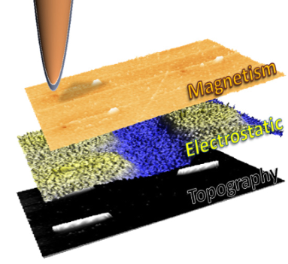
- of the magnetic character of the sample. In addition, by means of variable field MFM [19], the changes in the signal as a function of the external magnetic field can be utilized either to evaluate the coercivity of the MFM probes [20][21] or to analyze the magnetic behavior of micro- and
- nanostructures [22][23], depending on the values of both the tip and sample coercive fields (Htip and Hsample) and the maximum external magnetic field applied (Hmax). Notice that the MFM measurements under an external magnetic field allow us to state the origin of the interaction but cannot remove other


Structural and magnetic properties of ternary Fe1–xMnxPt nanoalloys from first principles
Beilstein J. Nanotechnol. 2011, 2, 162–172, doi:10.3762/bjnano.2.20
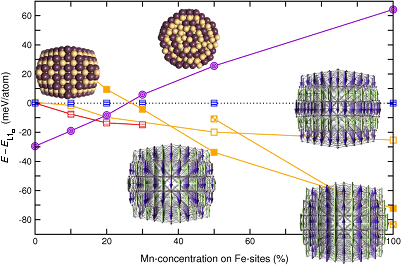
- properties in a close interval of composition and energy gives rise to the hope that this material may allow the selection of specific magnetic or structural modifications with a fairly small energetic effort, which could be provided by an external magnetic field. In this respect, it looks promising that the
- their slope and different magnetic structures become competitive in energy. If composition and degree of order are carefully tuned, it might be possible to select the ferro or ferrimagnetic phase by an external magnetic field, while the ground state is still AF. In fact, Menshikov et al. [73
- ] demonstrated in their experiments, that an external magnetic field can induce a magnetization at finite temperatures in the vicinity of the Néel temperature, which decays again towards high as well as towards low temperatures. The authors explain this fact with the presence of FM clusters with possible


Structure, morphology, and magnetic properties of Fe nanoparticles deposited onto single-crystalline surfaces
Beilstein J. Nanotechnol. 2011, 2, 47–56, doi:10.3762/bjnano.2.6
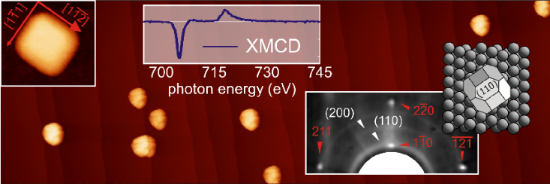
- electron yield at each photon energy and by switching the Ni film magnetization with a short external magnetic field pulse at each data point (a current of ≈100 A through two coils, 180 windings, magnetic field ≈1700 G). The photon helicity was kept fixed. Note that the nanoparticle data in Figure 2b are

Magnetic interactions between nanoparticles
Beilstein J. Nanotechnol. 2010, 1, 182–190, doi:10.3762/bjnano.1.22
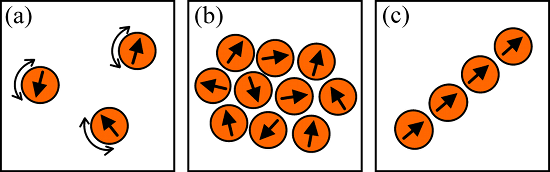
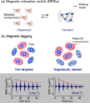
- tendency for magnetic nanoparticles to form chains, especially if they can move freely in an external magnetic field, for example, if they are suspended in a liquid. If the nanoparticles form chains, a ferromagnetic ordering of the magnetic moments is favored in zero applied field with the magnetization



Magnetic nanoparticles for biomedical NMR-based diagnostics
Beilstein J. Nanotechnol. 2010, 1, 142–154, doi:10.3762/bjnano.1.17
- overall magnetic moments when placed in an external magnetic field but lose their moments when the field is removed. Distinct from paramagnetism, which arises from individual spins at the atomic or molecular level, superparamagnetism applies to magnetic elements that already assume a magnetically-ordered
- magnetization is known to increase with particle size [33]. Ideally, each magnetic spin within a bulk magnetic material would be aligned parallel to the external magnetic field. However, in the nanoscale regime, surface spins tend to be tilted, a feature that reduces the overall magnetic moment. By increasing
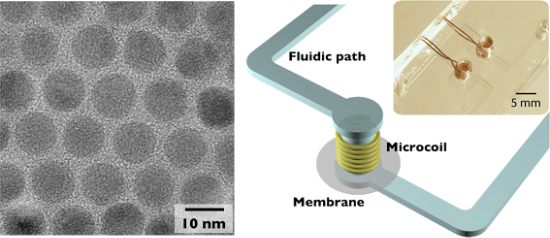
- network for sample handling, and a small permanent magnet for generating an external magnetic field. The first μNMR prototype was designed with a 2 × 4 planar microcoil array that was lithographically patterned onto a glass substrate (Figure 4a) [14]. This array format enabled the performance of parallel


Review and outlook: from single nanoparticles to self-assembled monolayers and granular GMR sensors
Beilstein J. Nanotechnol. 2010, 1, 75–93, doi:10.3762/bjnano.1.10
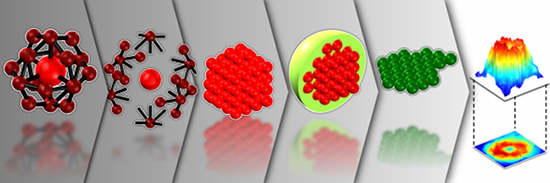
- response to an external magnetic field resembles the Langevin behavior of paramagnetic materials but with the high susceptibility and magnetization values of the ferromagnetic materials they are composed of, compare Figure 7. With even smaller particles, surface effects become dominant and a fully quantum
- structured sample, a suspension of ferromagnetic particles can be placed on the substrate in the presence of an external magnetic field. For manufacturing of particle layers, a homogeneous magnetic field needs to be employed; inhomogeneous fields result in the accumulation of nanoparticles along the area
- configuration of a TMR sensor is shown in Figure 12(b): Two thin ferromagnetic films are separated by an insulating barrier [63]. If the TMR sensor is positioned in an external magnetic field and a bias voltage is applied across the stack, then a quantum mechanical tunneling current flows across the insulator