


Search results
Search for "immobilization" in Full Text gives 127 result(s) in Beilstein Journal of Nanotechnology.
Novel acridone-modified MCM-41 type silica: Synthesis, characterization and fluorescence tuning
Beilstein J. Nanotechnol. 2011, 2, 284–292, doi:10.3762/bjnano.2.33
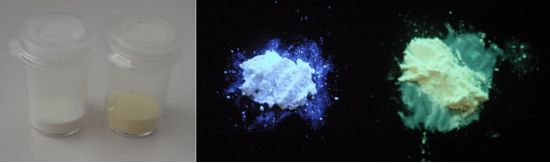
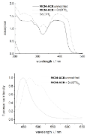
- , complex formation with the scandium(III) cation is clearly observed. The infrared absorption of the C=O vibrational band (precursor 1: 1630 cm−1, N-methylacridone: 1630 cm−1 [18]) shifts slightly to lower wavenumbers (Figure 2) after the immobilization, and also splits into two resonances (MCM-ACR: 1625


Electrochemical behavior of dye-linked L-proline dehydrogenase on glassy carbon electrodes modified by multi-walled carbon nanotubes
Beilstein J. Nanotechnol. 2010, 1, 135–141, doi:10.3762/bjnano.1.16
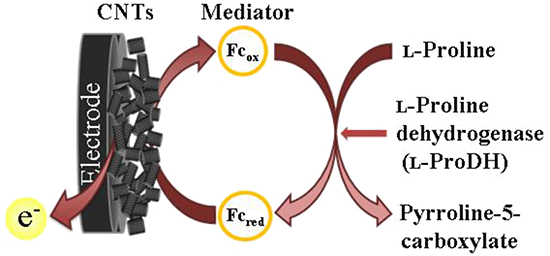
- enzyme, specific immobilization strategies, including electron mediators, should be considered [10][11][12]. In the last decade, the use of nano materials, especially carbon nanotubes (CNTs), in the construction of enzyme biosensors has received considerable attention. Because of their excellent
- ) from hyperthermophilic archaeon (Thermococcus profundus) was used to fabricate L-proline sensor based electrodes modified by layer-by-layer self-assembly immobilization of dye-linked L-proDH and ferrocene-labeled redox polyelectrolytes [9][28], which exhibited an amperometric current response to L


Other Beilstein-Institut Open Science Activities



