Search results
Search for "optical absorption" in Full Text gives 137 result(s) in Beilstein Journal of Nanotechnology.
Enhanced photocatalytic activity of Ag–ZnO hybrid plasmonic nanostructures prepared by a facile wet chemical method
Beilstein J. Nanotechnol. 2014, 5, 639–650, doi:10.3762/bjnano.5.75
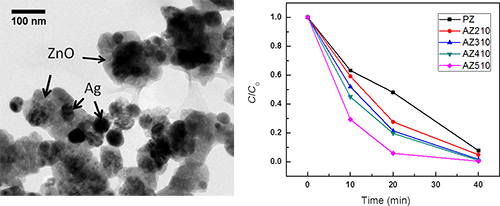
- the background, with an energy slit of 8 eV for Zn, 30 eV for O and 2 eV for Ag. The observed EFTEM images confirmed the decoration of ZnO nanostructures with Ag nanoparticles. Optical absorption and photoluminescence The UV–visible absorption spectra of samples with varying Ag concentration are shown


Photoactivation of luminescence in CdS nanocrystals
Beilstein J. Nanotechnol. 2014, 5, 355–359, doi:10.3762/bjnano.5.40
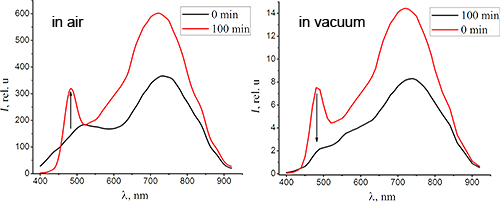
- nanocrystals used in these experiments were prepared by colloid chemistry of solutions of cadmium- and sulfursalts in an aqueous gelatin solution. Details of the sample preparation are described in [15]. The average radius of the cadmium sulfide nanocrystals was calculated from the optical absorption spectra
- measured by a differential copper–constantan thermocouple. Results and Discussion The optical absorption spectrum of the investigated NC is shown in Figure 1. The long-wavelength absorption edge that corresponds to the first optical transition in CdS NC is shifted relative to the energy band gap of the


Many-body effects in semiconducting single-wall silicon nanotubes
Beilstein J. Nanotechnol. 2014, 5, 19–25, doi:10.3762/bjnano.5.2
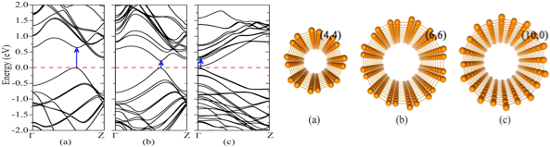
- SiNTs from 0.65, 0.28 and 0.05 eV at DFT level to 1.9, 1.22 and 0.79 eV at GW level. The Coulomb electron−hole (e−h) interactions significantly modify optical absorption properties obtained at noninteracting-particle level with the formation of bound excitons with considerable binding energies (of the
- anodes for lithium rechargeable batteries [10][11][12]. Although the ground-state geometric and electronic properties of SiNTs have been studied [14][15][16][17], properties of excited states, for example optical absorption of SiNTs, are still in need. It is of high importance to correctly understand the
- excitation and optical absorption properties. It is well-known that density functional theory (DFT) often fails in describing the properties of light absorption. This process requires a description of two-particle properties, which certainly goes beyond single-electron excitations that can be described at


Synthesis of indium oxi-sulfide films by atomic layer deposition: The essential role of plasma enhancement
Beilstein J. Nanotechnol. 2013, 4, 750–757, doi:10.3762/bjnano.4.85
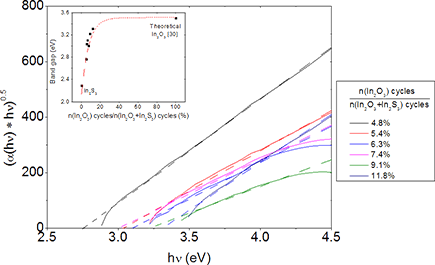
- corresponds to the thickest film. In general it can be said that the thinner the films, the lower the FWHM. From these observations, it seems that we obtained In2S3 films only. Thin films optical absorption were determined from transmittance (T) and reflectance (R) measurements by using the following formula


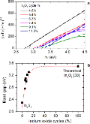

Modulation of defect-mediated energy transfer from ZnO nanoparticles for the photocatalytic degradation of bilirubin
Beilstein J. Nanotechnol. 2013, 4, 714–725, doi:10.3762/bjnano.4.81
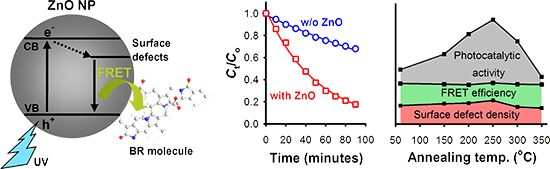
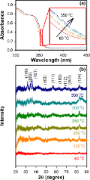
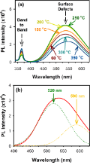
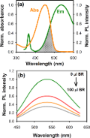
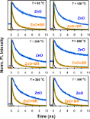
- fluorescence spectroscopy, we have explored the influence of the surface defect-states (mainly the oxygen vacancies) of the various as-synthesized and annealed ZnO nanoparticles on the photocatalytic degradation process of BR. Results and Discussion Figure 1a shows the UV–vis optical absorption spectra of the
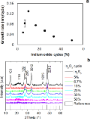
- ) and presence (τDA) of the acceptor were initially determined. The efficiency E was then calculated using the following equation: (a) UV–vis optical absorption and (b) X-ray diffraction pattern of ZnO nanoparticles annealed at various temperatures in air for 1 h. The 60 °C sample indicates the non


Photocatalytic antibacterial performance of TiO2 and Ag-doped TiO2 against S. aureus. P. aeruginosa and E. coli
Beilstein J. Nanotechnol. 2013, 4, 345–351, doi:10.3762/bjnano.4.40
- nanoparticles to visible light was increased and showed red shift (towards increased wavelength). The red shift of the absorption curve results in a reduction of the band gap energy and also the recombination rate, and hence, enhanced photocatalytic activity. The optical absorption coefficient α of a
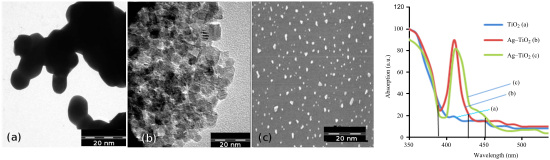
- -doped TiO2 with a 3% concentration of silver salt (Figure 2b), whereas they are scattered in the case of Ag-doped TiO2 nanoparticles with a 7% concentration (Figure 2c) of silver salt. UV–vis spectroscopy Optical properties were observed by UV–vis spectroscopy. Figure 3 demonstrates the optical
- absorption spectra of TiO2 and Ag/TiO2 (3% and 7%) nanoparticles. The absorption edge of TiO2 nanoparticles at 385 nm moved to a longer wavelength after doping with Ag ions (3% and 7%), showing the absorption edge at 435 nm and 450 nm, respectively. After doping with silver ions the response of TiO2


Paper modified with ZnO nanorods – antimicrobial studies
Beilstein J. Nanotechnol. 2012, 3, 684–691, doi:10.3762/bjnano.3.78
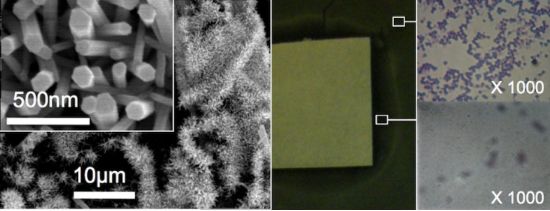
- offer large surface-to-volume ratios. Hydrothermally grown ZnO nanorods possess inherent defects in the form of oxygen vacancies and zinc interstitials, which shift its optical absorption from the ultraviolet to the visible region [20]. We previously reported the visible-light photocatalytic degradation


Effect of deposition temperature on the structural and optical properties of chemically prepared nanocrystalline lead selenide thin films
Beilstein J. Nanotechnol. 2012, 3, 438–443, doi:10.3762/bjnano.3.50
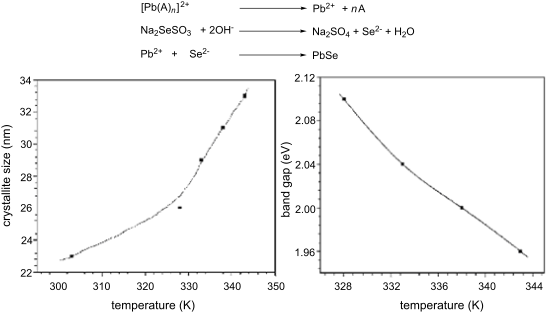
- diffraction (XRD), X-ray fluorescence (XRF), scanning electron microscopy (SEM) and optical absorption studies. The structural parameters, such as the lattice constant (a), crystallite size (D), dislocation density (ρ) and microstrain (ε) were evaluated from the XRD spectra. It was found that average
- crystallite size. The optical absorption spectra of the nanocrystalline PbSe films showed a blue shift, and the optical band gap (Eg) was found to increase from 1.96 to 2.10 eV with the decrease in crystallite size. Keywords: chemical bath deposition; lattice parameter; lead selenide; Nelson–Riley plot
- ; optical absorption; Introduction Lead selenide (PbSe) with its narrow band gap (Eg = 0.27 eV) [1] is an important semiconductor of the IV–VI lead chalcogenides group. PbSe has a large exciton Bohr radius (46 nm), which offers the opportunity to achieve strong size quantization at relatively large crystal




Highly efficient ZnO/Au Schottky barrier dye-sensitized solar cells: Role of gold nanoparticles on the charge-transfer process
Beilstein J. Nanotechnol. 2011, 2, 681–690, doi:10.3762/bjnano.2.73
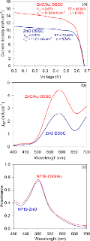
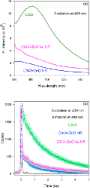
- nanorods. The optical absorptions of the ZnO-nanorod and ZnO/Au-nanocomposite photoelectrode are shown in Figure 2a. Due to the absorption by surface plasmons in the Au nanoparticles, a higher optical absorption of the ZnO/Au-nanocomposite photoelectrode near 520 nm was observed. The optical absorption by
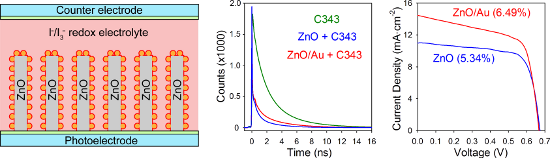
- higher Jsc (82.46 μA/cm2) as well as Voc (0.39 V) compared to the bare ZnO-nanorod solar cell, which is mainly attributed to the higher optical absorption of the ZnO/Au photoelectrode due to the absorption by surface plasmons in Au nanoparticles. In the case of the ZnO/Au solar cells without any
- successfully fabricated and their performances were compared with the bare ZnO-nanorod DSSC and discussed. Incorporation of Au nanoparticles into the ZnO-nanorod photoelectrode led to higher optical absorption by the photoelectrode and high dye intake, resulting in an ~35% enhancement in the photocurrent in



Investigation on structural, thermal, optical and sensing properties of meta-stable hexagonal MoO3 nanocrystals of one dimensional structure
Beilstein J. Nanotechnol. 2011, 2, 585–592, doi:10.3762/bjnano.2.62
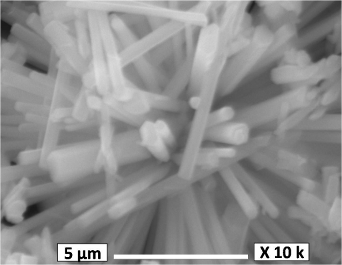
- 450 °C the product is in a stable orthorhombic structure (Figure not included). Above 450 °C no changes in the TG/DTA curve are seen revealing that the thermodynamically stable α-MoO3 was achieved. Optical absorption studies The optical absorption behavior and band gap energy of h-MoO3 was studied by
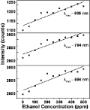
- stable orthorhombic was observed at 430 °C. A formation and growth mechanism for the h-MoO3 nanocrystals with 1D structure was proposed. The estimated band gap was 2.99 eV from the optical absorption studies. Finally, the ethanol vapor-sensing behavior was investigated and the sensor response increased


Precursor concentration and temperature controlled formation of polyvinyl alcohol-capped CdSe-quantum dots
Beilstein J. Nanotechnol. 2010, 1, 119–127, doi:10.3762/bjnano.1.14
- which could be used conveniently for tuning the size of the particles, as well as their optical properties. The synthesized quantum dots were characterized by optical absorption spectroscopy, fluorescence spectroscopy, X-ray diffraction, atomic force microscopy and transmission electron microscopy. The
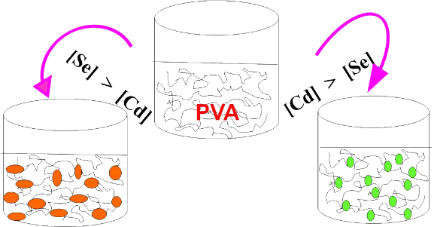
- temperature on the size of the synthesized CdSe quantum dots, as well as the optical absorption and the fluorescence spectra, are presented. Results and discussion CdSe nanoparticles were synthesized by the reaction between Cd(OAc)2 and Na2SeSO3, in the presence of 9.2% PVA, in aqueous medium. Beautiful
- due to slow aggregation of the initially produced nanoparticles, as monitored by UV–vis spectroscopy. Optical absorption study CdSe sols were synthesized, in the case of greenish-yellow colored sols, by keeping concentration of Cd(OAc)2 higher than that of Na2SeSO3, and vice versa for orange colored




Enhanced visible light photocatalysis through fast crystallization of zinc oxide nanorods
Beilstein J. Nanotechnol. 2010, 1, 14–20, doi:10.3762/bjnano.1.3
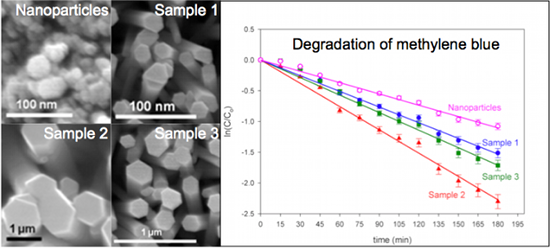
- Abstract Hydrothermally grown ZnO nanorods have inherent crystalline defects primarily due to oxygen vacancies that enhance optical absorption in the visible spectrum, opening up possibilities for visible light photocatalysis. Comparison of photocatalytic activity of ZnO nanorods and nanoparticle films on
- ][3][4]. Optical absorption in the ultraviolet region (peaking around 220 nm) [5] and low photoefficiency [6][7] are factors that deter the wide scale use of TiO2 for photocatalytic activities under sunlight. Zinc oxide (ZnO), with a high surface reactivity owing to a large number of native defect
- microwave irradiation) have already been reported in a previous publication [20]. A higher optical absorption in the visible region was observed in this case. The faster degradation of methylene blue (MB) in the presence of nonstoichiometric crystallites of ZnO prepared through fast crystallization can be