


Search results
Search for "spin coating" in Full Text gives 140 result(s) in Beilstein Journal of Nanotechnology.
Photoelectrochemical and Raman characterization of In2O3 mesoporous films sensitized by CdS nanoparticles
Beilstein J. Nanotechnol. 2013, 4, 255–261, doi:10.3762/bjnano.4.27
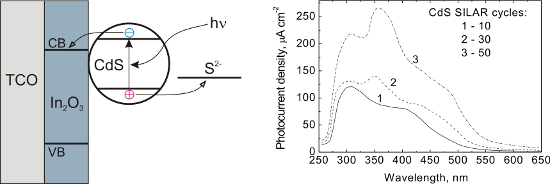
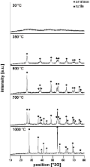
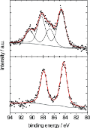
- sensitized by CdS nanoparticles and to characterize these systems by using different methods (SEM, TEM, AES, UV–vis absorption, BET surface area measurements and Raman spectroscopy). Experimental Mesoporous In2O3 films were prepared by spin-coating deposition of a colloidal indium hydroxide solution onto


Functionalization of vertically aligned carbon nanotubes
Beilstein J. Nanotechnol. 2013, 4, 129–152, doi:10.3762/bjnano.4.14
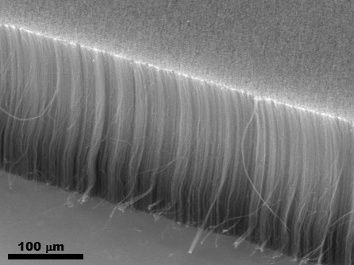
- for the catalysts, which are then deposited by dip or spin coating or, alternatively, are filled into nanoporous architectures serving as templates for the CNT growth. Plasma vapor deposition is an efficient method for the preparation of thin films of metal catalysts with well-defined thicknesses. The
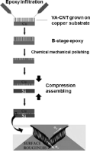
- deposited on flexible substrates. The inconvenience is the weak resistance to acid, the weak resistance after repeated strain and the weak conductivity in comparison to glass [128]. Peng [129] developed a CNTs/polymer composite material by spin-coating a polymer solution onto a VA-CNTs sample, followed by








Tuning the properties of magnetic thin films by interaction with periodic nanostructures
Beilstein J. Nanotechnol. 2012, 3, 831–842, doi:10.3762/bjnano.3.93
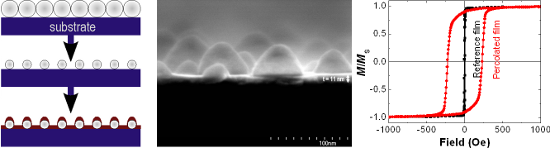
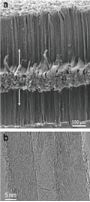
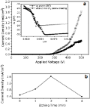
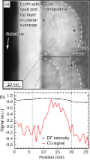
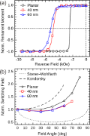
- nanostructuring and magnetism will be discussed in the following subsections. First, we present achievements and limitations of the approach. Monolayers of PS spheres have been prepared by drop-drying [21], spin-coating [22], Langmuir–Blodgett deposition or dip-coating techniques [23]. For PS sizes of 200 nm and


Current–voltage characteristics of single-molecule diarylethene junctions measured with adjustable gold electrodes in solution
Beilstein J. Nanotechnol. 2012, 3, 798–808, doi:10.3762/bjnano.3.89
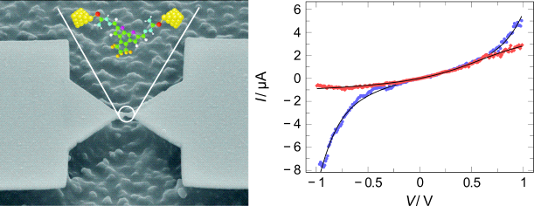
- (Figure S1 in Supporting Information File 1). NMR spectra were recorded on a Bruker Avance DRX600 (600 MHz) and a Jeol ECP-Eclipse 400 (400 MHz). Device fabrication The spin-coating of polyimide (2 μm in thickness) was performed on a softly polished bronze wafer (200 μm in thickness), and then the wafer
- was annealed for 6 h at 430 °C in vacuum (10−5 mbar). The polyimide layer serves as an electrical insulator and a sacrificial layer in the subsequent etching process. Prior to performing the electron beam lithography process, a double layer of electron-beam resists, MMA-MAA/PMMA, was deposited by spin
- -coating on the wafer. After developing, the patterned samples were mounted in an electron-beam evaporator under ultrahigh vacuum (10−9 mbar), and gold of about 80 nm thickness was deposited at a rate of 1 Å/s. After lift-off, the polyimide layer was partially etched away (thickness reduction ≈700 nm) by


The memory effect of nanoscale memristors investigated by conducting scanning probe microscopy methods
Beilstein J. Nanotechnol. 2012, 3, 722–730, doi:10.3762/bjnano.3.82
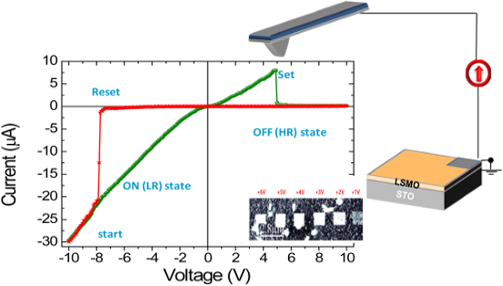
- spin coating, at 6000 rpm for 2 min, and annealed at temperatures in the range of 900–1000 °C under an oxygen gas flux, for different times up to 12 h. Heteroepitaxial growth of LSMO films was confirmed by θ–2θ XRD patterns and XRD q-plot measurements showed that the films are fully strained. The


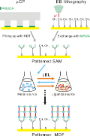
Polymer blend lithography: A versatile method to fabricate nanopatterned self-assembled monolayers
Beilstein J. Nanotechnol. 2012, 3, 620–628, doi:10.3762/bjnano.3.71
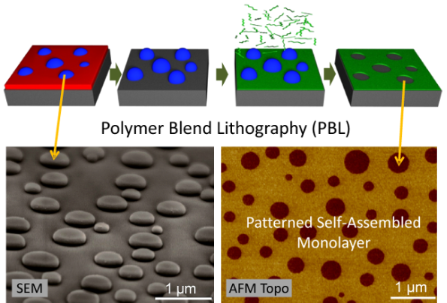
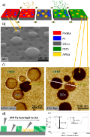
- produce patterned self-assembled monolayers (SAM) on solid substrates featuring two or three different chemical functionalities. For the pattern generation we use the phase separation of two immiscible polymers in a blend solution during a spin-coating process. By controlling the spin-coating parameters
- inducing breath figures (evaporated condensed entity) at higher humidity during the spin-coating process. Here we demonstrate the formation of a lateral pattern consisting of regions covered with 1H,1H,2H,2H-perfluorodecyltrichlorosilane (FDTS) and (3-aminopropyl)triethoxysilane (APTES), and at the same
- growth of ZnO nanostructures [1]. Keywords: breath figure; nanopatterned template; polymer blend lithography (PBL); self-assembled monolayer (SAM); self assembly; spin coating; vapor phase; Introduction Self-assembled monolayers (SAMs) are well-known and have been intensively studied for many years


The oriented and patterned growth of fluorescent metal–organic frameworks onto functionalized surfaces
Beilstein J. Nanotechnol. 2012, 3, 570–578, doi:10.3762/bjnano.3.66
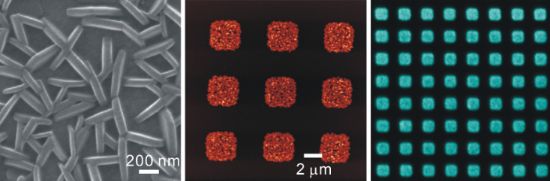
- ][30], electrochemical deposition [33], gel-layer deposition [35], spin-coating deposition from a precursor solution [17][45], Langmuir–Blodgett based layer-by-layer method [34][46], and direct step-wise layer-by-layer growth [29][31][44][47][48]. Of these, the latter method is particular suitable





Surface functionalization of aluminosilicate nanotubes with organic molecules
Beilstein J. Nanotechnol. 2012, 3, 82–100, doi:10.3762/bjnano.3.10
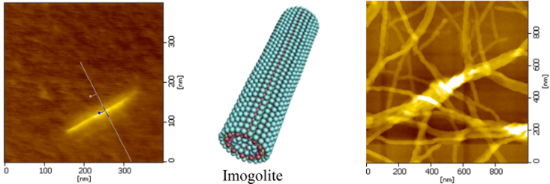
- was evaluated by measurement of the water contact angle (CA) of the DDPO4-imogolite film. DDPO4-imogolite was dispersed in ethanol at a concentration of 2 mg mL−1, and this dispersion was cast onto a silicon wafer by spin coating. For comparison, an aqueous imogolite solution was also cast onto a
- -substituted polythiophene systems was reported [84]. Using a simple solution fabrication process, by dispersing carbon nanotubes in a polythiophene solution followed by spin coating of the solution onto a glass substrate, a highly sensitive and selective chemiresistor was successfully developed. Due to the
- powerful tool for the direct observation of the aggregation of polymeric nanofibers. By spin coating a dilute solution in anisole, a network of nanofibers more or less entirely covers the silicon substrate. The dimensions of the nanofiber were determined from DFM images; as shown in Figure 23a, P3HT


Self-assembled monolayers and titanium dioxide: From surface patterning to potential applications
Beilstein J. Nanotechnol. 2011, 2, 845–861, doi:10.3762/bjnano.2.94



Mechanical characterization of carbon nanomembranes from self-assembled monolayers
Beilstein J. Nanotechnol. 2011, 2, 826–833, doi:10.3762/bjnano.2.92
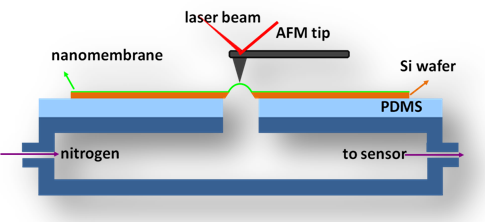
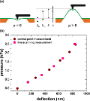
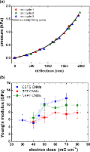
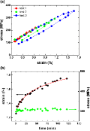
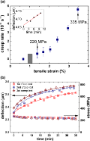
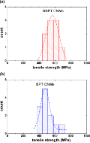
- nanodevices from freestanding nanomembranes. A variety of approaches to fabricate nanomembranes has been tested: Spin-assisted layer-by-layer (LBL) assembly [3][4]; spin-coating of organic–inorganic hybrid films with an interpenetrating network (IPN) structure [5][6]; cross-linking of ligand-stabilized

Enhancement of the critical current density in FeO-coated MgB2 thin films at high magnetic fields
Beilstein J. Nanotechnol. 2011, 2, 809–813, doi:10.3762/bjnano.2.89
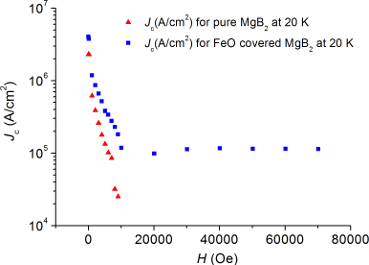
- previous work [11]. Thin MgB2 film samples with dimensions ~4.5 × 5.0 mm2 were used in our work. These samples were obtained by cutting a MgB2 film into two similar pieces: One 4.38 × 5.18 mm2 piece was covered with FeO nanoparticles, which had a diameter of 10 nm, by spin coating at 4000 rpm centrifuge


Nanostructured, mesoporous Au/TiO2 model catalysts – structure, stability and catalytic properties
Beilstein J. Nanotechnol. 2011, 2, 593–606, doi:10.3762/bjnano.2.63
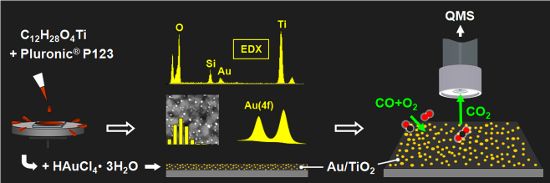
- model catalysts consisting of a thin mesoporous TiO2 film of 200–400 nm thickness with Au nanoparticles, with a mean particle size of ~2 nm diameter, homogeneously distributed therein. The systems were prepared by spin-coating of a mesoporous TiO2 film from solutions of ethanolic titanium
- and catalytic properties of ultra-thin Au/TiO2 catalyst films, which were prepared by spin-coating a thin film of mesoporous TiO2 of 200–400 nm thickness on a flat Si(100) substrate and subsequent loading with Au nanoparticles. After describing the experimental procedures, we first present
- , the conversions given in the next section are maximum values; lower values are also possible. Results and Discussion Characterization of TiO2 coatings and Au/TiO2 catalysts The thin-film Au/TiO2 catalysts were prepared by an evaporation-induced self-assembly (EISA) approach, by spin-coating a Si(100






Towards multiple readout application of plasmonic arrays
Beilstein J. Nanotechnol. 2011, 2, 501–508, doi:10.3762/bjnano.2.54
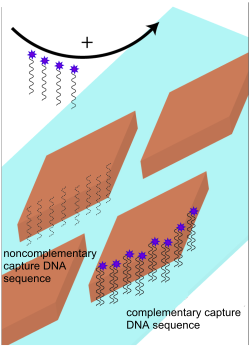
- , followed by spin-coating of a 120 nm thick PMMA (polymethyl methacrylate) resist layer onto the metal film. The resist layer was exposed by a commercial e-beam writer (LION LV-1, Vistec Electron Beam GmbH) operating at 20 keV. After the development in organic solvents (60 s in MIBK:IPA = 1:1 solution), the


Extended X-ray absorption fine structure of bimetallic nanoparticles
Beilstein J. Nanotechnol. 2011, 2, 237–251, doi:10.3762/bjnano.2.28
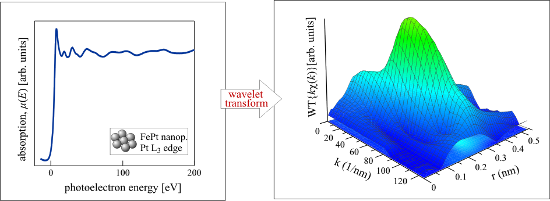
- -hexane with surfactants, precipitated out and centrifuged once again. This can be repeated several times, until a stable dispersion of nanoparticles in n-hexane is obtained. The nanoparticles can be brought onto a naturally oxidised Si substrate using the spin coating technique, dip coating or just by



Magnetic coupling mechanisms in particle/thin film composite systems
Beilstein J. Nanotechnol. 2010, 1, 101–107, doi:10.3762/bjnano.1.12
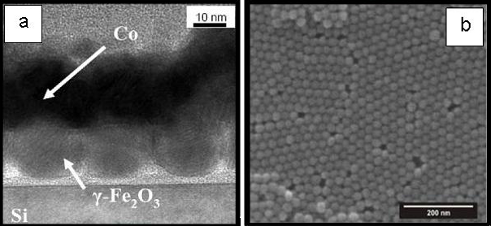
- other hand is less well studied. The aim of our present investigation is to shed light on these various interactions. Results and Discussion Structural characterization Hexagonal close packing of self-assembled NPs as a result of the spin-coating process was confirmed by means of atomic force microscopy
- (AFM) images in Figure 1a and scanning electron microscopy (SEM) images in Figure 1b. The monodisperse nature of the particles and their ordering can be observed in these images. Furthermore, in both images common faults can be seen which are encountered in NP monolayer samples prepared by spin-coating
- , such as the presence of regions with two overlapping layers, missing particles (voids), and dislocations separating domains of hexagonal order. Aside from the presence of local defects, the spin-coating technique has proven to be able to produce long range hexagonal order over areas of 10 × 10 mm2 with





