


Search results
Search for "spring constant" in Full Text gives 182 result(s) in Beilstein Journal of Nanotechnology.
Dynamic force microscopy simulator (dForce): A tool for planning and understanding tapping and bimodal AFM experiments
Beilstein J. Nanotechnol. 2015, 6, 369–379, doi:10.3762/bjnano.6.36
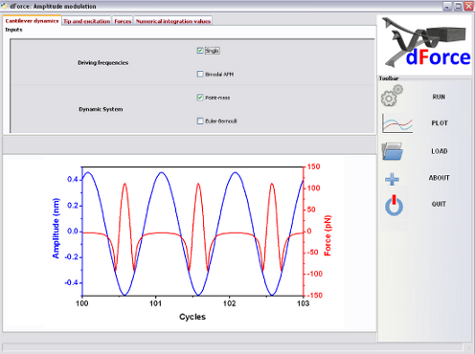
- mass of the cantilever tip, ω0 is the angular resonant frequency, Q the quality factor, k the spring constant of the fundamental resonance (first flexural mode) and Fts is the tip–sample interaction force. The above equation is applicable when the contributions from higher modes to the cantilever




Mechanical properties of MDCK II cells exposed to gold nanorods
Beilstein J. Nanotechnol. 2015, 6, 223–231, doi:10.3762/bjnano.6.21
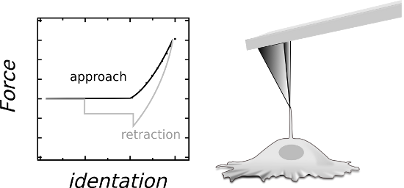
- Instrument AG, Berlin, Germany) with HEPES buffered culture medium kept at 37 °C. AFM images were performed in contact mode. Before force spectroscopy measurements the exact spring constant of the used cantilever was determined by thermal noise analysis using software provided by the manufacturer. Local


Kelvin probe force microscopy in liquid using electrochemical force microscopy
Beilstein J. Nanotechnol. 2015, 6, 201–214, doi:10.3762/bjnano.6.19
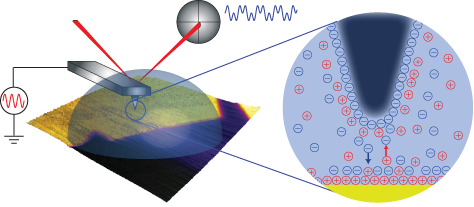
- ground potential with respect to the tip. All OLBS and EcFM measurements were performed using a commercial AFM system (Asylum Research, MFP-3D) and as-received Pt/Ir-coated (Nanosensors, PPP-EFM) cantilevers with a nominal mechanical resonant frequency and spring constant of 75 kHz and 2.8 N/m


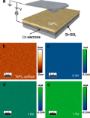
![[Graphic 6]](/bjnano/content/inline/2190-4286-6-19-i11.png?max-width=637&scale=1.18182) response collected 200 nm above a grounded Au electrode in (a, b, c) air, (d, e, f) decane an...
response collected 200 nm above a grounded Au electrode in (a, b, c) air, (d, e, f) decane an...


![[Graphic 22]](/bjnano/content/inline/2190-4286-6-19-i27.png?max-width=637&scale=1.18182) spectra [bias-on] collected 500 nm above HOPG in aqueous solutions of increasing salt concent...
spectra [bias-on] collected 500 nm above HOPG in aqueous solutions of increasing salt concent...

![[Graphic 25]](/bjnano/content/inline/2190-4286-6-19-i30.png?max-width=637&scale=1.18182) spectra [bias-on] collected 500 nm above (a) HOPG and (b) Au in milli-Q water (vertical color...
spectra [bias-on] collected 500 nm above (a) HOPG and (b) Au in milli-Q water (vertical color...

![[Graphic 27]](/bjnano/content/inline/2190-4286-6-19-i32.png?max-width=637&scale=1.18182) spectra [bias-on] recorded 500 nm above a HOPG/Au boundary in milli-Q water. T...
spectra [bias-on] recorded 500 nm above a HOPG/Au boundary in milli-Q water. T...

Increasing throughput of AFM-based single cell adhesion measurements through multisubstrate surfaces
Beilstein J. Nanotechnol. 2015, 6, 157–166, doi:10.3762/bjnano.6.15
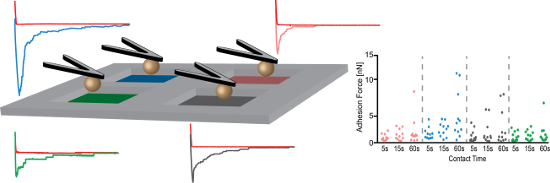
- protein coatings of PDMS and glass-surfaced wells, a NanoWizzard II AFM (JPK Instruments) mounted on an inverted microscope (Axio Observer.Zi, Zeiss) was used. AFM imaging was performed in intermittent contact mode with a v-shaped cantilever (SNL, Brucker) having a nominal spring constant of 0.58 N/m
- experiments. 200 µm-long, tip-less, v-shaped, silicon nitride cantilevers having nominal spring constants of 0.06 N/m (NP-O, Bruker) were used for adhesion measurements. The spring constant of every cantilever was determined prior to the experiment using the thermal noise method. Prior to experiments, cells


Accurate, explicit formulae for higher harmonic force spectroscopy by frequency modulation-AFM
Beilstein J. Nanotechnol. 2015, 6, 149–156, doi:10.3762/bjnano.6.14
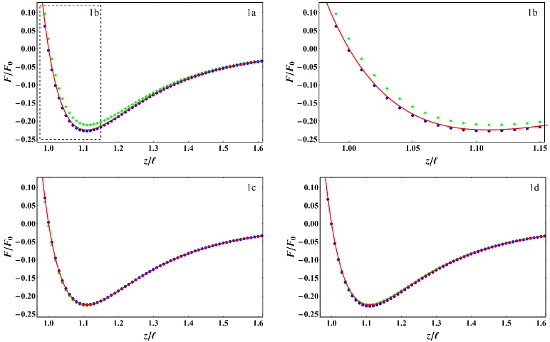
- –surface interaction Here, k is the effective cantilever spring constant, ω0 is the fundamental resonance frequency in the absence of tip–surface interaction, q(t) is the tip position, γ is the damping coefficient, and F0 and ω are the amplitude and frequency of the driving force, respectively. As the


Multifunctional layered magnetic composites
Beilstein J. Nanotechnol. 2015, 6, 134–148, doi:10.3762/bjnano.6.13
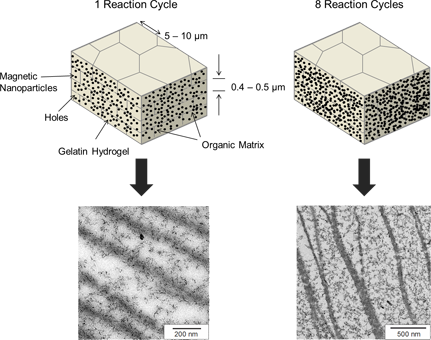
- of the cantilever from the raw displacement data. The spring constant of the cantilever (0.56 N/m) was deduced from its thermal noise spectrum prior to the attachment of the colloidal probe [66]. Magnetite formation inside a gelatin gel matrix (grey) that is placed inside the chitin scaffold of





The capillary adhesion technique: a versatile method for determining the liquid adhesion force and sample stiffness
Beilstein J. Nanotechnol. 2015, 6, 11–18, doi:10.3762/bjnano.6.2
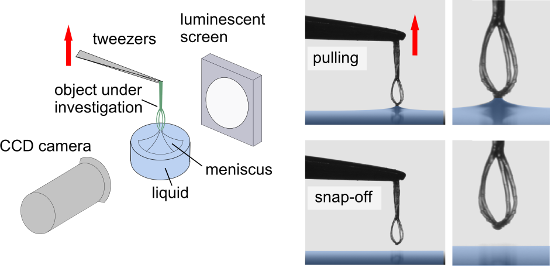
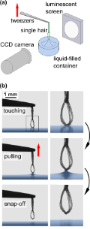
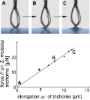
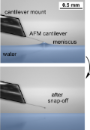
- -off, the elongation, Δy, of the trichome in the direction of the force was observed. Assuming Hooke’s law, its spring constant is Likewise, other elastic constants such as Young’s modulus can be determined, as shown later in the section where human head hairs are examined. The contribution of the
- the average spring constant of the trichomes of Salvinia molesta to be Dpulling = (2.1 ± 0.2 ± 0.2) N/m, where the data denotes the average value, followed by the statistical and systematic errors, respectively. The data also support the assumption that the trichomes serve as soft springs (see above
- spring constant according to Hooke´s law requires a linear elongation with increasing force, which is also proved by our method. In general, CAT allows the determination of the force–elongation curves of single structural entities. For this purpose, not only the image of the meniscus immediately before


High-frequency multimodal atomic force microscopy
Beilstein J. Nanotechnol. 2014, 5, 2459–2467, doi:10.3762/bjnano.5.255
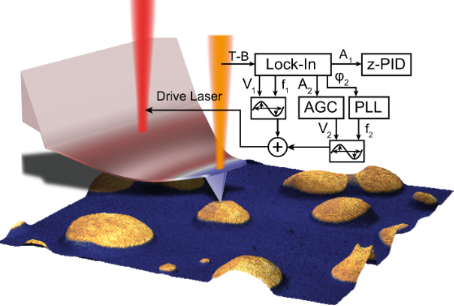
- of the cantilever (P0) as where V0 is the excitation voltage, f0 the excitation frequency, k the spring constant, A the amplitude and Q the quality factor far from the surface [39]. The acquired dissipation is, to a first approximation, only dependent on the materials properties and the additional
- and inversely with the quality factor. The increased ratio of resonance frequency to spring constant makes it clear that the use of small cantilevers is ideally suited for low-dissipation imaging on multiple dynamic modes. Drive amplitude modulation imaging For biophysical imaging with atomic force
- in water [40]. One issue of note is that higher eigenmodes have an inherently higher dynamic stiffness that can be up to two orders of magnitude larger than the fundamental mode. This can be problematic for softer samples, as the power dissipated into the sample increases linearly with the spring


Nanometer-resolved mechanical properties around GaN crystal surface steps
Beilstein J. Nanotechnol. 2014, 5, 2164–2170, doi:10.3762/bjnano.5.225
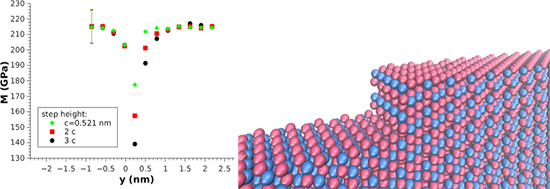
- spring constant of 39 N/m. The second resonance mode was used for further analysis. The reduced Young’s modulus was measured by using a reference approach with three reference samples: fused silica (M = 75 GPa), silicon (M = 165 GPa) and sapphire (M = 433 GPa), which were demonstrated to be sufficient


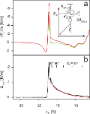
![[Graphic 3]](/bjnano/content/inline/2190-4286-5-225-i13.png?max-width=637&scale=1.18182) along the y-axis of the upper Ga atom...
along the y-axis of the upper Ga atom...


Modification of a single-molecule AFM probe with highly defined surface functionality
Beilstein J. Nanotechnol. 2014, 5, 2122–2128, doi:10.3762/bjnano.5.221
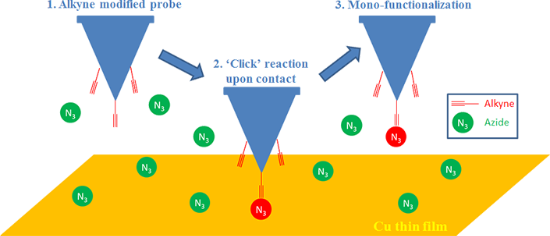
- spring constant is 10 pN/nm and tip curvature is 2 nm. The Au-coated AFM probes (CSG10/Au) were gifts from NT-MDT with 2.5 nm adhesive Ti layer and 35 nm Au layer, the nominal spring constant is 110 pN/nm and tip curvature is 35 nm. The aminopropylsilane-coated glass slides (C18-5131-M20) were purchased
- . When the probe is retracted, the force to break the hydrogen bonds should be detectable. The force spectroscopy experiments were carried out in contact mode at room temperature in isopropanol. The spring constant of the AFM probes were calibrated by using the thermal noise method [30]. The measured


Optical properties and electrical transport of thin films of terbium(III) bis(phthalocyanine) on cobalt
Beilstein J. Nanotechnol. 2014, 5, 2070–2078, doi:10.3762/bjnano.5.215
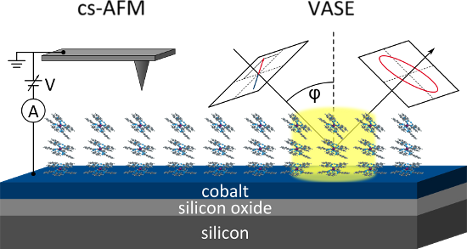
- performed in AC tapping mode, which guarantees minimal contact between the AFM probe and the organic film. Ultra sharp (4–10 nm radius) Olympus cantilevers allowed high sensitivity measurements. cs-AFM measurements were performed in contact mode using special Pt-coated Si cantilevers with a spring constant


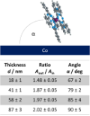
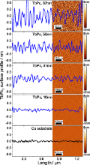
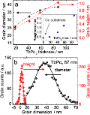

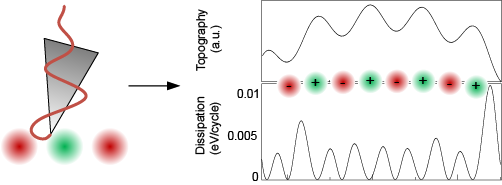
Dissipation signals due to lateral tip oscillations in FM-AFM
Beilstein J. Nanotechnol. 2014, 5, 2048–2057, doi:10.3762/bjnano.5.213
- oscillation of a harmonic spring with the spring constant kz. The mass mz has to be chosen such that the frequency matches the frequency of the cantilever [24]. The internal damping of the cantilever motion is experimentally compensated by a driving force. There exist sophisticated models that describe the
- and φ the torsional angle of the cantilever. Denoting the moment of inertia of the cantilever by J and the torsional spring constant by kφ, the equation of motion for φ without the interaction with the substrate would be , which is in agreement with Equation 2, if one identifies kx = kφ/r2 and mx = J
- parameter set Before we study the influence of single parameters, we want to get a quick overview, what can actually be expected. This is obtained by a Monte Carlo sampling of the parameter space, in which we chose combinations of parameters randomly within a reasonable range. The normal spring constant kz


Hydrophobic interaction governs unspecific adhesion of staphylococci: a single cell force spectroscopy study
Beilstein J. Nanotechnol. 2014, 5, 1501–1512, doi:10.3762/bjnano.5.163
- , MA, USA) with a nominal spring constant of 0.03 N/m. After the cantilevers were cleaned in an air plasma, they were vertically immersed into a solution of 4 mg/mL dopamine hydrochloride (99%, Sigma-Aldrich) in 10 mM TRIS-buffer (pH 7.9 at 22 °C) and kept at 4 °C in the fridge for 50 min. The
- ), mounted onto the AFM. Subsequently, it was calibrated in liquid by using the thermal tune technique [23], which allows for the calculation of the individual spring constant of the cantilever. Afterwards, holder and cantilever were placed into a micromanipulation system (Narishige Group, Japan). The
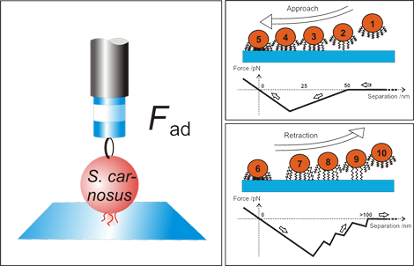
- recorded during the approach and retraction of the bacterial probe to and from the surface. The deflection data was converted into force values by means of the spring constant of the cantilever, determined as described above. The approach is performed until a certain repulsive force is reached (“force


A nanometric cushion for enhancing scratch and wear resistance of hard films
Beilstein J. Nanotechnol. 2014, 5, 1005–1015, doi:10.3762/bjnano.5.114
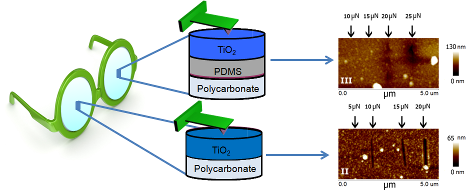
- beams) enables simultaneous work using both beams. Atomic force microscopy (AFM). All scanning probe microscopy was done using an ICON instrument (Bruker AXS SAS). The deflection sensitivity of each probe was measured by pressing the probe on a hard surface and spring constant was calibrated by the
- information was obtained via the torsional deflection of the cantilever with the scan direction running perpendicular to the major axis of the cantilever. Quantitative values of the frictional force were made as per reference [51]. A silicon nitride "A" shaped cantilever (normal spring constant 0.32 N/m) with



Calibration of quartz tuning fork spring constants for non-contact atomic force microscopy: direct mechanical measurements and simulations
Beilstein J. Nanotechnol. 2014, 5, 507–516, doi:10.3762/bjnano.5.59
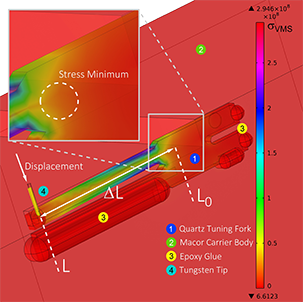
- -Leopoldshafen, Germany 10.3762/bjnano.5.59 Abstract Quartz tuning forks are being increasingly employed as sensors in non-contact atomic force microscopy especially in the “qPlus” design. In this study a new and easily applicable setup has been used to determine the static spring constant at several positions
- prefactor and therefore directly suffer from an inaccurate determination of the spring constant. Here we present an experimental procedure that allows for the direct measurement of the stiffness of a tuning fork sensor in the “qPlus” design with standard lab equipment. Our results reveal that a large spread
- origin is shifted to the position of zero stress onset inside the tuning fork base and torsional effects are included as well. Comparison with experimental spring constant data still show that the spring constant is overestimated by FEM and beam formula. This effect is attributed to a small but not




The softening of human bladder cancer cells happens at an early stage of the malignancy process
Beilstein J. Nanotechnol. 2014, 5, 447–457, doi:10.3762/bjnano.5.52
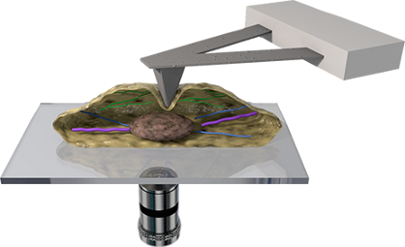
- silicon nitride cantilevers terminated with a silicon tip (MLCT-C, Bruker, USA). Those cantilevers are characterized by a nominal spring constant k = 0.01 N/m while the length of the tip length is about 3 µm long, with a half-angle of 20° and a radius of 20 nm. The sensitivity of the photodiode was


Exploring the complex mechanical properties of xanthan scaffolds by AFM-based force spectroscopy
Beilstein J. Nanotechnol. 2014, 5, 365–373, doi:10.3762/bjnano.5.42
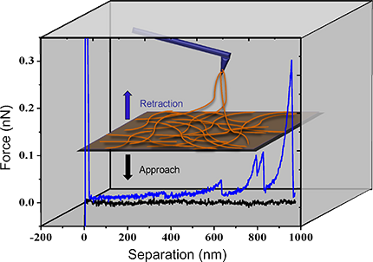
- experiments were performed after 15 min of stabilization. Atomic force microscopy AFM imaging: AFM measurements were conducted on a commercial Agilent AFM/STM 5500 microscope (Agilent Technologies, USA) in contact mode. Nitride silicon cantilevers (OMCL-TR400PSA-1) with a spring constant of 0.02 N/m and a


Frequency, amplitude, and phase measurements in contact resonance atomic force microscopies
Beilstein J. Nanotechnol. 2014, 5, 278–288, doi:10.3762/bjnano.5.30
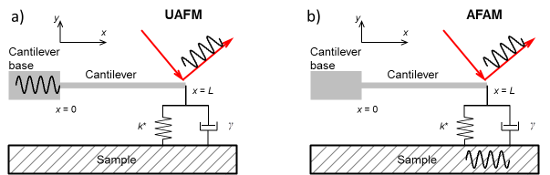
- the cantilever spring constant, k* the contact stiffness, γ* the contact damping constant, and the dimensionless contact damping constant. With the above specified boundary conditions the solution further simplifies to with the following constants for the two configurations: and with M± = sin αL cosh
- length L = 225.03 µm, width w = 30.00 µm, and thickness T = 4.89 µm. With mass density ρSi = 2329.00 kg/m3 and Young’s modulus ESi = 130.00 GPa, the cantilever’s spring constant was calculated as kc = 10.00 N/m. Using these parameters and considering ηair = 2.50 s−1 in Equation 1, the first two
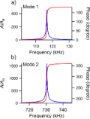
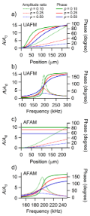
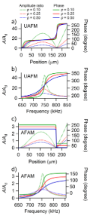


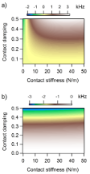
Unlocking higher harmonics in atomic force microscopy with gentle interactions
Beilstein J. Nanotechnol. 2014, 5, 268–277, doi:10.3762/bjnano.5.29
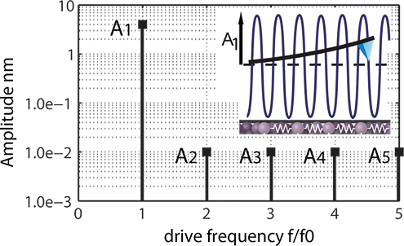
- motion of the mth eigenmode where k(m), Q(m), ω(m), and z(m) are the spring constant, quality factor, natural frequency and position of the mth eigenmode. The term FD stands for the external driving force where the subscript without brackets, n, indicates the harmonic number. Note that here ωn = nω

![[Graphic 7]](/bjnano/content/inline/2190-4286-5-29-i27.png?max-width=637&scale=1.18182) of higher harmonics, including the fundamental shift
of higher harmonics, including the fundamental shift ![[Graphic 8]](/bjnano/content/inline/2190-4286-5-29-i28.png?max-width=637&scale=1.18182) , when N = 10 external harmonic ...
, when N = 10 external harmonic ...


The role of surface corrugation and tip oscillation in single-molecule manipulation with a non-contact atomic force microscope
Beilstein J. Nanotechnol. 2014, 5, 202–209, doi:10.3762/bjnano.5.22
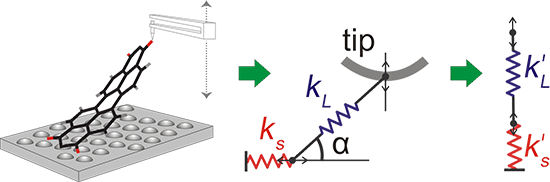
- determined by the softer spring S (surface corrugation) and L can be considered as rigid, except for α0 close to 90°, where diverges while remains finite. The total spring constant of the system becomes This expression reflects the basic properties of the correction term Δcorr(α0). Firstly, we find that

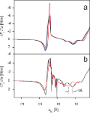
Influence of the adsorption geometry of PTCDA on Ag(111) on the tip–molecule forces in non-contact atomic force microscopy
Beilstein J. Nanotechnol. 2014, 5, 98–104, doi:10.3762/bjnano.5.9
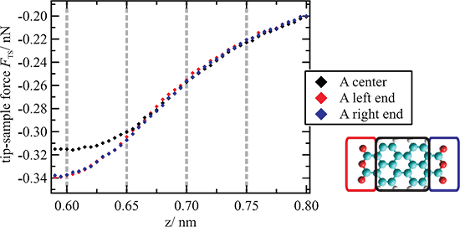
- atomic force microscope (Omicron LT-SPM) that was operated in frequency-modulation mode [11] under ultrahigh vacuum conditions and at a temperature of ≈5 K using a tuning fork sensor (resonance frequency f0 = 24640 Hz, spring constant k ≈ 2000 N/m) in the qPlus design [12]. The amplitude of the sensor
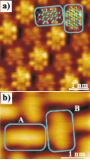



Exploring the retention properties of CaF2 nanoparticles as possible additives for dental care application with tapping-mode atomic force microscope in liquid
Beilstein J. Nanotechnol. 2014, 5, 36–43, doi:10.3762/bjnano.5.4
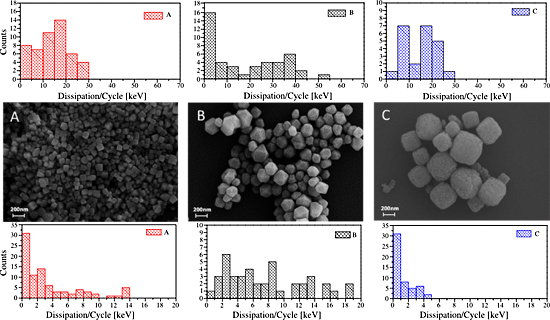
- by tip–sample interactions. If the cantilever has a normal spring constant k and is driven sinusoidally with the amplitude A0 and drive frequency ω0, we can calculate the average power dissipated by tip–sample interactions as where A is the damped amplitude at the given set point, Qcant the quality


Surface assembly and nanofabrication of 1,1,1-tris(mercaptomethyl)heptadecane on Au(111) studied with time-lapse atomic force microscopy
Beilstein J. Nanotechnol. 2014, 5, 26–35, doi:10.3762/bjnano.5.3
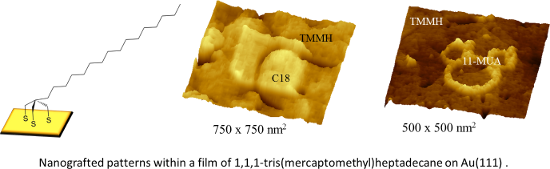
- accomplished with silicon nitride tips, which had an average spring constant of 0.5 N/m (Bruker Instruments, Camarillo, CA). Digital images were processed and analyzed with Gwyddion v.2.25 software [43]. Analysis of surface coverage was accomplished by manually selecting a threshold value to convert images to


Noise performance of frequency modulation Kelvin force microscopy
Beilstein J. Nanotechnol. 2014, 5, 1–18, doi:10.3762/bjnano.5.1
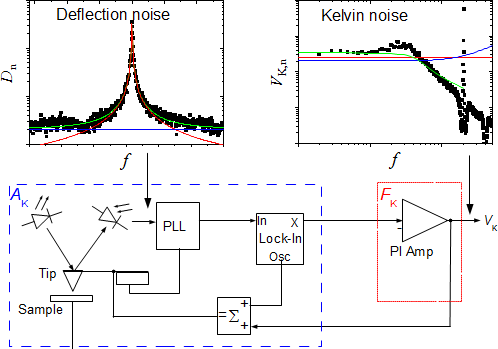
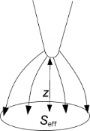
- merit factor is If it is assumed that the maximum oscillation amplitude D0 cannot exceed a certain fraction of z and hence is proportional to it, it reduces to Furthermore, a relation has to be respected between minimum tip–sample distance z and spring constant k to avoid snap to contact. Figure 17
- shows the tip in the attractive part of the van-der-Waals interaction. The force gradient in this field must not exceed the spring constant to avoid snap to contact. We take the attractive range of a Lennard-Jones type of potential The force gradient is proportional to the second derivative: To avoid
- 49 for the relation between z and k yields Unsurprisingly, for the case of dominating sensor noise, maximization of the merit factor requires minimizing the sensor noise. Both merit factors, Equation 50 and Equation 55, suggest downsizing both the probe spring constant and mass. If one considers f0





Peak forces and lateral resolution in amplitude modulation force microscopy in liquid
Beilstein J. Nanotechnol. 2013, 4, 852–859, doi:10.3762/bjnano.4.96
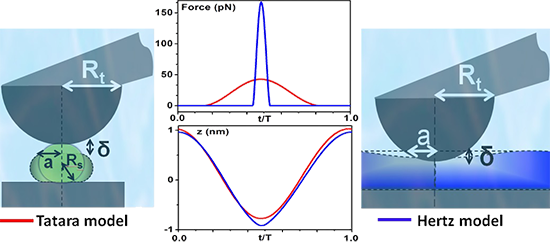
- of motion for the microcantilever–tip system is approximated by using the point-mass model [25], where m is the effective cantilever mass that includes the added mass of the fluid, and ω0, Q, k and Fts are, respectively, angular resonant frequency, quality factor, spring constant and tip–sample





