


Search results
Search for "van der Waals forces" in Full Text gives 143 result(s) in Beilstein Journal of Nanotechnology.
Unlocking higher harmonics in atomic force microscopy with gentle interactions
Beilstein J. Nanotechnol. 2014, 5, 268–277, doi:10.3762/bjnano.5.29
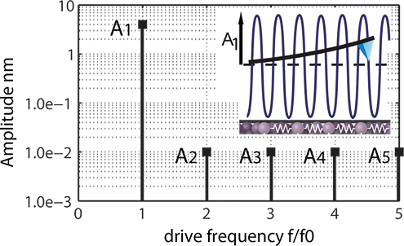
- phase shift calculated as the sums ΣΔ (n = 1–9) are 119.8, 19.3 and 5.4° and decrease with decreasing the variations in peak force, i.e., 29, 8 and 3 pN, respectively. It is also interesting to note that the source of variations in peak force with variations in Hamaker H (Equation 10), i.e., van der
- Waals forces, relates to variations in the distance of minimum approach, dm, with variations in H. To be more specific, dm, increases with increasing H. For example, in the simulations, by varying H from H1 = 0.2 × 10⁻¹⁹ J to H2 = 1.4 × 10⁻¹⁹ J the variation is Δdm ≈ 0.83 nm. This would experimentally

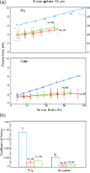
![[Graphic 7]](/bjnano/content/inline/2190-4286-5-29-i27.png?max-width=637&scale=1.18182) of higher harmonics, including the fundamental shift
of higher harmonics, including the fundamental shift ![[Graphic 8]](/bjnano/content/inline/2190-4286-5-29-i28.png?max-width=637&scale=1.18182) , when N = 10 external harmonic ...
, when N = 10 external harmonic ...


Influence of the adsorption geometry of PTCDA on Ag(111) on the tip–molecule forces in non-contact atomic force microscopy
Beilstein J. Nanotechnol. 2014, 5, 98–104, doi:10.3762/bjnano.5.9
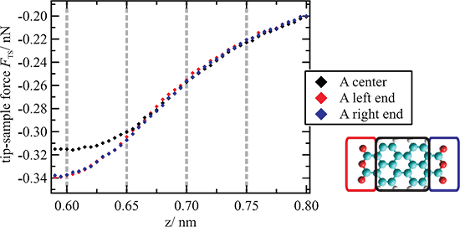
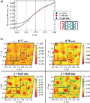
- individually, the evolution of the intramolecular contrast as a function of the distance z is as expected. At larger distances, in the regime of attractive long-range interactions such as van-der-Waals forces, no internal structures can be observed in the horizontal cuts through the 3D force field. The



Polynomial force approximations and multifrequency atomic force microscopy
Beilstein J. Nanotechnol. 2013, 4, 352–360, doi:10.3762/bjnano.4.41
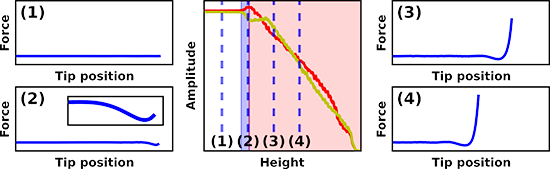
- attractive force regime due to the van der Waals forces between the tip and the surface is reached. In this regime new frequency components appear in the motion spectrum, so-called intermodulation products. Note that in the time domain, the distortion of the signal is barely visible. Both polynomial and ADFS

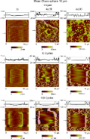
![[Graphic 19]](/bjnano/content/inline/2190-4286-4-41-i45.png?max-width=637&scale=1.18182) matrix (a) and its pseudo-inverse (b). Only rows with non-zero elements are d...
matrix (a) and its pseudo-inverse (b). Only rows with non-zero elements are d...


Selective surface modification of lithographic silicon oxide nanostructures by organofunctional silanes
Beilstein J. Nanotechnol. 2013, 4, 218–226, doi:10.3762/bjnano.4.22
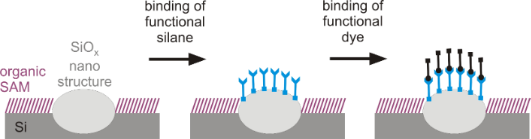
- interactions or van-der-Waals forces) on the other hand are characterized by weaker binding strengths and a lower selectivity, and thus, are not as suitable for multistep surface functionalization as covalent binding. Although the covalent functionalization of LAO patterns has been reported several times


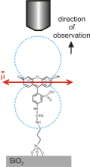
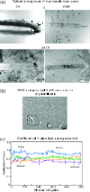
![[Graphic 2]](/bjnano/content/inline/2190-4286-4-22-i2.png?max-width=637&scale=1.18182) (red arrow) of FITC bound to a SiO2 surface.
(red arrow) of FITC bound to a SiO2 surface.
Functionalization of vertically aligned carbon nanotubes
Beilstein J. Nanotechnol. 2013, 4, 129–152, doi:10.3762/bjnano.4.14
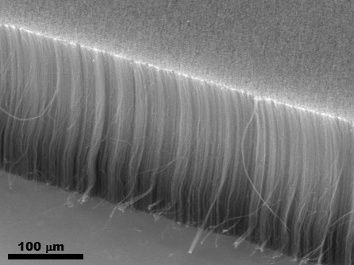
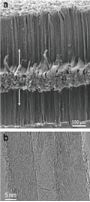
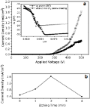
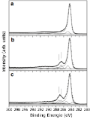
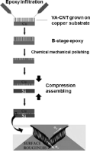
- key achievement was the engineering of vertically oriented CNT-arrays by using CVD of ethylene, size-controlled Fe catalytic particles, and nanotube positioning by substrate patterning. The mechanism of the alignment of the CNTs was proposed to be due to the van der Waals forces where the outer wall








Towards 4-dimensional atomic force spectroscopy using the spectral inversion method
Beilstein J. Nanotechnol. 2013, 4, 87–93, doi:10.3762/bjnano.4.10
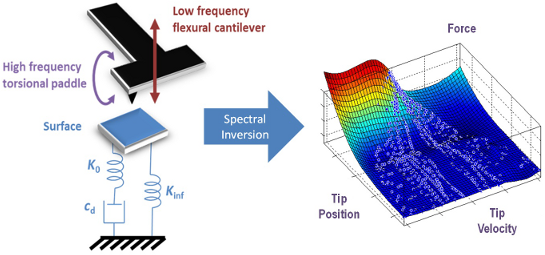
- torsional eigenmode positions as a function of time at regularly spaced intervals (digitally) for several flexural periods; and (iv) application of the inversion procedure described above to recover the tip–sample forces. The tip–sample interaction was simulated as the combination of attractive van der
- Waals forces (modeled through the Hamaker equation [13]) plus repulsive and dissipative interactions. In most cases, the repulsive forces were modeled by using a Hertzian contact [13], while the dissipative interactions were modeled by using a viscous force term proportional to the tip speed with a


Effect of spherical Au nanoparticles on nanofriction and wear reduction in dry and liquid environments
Beilstein J. Nanotechnol. 2012, 3, 759–772, doi:10.3762/bjnano.3.85
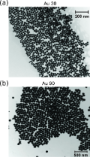
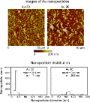
- , can prevent nanoparticles from reaching their intended target [7]. Smaller nanoparticles can diffuse through surfaces and avoid detection by the RES. Studies have shown that forces such as hydrodynamic and van der Waals forces along with the nanoparticle size influence lateral drift (margination) and
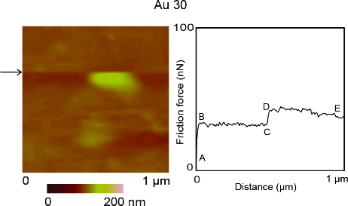
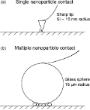
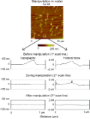
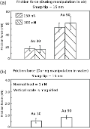
- is the result of adhesion between the nanoparticle and the silicon substrate. The adhesive force can include van der Waals forces under both dry and submerged-in-water conditions and meniscus forces under dry conditions. In this regime the friction force is not proportional to the normal load since



Dimer/tetramer motifs determine amphiphilic hydrazine fibril structures on graphite
Beilstein J. Nanotechnol. 2012, 3, 658–666, doi:10.3762/bjnano.3.75
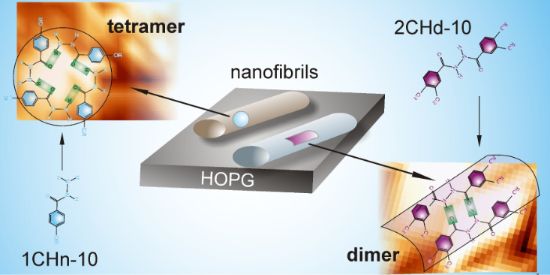
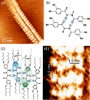
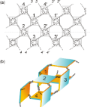
- different from known mesophase bulk structures. The structures are described by building-block models based on hydrogen-bonded dimer and tetramer precursors of hydrazines. The closure and growth in length of building units into fibrils takes place through van der Waals forces acting between the dangling
- neighbouring tetramers in which the tetramer building blocks are represented by squares. The structure constituted by blocks 1, 2, 3 and 4 represents a repeating unit of the fibril. The aliphatic chains of the subsequent tetramers interact through van der Waals forces between the interdigitating chains. Thus




Repulsive bimodal atomic force microscopy on polymers
Beilstein J. Nanotechnol. 2012, 3, 456–463, doi:10.3762/bjnano.3.52
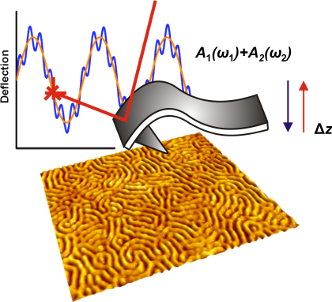
- the driving signal that is larger than 90° indicates a net attractive regime, in which van der Waals forces dominate the interaction. Smaller values indicate a net repulsive regime, in which Pauli repulsion becomes increasingly dominant. The ratio of the amplitudes is crucial for the contrast in the



Drive-amplitude-modulation atomic force microscopy: From vacuum to liquids
Beilstein J. Nanotechnol. 2012, 3, 336–344, doi:10.3762/bjnano.3.38
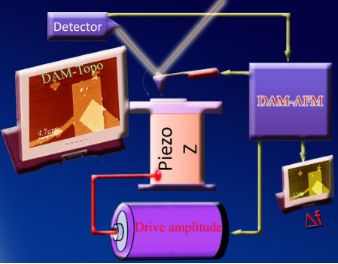
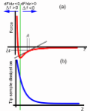
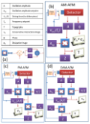
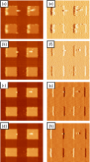
- conditions in both regimes. In liquid, the absence of significant van der Waals forces results in a monotonic interaction [4] and the feedback in both FM and AM is often perfectly stable. However biological samples, such as viruses, tend to contaminate the tip and introduce attractive interactions causing FM


Graphite, graphene on SiC, and graphene nanoribbons: Calculated images with a numerical FM-AFM
Beilstein J. Nanotechnol. 2012, 3, 301–311, doi:10.3762/bjnano.3.34
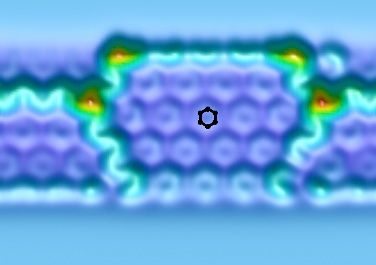
- implemented with the n-AFM, advanced first-principles methods [92] are well adapted to deal with local changes of electronic structure when the tip interacts with the sample surface, especially for KPFM [93][94]. For weak chemical interactions and van der Waals forces, theoretical studies have demonstrated


Modeling noncontact atomic force microscopy resolution on corrugated surfaces
Beilstein J. Nanotechnol. 2012, 3, 230–237, doi:10.3762/bjnano.3.26
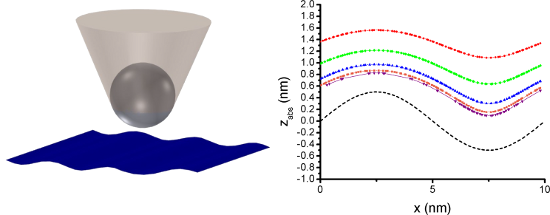
- quasi-1-D substrate corrugation (modeled as a sinusoid) and obtain the response of a spherical tip to van der Waals (vdW) interactions. To our knowledge, it is the first model to directly incorporate the lateral variation of van der Waals forces due to surface corrugation and to attempt to quantify this
- , using an approach that incorporates the IDL routines INTERPOLATE and INT_3D. As a check on this numerical integration, we compare against the exact analytical result for a sphere attracted to a flat surface by van der Waals forces. It is well-known that the sphere–plane Hamaker integration has the
- , we discussed the Hamaker integration for a sphere interacting with a flat surface through van der Waals forces. The integration can be carried out without approximation to yield the exact formula; this exact formula is cumbersome and given by Equation 10. In the limit z << R, this formula simplifies


An NC-AFM and KPFM study of the adsorption of a triphenylene derivative on KBr(001)
Beilstein J. Nanotechnol. 2012, 3, 221–229, doi:10.3762/bjnano.3.25
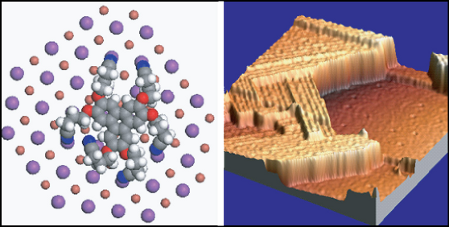
- voltage of the surrounding MLh domain. As expected the spatial resolution in the Kelvin map is lower than in the topography map due to the longer range of electrical forces relative to van der Waals forces. The different domains that appear in Figure 6 have been labeled and the monoatomic KBr steps




Theoretical study of the frequency shift in bimodal FM-AFM by fractional calculus
Beilstein J. Nanotechnol. 2012, 3, 198–206, doi:10.3762/bjnano.3.22
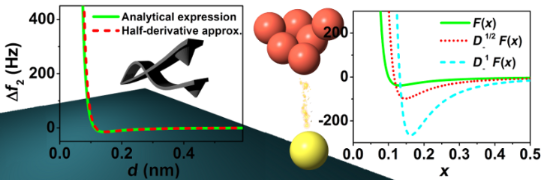
- length scale of the interaction force. For the force which appears in the DMT model [51] where H is the Hamaker constant of the long-range van der Waals forces, d0 is the equilibrium distance, R is the tip radius and Eeff is the effective Young’s modulus, which is related to the Young’s moduli Et and Es


STM study on the self-assembly of oligothiophene-based organic semiconductors
Beilstein J. Nanotechnol. 2011, 2, 802–808, doi:10.3762/bjnano.2.88
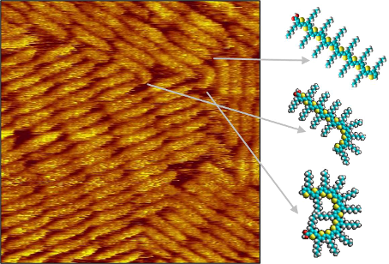
- weak intermolecular van der Waals forces and molecule–substrate interactions, as well as intermolecular hydrogen bonding in the case of functionalized oligothiophenes [15][16][17]. The typical flat metallic substrates (HOPG, Au(111), Ag(111), etc.) employed in STM differ from the ITO electrodes used in


Distinguishing magnetic and electrostatic interactions by a Kelvin probe force microscopy–magnetic force microscopy combination
Beilstein J. Nanotechnol. 2011, 2, 552–560, doi:10.3762/bjnano.2.59
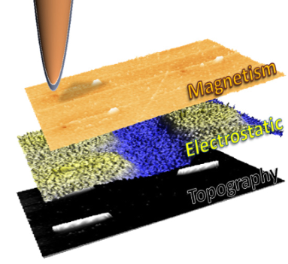
- Table 1. The values have been calculated using Equation 2 and Equation 3 and the equation in [30]. For the van der Waals forces we assume a tip radius of 30 nm and AH of about 10−19 J. The electrostatic interaction is calculated for a tip with an electrical radius slightly smaller due to the existence


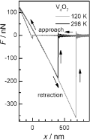
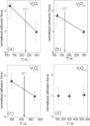
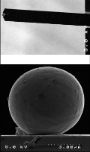
Switching adhesion forces by crossing the metal–insulator transition in Magnéli-type vanadium oxide crystals
Beilstein J. Nanotechnol. 2011, 2, 59–65, doi:10.3762/bjnano.2.8
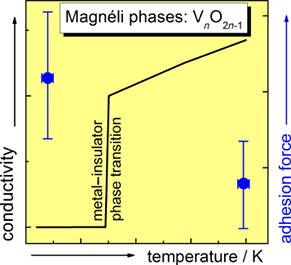
- ) has become a powerful tool for measuring the forces interacting between a sharp tip and a solid sample surface, such as van der Waals forces and short-range chemical forces [14][15][16][17]. Typically, the AFM is used for a spatially resolved imaging of forces, which requires a tip with a sharp apex



Defects in oxide surfaces studied by atomic force and scanning tunneling microscopy
Beilstein J. Nanotechnol. 2011, 2, 1–14, doi:10.3762/bjnano.2.1
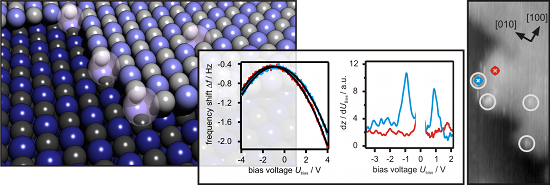
- and van der Waals forces. The averaged frequency shift at the largest separation is about Δf = −0.52 Hz. By decreasing the tip-sample distance by 0.5 Å, the absolute value of the tunneling current and the frequency shift increase at the position of the defect. The tunneling current increases to It





