Search results
Search for "binding energies" in Full Text gives 185 result(s) in Beilstein Journal of Nanotechnology.
Electrical characterization of single molecule and Langmuir–Blodgett monomolecular films of a pyridine-terminated oligo(phenylene-ethynylene) derivative
Beilstein J. Nanotechnol. 2015, 6, 1145–1157, doi:10.3762/bjnano.6.116
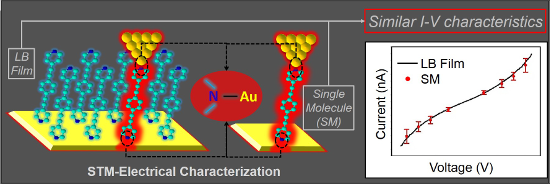
- groups [67][68][69] and fullerenes [60][70][71]. However, many of these groups have significant limitations including chemical degradation at working temperatures [72][73], associated polymerization phenomena [74], small binding energies [74], unexpectedly high contact resistance [75][76][77][78][79][80
- plane. To provide a precise energy calibration, the XPS binding energies were referenced to the C 1s peak at 284.6 eV. The thickness of LB films on the gold substrates was estimated using the attenuation of the Au 4f signal from the substrate according to ILB film = Isubstrate exp(−d/λsinθ), where d is


Electronic interaction in composites of a conjugated polymer and carbon nanotubes: first-principles calculation and photophysical approaches
Beilstein J. Nanotechnol. 2015, 6, 1138–1144, doi:10.3762/bjnano.6.115
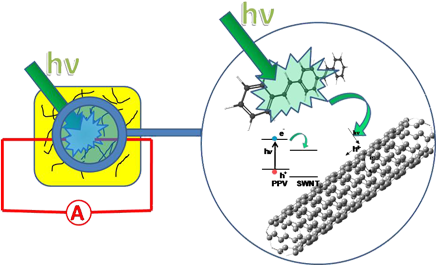
- are summarized in Figure 2. We indeed find strong interaction between the PPV and both nanotubes with binding energies of 1.21 eV and 0.94 eV for the (4,4) and (7,0) tubes respectively. Figure 2c–f show band structures for the tube segments with and without the PPV. The metallic (4,4) tube is almost


Transformation of hydrogen titanate nanoribbons to TiO2 nanoribbons and the influence of the transformation strategies on the photocatalytic performance
Beilstein J. Nanotechnol. 2015, 6, 831–844, doi:10.3762/bjnano.6.86
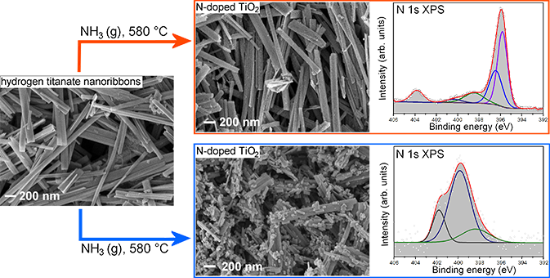
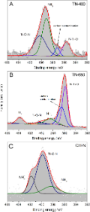
- respect to the N content, is hydrogen titanate. The effect of nitrogen substitutional doping should also be reflected in the position of the Ti 2p XPS peak. A small energy shift of the Ti 2p peak to lower binding energies is observed as the calcination temperature is increased (Figure S6, Supporting




Statistics of work and orthogonality catastrophe in discrete level systems: an application to fullerene molecules and ultra-cold trapped Fermi gases
Beilstein J. Nanotechnol. 2015, 6, 755–766, doi:10.3762/bjnano.6.78
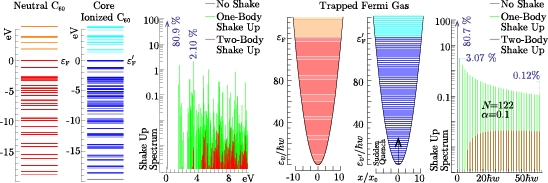
- particular, we consider the highest and lowest occupied MOs of the neutral molecule and some MOs of the ionized molecule to have similar binding energies relative to the perturbed Fermi level. The squared overlap between these states are listed in Table 1, while some of their orbital shapes are shown in

![[Graphic 22]](/bjnano/content/inline/2190-4286-6-78-i30.png?max-width=637&scale=1.18182) ) fullerene molecules, as com...
) fullerene molecules, as com...


Self-assembled anchor layers/polysaccharide coatings on titanium surfaces: a study of functionalization and stability
Beilstein J. Nanotechnol. 2015, 6, 617–631, doi:10.3762/bjnano.6.63
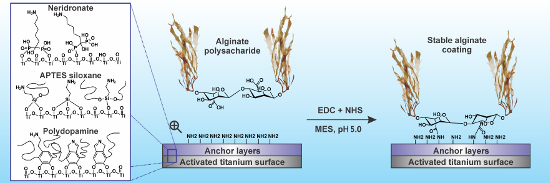
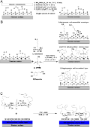
- template striping [43], our high resolution titanium 2p spectra in the region of 450–468 eV showed the characteristic Ti 2p spin-split doublet structure, with a separation of approximately 6 eV between the Ti 2p1/2 and Ti 2p3/2 peaks (Figure 1). The binding energies of the contributions within the Ti 2p3/2


Conformal SiO2 coating of sub-100 nm diameter channels of polycarbonate etched ion-track channels by atomic layer deposition
Beilstein J. Nanotechnol. 2015, 6, 472–479, doi:10.3762/bjnano.6.48
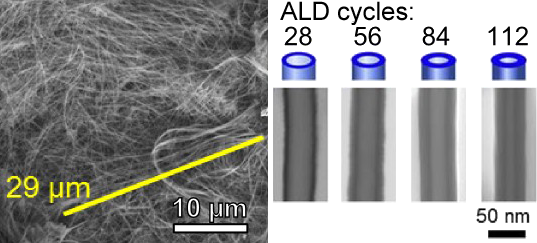
- observed, which may result from incorporated pyridinium chloride. Detailed analysis of the Si 2p peak at 103.3 eV reveals that silicon is exclusively present as Si4+ (see Table 2). This conclusion is based on a comparison with literature values for Si3+, Si2+, and Si1+ binding energies of 102.3, 101.3, and


Palladium nanoparticles anchored to anatase TiO2 for enhanced surface plasmon resonance-stimulated, visible-light-driven photocatalytic activity
Beilstein J. Nanotechnol. 2015, 6, 428–437, doi:10.3762/bjnano.6.43
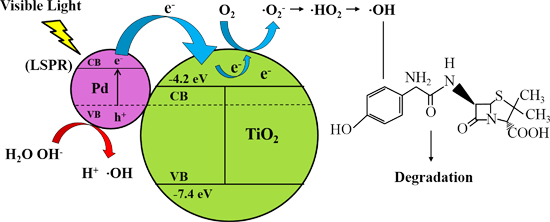
- employed. As shown in Figure 6a, there are two peaks observed at binding energies of 458.8 eV and 464.4 eV, which correspond to Ti 2p3/2 and Ti 2p1/2 spin–orbit-splitting photoelectrons for pure anatase TiO2 [29]. These indicate the presence of typical Ti4+ in the synthesized samples. The presence of Pd
- NPs can be distinguished by two peaks centered at binding energies of 334.3 eV and 340.0 eV, which are assigned to Pd 3d5/2, and Pd 3d3/2, respectively (Figure 6b) [48] and confirm the predominantly metallic form of the deposited noble metal. Optical absorption and photoluminescence The optical


X-ray photoelectron spectroscopy of graphitic carbon nanomaterials doped with heteroatoms
Beilstein J. Nanotechnol. 2015, 6, 177–192, doi:10.3762/bjnano.6.17
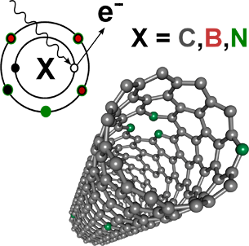
- , incorrect conclusions can easily be drawn, especially in the assignment of measured binding energies into specific atomic configurations. Starting from the characteristics of pristine materials, this review provides a practical guide for interpreting X-ray photoelectron spectra of doped graphitic carbon
- nanomaterials, and a reference for their binding energies that are vital for compositional analysis via XPS. Keywords: carbon nanotubes; core level photoemission; graphene; substitutional doping; X-ray photoelectron spectroscopy (XPS); Introduction Graphitic carbon nanomaterials consist of carbon bonded via
- significant influence of the substrate for measurements of graphene [35][36], and the disentanglement of the intrinsic photoemission responses of semiconducting and metallic single-walled carbon nanotubes (SWCNTs) [37]. Furthermore, as we shall see, identifying the binding energies associated with specific


Intake of silica nanoparticles by giant lipid vesicles: influence of particle size and thermodynamic membrane state
Beilstein J. Nanotechnol. 2014, 5, 2468–2478, doi:10.3762/bjnano.5.256

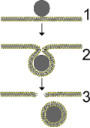
- ) after the incubation with nanoparticles (r = 42 nm, magenta). Obviously, vesicle membrane is consumed while particles are internalized. Expected van der Waals (solid line) and double layer (dashed line) binding energies as a function of the particle–membrane distance. The double layer interaction


Two-dimensional and tubular structures of misfit compounds: Structural and electronic properties
Beilstein J. Nanotechnol. 2014, 5, 2171–2178, doi:10.3762/bjnano.5.226

- can be seen as an extension of Ohno’s work [12][35], which was limited to the valence bands and has been discussed above. They showed that tin and lead are divalent in compounds of the structure (MX)1+yTMX2 due to the fact that the core-level binding energies of these elements do not differ in either


UHV deposition and characterization of a mononuclear iron(III) β-diketonate complex on Au(111)
Beilstein J. Nanotechnol. 2014, 5, 2139–2148, doi:10.3762/bjnano.5.223
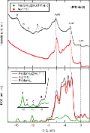
- between −2 and −7 eV is strongly dominated by the gold features while few molecular states are clearly visible only at higher binding energies, that is, at more negative values of E − EF (see inset in the bottom panel of Figure 2). These deeper molecular states can be easily associated to those observed
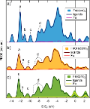
- larger discrepancies observed at higher binding energies. By plotting the projected density of states (PDOS) on the ligands and the iron ion (see Figure 3a), it is evident that dpm− ligands provide the main orbital contributions to the energy region where the molecular peaks (a, b, c, d) can be



The impact of the confinement of reactants on the metal distribution in bimetallic nanoparticles synthesized in reverse micelles
Beilstein J. Nanotechnol. 2014, 5, 1966–1979, doi:10.3762/bjnano.5.206
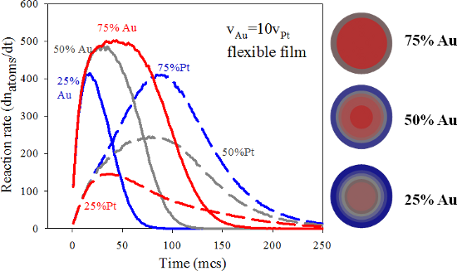
- atomic binding energy of A-A, B-B, and A-B species. These different binding energies (A-A, B-B, and A-B) dictate the minimum size that must be reached by atoms for nucleation depending on the composition. This phenomena is included in the simulation model by means of the inclusion of three critical


Cathode lens spectromicroscopy: methodology and applications
Beilstein J. Nanotechnol. 2014, 5, 1873–1886, doi:10.3762/bjnano.5.198

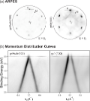
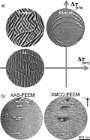
- of 0.42 ± 0.03 eV obtained on graphene/Ir(100) [50]. Our results are in fair agreement with μ-ARPES data for the graphene/Au/Ni(111) system [64]. On the Ni substrate, the Au intercalation leads to a non-rigid shift of the bands of graphene towards lower binding energies, the π-band moving by



Silicon and germanium nanocrystals: properties and characterization
Beilstein J. Nanotechnol. 2014, 5, 1787–1794, doi:10.3762/bjnano.5.189
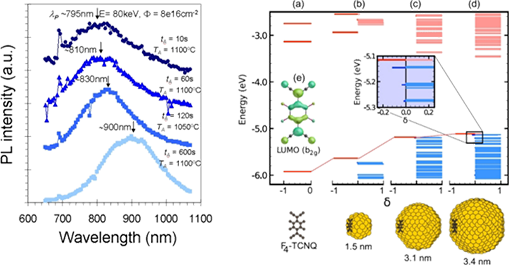
- NCs, in which surface conditions affect the electronic states, theory predicts that phosphorous and boron levels are rather deep with carrier binding energies of the order of 1 eV, anticipating serious difficulties in finding suitable dopants to operate at room temperature [21][58][59][60]. In this


Highly NO2 sensitive caesium doped graphene oxide conductometric sensors
Beilstein J. Nanotechnol. 2014, 5, 1073–1081, doi:10.3762/bjnano.5.120
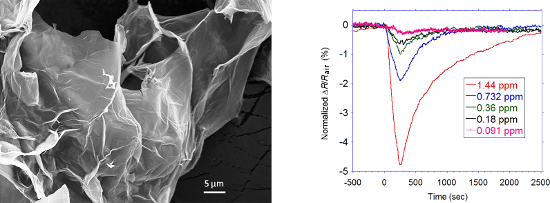
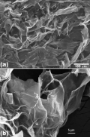
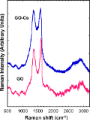
- peaks (Figure 3b and 3c), we identify the C–C contribution as the peak at 285.3 eV binding energy, while the C–O, C=O and COOH groups are assigned to binding energies of 287.5, 288.4 and 289.1 eV, respectively [62][63]. Figure 3b and 3c show that the intensity of the C–O band in the GO-Cs decreases




Gas sensing with gold-decorated vertically aligned carbon nanotubes
Beilstein J. Nanotechnol. 2014, 5, 910–918, doi:10.3762/bjnano.5.104
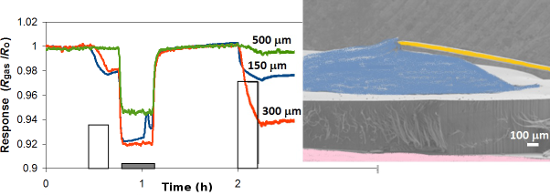
- a highly focused beam size set at 200 μm. The energy resolution was 0.7 eV. The binding energies were calibrated using the Au 4f peaks. Sensor preparation Parallel silver electrodes, with an electrode gap of 800 µm, were drop casted on top of the VA-CNTs samples. A commercial Ag paste (Heraeus AD
- area of 5%) at 286.4 eV is due to the presence of oxygen [29]. The low intensity of the components related to defects and the presence of oxygen indicates that the sp2 structure is preserved. Figure 7b presents the Au 4f core level spectrum used as a reference to align the binding energies. It can be


Biomolecule-assisted synthesis of carbon nitride and sulfur-doped carbon nitride heterojunction nanosheets: An efficient heterojunction photocatalyst for photoelectrochemical applications
Beilstein J. Nanotechnol. 2014, 5, 770–777, doi:10.3762/bjnano.5.89
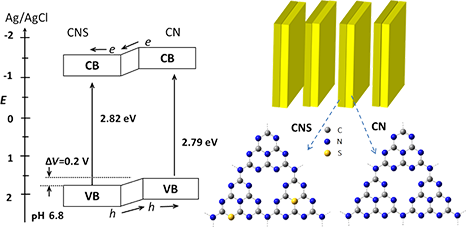
- diffraction (XRD) patterns were obtained on a Bruker D2 diffractometer (Bruker AXS, λ = 0.15418 nm). The chemical states and percentage of sulfur were measured by using X-ray photoelectron spectroscopy (XPS) on a VG Escalab 220i XL and the binding energies were calibrated by using the C 1s peak at 285.0 eV


Carbon dioxide hydrogenation to aromatic hydrocarbons by using an iron/iron oxide nanocatalyst
Beilstein J. Nanotechnol. 2014, 5, 760–769, doi:10.3762/bjnano.5.88
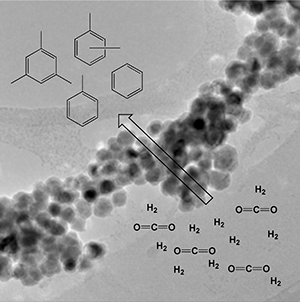
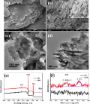
- carried out under vacuum (p < 5·10−9 Torr) and heated to 120 °C to remove any adsorbed molecules on the surface. The XPS binding energies were measured with a precision of 0.025 eV. The analyzer pass energy was set to 17.9 eV, the contact time was 50 ms, and the area scanned was 4 mm2. Conclusion We have


Resonance of graphene nanoribbons doped with nitrogen and boron: a molecular dynamics study
Beilstein J. Nanotechnol. 2014, 5, 717–725, doi:10.3762/bjnano.5.84
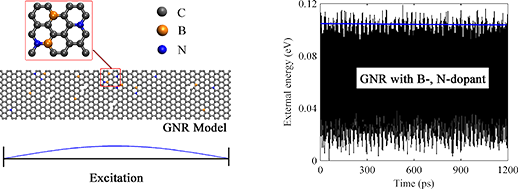
- empirical bond order (REBO) potential [24] was employed, which gives a good representation for the binding energies and elastic properties of carbon nanotubes and graphene [25]. In general, the REBO potential is given as where, EREBO represents the short-distance C–C interaction, ELJ depicts a longer


CoPc and CoPcF16 on gold: Site-specific charge-transfer processes
Beilstein J. Nanotechnol. 2014, 5, 524–531, doi:10.3762/bjnano.5.61
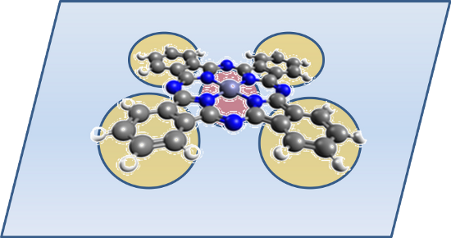
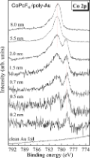
- , more bulk-like films. In addition, the shape of the spectrum changes for coverage in the monolayer range. In general, the shape of the Co 2p spectrum is determined by satellite features at higher binding energies arising from multiplet splitting due to the interaction of unpaired electrons in the
- the first few organic layers and can be understood by polarization screening [26]. Thus, a small shift (0.3–0.4 eV) toward lower binding energies might be expected for all core levels at the interface compared to the bulk value. The question therefore arises why an energetic shift of F 1s to lower
- binding energies at the interface to Au is hardly observable. Bidirectional charge transfer In order to understand the polarization and charge-transfer processes for the CoPcF16 macrocycle at the interface to poly-Au in more detail, we analyzed the energetic shifts of all core level lines of F 1s, N 1s


One-step synthesis of high quality kesterite Cu2ZnSnS4 nanocrystals – a hydrothermal approach
Beilstein J. Nanotechnol. 2014, 5, 438–446, doi:10.3762/bjnano.5.51
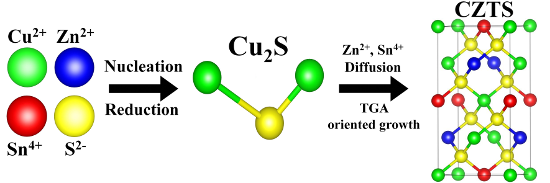
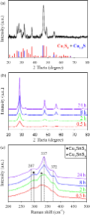
- ). The peaks of Sn 3d show binding energies at 486.35 and at 494.77 eV respectively, which is in good agreement with the value of Sn(IV). The S 2p peaks are located at 161.76 and 162.92 eV, which are consistent with the binding energy of sulfur in sulfide state of CZTS. These results are in agreement




Interaction of iron phthalocyanine with the graphene/Ni(111) system
Beilstein J. Nanotechnol. 2014, 5, 308–312, doi:10.3762/bjnano.5.34
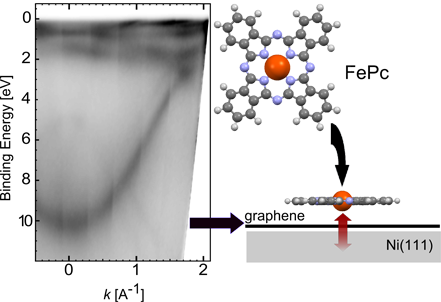
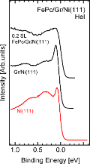
- very close to the Fermi level. Furthermore, the Gr-π band is shifted by 2.5 eV towards higher binding energies as compared to Gr/Ir, and no linear dispersion is observed at the K point, which is in agreement with previous results [11]. Carbon atoms adsorb on two different sites on Ni(111), on top of Ni


3D-nanoarchitectured Pd/Ni catalysts prepared by atomic layer deposition for the electrooxidation of formic acid
Beilstein J. Nanotechnol. 2014, 5, 162–172, doi:10.3762/bjnano.5.16
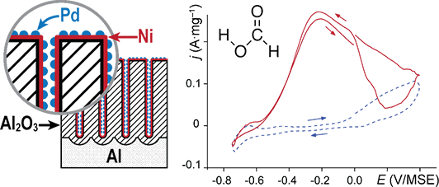
- transferring it to the XPS chamber. Note that a contribution coming from SiO2 in the XPS spectrum in the O 1s binding energies region is possible since an interfacial SiO2 layer is formed between Si and NiO (Figure S2, Supporting Information File 1). However, the contribution of Si in the survey spectrum is


Core level binding energies of functionalized and defective graphene
Beilstein J. Nanotechnol. 2014, 5, 121–132, doi:10.3762/bjnano.5.12
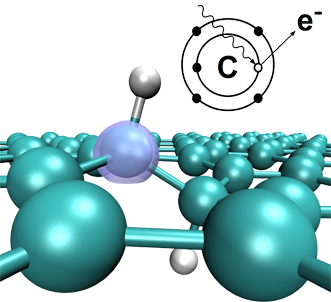
- calculated core level binding energies for variously functionalized or defected graphene by delta Kohn–Sham total energy differences in the real-space grid-based projector-augmented wave density functional theory code (GPAW). To accurately model extended systems, we applied periodic boundary conditions in
- large unit cells to avoid computational artifacts. In select cases, we compared the results to all-electron calculations using an ab initio molecular simulations (FHI-aims) code. We calculated the carbon and oxygen 1s core level binding energies for oxygen and hydrogen functionalities such as graphane
- . However, for low-dimensional carbon nanomaterials such as graphene or carbon nanotubes, the escape depth exceeds the size of the system, and this makes XPS in practice a convenient bulk characterization tool. In order to interpret the binding energies measured by XPS, a reference to which such energies


Study of mesoporous CdS-quantum-dot-sensitized TiO2 films by using X-ray photoelectron spectroscopy and AFM
Beilstein J. Nanotechnol. 2014, 5, 68–76, doi:10.3762/bjnano.5.6
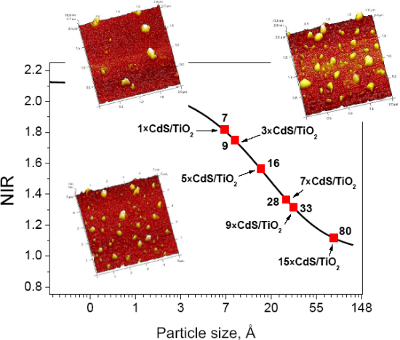
- to oxidized forms of carbons, which are usually detected (286.2 eV (C–O); 287.8 eV (C=O, O–C–O) and 288.6 eV (COO) [18]. The Cd 3d5/2 and Cd 3d3/2 were found at 411.3 and 404.6 eV respectively for QDs−CdS/TiO2 and were attributed to Cd2+ in CdS [19]. The difference between the binding energies of Cd