Search results
Search for "confinement" in Full Text gives 261 result(s) in Beilstein Journal of Nanotechnology. Showing first 200.
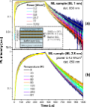
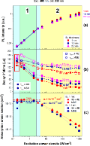
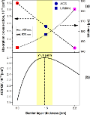
Changes of the absorption cross section of Si nanocrystals with temperature and distance
Beilstein J. Nanotechnol. 2017, 8, 2315–2323, doi:10.3762/bjnano.8.231
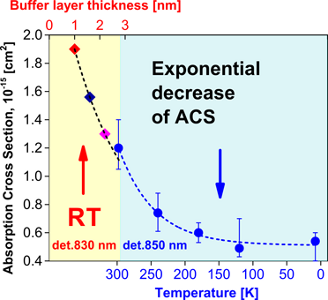
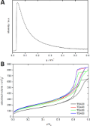
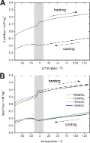
- silicon, which reveals all advantages of the quantum confinement effect [1], is a promising candidate for the development of a new generation of Si photovoltaic and photonic devices [2]. SiO2-embedded silicon nanocrystals (Si NCs) can be relatively easy integrated into current CMOS technology. In


Ta2N3 nanocrystals grown in Al2O3 thin layers
Beilstein J. Nanotechnol. 2017, 8, 2162–2170, doi:10.3762/bjnano.8.215
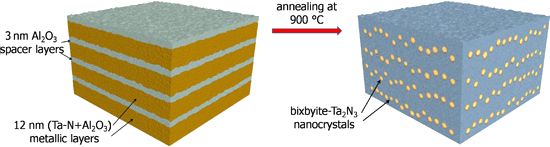
- . However, the confinement of Ta and Al2O3 to the initially deposited metallic and spacer layers are much less pronounced. In other words, some of the Ta atoms diffuse to the alumina spacer layers, while a part of the alumina diffuses to the metallic layers. Importantly, the TaN− profile of the ML12m9


Substrate and Mg doping effects in GaAs nanowires
Beilstein J. Nanotechnol. 2017, 8, 2126–2138, doi:10.3762/bjnano.8.212
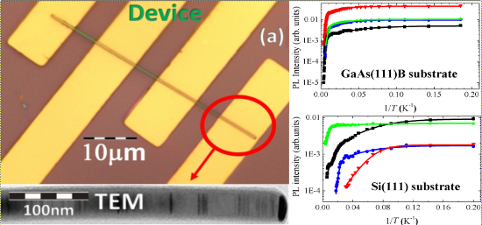
- -excitation channels of the same type found for lower Mg doping. Nevertheless, the activation energies in this work are clearly higher. This result suggests: i) a decrease of the possible confinement of charge carriers in the radiative states; ii) a non-significant change of the overall density of non
- confinement. The XRD results suggest a small increase of the WZ fraction in these nanowires but cannot clarify this question. We must note that PL is a technique that inspects a large quantity of nanowires simultaneously and the discussion of its results with the ones from local analyses like the ones
- polytypism involving single-phase segments with quite different thicknesses creates different levels of quantum confinement which is reflected in a spread of localization energies of charge carriers in the wells, thus affecting the photon energies of the radiative transitions. Thirdly, no experimental


Optical techniques for cervical neoplasia detection
Beilstein J. Nanotechnol. 2017, 8, 1844–1862, doi:10.3762/bjnano.8.186
- fluorophores for cellular imaging [57][83][85][90][91][92][93]. The unique optical properties of semiconductor quantum dots including quantum confinement effect, wide absorption spectrum (i.e., broad excitation band), and narrow emission spectrum (i.e., tunable fluorescence emission via QD bandgap engineering



Micro- and nano-surface structures based on vapor-deposited polymers
Beilstein J. Nanotechnol. 2017, 8, 1366–1374, doi:10.3762/bjnano.8.138
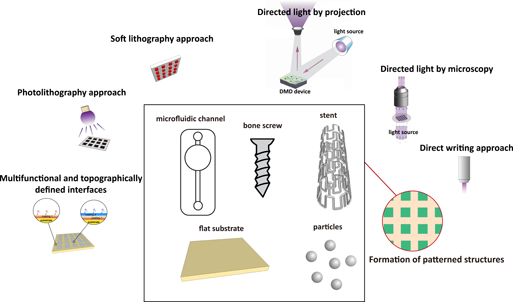
- ) (PDMS), and poly(tetrafluoroethylene) (PTFE) [24]. Microcontact printing (μCP) is a commonly exploited technique that uses a PDMS elastomer to stamp patterns of reactive substances on mostly flat surfaces [17]. It is also widely adopted for the confinement of pattern formation on vapor-deposited coating
- confinement of these chemical conducts in relevant locations of interest. The vapor deposition process and the resulting thin polymer films provide consistent coatings, which decouple the underlying substrate surface properties and can be applied for surface modification on most of the substrate geometry and


3D continuum phonon model for group-IV 2D materials
Beilstein J. Nanotechnol. 2017, 8, 1345–1356, doi:10.3762/bjnano.8.136
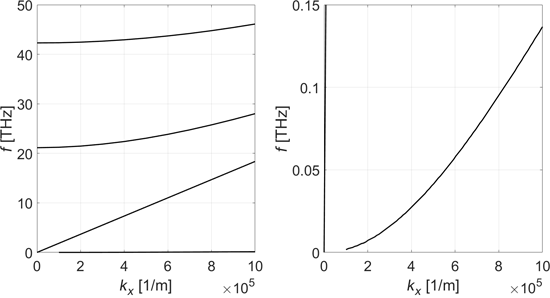
- displacement. Confinement of the optical phonon modes implies . Assuming [type I] where are constants, the Maxwell–Poisson equation and the boundary conditions are fulfilled if εzz(ω) = 0. Hence confined optical phonons exist in graphene. Application: silicene We refer to silicene as the canonical example of


![[Graphic 19]](/bjnano/content/inline/2190-4286-8-136-i109.png?max-width=637&scale=1.18182) phonon modes of single-layer MoS2. The right plot is a ...
phonon modes of single-layer MoS2. The right plot is a ...
Near-field surface plasmon field enhancement induced by rippled surfaces
Beilstein J. Nanotechnol. 2017, 8, 956–967, doi:10.3762/bjnano.8.97
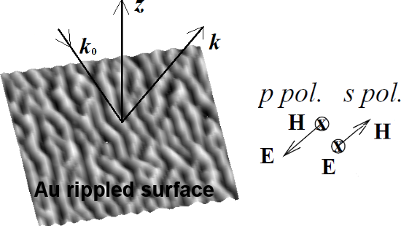
- role, in particular whenever the nanostructure morphology shows anisotropy at the local scale. Polarization can induce strong confinement of plasmons in the resonance region in close correlation with the local surface morphology, characterized by a pattern of hills and valleys. As a consequence, an


Bio-inspired micro-to-nanoporous polymers with tunable stiffness
Beilstein J. Nanotechnol. 2017, 8, 906–914, doi:10.3762/bjnano.8.92
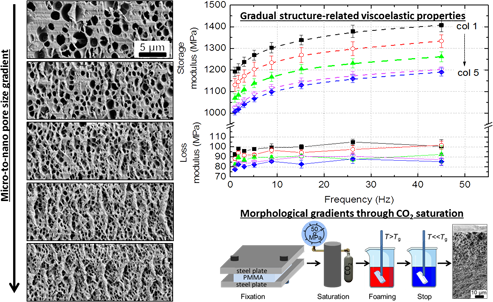
- properties of a material with a pore-size gradient, have not been demonstrated yet. For nanocellular polymers, for example, two opposite effects were predicted: (i) local hardening of the material due to material confinement on nanometre dimensions [21] and (ii) a great reduction of elastic modulus of thin
- to 254 nm for pore area fractions of 35% and 17%, respectively. A decreasing pore-wall thickness may stimulate the confinement of the polymer chains within the pore walls and lead to a reduced mobility of the macromolecules, as it was described for PMMA-based low-density nanoporous materials with
- mean pore size of 200 nm [29]. However, the pores in our sample are well above this size. Therefore, we do not expect to observe such a confinement effect. Although the cell size in cellular materials fit to a log-normal [28][30][31][32] or gamma [32] distribution, the arithmetical mean μ and the


Investigation of growth dynamics of carbon nanotubes
Beilstein J. Nanotechnol. 2017, 8, 826–856, doi:10.3762/bjnano.8.85
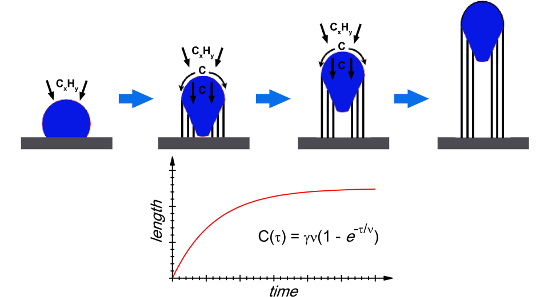
- . Without a templating outer nanotube, fluctuations in growth conditions result in a finite lifetime of the catalyst. And growth stops once the particle is deactivated by a passivating layer of carbon. However, inside the atomically tight tubular confinement provided the outer nanotube, the formation of a


First examples of organosilica-based ionogels: synthesis and electrochemical behavior
Beilstein J. Nanotechnol. 2017, 8, 736–751, doi:10.3762/bjnano.8.77
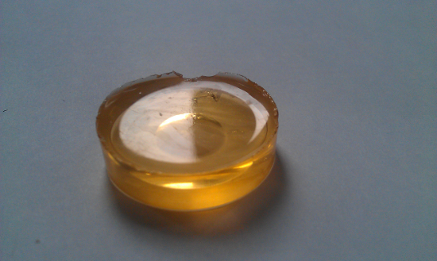
- close to the conductivity of the pristine IL indicating that the confinement of the IL into a matrix does not significantly affect the conductivity [11][16][17]. Again using the same IL, Martinelli and coworkers have provided a set of interesting studies on how the ion flexibility and dynamics affect
- where the IL confinement leads to an intermediate state between liquid and solid (conductivity vs mechanical strength, respectively), since σ298 K = 3.15 × 10⁻³ S·cm−1 and σ343 K = 1.12 × 10⁻² S·cm−1 for one of the best polymer nanocomposite ionogel composed of modified PMMA bearing trimethoxysilane
- what has been reported so far [23][24]. These data therefore show that all organosilica monoliths yield stable monolithic IGs with high IL loading. DSC data (Figure 11) and EIS analysis (Figure 12-14) show that (i) the confinement of the IL in the matrix does not affect its physical properties and (ii








Fiber optic sensors based on hybrid phenyl-silica xerogel films to detect n-hexane: determination of the isosteric enthalpy of adsorption
Beilstein J. Nanotechnol. 2017, 8, 475–484, doi:10.3762/bjnano.8.51
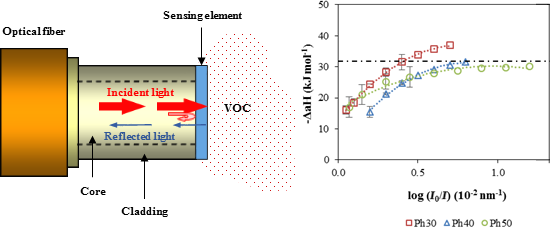
- confinement effects related to the condensation of adsorbates in narrower mesopores [27][28]. The solid–fluid interaction increases as the pore size diminishes and, therefore, the adsorption enthalpy in the phase transition region [26]. Conclusion We investigated the response, in the presence of n-hexane, of






Flexible photonic crystal membranes with nanoparticle high refractive index layers
Beilstein J. Nanotechnol. 2017, 8, 203–209, doi:10.3762/bjnano.8.22
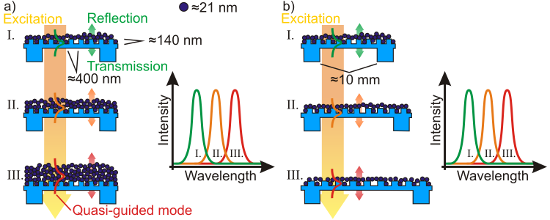
- . As seen from Equation 2 these two changes have opposite effects on the resonance wavelength λ. Additional, the effective refractive index for modes of higher wavelength reduces due to the smaller confinement factor in the waveguide layer. Figure 3 plots the experimentally observed resonance shifts


Tunable plasmons in regular planar arrays of graphene nanoribbons with armchair and zigzag-shaped edges
Beilstein J. Nanotechnol. 2017, 8, 172–182, doi:10.3762/bjnano.8.18
- platform for controlling the propagation of surface-plasmon waves [15], because of its unique electronic and optical properties [16]. In particular, the extrinsic plasmons of this one-atom-thick hexagonal lattice of sp-bonded carbon atoms have shown much stronger confinement, larger tunablity and lower
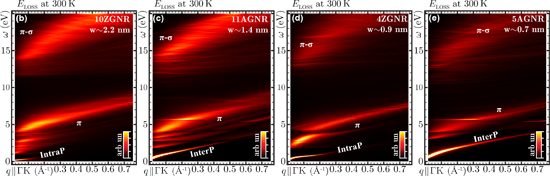
- evidently absent in graphene. Quantum confinement and chirality are key factors for plasmon resonances at frequencies smaller than 2 eV. We see that zigzag systems exhibit an intraband plasmon, while armchair systems present an interband plasmon. These two modes correspond to the surface and edge plasmons


![[Graphic 8]](/bjnano/content/inline/2190-4286-8-18-i16.png?max-width=637&scale=1.18182) , Equation 6) and EL function (ELOSS, Equation 8) at room temperature for the GNR arrays of Figure 1 ...
, Equation 6) and EL function (ELOSS, Equation 8) at room temperature for the GNR arrays of Figure 1 ...

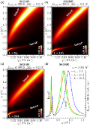
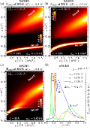
Effect of Anderson localization on light emission from gold nanoparticle aggregates
Beilstein J. Nanotechnol. 2016, 7, 2013–2022, doi:10.3762/bjnano.7.192
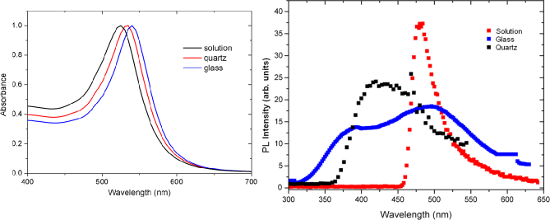
- , respectively. The photon localization phenomena have been used intensively in optical antennas [9]. The understanding of the behavior of optical confinement would help the growing areas of photodetection [10], light emission [11], sensing [12] and spectroscopy [1]. Another crucial property of metals is the
- -similar pattern allowed nanofocusing and high field enhancement to be achieved in the subwavelength regime. The principle of confinement of optical pulses in metal nanoparticles arises from the existence of plasmons in metals, consisting of collective oscillations of an electron gas. In this work, we
- symmetric plasmon has a larger dipole moment and couples easily with light giving rise to plasmon absorption [20]. This can be seen in the PL emission from the AuNPs, since field enhancement due to confinement is possible by controlling the gaps and distances between the nanoparticles to create hot spots


Zigzag phosphorene nanoribbons: one-dimensional resonant channels in two-dimensional atomic crystals
Beilstein J. Nanotechnol. 2016, 7, 1983–1990, doi:10.3762/bjnano.7.189

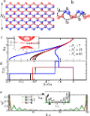
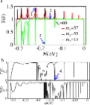
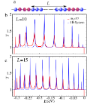
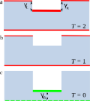
- Paulo, SP, Brazil 10.3762/bjnano.7.189 Abstract We theoretically investigate phosphorene zigzag nanoribbons as a platform for constriction engineering. In the presence of a constriction at one of the edges, quantum confinement of edge-protected states reveals conductance peaks, if the edge is uncoupled
- different character than the resonances in the central band we will be focusing on. These transmission plateaus are due to the lateral confinement in a nanoribbon. This is confirmed by the green curve for mZ = 15, a deep step leading to a large shifting of the valence and conduction bands transmission
- would become rather involved with the presence of defect-induced barriers. However, scanning probe microscopy remains a way to reveal the edge quantum confinement. Conclusion So far, we have ignored the effect of Coulomb interactions. It is well known that the interplay of Coulomb blockade and quantum



Cubic chemically ordered FeRh and FeCo nanomagnets prepared by mass-selected low-energy cluster-beam deposition: a comparative study
Beilstein J. Nanotechnol. 2016, 7, 1850–1860, doi:10.3762/bjnano.7.177
- , Université H. Poincarré-CNRS, F-5406 Vandoeuvre les Nancy, France Interfaces, Confinement, Matériaux et Nanostructures, UMR7374 Université d'Orléans-CNRS, F-45071 Orléans cedex, France Université Grenoble Alpes, Inst NEEL, F-38000 Grenoble, France CNRS, Inst NEEL, F-38000 Grenoble, France 10.3762/bjnano


Precise in situ etch depth control of multilayered III−V semiconductor samples with reflectance anisotropy spectroscopy (RAS) equipment
Beilstein J. Nanotechnol. 2016, 7, 1783–1793, doi:10.3762/bjnano.7.171
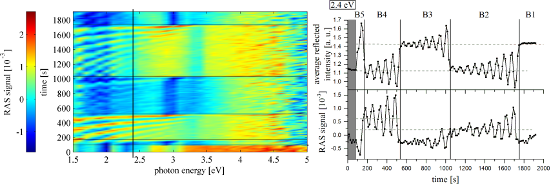
- mask of photoresist has been used to define the stripes (laser ridges). Adjacent to each of the ridges the upper cladding, the active region, and the lower cladding are removed by dry-etching to achieve strong optical confinement (compare [35]). In a second lithographic process (process II, see Figure


Fingerprints of a size-dependent crossover in the dimensionality of electronic conduction in Au-seeded Ge nanowires
Beilstein J. Nanotechnol. 2016, 7, 1574–1578, doi:10.3762/bjnano.7.151
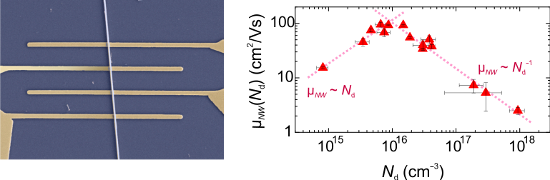
- have quasi one-dimensional character as reflected by the extracted screening lengths. Keywords: electrical transport; germanium nanowires; quasi-1D confinement; screening length; VLS growth; Results and Discussion Synthetic germanium nanowires (Ge NWs) have been proposed as potential next-generation


![[Graphic 7]](/bjnano/content/inline/2190-4286-7-151-i9.png?max-width=637&scale=1.18182) and 1D screening length λ(1D) as function of carr...
and 1D screening length λ(1D) as function of carr...
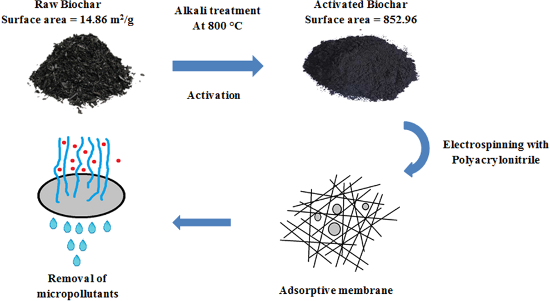
Development of adsorptive membranes by confinement of activated biochar into electrospun nanofibers
Beilstein J. Nanotechnol. 2016, 7, 1556–1563, doi:10.3762/bjnano.7.149




Dynamic of cold-atom tips in anharmonic potentials
Beilstein J. Nanotechnol. 2016, 7, 1543–1555, doi:10.3762/bjnano.7.148
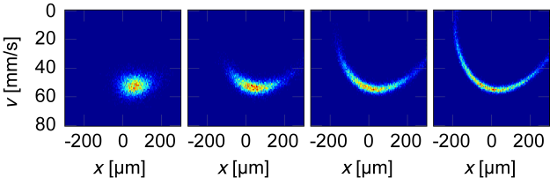
- are identical as before, while the anharmonic trap has been extended in the transversal direction by a harmonic confinement with frequency ωy/z = 2π × 500 Hz. For comparison, Figure 3 includes the result for noninteracting particles, showing a reduced damping. Following Equation 12, the damping time
- holder. With counter-propagating currents, they produce a linear quadrupole field above the chip surface with atomic confinement in radial (x,y)-direction. Trapping in z-direction is achieved by superpositioning an inhomogeneous field along z. It is produced by a set of chip wires (transport wires
- explicitly using an infinite long wire approximation. The axial confinement is approximated via a harmonic potential along z. Homogeneous fields in y and z-direction are taken into account. Using this model function, the full trap anharmonicity in the x,y-direction is reproduced. For the numerical




Nanostructured germanium deposited on heated substrates with enhanced photoelectric properties
Beilstein J. Nanotechnol. 2016, 7, 1492–1500, doi:10.3762/bjnano.7.142
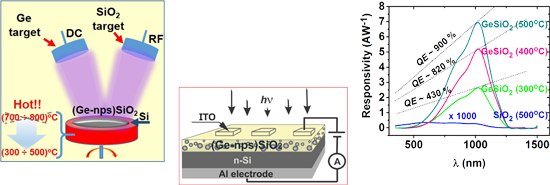
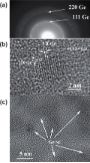
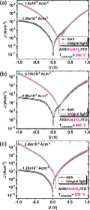
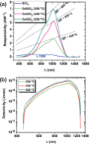
- ; Introduction In the recent years, much attention was directed to study quantum confinement in nanostructures. Through the influence of quantum confinement on the electrical and optical properties new paths to improving and develop functional devices in nanoscale electronics and optoelectronics can be opened
- to the indirect bandgap issue of Ge-based materials are partially overcome, but the difficulty of controlling size and shape of the nanoparticles still remains. New approaches for fine-tuning the size and shape of nanoparticles would facilitate the understanding of their quantum confinement behavior




Diameter-driven crossover in resistive behaviour of heavily doped self-seeded germanium nanowires
Beilstein J. Nanotechnol. 2016, 7, 1284–1288, doi:10.3762/bjnano.7.119
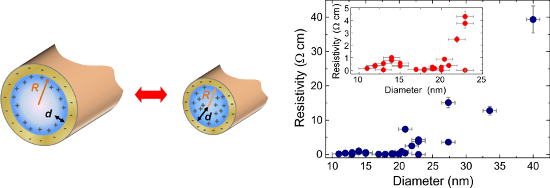
- ][5][6][7][8][9]. Germanium nanowires (Ge NWs) are of particular interest as they provide the prospect for quantum-related phenomena associated with one-dimensional (1D) confinement already at diameters of tens of nm [10], or determining their electronic properties by surface doping [11]. Among
- coordinates [20][21] and for simplicity assuming a constant free-hole concentration nh. One finds the expression [22] where Φ0 is the electrostatic potential at the core/shell interface, ε0 is the vacuum permittivity, εr the dielectric constant of germanium, and e the elementary charge. The confinement of
- average sub-band bottom spacing compares to the thermal energy at room temperature (Supporting Information File 1) suggesting that a description within the 1D Kubo–Greenwood framework is valid [24]. These findings also demonstrate that indeed at diameters ≤ 20 nm the confinement is not negligible and

Mesoporous hollow carbon spheres for lithium–sulfur batteries: distribution of sulfur and electrochemical performance
Beilstein J. Nanotechnol. 2016, 7, 1229–1240, doi:10.3762/bjnano.7.114
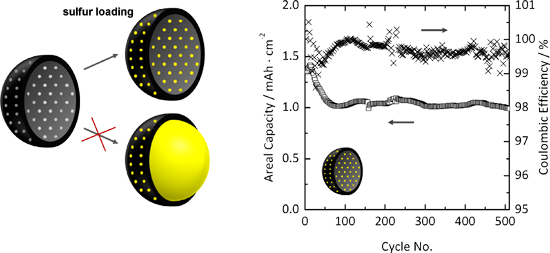
- the use in lithium–sulfur batteries because of the large internal void offering space for sulfur and polysulfide storage and confinement. However, there is an ongoing discussion whether the cavity is accessible for sulfur. Yet no valid proof of cavity filling has been presented, mostly due to
- lack of Raman bands might also be due to confinement effects. Thus, the appearance of bands at high sulfur loadings could also be explained either by sulfur filling the cavities of HCS or by sulfur accumulating on the outside of the spheres. SEM and EDX SEM images of HCS-58-vac and HCS-67-vac (Figure
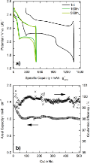
- wt % sulfur and with reasonably high sulfur loading of 2.0 mg·cm−2 showed stable electrochemical performance over 500 cycles. It seems possible that the empty cavity has a positive effect on polysulfide confinement. In summary, the HCS employed in this work are a promising system capable of storing


A terahertz-vibration to terahertz-radiation converter based on gold nanoobjects: a feasibility study
Beilstein J. Nanotechnol. 2016, 7, 983–989, doi:10.3762/bjnano.7.90
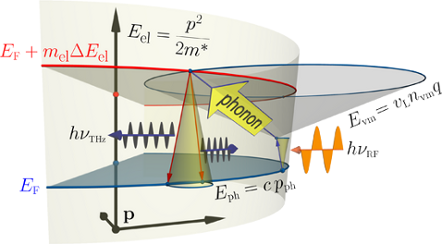
- at large angle γ to the momentum of the phonon. The absorption condition for the microwave-range photon is the following: where mel is the number of electron energy “gaps” (quantization steps between confinement-induced discrete energy levels in the nanoobject), and nvm is a number of vibrational
- form: where L is the confinement length delimiting the propagation of compression waves (i.e., the maximal dimension of a GNB or the median circumference of a GNR, correspondingly), and the sound velocity vL relates frequency to wave vector. Further on, assuming that the density in a GNB equals that
- , and the confinement-imposed energy quantization would likely prevent the necessary energy match of their respective nvmΔEvm values. Putting it differently, the major peaks in the densities of modes of transversal and longitudinal phonons in gold (and particularly in gold nanoparticles) are well



The role of morphology and coupling of gold nanoparticles in optical breakdown during picosecond pulse exposures
Beilstein J. Nanotechnol. 2016, 7, 869–880, doi:10.3762/bjnano.7.79
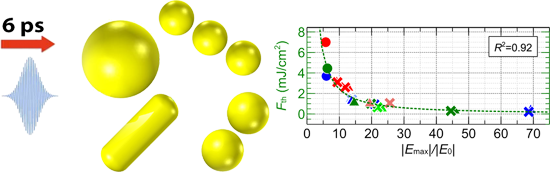
- confinement corrections to the bulk optical properties of gold [3], (ii) a hyperbolic two-temperature model for the thermodynamic evolution of the electron and lattice temperatures of the gold nanoparticle [47], (iii) a rate equation of free-electron plasma generation in an aqueous environment based on the