Search results
Search for "mechanics" in Full Text gives 176 result(s) in Beilstein Journal of Nanotechnology.
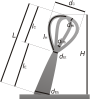
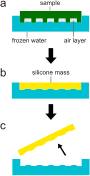
Measuring air layer volumes retained by submerged floating-ferns Salvinia and biomimetic superhydrophobic surfaces
Beilstein J. Nanotechnol. 2014, 5, 812–821, doi:10.3762/bjnano.5.93
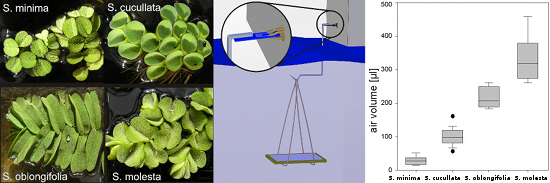
- 'Biodiversity in change' of the Academy of Sciences and Literature in Mainz. The authors thank the Botanical Gardens of the University Bonn for the cultivation and kind provision of the Salvinia plants. We acknowledge our partners, the working group of Professor Alfred Leder (Chair of Fluid Mechanics - LSM) at


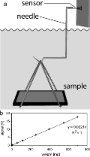
The softening of human bladder cancer cells happens at an early stage of the malignancy process
Beilstein J. Nanotechnol. 2014, 5, 447–457, doi:10.3762/bjnano.5.52
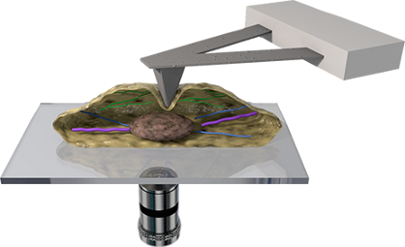
- cell and the extracellular matrix, and the presence or development of progressive diseases. However, the specific role of the mechanical properties of the cells and the extracellular matrix in pathogenesis such as tumor progression remain poorly understood at best. The relationship between mechanics at
- the cellular level and tumorigenesis represents a new perspective for which many issues need to be addressed. The studies of cell mechanics have gained great importance with the advent of AFM measurements, which demonstrated the capability to probe single cells and underlining a correlation between
- cell mechanics, in particular elasticity, and cancer [5][6]. The first measurements showed that cancerous human bladder cells were softer than non-malignant bladder cells. Further measurements of cancerous cells have confirmed that a lowering of the elastic modulus of the cells is a general feature of


Single-asperity contact mechanics with positive and negative work of adhesion: Influence of finite-range interactions and a continuum description for the squeeze-out of wetting fluids
Beilstein J. Nanotechnol. 2014, 5, 419–437, doi:10.3762/bjnano.5.50
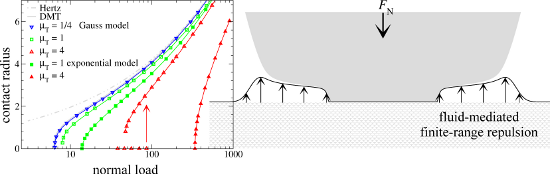
- Martin H. Muser Jülich Supercomputing Centre, FZ Jülich, 52428 Jülich, Germany 10.3762/bjnano.5.50 Abstract In this work, single-asperity contact mechanics is investigated for positive and negative work of adhesion Δγ. In the latter case, finite-range repulsion acts in addition to hard-wall
- of the finite-range attraction. The results can benefit the interpretation of atomic force microscopy in liquid environments and the modeling of multi-asperity contacts. Keywords: cohesive zone model; contact mechanics; environmental; fluid squeeze-out; nanomechanics; single-asperity contacts
- ; Introduction The continuum description of single-asperity contact mechanics has received much attention in the last few decades. This is in large parts because it describes force-displacement curves rather accurately down to nanometer scales relevant to atomic force microscopy (AFM) [1][2][3]. The


Tensile properties of a boron/nitrogen-doped carbon nanotube–graphene hybrid structure
Beilstein J. Nanotechnol. 2014, 5, 329–336, doi:10.3762/bjnano.5.37
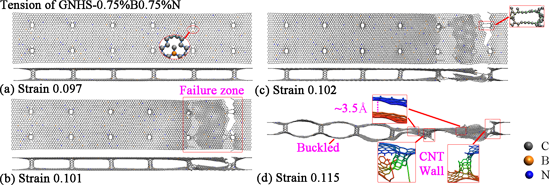
- in the fields of mechanics, photology, electronics and bio-sensing [1][2]. Through the chemical vapor deposition (CVD) method, a graphene–nanotube hybrid structure (GNHS) has been synthesized recently [3][4][5], which evidently demonstrates an improved performance for the application as field


Modeling and optimization of atomic layer deposition processes on vertically aligned carbon nanotubes
Beilstein J. Nanotechnol. 2014, 5, 234–244, doi:10.3762/bjnano.5.25
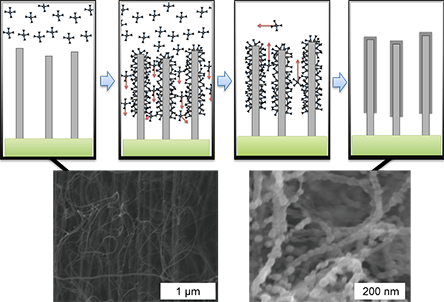
- Electrical Engineering, ETH Zürich, Zürich CH-8092, Switzerland Laboratory for Mechanics of Materials and Nanostructures, EMPA, Thun CH-3602, Switzerland 10.3762/bjnano.5.25 Abstract Many energy conversion and storage devices exploit structured ceramics with large interfacial surface areas. Vertically



The role of surface corrugation and tip oscillation in single-molecule manipulation with a non-contact atomic force microscope
Beilstein J. Nanotechnol. 2014, 5, 202–209, doi:10.3762/bjnano.5.22
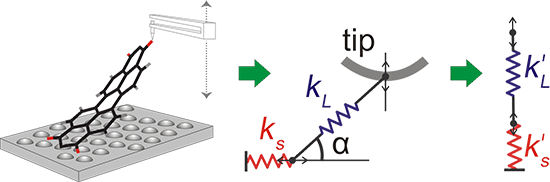
- experiment, and facilitates a better understanding of the mechanics of single-molecular junctions. Our simulations reveal that the surface corrugation adds a positive frequency shift to the measurement that generates an apparent repulsive force. Furthermore, we demonstrate that the scatter observed in the
- manipulation by including the three factors mentioned above into the simulation model and by demonstrating that even their qualitative consideration improves the correspondence between simulations and experiment, and therefore facilitates an improved understanding of the mechanics of single-molecular junctions
- the sliding of the molecule across the corrugated surface potential. On the methodological side, the important message of this work is to demonstrate that the force-field modeling of single-molecule manipulation can be successful in explaining precise details of the NC-AFM junction mechanics. However

Manipulation of nanoparticles of different shapes inside a scanning electron microscope
Beilstein J. Nanotechnol. 2014, 5, 133–140, doi:10.3762/bjnano.5.13
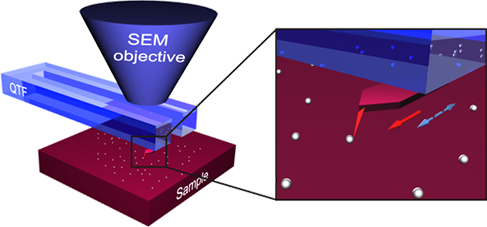
- and compared with the experimentally measured force. The effect of NP morphology on the nanoscale friction is discussed. Keywords: contact mechanics; nanomanipulation; nanoparticles; nanotribology; scanning electron microscopy (SEM); Introduction The manipulation of nanoparticles (NPs) is a powerful
- of the contact: where Θ is the contact angle for Ag/SiO2 interface. As described previously [20], for sphere-like NPs contact mechanics (adhesive contact approach) must be applied. The contact area is typically calculated on the basis of continuum elasticity models for deformable spheres such as the


Energy transfer in complexes of water-soluble quantum dots and chlorin e6 molecules in different environments
Beilstein J. Nanotechnol. 2013, 4, 895–902, doi:10.3762/bjnano.4.101
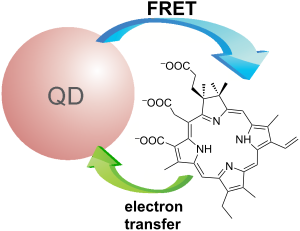
- Irina V. Martynenko Anna O. Orlova Vladimir G. Maslov Alexander V. Baranov Anatoly V. Fedorov Mikhail Artemyev Saint Petersburg National Research University of Information Technologies, Mechanics and Optics, Saint Petersburg, Russia Institute for Physico-Chemical Problems, Belarussian State


Peak forces and lateral resolution in amplitude modulation force microscopy in liquid
Beilstein J. Nanotechnol. 2013, 4, 852–859, doi:10.3762/bjnano.4.96
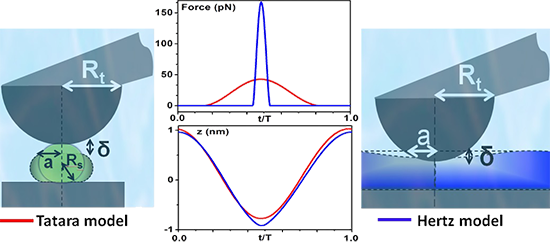
- tip motion in liquid. The forces are obtained by using two contact mechanics models, Hertz and Tatara. We present a comparison between the numerical simulations and three analytical models for a wide variety of probe and operational parameters. In general, the forces derived from analytical
- expressions are not in good quantitative agreement with the simulations when the Young modulus and the set-point amplitude are varied. The only exception is the parametrized approximation that matches the results given by Hertz contact mechanics for soft materials and small free amplitudes. We also study the
- mechanics and thus their application range is somehow limited. Numerical simulations have supported the development of AM-AFM by predicting several properties of the tip motion [25][26][27]. Those simulations provide the standards against which new experimental or analytical methods should be compared [28


Dynamic nanoindentation by instrumented nanoindentation and force microscopy: a comparative review
Beilstein J. Nanotechnol. 2013, 4, 815–833, doi:10.3762/bjnano.4.93
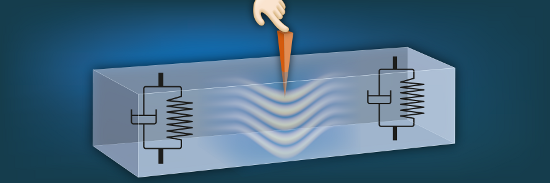
- important phenomenon that drives material response at different scales of time and space. Burgeoning interest in nanoscale dynamic material mechanics has driven, and been driven by two key techniques: instrumented nanoindentation and atomic force microscopy. This review provides an overview of fundamental
- controlling mechanics at the nanometer level is the key to a wide range of cutting-edge topics in science and technology, which range from engineered devices to biological organisms and include novel materials. A number of impressive technologies have been employed in such studies that include, but are not
- the overall force behavior at the nanoscale. Several groups considered the effects of adhesion under various contact mechanics models in the 1970s [9][10][11][12][13]. These models analyze the changing contact shapes and stresses that occur when the surface energy and the adhesive forces in the




Size-dependent characteristics of electrostatically actuated fluid-conveying carbon nanotubes based on modified couple stress theory
Beilstein J. Nanotechnol. 2013, 4, 771–780, doi:10.3762/bjnano.4.88
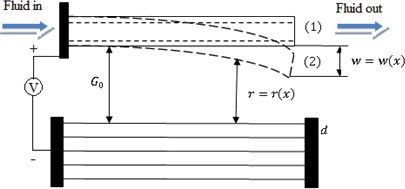
- with an initial gap G0 (state 1 in Figure 1). Continuum mechanics are applied in order to analyze the nanosystem. A voltage V is applied between the CNT as the positive electrode and the graphene sheets as the negative electrode (ground plate). This voltage and cooperated with the interatomic forces


Large-scale atomistic and quantum-mechanical simulations of a Nafion membrane: Morphology, proton solvation and charge transport
Beilstein J. Nanotechnol. 2013, 4, 567–587, doi:10.3762/bjnano.4.65
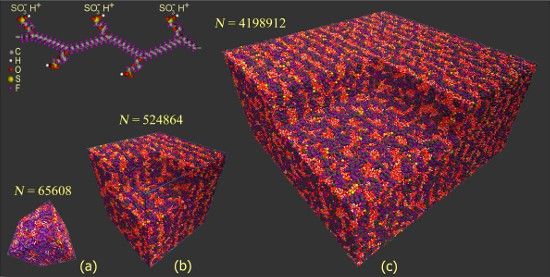
- which local density fields are employed as collective variables for simulating the structural evolution of phase-separation morphologies [11][48][49][50][51][52][53]. Several different quantum mechanics approaches have been used in attempts to understand electronic structure and proton conduction in


High-resolution nanomechanical analysis of suspended electrospun silk fibers with the torsional harmonic atomic force microscope
Beilstein J. Nanotechnol. 2013, 4, 243–248, doi:10.3762/bjnano.4.25
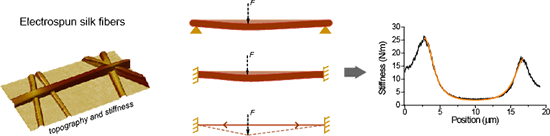
- reliable method to investigate the mechanics of materials with complex geometries. Keywords: atomic force microscopy; nanomechanical characterization; silk fibers; tissue scaffolds; torsional harmonic cantilevers; Introduction Dynamic atomic force microscopy (AFM) methods provide opportunities for high
- force–distance curves to parameters representing the material properties. Although contact-mechanics models can be used for a wide variety of polymer composites, block-copolymers, and biomaterials [27][28][29][30][31][32][33][34], these models are not applicable to materials with complex geometries. For
- at the nodes of the fiber network (pinned versus clamped), and the presence of mechanical tension within the fibers can influence their mechanical behavior. We have carried out experiments to determine the relative influences of these parameters on the mechanics of electrospun silk fibers. Results


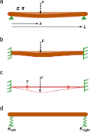
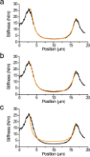
Spring constant of a tuning-fork sensor for dynamic force microscopy
Beilstein J. Nanotechnol. 2012, 3, 809–816, doi:10.3762/bjnano.3.90
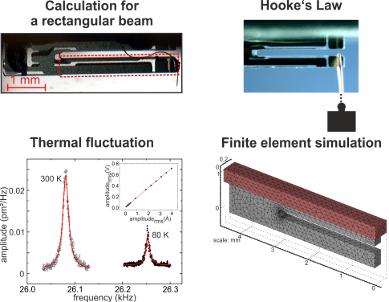
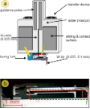
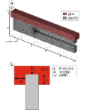
- thickness of the glue, keeping all the others exactly the same. The simulations were performed with the commercial FEM-software COMSOL Multiphysics 3.5 (COMSOL Multiphysics GmbH, Berlin, Germany) and the additional module “Structural Mechanics”. The model introduced below is simulated by the 3-D model
- “Solid, Stress-Strain” and statically analyzed by the module “Structural Mechanics”. A grid model is built for the TF (see Figure 5a) including the glue that is used to attach it to the rigid support. To simulate the experimental configuration as well as possible, it is assumed that the prong of the TF




Mapping mechanical properties of organic thin films by force-modulation microscopy in aqueous media
Beilstein J. Nanotechnol. 2012, 3, 464–474, doi:10.3762/bjnano.3.53
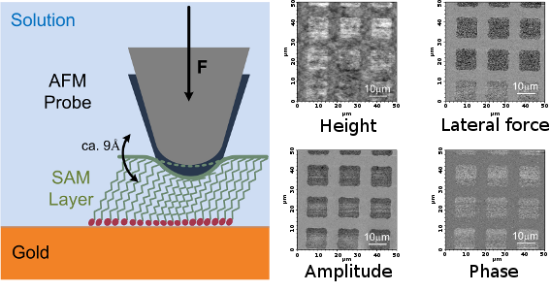
- properties of self-assembled monolayers and end-tethered protein thin films in aqueous media. Furthermore, we describe a simple analysis of the contact mechanics that enables the selection of FMM imaging parameters and thus yields a reliable interpretation of the FMM image contrast. Keywords: acoustic
- mechanics when the static contact force is much greater than the adhesion force [41][42][43]. Furthermore, the Hertzian contact model has been successfully extended to characterize the stiffness of thin, layered materials [3][44]. If necessary, tip–sample adhesion can easily be included in the contact
- analysis by selecting an appropriate contact mechanics model, such as the Johnson–Kendall–Roberts (JKR) or the Derjaguin–Muller–Toporov (DMT) model [41][45]. Although contact deformation and force have a nonlinear relationship in the Hertzian contact model, this model can be linearized for a small force



Theoretical study of the frequency shift in bimodal FM-AFM by fractional calculus
Beilstein J. Nanotechnol. 2012, 3, 198–206, doi:10.3762/bjnano.3.22
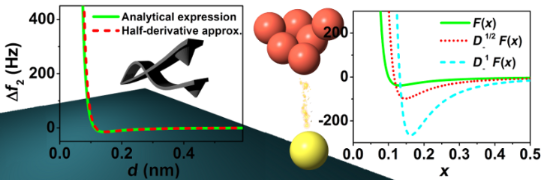
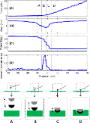
- of the interaction force. The approximations are also valid for two different types of forces, namely Lennard-Jones interactions and DMT contact-mechanics forces. We conclude that the fractional-calculus approach is well suited to describe bimodal frequency modulation AFM experiments, which are


Direct monitoring of opto-mechanical switching of self-assembled monolayer films containing the azobenzene group
Beilstein J. Nanotechnol. 2011, 2, 834–844, doi:10.3762/bjnano.2.93
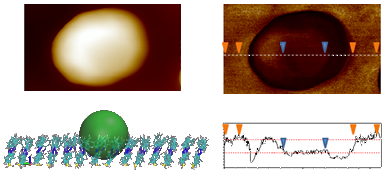
- bonds and from intermolecular interactions in the film. These results demonstrate the power and insights gained from cutting-edge AFM technologies, and advanced computational methods. Keywords: AFM; azobenzene; elastic modulus; molecular dynamics; nanomechanics; photoswitch; quantum mechanics
- in their ability to resolve the pattern of switching. For instance molecularly resolved images identified concerted switching in a small monolayer domain. And whereas concerted switching in such small domains may provide a path to overcome steric constraints, the fine mechanics of the cis↔trans



Mechanical characterization of carbon nanomembranes from self-assembled monolayers
Beilstein J. Nanotechnol. 2011, 2, 826–833, doi:10.3762/bjnano.2.92
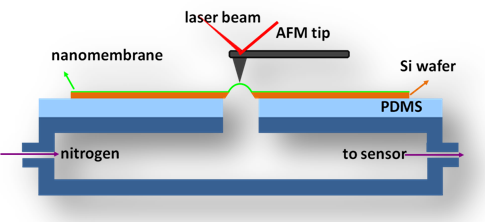
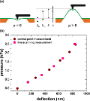
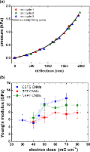
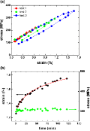
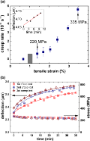
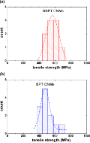
- the center of the membrane and measuring the corresponding deflection (the central-point method). These techniques can be used to determine Young’s modulus and the prestress. They also allow us to investigate the viscoelastic behavior and thus generate insights into the mechanics of CNMs. Results and

Nonconservative current-induced forces: A physical interpretation
Beilstein J. Nanotechnol. 2011, 2, 727–733, doi:10.3762/bjnano.2.79
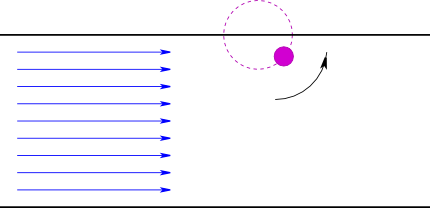
- particle is proportional to (the curl of) the local momentum flux of the flow, [p(r)j(r)], with a constant of proportionality σtr. At this stage, quantum mechanics has all but disappeared from the problem: We have a classical interaction between a, generally, spatially nonuniform steady gas flow and an

Self-organizing bioinspired oligothiophene–oligopeptide hybrids
Beilstein J. Nanotechnol. 2011, 2, 525–544, doi:10.3762/bjnano.2.57
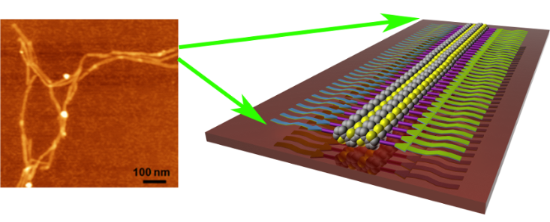
- –peptide conjugates and to gain more insight into the structure and dynamical behavior of the aggregates at finite temperatures, a theoretical methodology based on classical mechanical force fields and molecular dynamics simulations was developed [23]. Although molecular models based on classical mechanics
- . To the best of our knowledge, we were the first to apply the rational principles of structure prediction by means of conformation space search based on molecular mechanics, and subsequent MD simulations to study the peptide-directed, noncovalent assembly of thiophene-peptide hybrids [23][31][32][33




Towards a scalable and accurate quantum approach for describing vibrations of molecule–metal interfaces
Beilstein J. Nanotechnol. 2011, 2, 427–447, doi:10.3762/bjnano.2.48
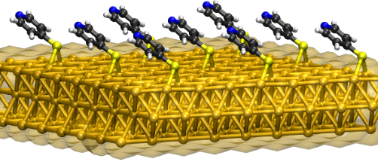
- systems and, as such, are able to account for resonance phenomena, combination bands and vibrational overtones in a hierarchical and consistent manner. While temperature effects can be included using a statistical mechanics framework, these are usually neglected, and thus the approach is better suited to


Functional morphology, biomechanics and biomimetic potential of stem–branch connections in Dracaena reflexa and Freycinetia insignis
Beilstein J. Nanotechnol. 2011, 2, 173–185, doi:10.3762/bjnano.2.21
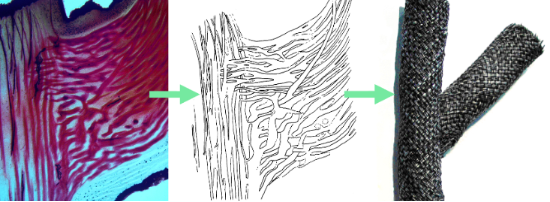
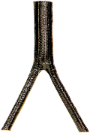
- conspicuous crowns by anomalous secondary growth, F. insignis remains relatively small and is only capable of primary growth. Biomechanical investigations were performed by applying vertical loads up to rupture to lateral branches of both species. This allows the analysis of the fracture mechanics and the
- morphology and mechanics of branch–stem-junctions have yet not been analysed quantitatively. For our studies we chose two branched arborescent monocotyledons, Dracaena reflexa and Freycinetia insignis, in order to answer the following questions: How are the fibrous bundles in the main stem connected to those





Review of "Contact Mechanics and Friction: Physical Principles and Applications" by Valentin L. Popov
Beilstein J. Nanotechnol. 2011, 2, 57–58, doi:10.3762/bjnano.2.7

- Stanislav N. Gorb Department of Functional Morphology and Biomechanics, Zoological Institute at the University of Kiel, Am Botanischen Garten 1–9, D-24098 Kiel, Germany 10.3762/bjnano.2.7 Keywords: adhesion; capillarity; contact mechanics; continuum mechanics; friction; lubrication; materials
- science; structural mechanics; system dynamics; tribology; Popov, V. L. Contact Mechanics and Friction: Physical Principles and Applications, 1st ed. Springer-Verlag: Berlin, Heidelberg, 2010. XV, 362 pages, ISBN 978-3-642-10802-0 (Print), 978-3-642-10803-7 (Online). doi:10.1007/978-3-642-10803-7 The
- book “Contact Mechanics and Friction: Physical Principles and Applications” is written by a theoretical physicist but from the point of view of an engineer. It covers an amazingly broad spectrum of topics ranging from atomic scale friction, continuum and structural mechanics, materials science
Defects in oxide surfaces studied by atomic force and scanning tunneling microscopy
Beilstein J. Nanotechnol. 2011, 2, 1–14, doi:10.3762/bjnano.2.1
- quantum mechanics [10][11]. Furthermore magnetic forces, friction forces, capillary forces etc. can in principle occur in NC-AFM. These forces are not relevant in this paper, since, e.g., a magnetic tip is necessary to detect magnetic forces, or non conservative forces have to be measured to determine


Tip-sample interactions on graphite studied using the wavelet transform
Beilstein J. Nanotechnol. 2010, 1, 172–181, doi:10.3762/bjnano.1.21
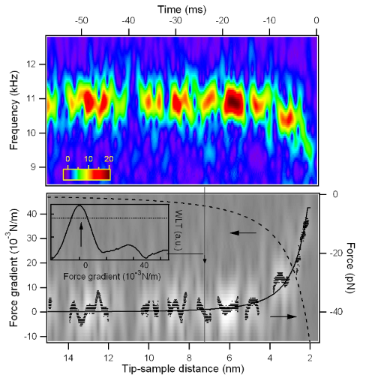
- GS corresponds to more oscillations under the envelope. The "Heisenberg box" shows the relationship between the time and frequency resolution, like the uncertainty principle in quantum mechanics (adapted from [15]). b) A graphical representation of the delay and dilation transformations used in the