Search results
Search for "nickel" in Full Text gives 186 result(s) in Beilstein Journal of Nanotechnology.
Materials and characterization techniques for high-temperature polymer electrolyte membrane fuel cells
Beilstein J. Nanotechnol. 2015, 6, 68–83, doi:10.3762/bjnano.6.8
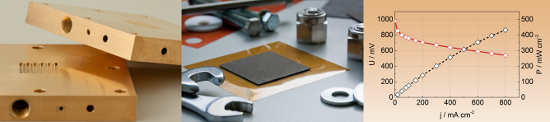
- . To reduce the noble-metal loading of a fuel cell, platinum alloy catalysts such as PtNi and PtCo may be used. However, the stability of these Pt alloy catalysts is questionable partially because, under fuel cell operating conditions, transition metals such as nickel and cobalt are expected to form




Interaction of dermatologically relevant nanoparticles with skin cells and skin
Beilstein J. Nanotechnol. 2014, 5, 2363–2373, doi:10.3762/bjnano.5.245
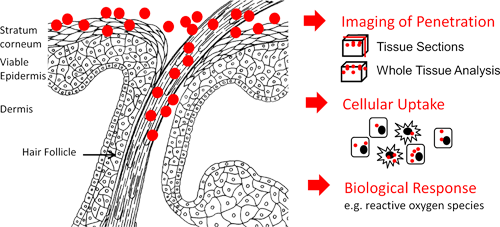
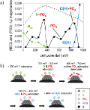
- DNA damage and apoptosis were detected in human skin epidermal cells after exposure to nickel nanoparticles [42]. Phototoxicity of zinc oxide nanoparticles induced the generation of oxidative DNA damage during UVA and visible light irradiation in keratinocytes [43]. Oxidative stress and skin cell


Characterization of 10,12-pentacosadiynoic acid Langmuir–Blodgett monolayers and their use in metal–insulator–metal tunnel devices
Beilstein J. Nanotechnol. 2014, 5, 2240–2247, doi:10.3762/bjnano.5.233
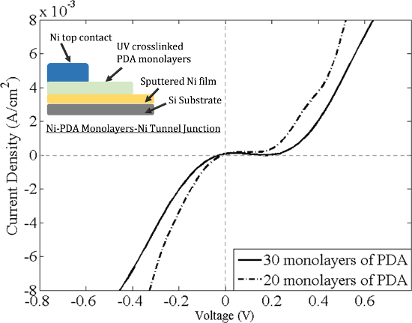
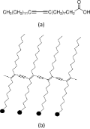
- , horizontal deposition) techniques were used to deposit the PDA film on various substrates (glass, quartz, silicon, and nickel-coated film on glass). The electrochemical, electrical and optical properties of the LB and LS PDA films were studied using cyclic voltammetry, current–voltage characteristics (I–V
- ), and UV–vis and FTIR spectroscopies. Atomic force microscopy measurements were performed in order to analyze the surface morphology and roughness of the films. A MIM tunnel diode was fabricated using a PDA monolayer assembly as the insulating barrier, which was sandwiched between two nickel layers. The
- , indium tin oxide (ITO) glass, quartz and nickel substrates for optical spectroscopy, cyclic voltammetry and electrical measurements [12][13][14][15]. The optical and electrochemical properties of the films were investigated using FTIR and cyclic voltammetric studies, respectively. The electrochemical


Carbon nano-onions (multi-layer fullerenes): chemistry and applications
Beilstein J. Nanotechnol. 2014, 5, 1980–1998, doi:10.3762/bjnano.5.207
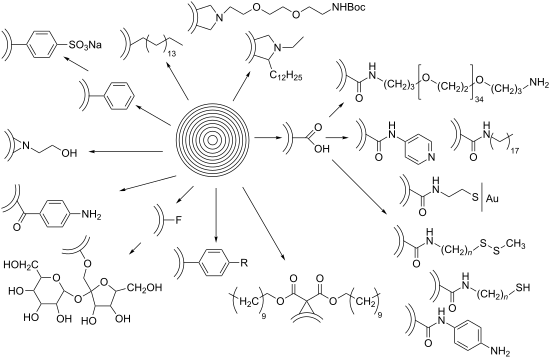
- , the same group decorated the surface of CNO with Ni(OH)2 or NiO as pseudocapacitive redox material and showed that these composites can be promising materials for the development of supercapacitors [61]. In order to achieve this, the CNO surface was modified with nickel particles, which were
- synthesized in situ from nickel nitrate hexahydrate and ammoniumhydroxide in ethanol in the presence of (4-dimethylamino)pyridine (4-DMAP) as modifier in a one-pot multi-step reaction. Calcination of the CNO/4-DMAP/Ni(OH)2 composite led to the CNO/4-DMAP/NiO composite material. The electrochemical properties
- group of H. Y. Yang [62]. The composite was prepared from KMnO4 and CNOs in different weight ratios in deionized water by heating in an autoclave. The formed CNO–MnO2 composite was then implemented in an asymmetric pseudocapacitor with the CNO–MnO2 composite as working electrode and nickel foam as


Cathode lens spectromicroscopy: methodology and applications
Beilstein J. Nanotechnol. 2014, 5, 1873–1886, doi:10.3762/bjnano.5.198

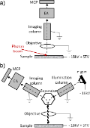
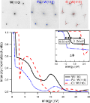
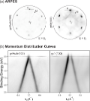
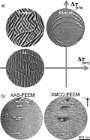
- , investigating the carburisation of the Re(0001) substrate as a function of temperature [45]. The literature shows a plethora of other experiments exploiting the LEED capabilities of LEEM with notable examples of graphene on single and polycrystalline copper [46][47][48], nickel [49] and on non-threefold



Nanocrystalline ceria coatings on solid oxide fuel cell anodes: the role of organic surfactant pretreatments on coating microstructures and sulfur tolerance
Beilstein J. Nanotechnol. 2014, 5, 1712–1724, doi:10.3762/bjnano.5.181

- , releasing electrons into an external circuit to do electrical work before they pass to the cathode for consumption in the oxygen reduction reaction. It is well known that the performance of SOFC anodes, typically composites of nickel metal with a zirconia or ceria ionic conductor, is degraded by sulfur
- [5][6][7][8][9][10][11][12]. Current consensus holds that adsorption of sulfur onto the nickel surface [13] may impede the ability of nickel to catalyze the oxidation of hydrogen [9][14][15][16]. Understanding sulfur poisoning is crucial to developing SOFCs that could operate on commercial, sulfur
- same procedures as for the nickel-GDC anodes. Then cross-sections were prepared by using a focused ion beam unit, and EDXS maps were superimposed on the cross-sectional images (Figure 6). With YSZ replacing the GDC as the ionically conducting phase in the anode, the ceria coating could easily be


Current state of laser synthesis of metal and alloy nanoparticles as ligand-free reference materials for nano-toxicological assays
Beilstein J. Nanotechnol. 2014, 5, 1523–1541, doi:10.3762/bjnano.5.165
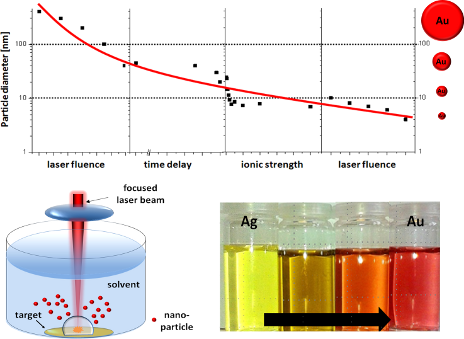
- , mammalian cells and bacteria are considered. Keywords: albumin; gold-silver; implant alloy; laser ablation; nickel-titanium; size control; wear debris; Introduction The widespread use of medical implants consisting of metals (e.g., gold coatings [1]) and alloys (e.g., NiTi, CoCr, stainless steel) [2][3][4
- cytocompatibility of implants due to their surface texture [125]. As titania nanoparticles are generally considered to possess a relatively low toxicity [126][127], possible adverse effects of NiTi alloys are prone to originate from nickel. So in order to evaluate toxic effects from these particles, TEM-EDX and
- EELS (electron energy loss spectroscopy) were used to analyze the ultrastructure of the particle by localizing nickel on a single-particle basis. Single particle EELS of a NiTi particle, laser-fabricated in acetone and embedded in a polymer, revealed a totally homogeneous ultrastructure [115] (Figure


Liquid fuel cells
Beilstein J. Nanotechnol. 2014, 5, 1399–1418, doi:10.3762/bjnano.5.153
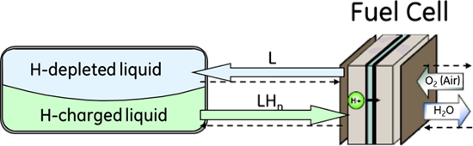
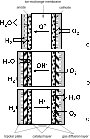
- on carbon was comparable [157]. Nickel-0based electrocatalysts are the most active for hydrazine oxidation. An alloy with the composition Ni0.6Co0.4 was about 6 times more active than the pure Ni catalyst [155]. The design space of binary Ni–M (with M = Mn, Fe, Zn, La) and ternary Ni–Mn–Fe and Ni–Zn

Nano-rings with a handle – Synthesis of substituted cycloparaphenylenes
Beilstein J. Nanotechnol. 2014, 5, 1320–1333, doi:10.3762/bjnano.5.145
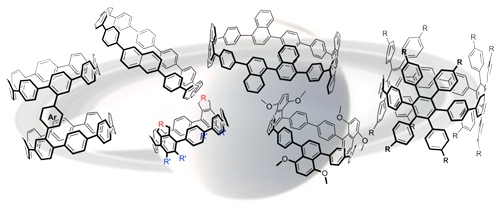
- using sodium naphthalenide affording the substituted [12]CPP 6 in 63% yield (Scheme 1). With the same strategy dodecaphenyl-substituted [9]CPP 9 was prepared by Müllen et al. (Scheme 2) [45]. A tetraphenyl-substituted cyclohexadiene building block 7 was combined via nickel-mediated Yamamoto coupling
- relies on the same strategy as that for the corresponding non-annelated CPP. It uses the L-shaped building block 16 and the pyrene unit is incorporated via Suzuki coupling of the diborylated 2,7-pyrene 22 to access the U-shaped unit 23. The two units were coupled using a nickel catalyst to give the
- ), providing the desired cis-diol in 36% yield after separation. The diol was further methylated by using MeI and NaH as base. They combined the designed L-shaped naphthylene modified building block 28 in a nickel-mediated shotgun macrocyclization producing the trimer 29 in 2% yield. Final aromatization under


Magnesium batteries: Current state of the art, issues and future perspectives
Beilstein J. Nanotechnol. 2014, 5, 1291–1311, doi:10.3762/bjnano.5.143
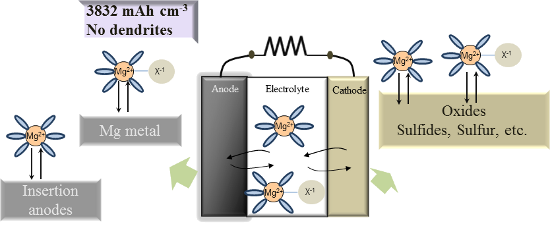
- a myriad of distinct batteries and energy storage chemistries [1]. Out of the several known battery technologies, secondary or rechargeable batteries, such as nickel metal hydride and lithium-ion, which allow for reversibly storing and harnessing power on demand while providing high power and energy
- cm−3 for Li metal), their specific energy densities were proven to be more competitive than that of other rechargeable batteries, such as nickel (Ni)–metal hydride, Ni-cadmium (Cd), and lead (Pb)–acid (about 2.5 times). They also provide higher specific power and have had long durability [1]. The


Enhanced photocatalytic hydrogen evolution by combining water soluble graphene with cobalt salts
Beilstein J. Nanotechnol. 2014, 5, 1167–1174, doi:10.3762/bjnano.5.128
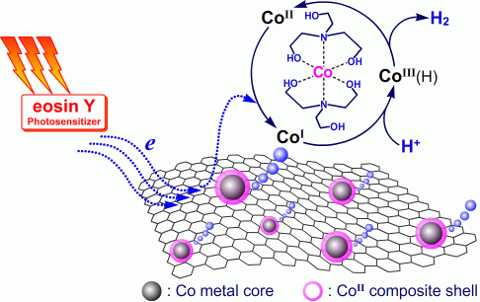
- , which limits its availability [5]. Hence, developing photocatalytic systems that rely only on earth-abundant elements are desired for making hydrogen a competitive alternative energy source. In recent years, systems based on iron complexes, nickel complexes or molybdenum complexes have been reported as


Dry friction of microstructured polymer surfaces inspired by snake skin
Beilstein J. Nanotechnol. 2014, 5, 1091–1103, doi:10.3762/bjnano.5.122

- using e-beam greytone lithography with a negative photoresist. Afterwards nickel copies were manufactured through an electroplating process. Replication of the microstructures was performed by using a two-step moulding technique according to Gorb [35]. The surface that ought to be replicated was used as


Integration of ZnO and CuO nanowires into a thermoelectric module
Beilstein J. Nanotechnol. 2014, 5, 927–936, doi:10.3762/bjnano.5.106
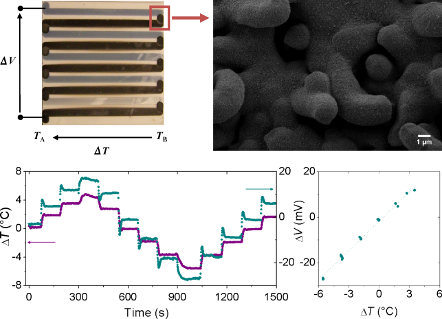
- -plate collimated proportional Xe detector with a nickel large-β filter, in glancing-angle mode in the range of 5–90 degree (ω = 1.5°). Raman characterization was performed by using a HORIBA (Kyoto, Japan) monochromator iHR320 configured with a grating of 1800 g/mm, coupled to a Peltier-cooled Synapse
- material for the probing tips, Chromel was used. Chromel is an alloy of nickel and chromium, which exhibits a positive absolute Seebeck coefficient of about 28.1 μV/K [39] and is commonly used with Alumel to form K-type thermocouples. The voltage ΔV, measured at the ends of the probing tips, is


Volcano plots in hydrogen electrocatalysis – uses and abuses
Beilstein J. Nanotechnol. 2014, 5, 846–854, doi:10.3762/bjnano.5.96
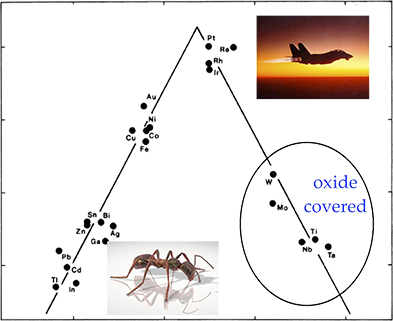
- , that there is no volcano once the oxide-covered metals are left out. We examine the factors that govern the reaction rate in the light of our own theory and conclude, that Sabatier’s principle is only one of several factors that determine the rate. With the exception of nickel and cobalt, the reaction
- rate does not decrease for highly exothermic hydrogen adsorption as predicted, because the reaction passes through more suitable intermediate states. The case of nickel is given special attention; since it is a 3d metal, its orbitals are compact and the overlap with hydrogen is too low to make it a
- for hydrogen evolution, have been constructed. In this article we shall critically consider the concepts behind and the experimental results for the hydrogen volcano plot, both in acid and in alkaline solutions. We will present our own ideas and show some new theoretical results for nickel, which in


Injection of ligand-free gold and silver nanoparticles into murine embryos does not impact pre-implantation development
Beilstein J. Nanotechnol. 2014, 5, 677–688, doi:10.3762/bjnano.5.80
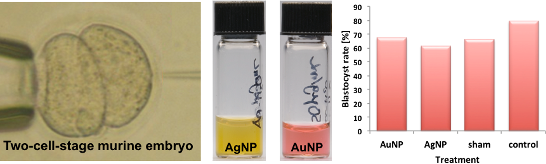
- ][17][18][19][20], nickel (NiNP) [21], zinc oxide (ZnONP) [22][23], titanium dioxide (TiO2NP) [23][24][25], aluminium trioxide (Al2O3NP) [23] and copper (CuNP) [22][25]. Toxic effects were observed after exposure to AgNP, CuNP, ZnONP and NiNP. AuNP, TiO2NP and Al2O3NP, on the other hand, seemed to be


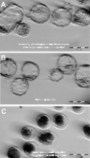


Towards precise defect control in layered oxide structures by using oxide molecular beam epitaxy
Beilstein J. Nanotechnol. 2014, 5, 596–602, doi:10.3762/bjnano.5.70
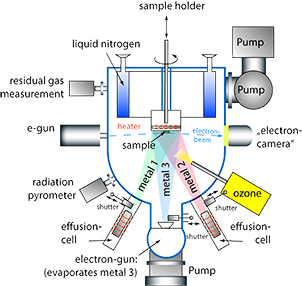
- . The transition metal Nickel (Ni) can have several valence states, Ni1+, Ni2+ and Ni3+. Since La2NiO4 is one of the Ruddlesden–Popper phases An+1BnO3n+1 with n = 1, it is challenging to grow it as a single phase without the intergrowth of other phases. Here we report that, by using our ALL-oxide MBE


In vitro toxicity and bioimaging studies of gold nanorods formulations coated with biofunctional thiol-PEG molecules and Pluronic block copolymers
Beilstein J. Nanotechnol. 2014, 5, 546–553, doi:10.3762/bjnano.5.64
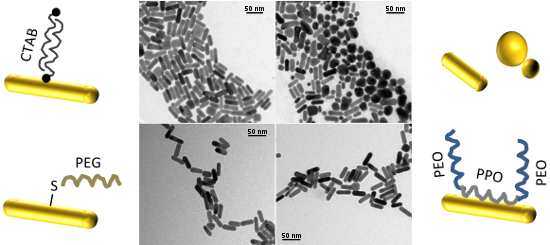
- electron microscope (TEM) was used with JEOL JEM-1010 to characterize the shapes and sizes of the AuNRs. The TEM specimens were prepared on 200 mesh nickel-coated grids. UV–vis absorption spectra of AuNRs were obtained by using a Hitachi U-2900 with a double-beam optical system and a spectral bandpass of


Plasma-assisted synthesis and high-resolution characterization of anisotropic elemental and bimetallic core–shell magnetic nanoparticles
Beilstein J. Nanotechnol. 2014, 5, 466–475, doi:10.3762/bjnano.5.54
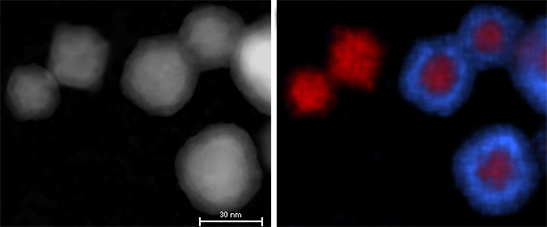
- , which relies on (optionally pulsed) DC plasma gas condensation has been developed. We demonstrate the synthesis of elemental nickel nanoparticles with highly tunable sizes and shapes and Ni@Cu CS-NPs with an average shell thickness of 10 nm as determined with scanning electron microscopy, high


Confinement dependence of electro-catalysts for hydrogen evolution from water splitting
Beilstein J. Nanotechnol. 2014, 5, 195–201, doi:10.3762/bjnano.5.21
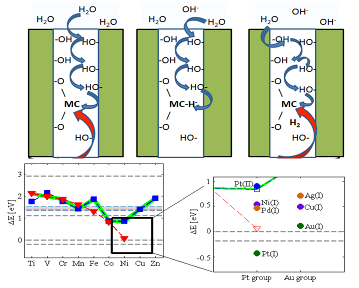
- reversible hydride-proton recombination reaction (Equation 6) has recently been proposed in case of a nickel electro-catalyst supported by seven-membered cyclic diphosphine ligands containing one pendant amine, with the Ni supporting the hydride and the amine providing the proton in the hydride-proton


3D-nanoarchitectured Pd/Ni catalysts prepared by atomic layer deposition for the electrooxidation of formic acid
Beilstein J. Nanotechnol. 2014, 5, 162–172, doi:10.3762/bjnano.5.16
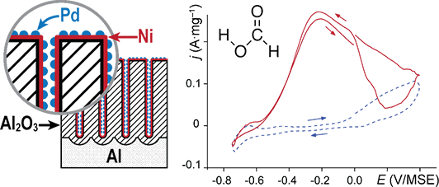
- , University of Ottawa, 161 Louis-Pasteur St., Ottawa, ON, K1N 6N5, Canada 10.3762/bjnano.5.16 Abstract Three-dimensionally (3D) nanoarchitectured palladium/nickel (Pd/Ni) catalysts, which were prepared by atomic layer deposition (ALD) on high-aspect-ratio nanoporous alumina templates are investigated with
- been studied by cyclic voltammetry (CV). Results and Discussion Nickel deposition Since ALD processes have been developed mainly for metal oxide and nitride thin films, metal depositions have been hampered mostly by the lack of relevant and stable precursors [31]. Although a new class of precursors
- have been investigated for the electrooxidation of formic acid in 0.5 M H2SO4. The deposition of nickel oxide from NiCp2 and O3 precursors on high aspect ratio nanoporous Al2O3 has been demonstrated. Although the chemical composition analysis of the NiO layers has not shown that the reductive treatment


Study of mesoporous CdS-quantum-dot-sensitized TiO2 films by using X-ray photoelectron spectroscopy and AFM
Beilstein J. Nanotechnol. 2014, 5, 68–76, doi:10.3762/bjnano.5.6
- (1486.6 eV) radiation (10 kV; 22 mA). Charge stabilization was achieved by using an electron flood gun adjusted at 8 eV and placing a nickel grid 3 mm above the sample. Pass energy for the analyzer was set to 160 eV for wide scan. The analyzed area was approximately 1.4 mm2 and the pass energy was set to



Preparation of NiS/ZnIn2S4 as a superior photocatalyst for hydrogen evolution under visible light irradiation
Beilstein J. Nanotechnol. 2013, 4, 949–955, doi:10.3762/bjnano.4.107
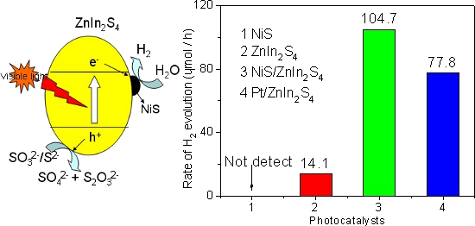
- Preparations. All the reagents are analytical grade and used without further purifications. Hexagonal ZnIn2S4 powder was synthesized according to our previously reported method [16]. In a typical synthesis of 0.5 wt % NiS/ZnIn2S4 photocatalyst, 0.2 g ZnIn2S4, 2.8 mg nickel acetate and 0.9 mg thioacetamide (TAA
- washed with de-ionized water several times before it was dried at 60 °C to obtain the final product. Samples with different amount of NiS (0.2, 0.25, 1.0, 2.0 wt %) were prepared by using different amounts of nickel acetate and TAA precursor during the hydrothermal treatment at 120 °C, while keeping
- other conditions the same. 0.5 wt % Pt/ZnIn2S4 was prepared by a photo-deposited method using H2PtCl6·6H2O as the starting material. Pure NiS was prepared by hydrothermal using nickel acetate and TAA as precursors at 120 °C for 4 h. Characterizations. X-ray diffraction (XRD) patterns were collected on a


Ultramicrosensors based on transition metal hexacyanoferrates for scanning electrochemical microscopy
Beilstein J. Nanotechnol. 2013, 4, 649–654, doi:10.3762/bjnano.4.72
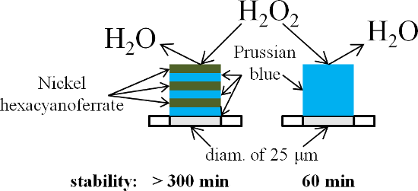
- as sensors in scanning electrochemical microscopy (SECM) experiments for imaging of hydrogen peroxide evolution. Keywords: energy related; hydrogen peroxide; nanomaterials; nickel hexacyanoferrate; Prussian Blue; scanning electrochemical microscopy; ultramicroelectrodes; Introduction The detection
- . Operational stability of the PB can be improved by covering its surface with polymer films [21][22], by entrapment of the catalysts into sol–gel [23][24][25], and by conductive polymer matrixes [26][27]. In [20] we have demonstrated a novel approach for the stabilization of a sensor based on mixed iron-nickel
- hexacyanoferrates. Here, we report on the highly stable ultramicrosensors comprised of alternating films of iron and nickel hexacyanoferrates for the imaging of hydrogen peroxide distribution in SECM. Results and Discussion Hexacyanoferrates were deposited onto UMEs with a diameter of 10 µm and 25 µm, respectively


AFM as an analysis tool for high-capacity sulfur cathodes for Li–S batteries
Beilstein J. Nanotechnol. 2013, 4, 611–624, doi:10.3762/bjnano.4.68
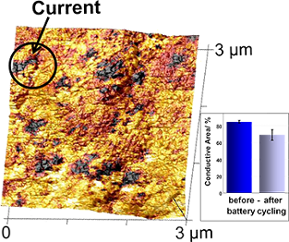
- nickel layer or by coating with Nafion [15][16]. To obtain a superior capacity and reversible cycle performance, the production of thin and porous sulfur cathodes or the use of foam-like structures as current collectors have been shown to be advantageous [9][17][18]. Recent studies have shown that the
- capacity of approximately 1000 mA·g(sulfur)−1 [19][20]. Another approach is based on vertically aligned carbon nanotubes (CNTs) grown on a nickel foil without any binder. To date, these binder-free CNT cathodes contain the highest published total ratio of sulfur (90%) in an electrode [21]. The advantage of



Ni nanocrystals on HOPG(0001): A scanning tunnelling microscope study
Beilstein J. Nanotechnol. 2013, 4, 406–417, doi:10.3762/bjnano.4.48
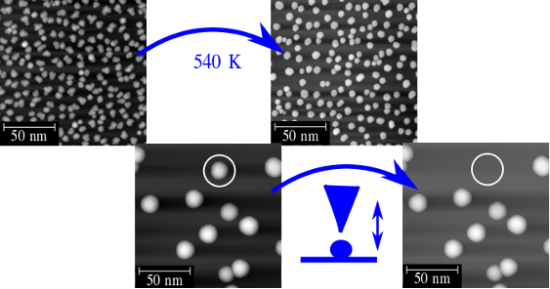
- reported [1]. Keywords: clusters; growth mode; Ni; nickel; Introduction Metallic nanoparticles have been widely studied in the past few decades owing to their broad range of applications, such as catalysis [2][3][4], quantum dots [5] or chemical sensors [6]. Moreover, nano particles consisting of only
- purposes are Ag, Pt, Pd, Cu, Rh and Ni [3]. Nickel clusters have recently received a lot of attention besides their catalytic properties [2][3][4] for the use as templates for the growth of small graphene islands [18]. The control of the size and the shape as well as the particle distribution play an
- for nickel deposition at room temperature, as done for example in the work of Bastl et al. [19]. Therefore we conclude that the temperature for the whole deposition process was significantly lower than room temperature. Influence of annealing on the clusters Figure 4a was recorded directly after