Search results
Search for "orientation" in Full Text gives 646 result(s) in Beilstein Journal of Nanotechnology. Showing first 200.
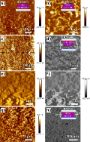
Fusion of purple membranes triggered by immobilization on carbon nanomembranes
Beilstein J. Nanotechnol. 2021, 12, 93–101, doi:10.3762/bjnano.12.8
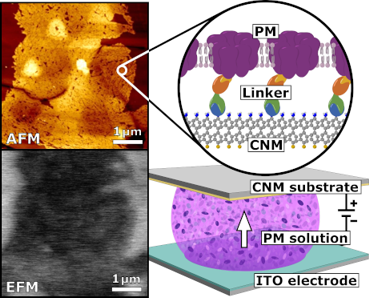
- (NTA) terminal groups for the interaction with the His-tagged PMs forming a quasi-monolayer of His-tagged PM on top of the CNM-NTA. The formation of the Ni-NTA/His-tag complex leads to the unidirectional orientation of PM on the CNM substrate. Electrophoretic sedimentation was employed to optimize the
- , the unidirectional orientation of the patches is an important requirement for a functional device [8]. Although various methods have already been tested with varying degrees of success in terms of orientation [23][24][25][26][27][28], the fusion of oriented membrane patches into a single, free
- using OriginPro 8 SR0 v8.0724 (OriginLab Corporation, Wellesley Hills, MA, USA). Results and Discussion Improving substrate coverage and PM orientation An oriented deposition of the PM patches is required to take advantage of the unidirectional proton transferability of PM. Preliminary experiments were


Kondo effects in small-bandgap carbon nanotube quantum dots
Beilstein J. Nanotechnol. 2020, 11, 1873–1890, doi:10.3762/bjnano.11.169
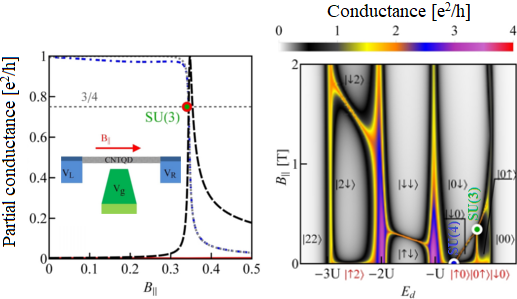
- different types. Full spin–orbital degeneracy might be recovered at zero field and, correspondingly, the SU(4) Kondo effect sets in. We point out the possibility of the occurrence of electron–hole Kondo effects in slanting magnetic fields, which we predict to occur in magnetic fields with an orientation
- close to perpendicular. When the field approaches a transverse orientation a crossover from SU(2) or SU(3) symmetry into SU(4) is observed. Keywords: carbon nanotubes; Kondo effect; mesoscopic transport; quantum dots; valleytronics; Introduction Due to their remarkable electronic, transport
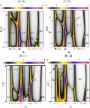
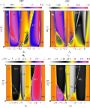
- –hole degeneracy occurring in transverse fields (|h1+⟩, |h−1+⟩, |e1−⟩, |e−1−⟩). Before discussing the correlation effects, let us show how the ground-state diagrams of an isolated dot change with the strength of SO interaction or with the orientation of the magnetic field. We restrict ourselves to the



![[Graphic 37]](/bjnano/content/inline/2190-4286-11-169-i52.svg?max-width=637&scale=1.18182) as a functio...
as a functio...


Scanning transmission imaging in the helium ion microscope using a microchannel plate with a delay line detector
Beilstein J. Nanotechnol. 2020, 11, 1854–1864, doi:10.3762/bjnano.11.167
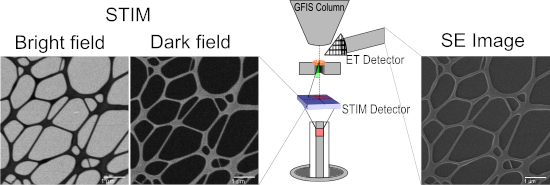
- the contrast of certain compositional features of the sample. Crystalline materials can also give rise to additional contrast mechanisms. In crystalline materials, the stopping force depends on the orientation of the crystal [16]. Along some orientations, the target atoms are aligned in rows or planes
- probability of undergoing large-angle scattering. Hence, it will have a smaller energy loss per distance compared to random directions. This phenomenon is called the channeling effect and has been described for megaelectronvolt ions in detail in [17]. When compared to a random orientation, the channeling
- . Diffraction patterns yield additional information on the crystal lattice and orientation. However, this application demands a detector with high spatial resolution taking into consideration the energy range and typical space restrictions in the HIM. In the past, several attempts to utilize the transmission


The influence of an interfacial hBN layer on the fluorescence of an organic molecule
Beilstein J. Nanotechnol. 2020, 11, 1663–1684, doi:10.3762/bjnano.11.149





PTCDA adsorption on CaF2 thin films
Beilstein J. Nanotechnol. 2020, 11, 1615–1622, doi:10.3762/bjnano.11.144
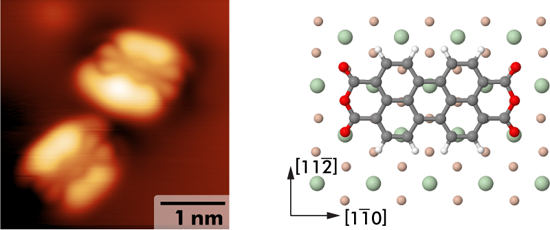
- is shown in Figure 3a, where the orientation along the double-lobe shape (i.e., along the long molecular axis, see also white dashed line in Figure 3c) was measured with respect to a CaF2 direction from more than 1000 molecules in a total of 10 images. The CaF2 directions were determined from filled
- (directions are included for clarity in Figure 4a). This orientation is in full agreement with the experimental observation in Figure 3a, where maxima in the orientation histogram were found at angles of about 30° off the directions. The PTCDA molecule is in a nearly flat-lying geometry, with the exception
- rationalised by nucleation at defects present within the CaF1 interface layer. In contrast, the CaF2/CaF1 layer is mostly defect-free. A statistical analysis revealed a preferred molecular orientation of the long molecular axis along a CaF2 direction, in full agreement with the DFT-calculated optimum


High-responsivity hybrid α-Ag2S/Si photodetector prepared by pulsed laser ablation in liquid
Beilstein J. Nanotechnol. 2020, 11, 1596–1607, doi:10.3762/bjnano.11.142
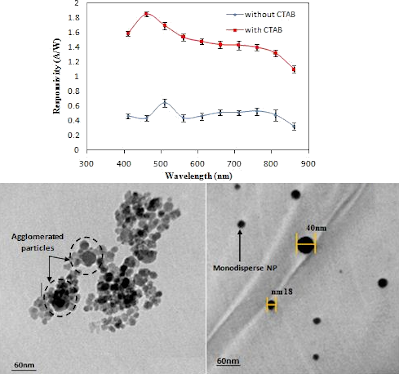
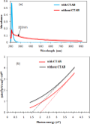
- detected after adding the CTAB surfactant. However, a preferred orientation along the (−121) plane was found when the CTAB surfactant was used. The significantly increased intensity of the (−121) plane and other peaks could be attributed to the increase in the degree of crystallinity of Ag2S caused by the
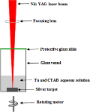
- silver target in a Tu solution with CTAB as a cationic surfactant. The effect of CTAB on the structural, optical and morphological properties of Ag2S NPs was studied. XRD results showed a preferred orientation along the (−121) plane after CTAB was introduced. TEM investigation showed that the average




Detecting stable adsorbates of (1S)-camphor on Cu(111) with Bayesian optimization
Beilstein J. Nanotechnol. 2020, 11, 1577–1589, doi:10.3762/bjnano.11.140
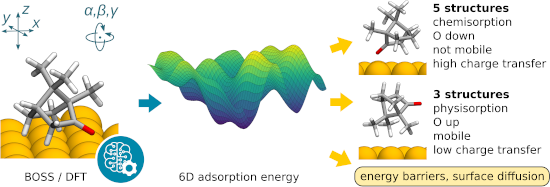
- , we study the adsorption of camphor on Cu(111) with respect to molecular orientation and location. We define the PES of adsorption in a 6D phase space with three rotational angles (α, β, γ) and three translational directions (x, y, z), which correspond to the Cu lattice directions [10−1], [−12−1] and
- [111], respectively (Figure 3b). The adsorption height of the molecule (z) is defined with respect to the center point of rotation (Figure 3b), which is the middle point of the line connecting two C atoms at the sides of the rigid cage of camphor. We investigate the orientation of the molecule with
- camphor on Cu(111) as a function of its (i) adsorption height (1D), (ii) orientation (3D), and (iii) adsorption site (2D). First, we investigate the height of the molecule with a 1D search (Figure 2b) to determine a suitable height for the rotational search. Based on the resulting energy curve we estimate


Adsorption and self-assembly of porphyrins on ultrathin CoO films on Ir(100)
Beilstein J. Nanotechnol. 2020, 11, 1516–1524, doi:10.3762/bjnano.11.134
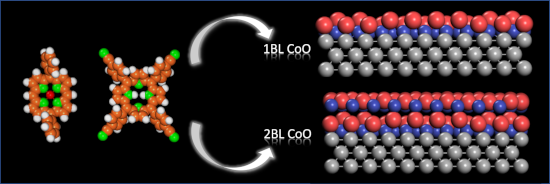
- orientation. The slabs were separated by approximately 12 Å of vacuum (measured from the topmost atom of the adsorbed molecule), resulting in a third cell dimension of 23 Å and 25 Å, respectively. For structural relaxation all molecular atoms were allowed to relax. Only in the case of 1, the central Co atom
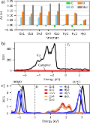
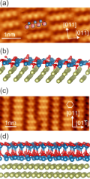
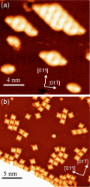
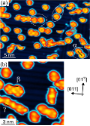
- and the closest H atom of the macrocycle. Expecting some distortions of the molecule on the surface, this is well in the range of dipolar and hydrogen bond distances [25][30][45]. From the molecular orientation of the assembly marked by the black rectangle in Figure 6a, shown in detail in Figure 6c
- respect to the rotation of the molecule on the surface. To this end, we calculated the total energy for different orientations of 1 on 1BL and 2BL CoO (Figure 7c). The orientation is given as the angle between the molecular axis (defined by the phenyl groups) and the direction of the Ir substrate. While




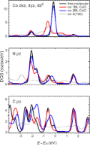
Controlling the electronic and physical coupling on dielectric thin films
Beilstein J. Nanotechnol. 2020, 11, 1492–1503, doi:10.3762/bjnano.11.132
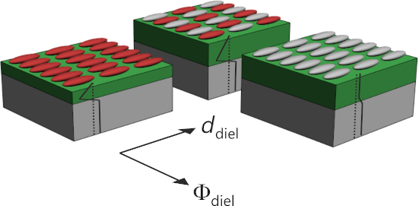
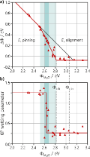
- regime) and charged and uncharged molecules (Fermi level pinning regime) can be obtained. Furthermore, it was found that charge transfer and temperature strongly influence the orientation, conformation, and wetting behavior (physical coupling) of the 6P layers on the MgO(100) thin films. Keywords
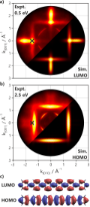
- . The azimuthal orientations of the molecules can be derived by comparing the orientations of the molecular emission patterns to the orientation of the emission pattern from the Ag(100) substrate or from the crystal surface unit cell inferred from low energy electron diffraction (LEED) experiments. This
- comparison shows that all charged molecules have their long axes aligned 45° with respect to the close-packed atomic rows of the substrate (i.e., along the [001]/[010] azimuths) in agreement with the orientation of the molecules obtained via STM in Figure 2b. Significantly, the theoretical maps shown in




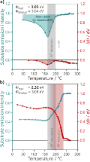
Protruding hydrogen atoms as markers for the molecular orientation of a metallocene
Beilstein J. Nanotechnol. 2020, 11, 1432–1438, doi:10.3762/bjnano.11.127
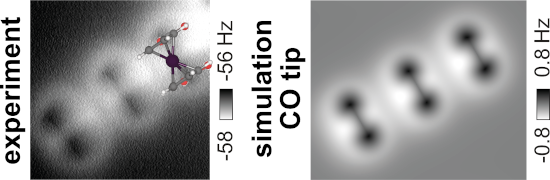
- cyclopentadienyl (Cp) rings. Simulated NC-AFM images show an excellent agreement with experimental constant-height NC-AFM data of FDCA molecules at several tip–sample distances. By measuring this distinct dumbbell shape together with the molecular orientation, a strategy is proposed to determine the conformation
- ][8]. Furthermore, the imaging of hydrogen atoms attached to propellane molecules with CO-functionalised tips was suggested to enable the identification of three-dimensional molecules [9]. Very recently, a combination of NC-AFM and automated structure detection has been able to resolve the orientation
- Figure 1a and Figure 1b, respectively. The molecule–surface bond, with a calculated binding energy for geo 1 of −1.74 eV, is surprisingly strong [22]. Due to the tilted molecular orientations, both geometries have two hydrogen atoms as the topmost unit protruding the surface. However, the orientation
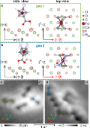


![[Graphic 10]](/bjnano/content/inline/2190-4286-11-127-i10.svg?max-width=637&scale=1.18182) row of FDCA molecules in geo 2. (a–c) Constant-height frequency-shi...
row of FDCA molecules in geo 2. (a–c) Constant-height frequency-shi...
Analysis of catalyst surface wetting: the early stage of epitaxial germanium nanowire growth
Beilstein J. Nanotechnol. 2020, 11, 1371–1380, doi:10.3762/bjnano.11.121
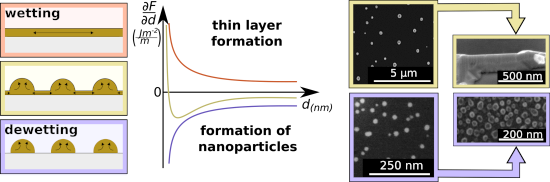
- the vW model fails since gold droplets are formed on the silicon oxide surface. A deep insight into the characteristics and properties of the observed material is needed to perform calculations using van der Waals interactions. However, thermal silicon oxide has no defined crystallographic orientation
- defined surface orientation with well-understood physical and chemical properties; therefore, even the fully theoretical vW model fits the real system behaviour. Nevertheless, the results for gold on silicon also vary due to the wide range of possible Hamaker constants, which are needed in the
- silicon oxide. One reason for this failure is the unknown ratio of different oxide species on the substrate surface and their unknown orientation. Therefore, an exact theoretical description of these systems is difficult. The two empirical models predict the formation of isolated droplets without a


Impact of fluorination on interface energetics and growth of pentacene on Ag(111)
Beilstein J. Nanotechnol. 2020, 11, 1361–1370, doi:10.3762/bjnano.11.120
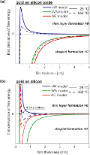
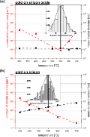
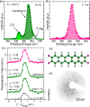
- or PFP with a flat-lying (long and short molecular axes parallel to the substrate) orientation, which have IEs (in monolayers on graphite) of 5.65 eV and 6.20 eV, respectively [25][26]. The decrease in the IE is due to solid state polarization, which is a general phenomenon for molecular thin films
- [40][41][42][43][44]. However, in thin films comprised of molecules in a standing orientation on SiO2 (long molecular axis perpendicular to the substrate), the IE of PEN decreases to 4.90 eV and the IE of PFP increases to 6.65 eV [45]. The opposite trend of the orientation dependency of the IEs has
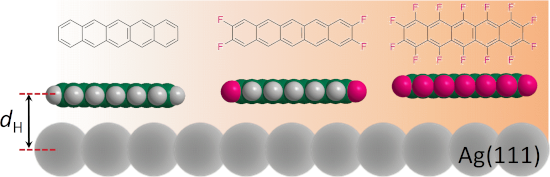
- contribution polarization [11][44]. Perfluorination does not impact the orientation of PEN and PFP in the contact layer with clean metals, where both compounds are lying flat [9][30][31][47][48][49][50][51][52]. On Au(111), the coupling strength of both monolayers with the substrate is rather similar and


Atomic defect classification of the H–Si(100) surface through multi-mode scanning probe microscopy
Beilstein J. Nanotechnol. 2020, 11, 1346–1360, doi:10.3762/bjnano.11.119
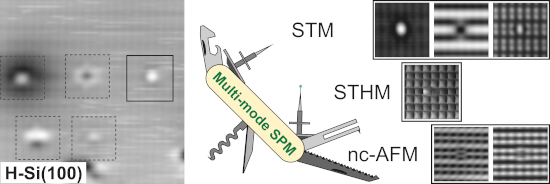
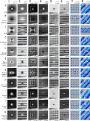
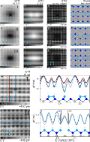
- STM images (Figure 2i-1,2,3) highlights the preferred tetrahedral bonding orientation of the saturating hydrogens of the Si, with the fourth bond affixing it to the side of the dimer beneath. The characteristic dark border in Figure 2i-1 and enhanced brightness in Figure 2i-2 are features commonly



Controlling the proximity effect in a Co/Nb multilayer: the properties of electronic transport
Beilstein J. Nanotechnol. 2020, 11, 1336–1345, doi:10.3762/bjnano.11.118
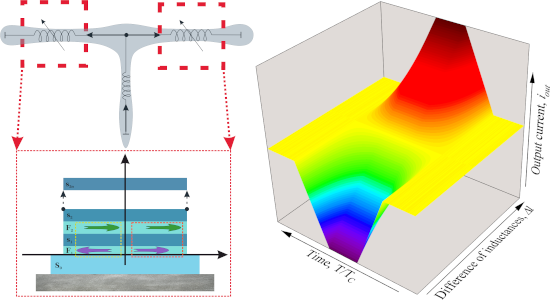
- multilayer. We observe that the resistive transition of the multilayer structure has multiple steps, which we attribute to the transition of individual superconductive layers with the critical temperature, Tc, depending on the local magnetization orientation of the neighboring F-layers. We argue that such
- parameter exceeds the value sufficient for carrying the applied transport current) depends on the magnetization orientation in the neighboring F-layers. It is at a maximum for the AP and at a minimum for the P orientation. From Figure 5b one can see that different segments may have a different sequence of
- explanation is based on the magnetic structure of the connected electrodes. If we assume that the “N”- (or “T”-) electrode consists of two (or three) domains with significantly different mutual magnetization orientation in the F-layers, this can provide different critical temperature values for each domain



Structural and electronic properties of SnO2 doped with non-metal elements
Beilstein J. Nanotechnol. 2020, 11, 1321–1328, doi:10.3762/bjnano.11.116
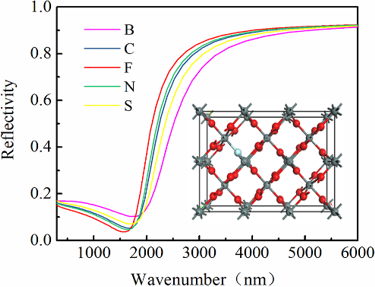
- preferred orientation, optical properties, and electrical properties of SnO2 film are improved. Analysis of the electrical properties of SnO2 films doped with different non-metal elements showed that the resistance of SnO2 films doped with N was higher [6][7][8] than that of SnO2 doped with other elements



Growth of a self-assembled monolayer decoupled from the substrate: nucleation on-command using buffer layers
Beilstein J. Nanotechnol. 2020, 11, 1291–1302, doi:10.3762/bjnano.11.113
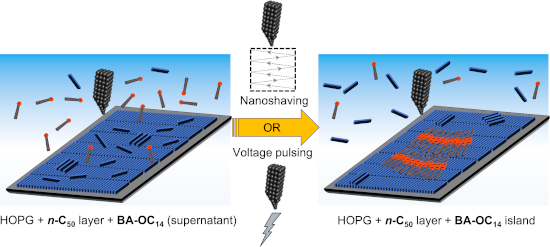
- controlled nucleation experiments described below, also confirm the formation of the BA-OC14 islands on top of the buffer layer. The registry of the alkyl chains of BA-OC14 with the graphite lattice can be understood by considering the orientation of the BA-OC14 islands with respect to the n-C50 lamellae. As


Proximity effect in [Nb(1.5 nm)/Fe(x)]10/Nb(50 nm) superconductor/ferromagnet heterostructures
Beilstein J. Nanotechnol. 2020, 11, 1254–1263, doi:10.3762/bjnano.11.109
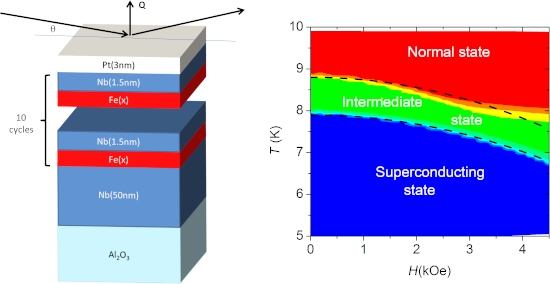
- Nb growth of (100) orientation on Al2O3() substrates was reported in [46]. The peculiarity of this growth, also seen in our samples, is an angle of approx. 3° between the above mentioned planes of Nb and Al2O3(). At TNb = 30 °C a transmission pattern (i.e., a regular arrangement of spots) and rings


![[Graphic 13]](/bjnano/content/inline/2190-4286-11-109-i17.svg?max-width=637&scale=1.18182) ) substrate, (b) the Pt cap layer, and the Nb buffer layer grown at...
) substrate, (b) the Pt cap layer, and the Nb buffer layer grown at...


![[Graphic 16]](/bjnano/content/inline/2190-4286-11-109-i20.svg?max-width=637&scale=1.18182) (T) for the samples s4 (black) and s3 (red) in the vicinity of the superconducting transition m...
(T) for the samples s4 (black) and s3 (red) in the vicinity of the superconducting transition m...
Magnetic-field-assisted synthesis of anisotropic iron oxide particles: Effect of pH
Beilstein J. Nanotechnol. 2020, 11, 1230–1241, doi:10.3762/bjnano.11.107
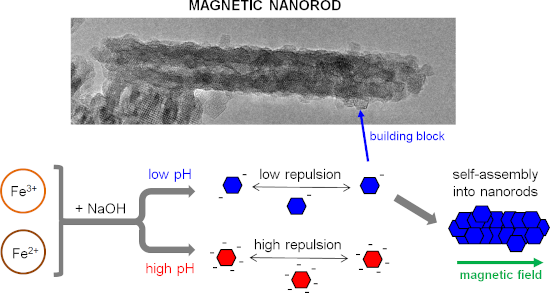
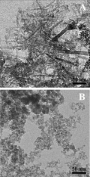
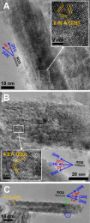
- . Fe3O4 nanorods were examined using high-resolution transmission electron microscopy proving that they are single-crystalline and do not have any preferred crystallographic orientation along the axis of the rods. According to the data obtained a growth mechanism was proposed for the rods that consists of
- bind to each other and position themselves in a column-like orientation, which gives a rod-like shape to the aggregate. Further recrystallization of the aggregates leads to the formation of single-crystal nanorods (Figure 7). The formation of single-crystal nanorods may be facilitated by the hexagonal
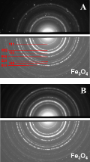
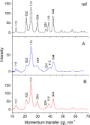
- the 2D electron diffractograms. The presence of rings but not point reflexes is consistent with the size of nanoparticles being smaller than the diameter of the illuminated area (2 μm) and with their random orientation. Data obtained from the radial-averaged diffraction pattern (Figure 5, Table 1





Influence of the magnetic nanoparticle coating on the magnetic relaxation time
Beilstein J. Nanotechnol. 2020, 11, 1207–1216, doi:10.3762/bjnano.11.105
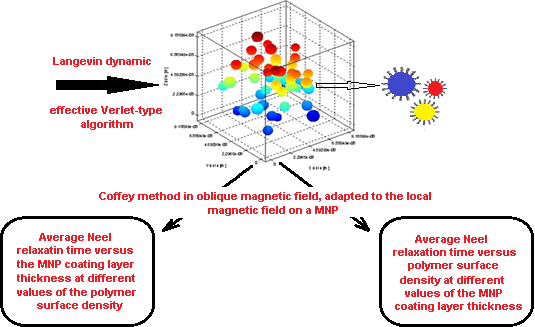
- the particle) and Brown relaxation (an external phenomenon driven by the rotation of the nanoparticle along the magnetic moment). Both internal and external sources of friction lead to a delay in the orientation of the particle magnetic moment in the direction of the applied magnetic field, thus


Hybridization vs decoupling: influence of an h-BN interlayer on the physical properties of a lander-type molecule on Ni(111)
Beilstein J. Nanotechnol. 2020, 11, 1168–1177, doi:10.3762/bjnano.11.101
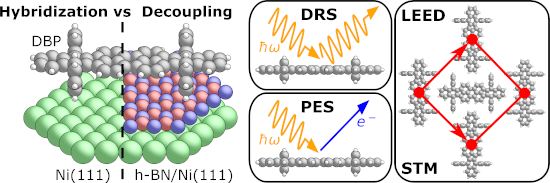
- cell rotation with respect to the primitive substrate vector (see Table 1). For this reason, we find that the molecules adopt a similar herringbone arrangement (rectangular unit cell with a basis of two molecules with different azimuthal orientation) on h-BN/Ni(111). This structural model was verified


Scanning tunneling microscopy and spectroscopy of rubrene on clean and graphene-covered metal surfaces
Beilstein J. Nanotechnol. 2020, 11, 1157–1167, doi:10.3762/bjnano.11.100
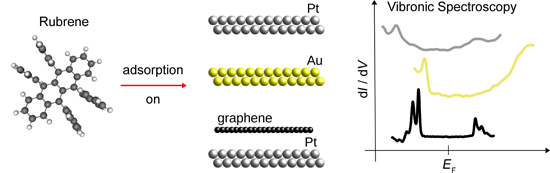
- . A template effect of graphene or a moiré lattice on the molecular assembly was not identified. Merely the orientation of the tetracene backbone perpendicular to a graphene crystallographic direction was observed. A finite residual coupling of the molecule to graphene-covered Pt(111) is likewise



Revealing the local crystallinity of single silicon core–shell nanowires using tip-enhanced Raman spectroscopy
Beilstein J. Nanotechnol. 2020, 11, 1147–1156, doi:10.3762/bjnano.11.99
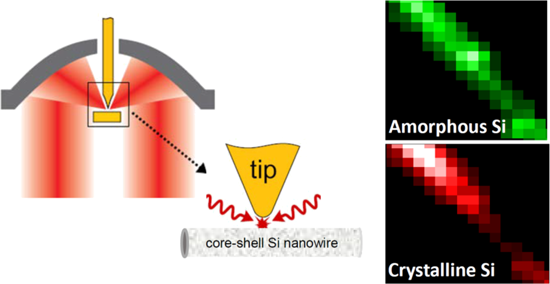
- popular method to investigate structural properties of silicon samples [16][17]. Mizoguchi et al. [18] and Hopkins et al. [19] utilized it to show the influence of stress on the crystal lattice orientation angles and to determine the degree of surface roughness. Kolb et al. measured the lattice
- grains with different orientation. Furthermore, catalyst migration along the SiNW backbone was observed in some cases (Figure 1c). Although the SiNWs grown by the VLS mechanism possess are crystalline, the silicon shells deposited onto the nanowires by thermal CVD (here using a temperature of 520 °C) can


Highly sensitive detection of estradiol by a SERS sensor based on TiO2 covered with gold nanoparticles
Beilstein J. Nanotechnol. 2020, 11, 1026–1035, doi:10.3762/bjnano.11.87
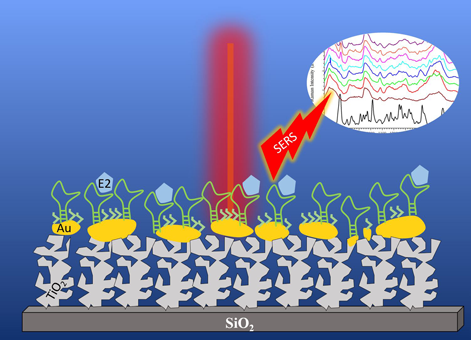
- orientation on the surface [31]. The MCH solution was prepared in phosphate-buffered saline (PBS) solution mixed with 10 mM MgCl2. The concentration of MCH was constant at 14.6 μM. The samples were rinsed three times with PBS and reverse osmosis water (RO water) to remove any unbound or excess molecules after



Gas-sensing features of nanostructured tellurium thin films
Beilstein J. Nanotechnol. 2020, 11, 1010–1018, doi:10.3762/bjnano.11.85
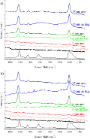
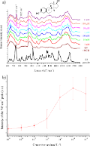
- predominant growth orientation of the nanocrystals. As a counter example, the XRD pattern of a Te film grown on Al2O3 substrates with a higher deposition rate ≈30 nm/s (Figure 2B, adapted from [27]) only shows two weak Te peaks (ASTM, 4-554). These type of films are considered amorphous. It should also be


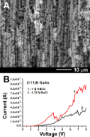
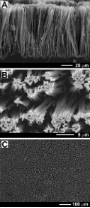
Electrochemical nanostructuring of (111) oriented GaAs crystals: from porous structures to nanowires
Beilstein J. Nanotechnol. 2020, 11, 966–975, doi:10.3762/bjnano.11.81
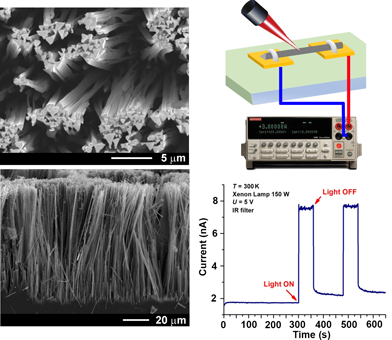
- with diameters of about 50 nm and oriented normally to a InP wafer, i.e., along the crystallographic [100] orientation, was obtained after anodic etching at elevated applied voltages [14]. High-aspect-ratio GaAs pillar arrays with triangular cross section were prepared by combining colloidal crystal
- in aqueous KOH solution [17]. However, this process was difficult to control. The bundles of GaAs nanowires were formed only in some regions of the surface and the orientation of the arrays was basically random. Usually, acidic or alcaline electrolytes are used for the electrochemical preparation of
- surface orientation, with an angle of approximately 109° between the pores. The pores tend to have a triangular cross section while the pore walls and tips exhibit a pronounced crystallographic anisotropy. A specific characteristic feature of crystallographically oriented pores is their ability to