


Search results
Search for "reflectance" in Full Text gives 228 result(s) in Beilstein Journal of Nanotechnology. Showing first 200.
Application of visible-light photosensitization to form alkyl-radical-derived thin films on gold
Beilstein J. Nanotechnol. 2017, 8, 1863–1877, doi:10.3762/bjnano.8.187
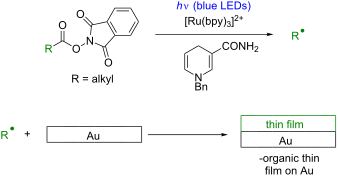
- irradiation all proved necessary for the deposition of robust films that could survive nanoshaving. In addition to characterizations with AFM, grazing angle infrared reflectance–absorbance spectroscopy (IRRAS), X-ray photoelectron spectroscopy (XPS), time-of-flight secondary ion mass spectrometry (TOF SIMS
- tips with an average spring constant of 0.6 N/m (Bruker Instruments, Camarillo, CA, USA). Digital images were processed with Gwyddion (v 2.30) software [53]. Grazing angle infrared reflectance absorbance spectroscopy (IRRAS): IRRAS spectra were recorded using a Bruker Tensor 27 instrument equipped with



Optical techniques for cervical neoplasia detection
Beilstein J. Nanotechnol. 2017, 8, 1844–1862, doi:10.3762/bjnano.8.186

- biochemical properties of tissues. The different methods, including spectroscopic (diffuse reflectance spectroscopy, induced fluorescence and autofluorescence spectroscopy, Raman spectroscopy) and imaging techniques (confocal microscopy, optical coherence tomography, Mueller matrix imaging polarimetry
- such as diffuse reflectance spectroscopy, fluorescence spectroscopy, Raman spectroscopy, in vivo confocal microscopy, optical coherence tomography and multi-wavelength imaging Mueller polarimetry, as well as the combination of different techniques have been explored to improve the detection of cervical
- neoplasia. The results of these studies as well as current trends to miniaturization of diagnostic instruments will be discussed further. Optical spectroscopy and imaging In vivo diffuse reflectance optical spectroscopy (DRS) exploits the fact that abnormal zones of the cervical epithelium illuminated with




Uptake and intracellular accumulation of diamond nanoparticles – a metabolic and cytotoxic study
Beilstein J. Nanotechnol. 2017, 8, 1649–1657, doi:10.3762/bjnano.8.165
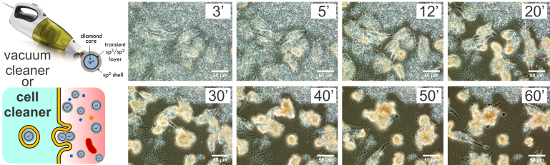
- prior to the grazing angle reflectance FTIR measurements. The optical absorbance was calculated in standard absorbance units as A = −log(R/R0), where R is the spectrum measured with NDs and R0 is the reference (background) spectrum recorded using the clean Au mirror before the NDs were applied. In all


Oxidative stabilization of polyacrylonitrile nanofibers and carbon nanofibers containing graphene oxide (GO): a spectroscopic and electrochemical study
Beilstein J. Nanotechnol. 2017, 8, 1616–1628, doi:10.3762/bjnano.8.161
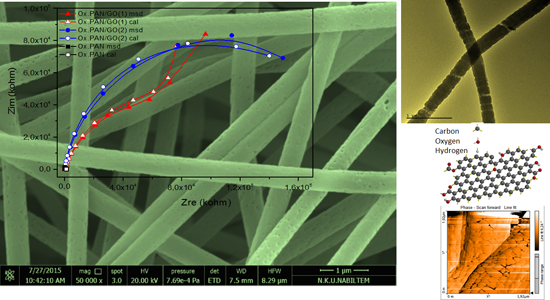
- morphological characterizations of the webs are carried out by using attenuated total reflectance Fourier transform infrared spectroscopy and Raman spectroscopy, scanning electron microscopy, atomic force microscopy and transmission electron microscopy. Mechanical tests are performed with a dynamic mechanical
- carbonization was performed at 900 °C for 1 h under nitrogen atmosphere. Characterization Attenuated total reflectance Fourier transform infrared spectroscopy (ATR-FTIR) and Raman spectroscopy were used to record the characteristic peaks of the oxidized and carbonized nanofibers. Mechanical properties of
- reflectance Fourier transform infrared spectroscopy (ATR-FTIR) (Perkin Elmer, Spectrum One, with a Universal ATR attachment with a diamond and ZnSe crystal). The microstructure of the carbonized nanofiber webs was investigated by Raman spectroscopy (DXR Raman spectrometer, Thermo Scientific, at 532 nm). The


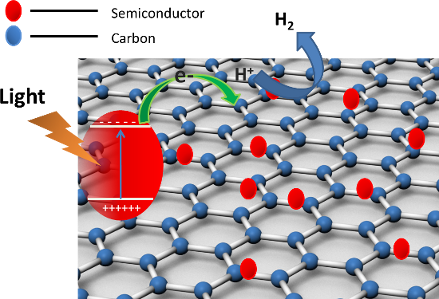
Two-dimensional carbon-based nanocomposites for photocatalytic energy generation and environmental remediation applications
Beilstein J. Nanotechnol. 2017, 8, 1571–1600, doi:10.3762/bjnano.8.159


Low-temperature CO oxidation over Cu/Pt co-doped ZrO2 nanoparticles synthesized by solution combustion
Beilstein J. Nanotechnol. 2017, 8, 1546–1552, doi:10.3762/bjnano.8.156

- ambient atmosphere. Raman spectra (100–750 cm−1) were obtained on a Horiba JY LabRAM HR 800 Raman spectrometer coupled with microscope in reflectance mode with 514 nm excitation laser sources and a spectral resolution of 0.3 cm−1. The amount of Cu and Pt in co-doped ZrO2 catalysts was confirmed using a




Oxidative chemical vapor deposition of polyaniline thin films
Beilstein J. Nanotechnol. 2017, 8, 1266–1276, doi:10.3762/bjnano.8.128
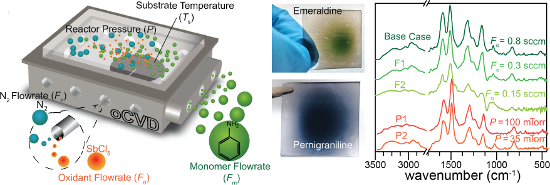
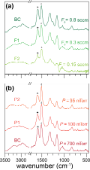
- a Thermo Nicolet 6700 spectrometer in transmission mode using an MCT/A detector at a resolution of 4 cm−1 and averaged over 128 scans. An FTIR spectrum of aniline monomer was also acquired in attenuated total reflectance (ATR) mode. Top-down SEM images were taken using a Zeiss Supra 50VP with the in




A top-down approach for fabricating three-dimensional closed hollow nanostructures with permeable thin metal walls
Beilstein J. Nanotechnol. 2017, 8, 1231–1237, doi:10.3762/bjnano.8.124
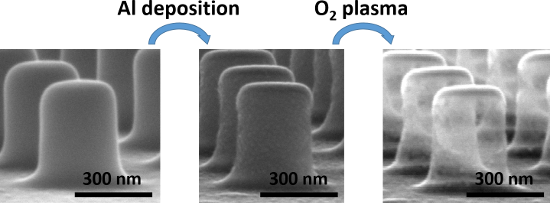
- . This hollow metal configuration features optical resonance as revealed by spectral reflectance measurements and numerical simulations. The fabricated nanocages were demonstrated as a refractometric sensor with a measured bulk sensitivity of 327 nm/refractive index unit (RIU). The pattern design
- of arrays of closed cylindrical nanocages of Al on a Si substrate. In addition, relevant optical and sensing properties of the hollow configuration are studied by reflectance measurements and simulations. Results and Discussion Scanning electron microscope (SEM) photographs in Figure 1 illustrate the
- measured spectral reflectance of a 600 nm period, square lattice of SU-8 nanopillars fabricated on an Al-coated Si substrate (blue curve), the same structure after the deposition of a 40 nm thick Al film (red curve), and the latter structure after an oxygen-plasma treatment (black curve). As analyzed in a


ZnO nanoparticles sensitized by CuInZnxS2+x quantum dots as highly efficient solar light driven photocatalysts
Beilstein J. Nanotechnol. 2017, 8, 1080–1093, doi:10.3762/bjnano.8.110
- spectrophotometer. The photoluminescence (PL) spectra were recorded on a Horiba Fluoromax-4 Jobin Yvon spectrofluorimeter. The diffuse reflectance spectra (DRS) were recorded on a Shimadzu 2600 UV–vis spectrophotometer. BaSO4 powder was used as a standard for baseline measurements and spectra were recorded in a
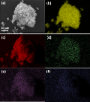
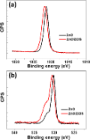
- photocatalyst. Supporting Information The Supporting Information contains UV–vis absorption, photoluminescence emission and diffuse reflectance spectra, Tauc plots, EDS analysis, XPS spectra, plots of ln(C0/C), an XRD pattern and an SEM image of the reused catalyst and the photocatalytic experiments in air




Optical response of heterogeneous polymer layers containing silver nanostructures
Beilstein J. Nanotechnol. 2017, 8, 1065–1072, doi:10.3762/bjnano.8.108
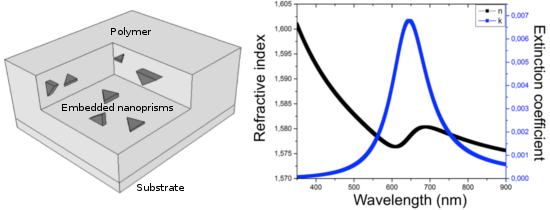
- , transfer matrix method (TMM) calculations of the reflectance were compared with reflectance measurements carried out on a spectrophotometer (Lambda 950, PerkinElmer). It should be noted that the complex refractive index is , where n is the frequency-dependent real refractive index, and k is the frequency
- indices were then used to calculate the reflectance using a TMM calculation. The calculated reflectance was compared to the measured reflectance (Figure 3) in order to validate the mathematical laws used to model the thin film layer. With the fit quality optimized, the comparison between the measured and
- calculated reflectance is necessary to verify the physical validity of the fit. The two curves follow the same tendency. The slight discrepancy in the reflectance spectra could be attributed to the measurement or to diffusion phenomena induced by the NPs, which is not taken into account in our ellipsometry


High photocatalytic activity of Fe2O3/TiO2 nanocomposites prepared by photodeposition for degradation of 2,4-dichlorophenoxyacetic acid
Beilstein J. Nanotechnol. 2017, 8, 915–926, doi:10.3762/bjnano.8.93
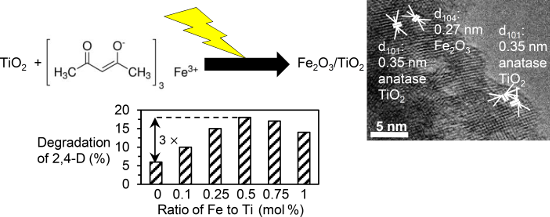
- the Fe(III) complex at 400 °C [5]. This is in contrast to the one prepared by the sol–gel method that showed an obviously reduced Eg value as the Fe ions were incorporated into the TiO2 lattice [7][19]. Diffuse reflectance (DR) UV–vis spectra and Tauc plots of the nanocomposites prepared by the


Synthesis of graphene–transition metal oxide hybrid nanoparticles and their application in various fields
Beilstein J. Nanotechnol. 2017, 8, 688–714, doi:10.3762/bjnano.8.74
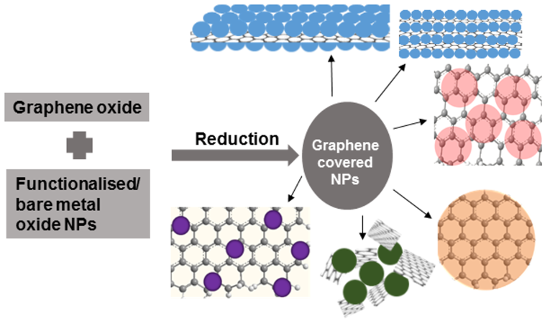
- excellent thermal (≈5000 W·m−1·K−1) [6] and electrical conductivity (up to 6000 S·cm−1) [7] and high theoretical specific surface area (2630 m2·g−1) [8]. Graphene is highly optically transparent (transmittance ≈97.7%) with absorption of <2.3% for visible light [9] and negligible reflectance (<0.1






Investigation of the photocatalytic efficiency of tantalum alkoxy carboxylate-derived Ta2O5 nanoparticles in rhodamine B removal
Beilstein J. Nanotechnol. 2017, 8, 604–613, doi:10.3762/bjnano.8.65
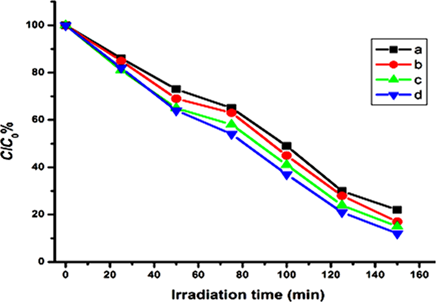
- . The distribution of particles is more uniform in the nanoparticles derived from carboxylato alkoxides than in those derived from alkoxides. UV–vis spectroscopy The optical properties of synthesized Ta2O5 nanoparticles were studied by UV–vis diffuse reflectance spectroscopy (DRS). The synthesized Ta2O5
- Ta2O5 synthesized from (a) Ta(On-Bu)4(OOCCH2Cl), (b) Ta(On-Bu)4(OOCCHCl2) and (c) Ta(On-Bu)4(OOCCCl3). Solid-state diffuse reflectance UV–vis spectrum and extrapolation of the band gap energy of Ta2O5 nanoparticles prepared from Ta(OEt)5. Degradation of RhB by Ta2O5 nanoparticles synthesized from (a) Ta


Graphene functionalised by laser-ablated V2O5 for a highly sensitive NH3 sensor
Beilstein J. Nanotechnol. 2017, 8, 571–578, doi:10.3762/bjnano.8.61
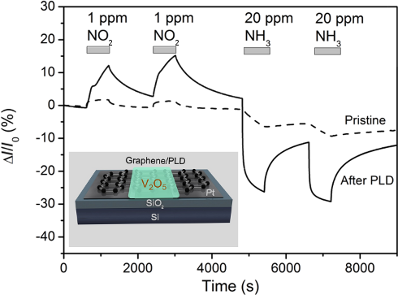
- observed as the result of the reaction of NH3 with two V2O5 adsorption sites, one with a surface OH group, forming positively charged NH4+, and the other with oxygen vacancy, forming species denoted as “coordinated NH3”. At the same time, the intensity of the V5+=O related band in the infrared reflectance


Thin SnOx films for surface plasmon resonance enhanced ellipsometric gas sensing (SPREE)
Beilstein J. Nanotechnol. 2017, 8, 522–529, doi:10.3762/bjnano.8.56
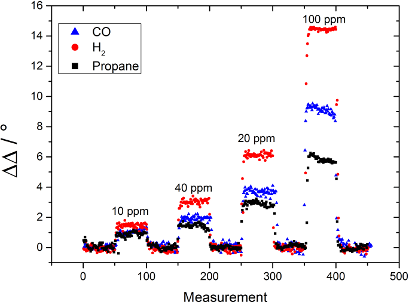
- complex reflectance ratio ρ after irradiation of a sample with linear polarized light is measured. For a simple two-media dielectric interface, the complex reflectance ratio is given by [26][27] with rp,s as the Fresnel coefficent and δp,s as the phase for the p- and s-polarization state. tanΨ and Δ are
- intermediate layer is gold, the effect of the surface plasmon resonance has to be taken into account for the description of the reflection coefficients. Because this phenomenon effects mostly the reflection coefficient of the p-polarized part Rp, the SPR effect can be described by the reflectance = |Rp|2
- . Close to the surface plasmon resonance, the reflectance can be written as with kx0 as the component of the wave vector of the incident light in the direction of the surface plasmon propagation and kSP = + iΓ∞ as the wave vector of a surface plasmon on an interface of two semi-infinite media according


Fiber optic sensors based on hybrid phenyl-silica xerogel films to detect n-hexane: determination of the isosteric enthalpy of adsorption
Beilstein J. Nanotechnol. 2017, 8, 475–484, doi:10.3762/bjnano.8.51
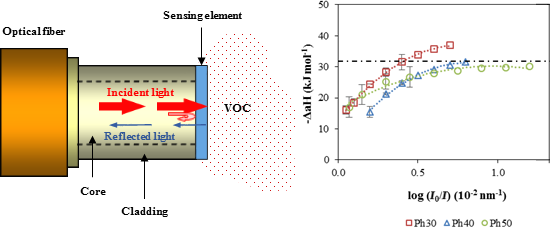
- , controlled porous texture that includes a specific surface area and average pore size distribution, and tunable surface chemistry. In the case of fiber optic reflectance sensors (FORSs), these sensitive films vary their optical properties upon interaction with the analyte, thereby resulting in a change in
- xerogel film covering the tip of the optical fiber, which acts as an optical cavity for which the fiber–xerogel provides the first interface and the xerogel–vapor provides the second interface. The reflectance of this sensing element may be expressed as follows [7][8][9]: In this equation, the
- the reflectance at the fiber–film interface and the sensor output signal. Furthermore, the reflectance is independent of temperature. The response of fiber optic sensors operating on reflection relies on the complex refractive index of the film and on the adsorption properties, which are related to






Fabrication of black-gold coatings by glancing angle deposition with sputtering
Beilstein J. Nanotechnol. 2017, 8, 434–439, doi:10.3762/bjnano.8.46
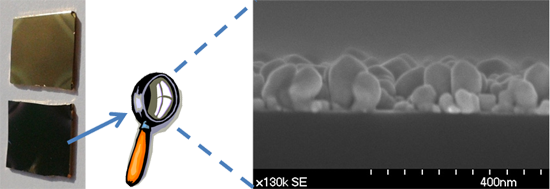
- ), on a Hitachi equipment working at 5 kV, and atomic force microscopy (AFM), on a Dimension Icon microscope from Bruker with super-sharp tips (radius about 3 nm) to minimize the inherent convolution with the shape of the probe. In order to study the optical behavior, spectral reflectance and
- the samples are responsible for their different appearance shown in Figure 2 and their distinctive spectral behavior presented in Figure 4, where the reflectance of the samples with black and golden color is plotted. For the sake of comparison, the calculated reflectance of a bare Si substrate and
- ). The most significant fact in Figure 4a is that the nanostructured samples deposited at high tilt angle exhibit low reflectance in the visible range (400–700 nm), less than 10% for the sample prepared with σ = 87° and less than 15% for that prepared with σ = 85°. Taking into account that the optical


Tailoring bifunctional hybrid organic–inorganic nanoadsorbents by the choice of functional layer composition probed by adsorption of Cu2+ ions
Beilstein J. Nanotechnol. 2017, 8, 334–347, doi:10.3762/bjnano.8.36
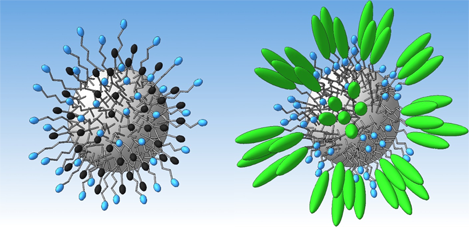
- surface layers were analyzed by diffuse reflectance infrared Fourier transform (DRIFT) spectroscopy, and 13C and 29Si solid-state NMR spectroscopy revealing their composition and organization. The fine chemical structure of the surface in the produced hybrid adsorbent particles and the ligand distribution
- were further investigated by electron paramagnetic resonance (EPR) and electron spectroscopy of diffuse reflectance (ESDR) spectroscopy using Cu2+ ion coordination as a probe. The composition and structure of the emerging surface complexes were determined and used to provide an insight into the
- potentially strong van der Waals bonding such as fluorinated groups. We also aimed to test the availability and reactivity of the amino function via Cu2+-cation adsorption as a probe, using electron paramagnetic resonance (EPR) and electron spectroscopy of diffuse reflectance (ESDR) spectroscopy. This


Colorimetric gas detection by the varying thickness of a thin film of ultrasmall PTSA-coated TiO2 nanoparticles on a Si substrate
Beilstein J. Nanotechnol. 2017, 8, 229–236, doi:10.3762/bjnano.8.25
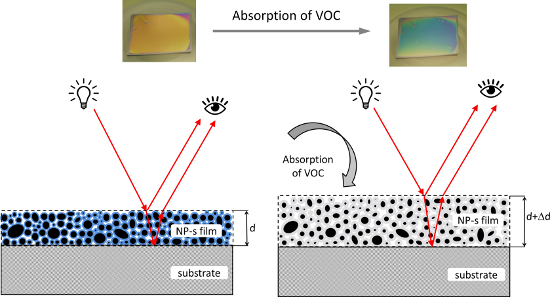
- regression algorithm. Ellipsometric measurements were generally performed at incidence and reflectance angles of 75°. TiO2 films made from NPs were modelled as homogeneous mixtures of supposedly dense materials, with the addition of voids for the adjustment of n and k. The optical properties of the thin
- equipped with an internal diffuse reflectance accessory (DRA). The DRA was configured so that both diffuse reflectance and specular reflectance were measured. The flow cell was attached to the measurement window of the DRA and was fastened securely. The flow cell (Figure 1) was constructed using 1 mm thick
- . Before filling the syringe with 20 mL of the gas mixture the gas was stirred for 3 min. During measurements, 20 mL of air with certain amounts of VOC vapor was injected with a syringe through the cell and the reflectance spectra were measured. After measurements, the cell was purged with 200 mL clean air


Performance of colloidal CdS sensitized solar cells with ZnO nanorods/nanoparticles
Beilstein J. Nanotechnol. 2017, 8, 210–221, doi:10.3762/bjnano.8.23
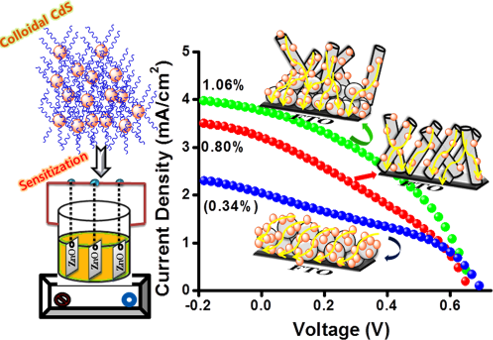
- reflectance spectra were measured on a UV–vis–NIR spectrometer (Shimadzu, UV-3600) on the considered films. Contact angle (CA) measurements were performed on a KRUSS Drop Shape Analyser, Germany (DSA-4). The photovoltaic J–V characteristics were measured using a solar simulator (Newport) at 100 mW/cm2 (1 sun
- sensitization on the photoanode. It is also interesting to notice the increased intensity of X-ray reflections of CdS after sensitization over ZnO-P compared to ZnO-R. The relatively lower reflectance spectrum of the CdS-sensitized ZnO-P illustrates a better CdS sensitization phenomenon and corroborates the XRD
- ) Diffuse reflectance spectrum of the same films compared to bare ZnO and (c) a digital image showing the difference in contact angle for ethanolic solution of N719 dye for ZnO-R and ZnO-P films. (a,b) Microstructural FESEM and TEM bright field images of synthesized ZnO-P and (c,d) ZnO-R. FESEM images of


Optical and photocatalytic properties of TiO2 nanoplumes
Beilstein J. Nanotechnol. 2017, 8, 190–195, doi:10.3762/bjnano.8.20
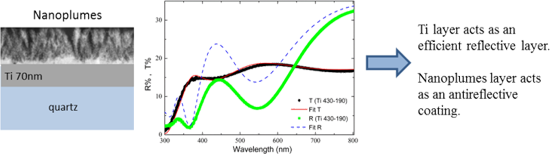
- , and as a consequence could favor the photocatalytic activity. In order to gain more insight into the realized structure, we performed transmittance (T) and reflectance (R) measurements in the range of 200–800 nm. The optical spectra are reported in Figure 4. The transmittance spectra (Figure 4a) show
- , and the dashed with the continuous line). The reflectance measurements are reported in Figure 4b. The total reflectance spectra of Ti (70-60) and Ti (70-150) present a shift in the reflectance peak, from 302 to 314 nm. This shift may be related to the variation on the sample thickness, due to the
- different chemical etching time. Although the measured spectra include wavelengths from 200 to 800 nm we will focus on the UV region, since the light source of photocatalytic experiments emits in this range (dashed vertical line). In this region the absolute values of reflectance for Ti (70-60) and Ti (70


Grazing-incidence optical magnetic recording with super-resolution
Beilstein J. Nanotechnol. 2017, 8, 28–37, doi:10.3762/bjnano.8.4
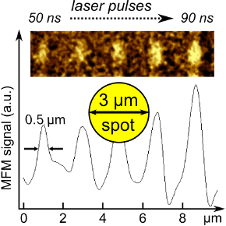
- absorption. Thermal modelling was done in Comsol MultiphysicsTM Version 5.2, using the heat module and the “Deposited Beam Power” feature. A loss of 5% at the DLC surface due to reflection was assumed, describing the case of p-polarized incident light, for which DLC has a particularly low reflectance at 70


Intercalation and structural aspects of macroRAFT agents into MgAl layered double hydroxides
Beilstein J. Nanotechnol. 2016, 7, 2000–2012, doi:10.3762/bjnano.7.191

- Fullprof suite program [57]. ChemBio 3D Ultra suite program was used to draw the molecular structure of macroRAFT copolymers, running MM2 energy-minimization. Attenuated total reflectance Fourier transform infrared (ATR-FTIR) spectra were measured in the range 400–4000 cm−1 on a FTIR Nicolet 5700 (Thermo


Monolayer graphene/SiC Schottky barrier diodes with improved barrier height uniformity as a sensing platform for the detection of heavy metals
Beilstein J. Nanotechnol. 2016, 7, 1800–1814, doi:10.3762/bjnano.7.173
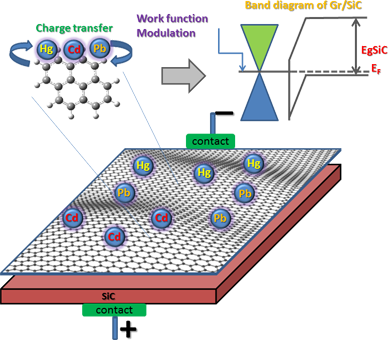
- The top-down sublimation growth process in an inductively heated furnace at 2000 °C under an argon pressure of 1 atm [50] was used to synthesize the 1 ML epitaxial graphene on n-type (nitrogen-doped) 4H-SiC (0001) substrates. A study of the grown samples by reflectance mapping and Raman
- our sample is characterized by the smallest value of the standard deviation for the Schottky barrier height. It can be explained by assuming a high uniformity of thickness (99% according to reflectance mapping) and barrier height. The derived values of the ideality factor of a diode junction suggest




Precise in situ etch depth control of multilayered III−V semiconductor samples with reflectance anisotropy spectroscopy (RAS) equipment
Beilstein J. Nanotechnol. 2016, 7, 1783–1793, doi:10.3762/bjnano.7.171
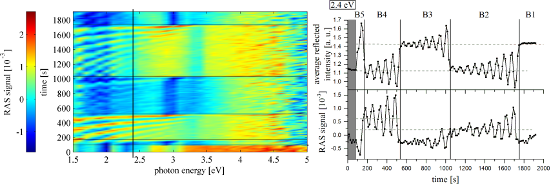
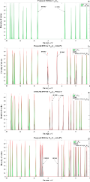
- Institut für Oberflächen- und Schichtanalytik (IFOS) GmbH, Trippstadter Str. 120, D-67663 Kaiserslautern, Germany 10.3762/bjnano.7.171 Abstract Reflectance anisotropy spectroscopy (RAS) equipment is applied to monitor dry-etch processes (here specifically reactive ion etching (RIE)) of monocrystalline
- sample in order to make RAS control possible. Keywords: broad area semiconductor lasers (BAL); dry-etch monitoring (RIE); precise etch depth control; reflectance anisotropy spectroscopy (RAS); III–V semiconductors; Introduction Reflectance anisotropy/difference spectroscopy (RAS/RDS) [1][2][3][4][5] is
- axes): with the reflectances/reflectivities R of the relevant directions of linear polarization designated by Miller’s indices of the corresponding principal axes (in this example [110] and ) and the total average reflectance/reflectivity [3][4][6][8]. In case the signal is given as a function of





