


Search results
Search for "thiol" in Full Text gives 179 result(s) in Beilstein Journal of Nanotechnology.
Photocatalytic antibacterial performance of TiO2 and Ag-doped TiO2 against S. aureus. P. aeruginosa and E. coli
Beilstein J. Nanotechnol. 2013, 4, 345–351, doi:10.3762/bjnano.4.40
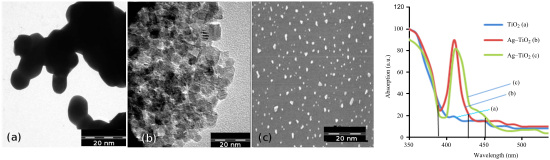
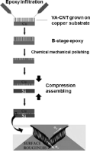
- ]. The simplest photocatalytic mechanism of silver ions is that it may take part in catalytic oxidation reactions between oxygen molecules in the cell and hydrogen atoms of thiol groups, i.e., two thiol groups become covalently bonded to one another through disulfide bonds (R–S–S–R), which leads to


Guided immobilisation of single gold nanoparticles by chemical electron beam lithography
Beilstein J. Nanotechnol. 2013, 4, 336–344, doi:10.3762/bjnano.4.39
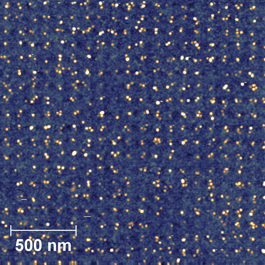
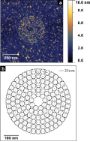
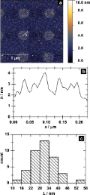
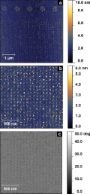
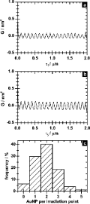
- interest. In this paper we present a straight-forward three-step procedure based on chemical electron beam lithography, which is capable of producing such arrays with gold nanoparticles (AuNPs). Preformed 6 nm AuNPs are immobilised on thiol patterns with a pitch of 100 nm by guided self-assembly
- in any type of periodic or aperiodic pattern. In order to make new steps in this direction, in this work, we present the local reduction of sulfonic acid terminated SAMs into thiol-terminated SAMs by CEBL on electron-transparent SiO2 membranes, which enabled us to analyse the site-selective
- immobilisation of AuNPs by scanning electron microscopy in transmission (SEM-T) and by atomic force microscopy (AFM). Based on these analyses, we were able to optimise the process yielding periodic patterns of single 6 nm AuNPs. Results and Discussion Generation of thiol groups on thin Si/SiO2 membranes


Selective surface modification of lithographic silicon oxide nanostructures by organofunctional silanes
Beilstein J. Nanotechnol. 2013, 4, 218–226, doi:10.3762/bjnano.4.22
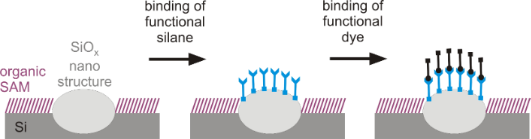
- silicon oxide surfaces are silane compounds such as trichlorosilanes or ethoxysilanes [20][21]. In order to provide the possibility for further chemical modification, functional silanes are of major interest. These molecules possess a functional head-group (e.g., carboxyl, amino or thiol group) in
- functional group. This group is reactive towards nucleophiles such as amine or thiol groups. A successful large-scale binding of FITC to amino-terminated silicon surfaces [27] has been demonstrated previously by fluorescence measurements [28]. The attachment of FITC on the oxide nanostructures is realized in


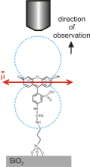
![[Graphic 2]](/bjnano/content/inline/2190-4286-4-22-i2.png?max-width=637&scale=1.18182) (red arrow) of FITC bound to a SiO2 surface.
(red arrow) of FITC bound to a SiO2 surface.
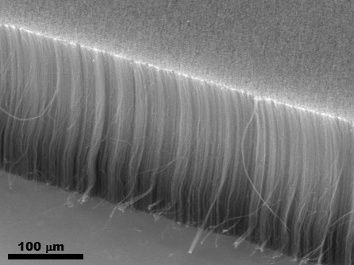
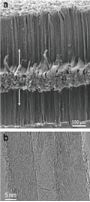
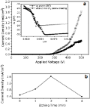
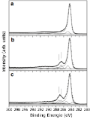
Functionalization of vertically aligned carbon nanotubes
Beilstein J. Nanotechnol. 2013, 4, 129–152, doi:10.3762/bjnano.4.14








Current–voltage characteristics of single-molecule diarylethene junctions measured with adjustable gold electrodes in solution
Beilstein J. Nanotechnol. 2012, 3, 798–808, doi:10.3762/bjnano.3.89
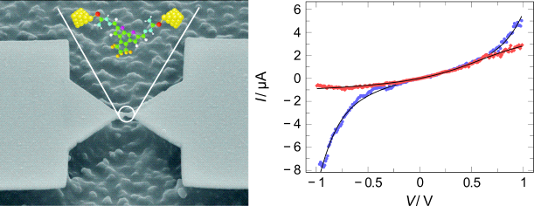
- (physisorption). In the case of physisorption, one can expect that the current is mediated by tunneling. For thiol end-groups on gold, it has been shown that both chemisorption and physisorption is possible [42][43][44] depending on the surface morphology and the deposition method. For the amine end-group the
- experimental situation is not so clear. However, since in most studies in which molecules with the same molecular core but different end-groups are compared, a higher conductance is found for thiol-terminated molecules than for amine-terminated [39][45], we expect that in the asymmetric junctions the coupling
- on one side is realized through the thiol end-group and on the other side-arm through the amine end-group. We now discuss our findings and data analysis of the species 4Py, which we probed in the closed state only. Examples of I–V’s and their fittings for the symmetric and the asymmetric case are


Controlled positioning of nanoparticles on a micrometer scale
Beilstein J. Nanotechnol. 2012, 3, 773–777, doi:10.3762/bjnano.3.86
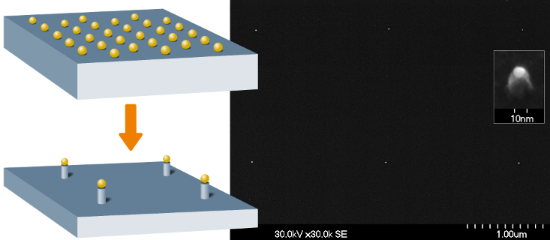
- through a thiol-group. To suppress interactions between nanoparticles or the molecules bound to them, usually interparticle distances of 50 nm are sufficient (for a recent study on near-field effects around a single dot see [27]). To guarantee single particle/molecule spectroscopy significantly larger


Paper modified with ZnO nanorods – antimicrobial studies
Beilstein J. Nanotechnol. 2012, 3, 684–691, doi:10.3762/bjnano.3.78
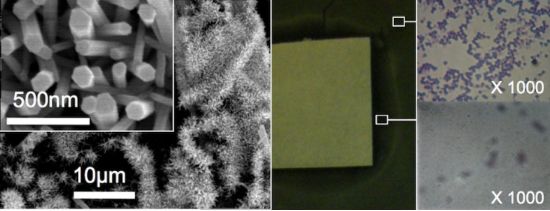
- . As a result, the ZnO nanoparticles that are used for nucleating the nanorods get attached to the surface without the need for any further surface treatments, such as, for example, the surface treatment of polyethylene fibers with dodecane thiol for attachment of ZnO seed nanoparticles prior to


Horizontal versus vertical charge and energy transfer in hybrid assemblies of semiconductor nanoparticles
Beilstein J. Nanotechnol. 2012, 3, 629–636, doi:10.3762/bjnano.3.72
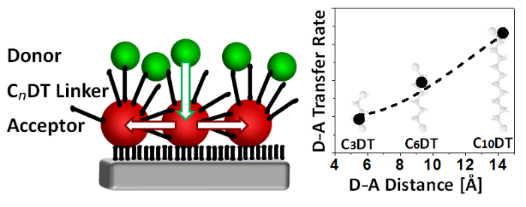
- . Experimental The NP assemblies were prepared as described previously [4]. Briefly, a monolayer of (3-mercaptopropyl)trimethoxysilane was self-assembled on quartz (Qz, fused silica) substrates. Next, a monolayer of core-only CdSe NPs (~6.3 nm diameter, emission peak at 641 nm) was attached to the thiol tail
- -octanedithiol (C8DT), and 1,10-decanedithiol (C10DT). Control experiments were performed with molecules of the same lengths but with only one thiol group. These molecules will be denoted as monothiols (MT, e.g., C6MT for 1-hexanethiol). To form the second layer of NPs, the samples were immersed in a solution of
- quenching was independent of the linker length. This effect is well known for CdSe NPs; it results from the formation of surface traps owing to the thiol binding [28][29][30][31]. The PL quenching, which is independent of the MT length, indicates that the number of traps is the same for all linkers, and


Mapping mechanical properties of organic thin films by force-modulation microscopy in aqueous media
Beilstein J. Nanotechnol. 2012, 3, 464–474, doi:10.3762/bjnano.3.53
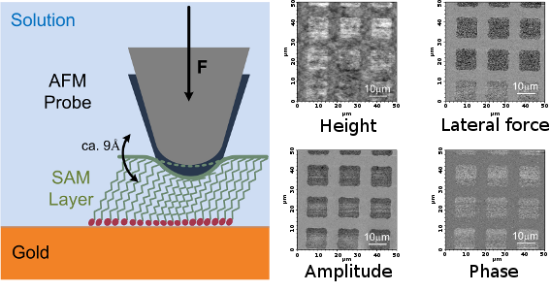
- and contact forces, and (ii) in the unambiguous interpretation of the contrast in the amplitude images [38][39][40]. We demonstrate the capability of FMM to image mechanical properties in aqueous media on surface-tethered proteins and self-assembled EG3-thiol (triethylene glycol mono-11
- in aqueous solution. Future work to quantify these properties requires additional analytical models that capture the interaction of the cantilever beam with the liquid environment. FMM on patterned EG3-thiol monolayers The properties and applications of alkanethiol self-assembled monolayers (SAMs) on
- gold surfaces have been the subject of interface science research for many years. The self-assembly of alkane thiol molecules on gold surfaces is a two-step process. The initial physisorption step on gold substrates is typically slow and concentration-dependent [55]. Once in contact, the molecules



Colloidal lithography for fabricating patterned polymer-brush microstructures
Beilstein J. Nanotechnol. 2012, 3, 397–403, doi:10.3762/bjnano.3.46
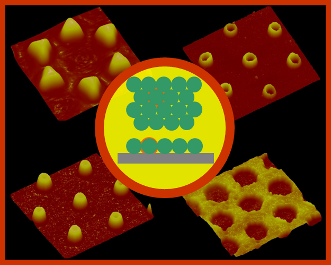
- obtained by sputter deposition of the metal [2][4]. When gold is chosen as the metal, the ensuing pattern can be easily functionalized chemically with a self-assembled monolayer (SAM) of a thiol initiator, which can be subsequently amplified into polymer brushes. Figure 1 shows this strategy for the
- between the microspheres (Figure 1A). After the microsphere mask was removed by sonication, an array of hexagonally arranged triangular gold islands remained (Figure 1B) on which we formed a SAM of thiol initiator (BrC(CH3)2COO(CH2)11SH) [27]. We then synthesized poly(N-isopropylacrylamide) (PNIPAAM
- –surface contact area. This so-called edge-spreading lithography (ESL) employing colloid microspheres as templates has been previously used to fabricate ring-shaped metal patterns [9]. Here we replaced the octadecanethiol (ODT) molecules with thiol initiator (BrC(CH3)2COO(CH2)11SH), and amplified the


Functionalised zinc oxide nanowire gas sensors: Enhanced NO2 gas sensor response by chemical modification of nanowire surfaces
Beilstein J. Nanotechnol. 2012, 3, 368–377, doi:10.3762/bjnano.3.43
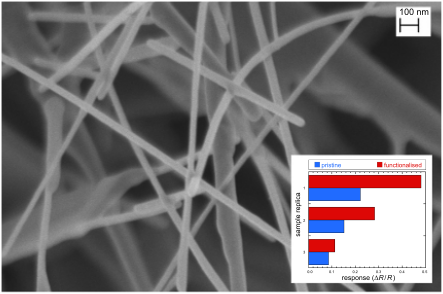
- the thiol. The long DT hydrocarbon chains were expected to create a strongly hydrophobic surface. Similarly ZnO nanowire sensors were functionalised by tris(hydroxymethyl)aminomethane (THMA), and the response of THMA-functionalised sensors was compared to that of the unfunctionalised ZnO nanowire
- thiol (confirmed by FTIR) raised the conductivity of each individual sensor above the measurement range of our instrument (which corresponds to a minimum conductance value of Gmax = 10 mS). We conclude from this that chemisorption of the thiol significantly increased the density of electrons present in


Variations in the structure and reactivity of thioester functionalized self-assembled monolayers and their use for controlled surface modification
Beilstein J. Nanotechnol. 2012, 3, 213–220, doi:10.3762/bjnano.3.24
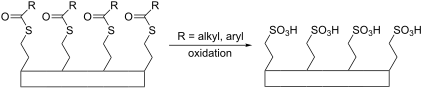
- ]. The preparation of (S)-undec-10-enyl thioacetate from ω-undecenylbromide followed the previously published procedure [17]. ω-Undecenyl thiol was prepared by acid hydrolysis of the thioacetate, as follows: In a round-bottom flask (250 mL) equipped with a magnetic stirring bar and a reflux condenser
- (50 mL) and brine (50 mL). The hexane was dried over MgSO4 and filtered, and the solvent was removed on a rotovap. The crude ω-undecenyl thiol was purified by flash chromatography (hexane): Yield 6.02 g (82%); 1H NMR δ 1.20–1.47 (m, 13H), 1.61 (m, 2H), 2.04 (m, 2H), 2.52 (q, J = 7.5 Hz, 2H), 4.93 (m
- , 2H), 5.81 (ddt, J = 6.6, 10.2, 17 Hz, 1H); 13C NMR δ 24.80, 28.51, 29.06, 29.20, 29.24, 29.56, 29.59, 33.95, 34.19, 114.27, 139.36. The general procedure for the conversion of ω-undecenyl thiol into the thioester–olefin precursors for compounds 1b–i, 2, 3 and 4 is as follows: In a dry, round-bottom


Parallel- and serial-contact electrochemical metallization of monolayer nanopatterns: A versatile synthetic tool en route to bottom-up assembly of electric nanocircuits
Beilstein J. Nanotechnol. 2012, 3, 134–143, doi:10.3762/bjnano.3.14
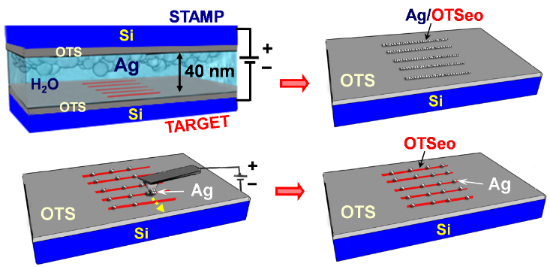
- different from those usually produced in conventional electrochemical deposition on thiol/gold monolayers [36][37][38][39][40][41][42][43][44][45], which may occur in the monolayer-free regions of a destructively patterned monolayer [36][37][38][39][40][41][42], underneath the monolayer [41][42], or on top


Electron-beam patterned self-assembled monolayers as templates for Cu electrodeposition and lift-off
Beilstein J. Nanotechnol. 2012, 3, 101–113, doi:10.3762/bjnano.3.11
- Zhe She Andrea DiFalco Georg Hahner Manfred Buck EaStCHEM School of Chemistry, University of St. Andrews, KY16 9ST, U.K School of Physics and Astronomy, University of St. Andrews, KY16 9ST, U.K 10.3762/bjnano.3.11 Abstract Self-assembled monolayers (SAMs) of 4'-methylbiphenyl-4-thiol (MBP0
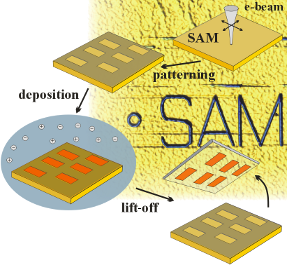
- hexadecane thiol (CH3(CH2)15SH, MC16) as a blocking thiol [15]. The present paper is an investigation of a scheme for creating surface features with smaller dimensions by using e-beam patterning of a single-component SAM of ω-(4'-methylbiphenyl-4-yl)thiol (CH3–C6H4–C6H4–SH, MBP0). While selective deposition
- affecting the nucleation rate is specific to metals that bind more strongly to the thiol head group than the original substrate metal. In this case the metal deposited at defects can easily intercalate and diffuse at the SAM–substrate interface [48]. In the case of templated deposition by means of an e-beam





Substrate-mediated effects in photothermal patterning of alkanethiol self-assembled monolayers with microfocused continuous-wave lasers
Beilstein J. Nanotechnol. 2012, 3, 65–74, doi:10.3762/bjnano.3.8
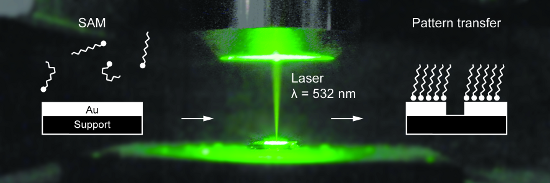
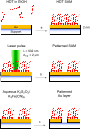
- , thermal desorption of the thiol molecules is initiated [11]. Subsequently, the Au layer in these laser-depleted surface areas was removed by means of wet-chemical etching [11][29]. For this purpose, the patterned substrates were immersed into an aqueous solution of K2S2O3 and K3Fe(CN)6. The HDT SAM acts
- emitted power of a laser pointer. This opens up an opportunity for truly cost-effective laser processing of thiol-based SAMs. In addition, parallel processing, e.g., by using micromirror displays [34], appears feasible. The choice of the support material, of course, also affects the lateral resolution of
- . At a constant irradiation time, a certain temperature is required in order to induce substantial desorption of thiol molecules [21][22][37]. Following Equations 3–11 this necessitates a critical laser power density. Processing at short irradiation times demands high power densities, which may lead to




Transmission eigenvalue distributions in highly conductive molecular junctions
Beilstein J. Nanotechnol. 2012, 3, 40–51, doi:10.3762/bjnano.3.5
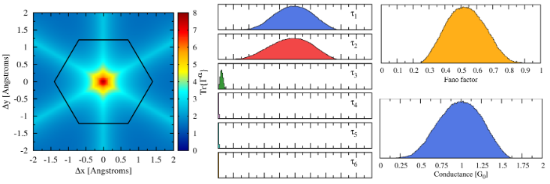
- ][12] to transport through SMJs utilized a semiempirical Hamiltonian [13] for the π-electrons, which accurately describes the gas-phase spectra of conjugated organic molecules. Although this approach should be adequate to describe molecules weakly coupled to metal electrodes, e.g., by thiol linkages
- the rank of Γα is equal to the number of covalent bonds formed between the two. For example, in a SMJ where a Au electrode bonds to an organic molecule through a thiol group, only a single bond is formed, and there is only one significant transmission channel [15][16]. In Pt–benzene–Pt junctions


![[Graphic 39]](/bjnano/content/inline/2190-4286-3-5-i64.png?max-width=637&scale=1.18182) (top panel) and Tr{Γ} (bottom panel) over the ensemble describ...
(top panel) and Tr{Γ} (bottom panel) over the ensemble describ...


X-ray spectroscopy characterization of self-assembled monolayers of nitrile-substituted oligo(phenylene ethynylene)s with variable chain length
Beilstein J. Nanotechnol. 2012, 3, 12–24, doi:10.3762/bjnano.3.2
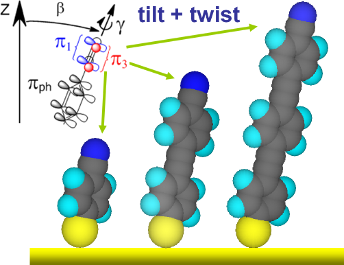
- were combined with a suitable anchor (head) group having a strong affinity to the selected substrate. The most frequently used group in this regard is thiol, which allows SAM-like assembly of the molecules on coinage metal and various semiconductor substrates, for example Au and GaAs, respectively
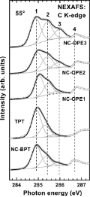
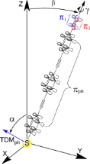
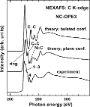
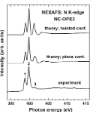
- spectra is shown in detail in Figure 4, along with the spectra of the two reference systems, viz. SAMs of nitrile-substituted biphenylthiol (NC-BPT) [30] and 1,1′;4′,1″-terphenyl-4-thiol (TPT) [42][43] on Au. The spectra of the target films are dominated by a strong peak, consisting of at least three
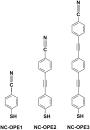
- integrity of the SAMs, infrared spectra were obtained. In all cases the SAMs had the expected spectra based on reference spectra of the pure thiol molecules used for self-assembly. A schematic drawing of the target molecules along with their acronyms. S 2p (a), C 1s (b), and N 1s (c) HRXPS spectra of the



Self-assembled monolayers and titanium dioxide: From surface patterning to potential applications
Beilstein J. Nanotechnol. 2011, 2, 845–861, doi:10.3762/bjnano.2.94
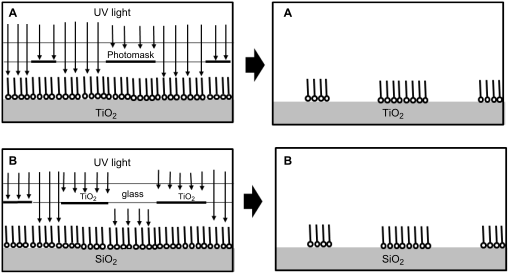
- dioxide was grown from a solution containing titanium sulfate and hydrogen peroxide [34]. Obtaining SAMs with sulfonate outer groups is not trivial. It is usually done either by reacting chemisorbed SAMs having a thioacetate terminal group [33] or by reacting terminating thiol groups with H2O2 in acetic
- ) heterojunction nanowires by a “bottom-up” approach [96]. Here, Au–TiO2–Au nanowires were prepared within nanoholes of anodic aluminum oxide templates. The preparation procedure included the deposition of gold by electroplating, chemisorption of 1,8-octanedithiol (HS–(CH2)8–SH), oxidation of the terminal thiol

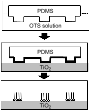


Direct monitoring of opto-mechanical switching of self-assembled monolayer films containing the azobenzene group
Beilstein J. Nanotechnol. 2011, 2, 834–844, doi:10.3762/bjnano.2.93
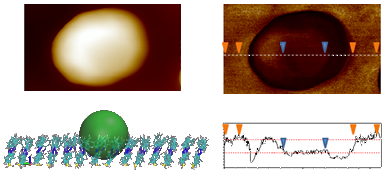
- atomic force microscopy (AFM) and atomistic computational study of the change in local stiffness, as induced by the optical cis↔trans conversion in a SAM of 4'-{[(1,1'-biphenyl)-4-yl]diazenyl}-(1,1'-biphenyl)-4-thiol (thio-2-DA). The experimental variation in stiffness shows quantitative agreement with
- Experimental methods Preparation of 4'-{[(1,1'-biphenyl)-4-yl]diazenyl}-(1,1'-biphenyl)-4-thiol (2, thio-2-DA) Initial attempts to prepare monolayers directly from compound 1 as reported previously [23][24] were unsuccessful. Therefore, a reduction was carried out as indicated in Figure 7, and outlined below
- and the mixture was sealed and stirred at room temperature for 4 h. The solvents were then evaporated under reduced pressure affording the thiol 2, thio-2-DA, which was used without further purification; 1H NMR (CDCl3) δ 3.5 (s, –SH), 7.4 (d, 3H), 7.5 (t, 2H), 7.6 (d, 2H), 7.7–7.8 (m, 6H), 8.0 (m, 4H
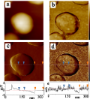



Mechanical characterization of carbon nanomembranes from self-assembled monolayers
Beilstein J. Nanotechnol. 2011, 2, 826–833, doi:10.3762/bjnano.2.92
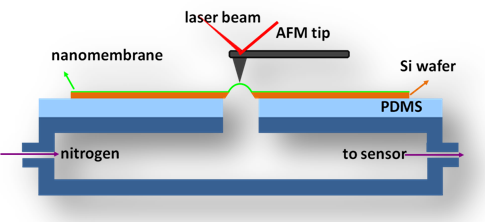
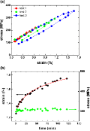
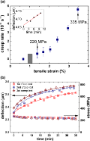
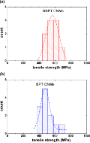
- terminal and/or anchor groups were used to prepare the CNMs, such as 4'-[(3-trimethoxysilyl)propoxy]-[1,1'-biphenyl]-4-carbonitrile (CBPS), 1,1'-biphenyl-4-thiol (BPT) and 4-nitro-1,1'-biphenyl-4-thiol (NBPT). The elastic properties, viscoelastic behaviors and ultimate tensile strength of these biphenyl
- case of biphenylthiol CNMs, chemical bonds between the CNM and silicon are unlikely, as intermolecular disulfide bonds form immediately after the cleavage of the thiol-CNM from its original gold substrate. Because flexible CNMs may even conform to surfaces with a nanoscale roughness, the adhesion
- biphenyl molecules were used to fabricate CNMs. SAMs of 4'-[(3-trimethoxysilyl)propoxy]-[1,1'-biphenyl]-4-carbonitrile (CBPS) were formed on silicon nitride, SAMs of 4'-nitro-1,1'-biphenyl-4-thiol (NBPT) and 1,1'-biphenyl-4-thiol (BPT) on gold surfaces. The thickness of the respective SAMs was determined

Towards quantitative accuracy in first-principles transport calculations: The GW method applied to alkane/gold junctions
Beilstein J. Nanotechnol. 2011, 2, 746–754, doi:10.3762/bjnano.2.82
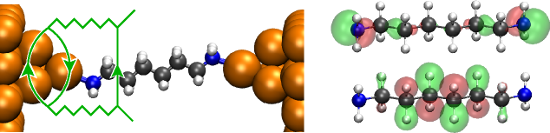
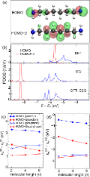
- structure of the molecule as well as the detailed atomic structure of the metal–molecule contact. Variations in the contact geometry beyond experimental control lead to an undesired spread in the measured conductance properties. For the most commonly used anchoring group, –thiol, these effects are rather
- investigated experimentally [1][12][33][34][35][36][37][38][39][40][41][42][43][44]. We focus here on the amine-linked alkanes to avoid the uncertainties related to the gold–thiol contact geometry, which is presently under debate [45][46][47][48][49][50]. We note that very recently it was shown that alkanes



Charge transport in a zinc–porphyrin single-molecule junction
Beilstein J. Nanotechnol. 2011, 2, 714–719, doi:10.3762/bjnano.2.77
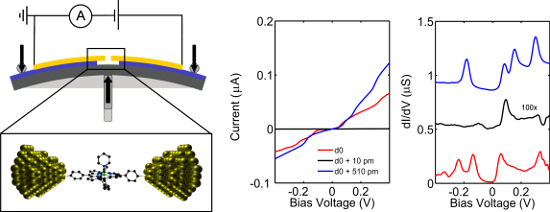
- complex of zinc(II) 5,15-di(p-thiolphenyl)-10,20-di(p-tolyl)porphyrin and pyridine (ZnTPPdT–Pyr) (see Figure 1a for the structural formula) was dissolved in dichloromethane (DCM) and deposited on the unbroken electrodes by means of self-assembly from solution. Two thiol groups on opposite sides of the


An MCBJ case study: The influence of π-conjugation on the single-molecule conductance at a solid/liquid interface
Beilstein J. Nanotechnol. 2011, 2, 699–713, doi:10.3762/bjnano.2.76
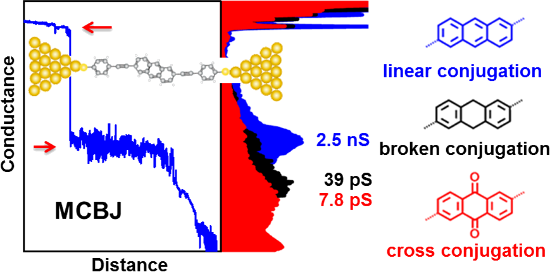
- ), which leads to the most probable conductance value of 10−4.5 G0 for a single gold|AC|gold junction. Further pulling causes an elongation of the Au–thiol bond until the junction breaks. The low-conductance feature is attributed to the formation of molecular stacks after breaking of the gold leads [44][62




The atomic force microscope as a mechano–electrochemical pen
Beilstein J. Nanotechnol. 2011, 2, 659–664, doi:10.3762/bjnano.2.70
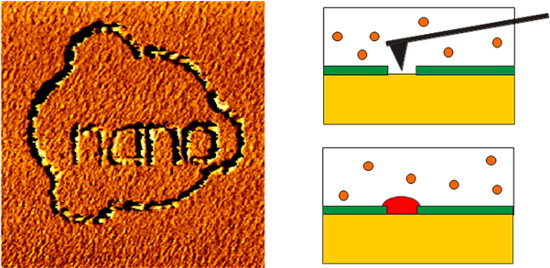
- passivation layer. This passivation layer consists of oxo-anions of the electrolyte, such as sulphate or hydrogen sulfate, which are well known from literature to cover metal films in their presence [29][30][31][32][33]. Alternatively, thiol molecules were used in our experiments as an organic passivation
- layer. These thiol molecules have a higher adhesion to the substrate but are not necessary for a precise deposition and are therefore not discussed in any more detail below. While an electrochemical potential appropriate for tip-induced electrochemical deposition is applied to the gold electrode


Fabrication of multi-parametric platforms based on nanocone arrays for determination of cellular response
Beilstein J. Nanotechnol. 2011, 2, 545–551, doi:10.3762/bjnano.2.58
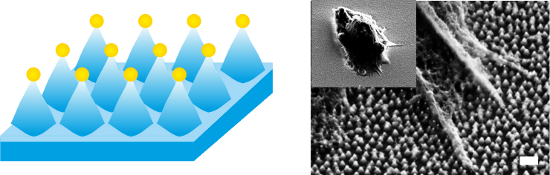
- substrates through a thiol linker system. Improved neural cell adhesion can be obtained and is dependent on the nature of the nanocone surface, thus illustrating the influence of different surface topographies on the nanometer length scale, on a complex cellular behavior such as cell adhesion. Substrate and
- on large areas. Gold nanoparticles on top of the nanostructures allow for spatially resolved functionalization with a variety of biomolecules through simple thiol chemistry. A 3,3'-dithiobis(sulfosuccinimidylpropionate) (DTSSP) linker molecule was used to immobilize laminin, an extracellular matrix
- human neuroblastoma cells. Figure 2 shows adhered SHSY5Y human neuroblastoma cells on top of the nanostructured arrays. The gold-tipped nanocones were biofunctionalized with laminin with DTSSP as a thiol-based linker between the gold tips and the protein. Laminin is a protein that mediates cell adhesion





