Search results
Search for "trapping" in Full Text gives 185 result(s) in Beilstein Journal of Nanotechnology.
Liquid-phase exfoliated graphene: functionalization, characterization, and applications
Beilstein J. Nanotechnol. 2014, 5, 2328–2338, doi:10.3762/bjnano.5.242
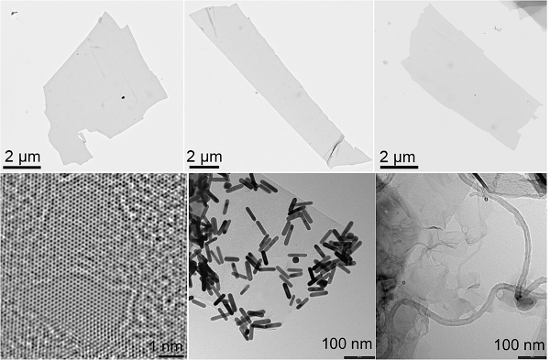
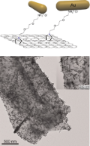
- and damage of graphene layers, (3) the Fc–CHO adsorption at the edges of graphene layers inducing the rolling up of a sheet to form a nanoscroll (schematically indicated in Figure 4), (4) the trapping of Fc–CHO into the scroll, and (5) finally, Fc–CHO accepts and donates unpaired electrons to the




Advances in NO2 sensing with individual single-walled carbon nanotube transistors
Beilstein J. Nanotechnol. 2014, 5, 2179–2191, doi:10.3762/bjnano.5.227
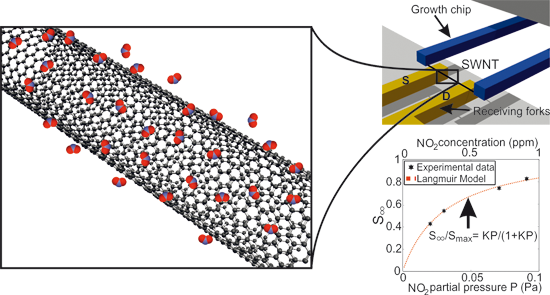
- trapping in the oxide and the dielectrics surrounding the nanotube. Robert-Peillard et al. [61] developed a model to qualitatively describe this phenomenon by using Fowler–Nordheim-type behavior for charge trapping by tunneling through the oxide layer. Although this model qualitatively describes the
- the gate voltage, the duration in which trapping can occur is reduced, and the charges have time to de-trap in the time between gate pulses, thereby reducing the induced screening. Building on this idea, Mattmann et al. [64][65] showed that by applying alternating gate pulses, i.e, every positive gate
- readout electronics. If charge trapping in the nanotube surroundings is the primary cause of hysteresis, eliminating these sources, for example by using a protective layer to avoid resist contamination on the SWNT, could be effective in reducing hysteresis [17][66]. By using a protective layer that can


Sequence-dependent electrical response of ssDNA-decorated carbon nanotube, field-effect transistors to dopamine
Beilstein J. Nanotechnol. 2014, 5, 2113–2121, doi:10.3762/bjnano.5.220
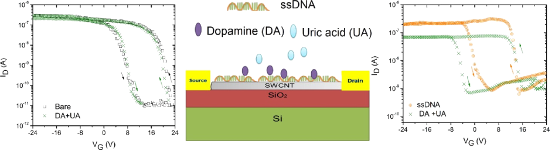
- increase in H indicates the contribution of carrier scattering, charge transfer and charge trapping mechanisms, respectively [17]. From the above results, three important points are noteworthy. First, the absence of the response to UA in the ssDNA-decorated device suggests the lack of interaction between
- voltage (−∆Vth) [25]. The electron donation to the SWCNT reduces the charge carrier concentration inside the nanotubes resulting in the formation of static charges, which reduces the slope of the transfer curve by generation of carrier scattering (−∆gmp/gmp) [17]. Furthermore, the charge trapping ability
- gap, which indicates the combination of carrier scattering, charge transfer and charge trapping mechanisms. In addition, ssDNA decoration of the SWCNT improved DA recognition even in the presence of the interferent, UA, which highlights the enhancement in molecular selectivity. The devices exhibited a


Effect of channel length on the electrical response of carbon nanotube field-effect transistors to deoxyribonucleic acid hybridization
Beilstein J. Nanotechnol. 2014, 5, 2081–2091, doi:10.3762/bjnano.5.217
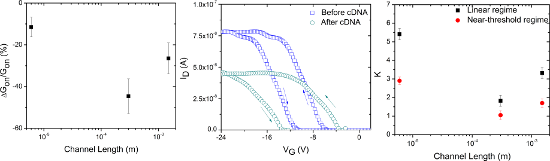
- contribution of charge-trapping mechanism to the observed behavior [27][28]. Similar DNA detection studies using CNTs based on the principle of impedance exhibited detection limits as low as 100 aM [29]. To verify whether the source of the signal is from the CNT channel, ID–VG curves of FETs with only the
- threshold voltage shift for forward (ΔVfth) and reverse (ΔVrth) gate voltage sweeps, and the change in hysteresis gap (ΔH) with L increased from about −0.5 to −2.5 V, 1 to 3 V and 1.5 to 5 V, respectively. The shift in Vth to more negative values for the forward sweep indicates electron trapping by the
- guanine and adenine bases [28][31]. Similarly, the shift in Vth to more positive values for the reverse sweep is an indicator of hole trapping by the cytosine and thymine bases [28][31]. Thus, the increase in charge traps in the channel region leads to an overall shift in Vth for forward and reverse


Silicon and germanium nanocrystals: properties and characterization
Beilstein J. Nanotechnol. 2014, 5, 1787–1794, doi:10.3762/bjnano.5.189
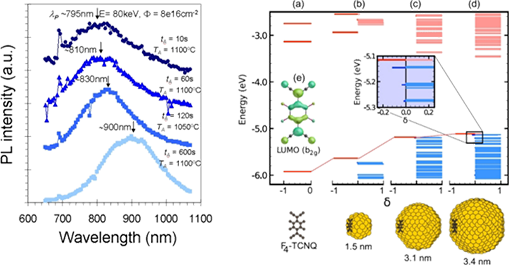
- enhancement. This is only valid for small NCs, while the enhancement diminishes as the density of larger NCs increases. As already mentioned, one of the main applications of the embedded NCs is in memory devices. To check the charge trapping properties of the embedded NCs, different electrical
- characterization techniques could be applied. The most common is the capacitance-voltage (C–V) technique that gives information about the memory window. Moreover, C–V gives valuable information as far as interface-defects and oxide defects are concerned. There are numerous studies on the charge-trapping properties
- of embedded NCs. However, it should be noted that in a significant number of those, the effects of defects (either interface-related or in the oxide) have been completely neglected, and the observed memory window (the flat band voltage shift ΔVFB) has been unconditionally ascribed to the NCs trapping


Magnesium batteries: Current state of the art, issues and future perspectives
Beilstein J. Nanotechnol. 2014, 5, 1291–1311, doi:10.3762/bjnano.5.143
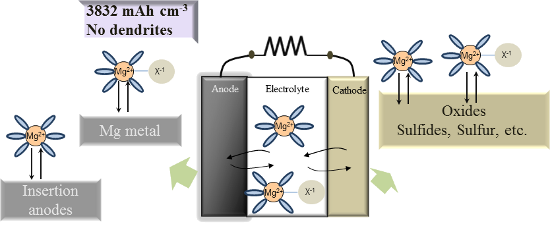
- deposition/stripping are volatile as they are ether-based. To overcome this challenge, one strategy would be trapping the solvent, used to solvate the magnesium ions, within a polymeric matrix. The electrolyte formed in this case is referred to as a gel electrolyte. This concept was previously applied to Li


Effects of palladium on the optical and hydrogen sensing characteristics of Pd-doped ZnO nanoparticles
Beilstein J. Nanotechnol. 2014, 5, 1261–1267, doi:10.3762/bjnano.5.140
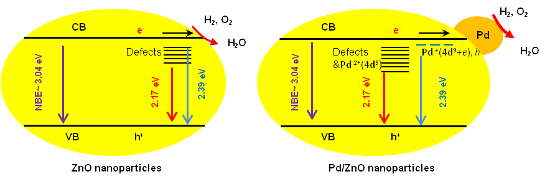
- -temperature wet-chemical process. Photoluminescence (PL) measurements at room temperature are then carried out in order to determine the role of vacancies, trapping levels, and the transition shift of the PL emission maximum in these samples. In order to study and optimize the four main factors affecting the


Organic and inorganic–organic thin film structures by molecular layer deposition: A review
Beilstein J. Nanotechnol. 2014, 5, 1104–1136, doi:10.3762/bjnano.5.123


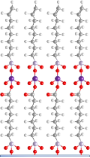


Dry friction of microstructured polymer surfaces inspired by snake skin
Beilstein J. Nanotechnol. 2014, 5, 1091–1103, doi:10.3762/bjnano.5.122

- that a decrease in frictional coefficient is due to the reduction of adhesive components of the frictional mechanisms [51][52]. Another approach to explain the reduction in frictional coefficient on many microstructured surfaces could be the possibility of trapping of loose wear particles within the


Functionalized nanostructures for enhanced photocatalytic performance under solar light
Beilstein J. Nanotechnol. 2014, 5, 994–1004, doi:10.3762/bjnano.5.113
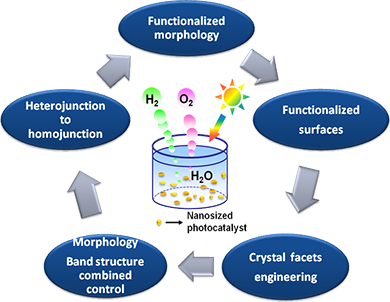
- found to have a close relationship with the doping amount of Ni ions and the highest activity was obtained when the amount of Ni doping was 1%. Here, the enhanced photocatalytic activity was attributed to doped Ni2+ ions which served as shallow trapping sites, preferentially trapping photoexcited holes
- . The assumption of the role of Ni2+ as shallow trapping sites could be rationalized by considering that the energy level of Ni2+ is located very close to the valence band edge of TiO2 [16]. After trapping a hole, Ni2+ will be oxidized to Ni3+. However, due to the instability of Ni3+, it will quickly
- return to Ni2+ again. The shallow trapping can therefore separate the arrival of photogenerated charges at the surface, so the recombination at the channel surface of mesopores could be greatly reduced. However, when the doping concentration is higher than the optimal level, or for too large particles


Optimizing the synthesis of CdS/ZnS core/shell semiconductor nanocrystals for bioimaging applications
Beilstein J. Nanotechnol. 2014, 5, 919–926, doi:10.3762/bjnano.5.105
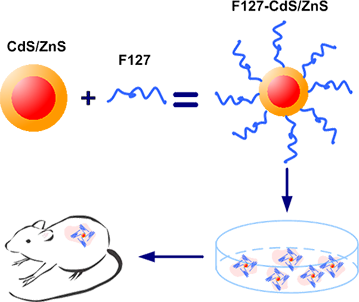
- QDs, and 38 ns for CdS QDs. ZnS has a major influence on the lifetime decay profile of CdS/ZnS QDs. Trapping states are caused by surface defects located within the bandgap, which lead to the rise of nonradiative recombination. Emission spectra The emission spectra were collected by using a Fluorolog


Optical modeling-assisted characterization of dye-sensitized solar cells using TiO2 nanotube arrays as photoanodes
Beilstein J. Nanotechnol. 2014, 5, 895–902, doi:10.3762/bjnano.5.102
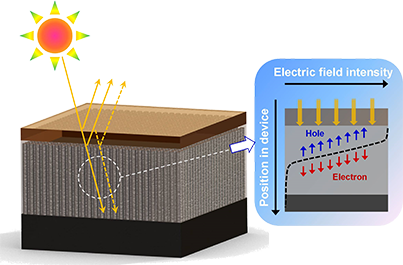
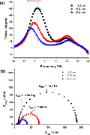
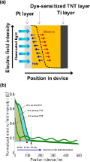
- TiO2 nanoparticles, vertically well-ordered TNT-based DSSCs presented an enhanced electron transport by efficiently reducing the recombination possibility of photogenerated charge carriers through minimizing the trapping sites that normally exist in the grain boundaries of randomly oriented TiO2


Fibrillar adhesion with no clusterisation: Functional significance of material gradient along adhesive setae of insects
Beilstein J. Nanotechnol. 2014, 5, 837–845, doi:10.3762/bjnano.5.95
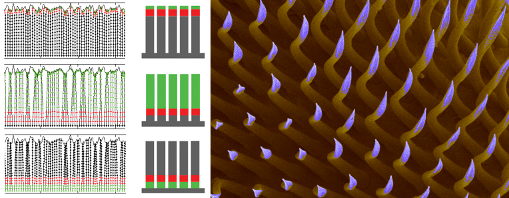
- contact may be increased due to the presence of specific micro- and nanostructures [1][2][3][4][5]. Crack trapping mechanisms in adhesive systems with multiple contacts provide advantages in attachment on rough substrates [6]. Also hierarchical organization of insect pad structures enables formation of


Measuring air layer volumes retained by submerged floating-ferns Salvinia and biomimetic superhydrophobic surfaces
Beilstein J. Nanotechnol. 2014, 5, 812–821, doi:10.3762/bjnano.5.93
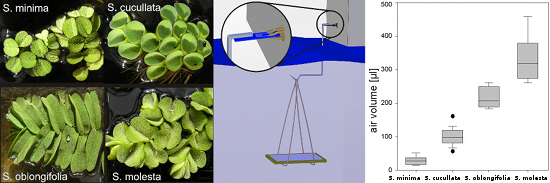
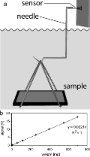
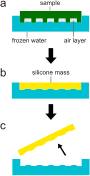
- the Cassie wetting state the solid–water interface is strongly reduced while the majority of the interface is between water and air, thereby trapping an air layer between water and surface. As a result the adhesion of the water to the surface is minimised and individual droplets often roll off at very


Visible light photooxidative performance of a high-nuclearity molecular bismuth vanadium oxide cluster
Beilstein J. Nanotechnol. 2014, 5, 711–716, doi:10.3762/bjnano.5.83

- oxidant. Trapping experiments using ethanol as a hydroxyl radical scavenger show significantly decreased photocatalytic substrate oxidation in the presence of EtOH. Photocatalytic performance analyses using monochromatic visible light irradiation show that the quantum efficiency Φ for indigo


High activity of Ag-doped Cd0.1Zn0.9S photocatalyst prepared by the hydrothermal method for hydrogen production under visible-light irradiation
Beilstein J. Nanotechnol. 2014, 5, 587–595, doi:10.3762/bjnano.5.69
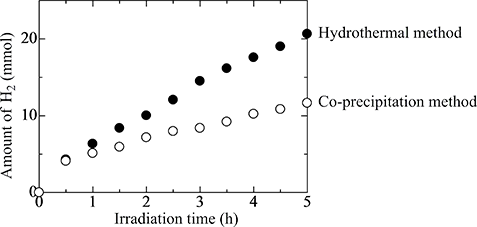
- was reported to show activity for hydrogen production from water [21] and hydrogen sulfide [22]. On the other hand, the properties of Ag+-doped Cd1−xZnxS have been investigated by spectroscopic and photochemical studies [23]. It was proposed that the Ag+ might act as a hole trapping site. Since the


Photovoltaic properties of ZnO nanorods/p-type Si heterojunction structures
Beilstein J. Nanotechnol. 2014, 5, 173–179, doi:10.3762/bjnano.5.17
- PV efficiency of the obtained hybrid PV cells [43]. However, a detailed explanation of the effect observed in this work will require a further study. Conclusion We investigated PV structures based on zinc oxide nanorods. Their 3D morphology leads to an increased light trapping. ZnONR with different



Large-scale atomistic and quantum-mechanical simulations of a Nafion membrane: Morphology, proton solvation and charge transport
Beilstein J. Nanotechnol. 2013, 4, 567–587, doi:10.3762/bjnano.4.65
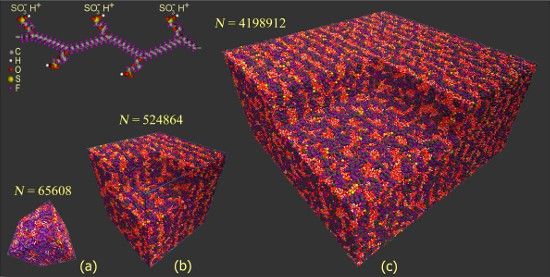
- due to local energy minima trapping, we generated several samples. Each initial configuration was created as a random distribution of Nafion chains, water molecules and hydronium ions. In the initial state we did not build our systems at a density equal to the experimental one. Instead, not to start


3D nano-structures for laser nano-manipulation
Beilstein J. Nanotechnol. 2013, 4, 534–541, doi:10.3762/bjnano.4.62
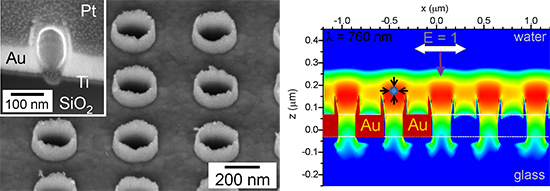
- the patterns of such nano-wells was investigated experimentally and numerically. By doing numerical simulations of 50-nm and 100-nm diameter polystyrene beads in water and air, we show the potential of such patterns for self-induced back-action (SIBA) trapping. The best trapping conditions were found
- to be a trapping force of 2 pN/W/μm2 (numerical result) exerted on a 50-nm diameter bead in water. The simulations were based on the analytical Lorentz force model. Keywords: extraordinary transmission; near field; optical tweezing; plasmonics; reactive ion etching; self-induced back-action
- ; Introduction Optical trapping is a fundamental experimental technique for physics and biology, which allows to precisely control and position micrometer-sized objects such as dielectric parts for nano-assembly, and biomaterials such as cells and bacteria, through the use of gradient forces, which originate


Digging gold: keV He+ ion interaction with Au
Beilstein J. Nanotechnol. 2013, 4, 453–460, doi:10.3762/bjnano.4.53
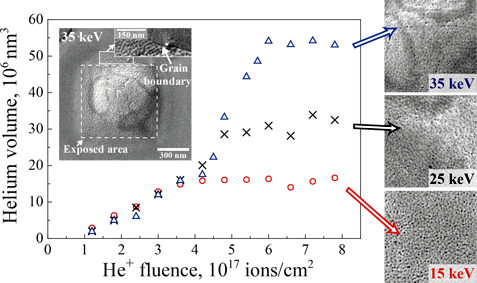
- trapping in Cu, which has similar physical properties to Au. In this case blistering was observed after a fluence of 4.0 × 1017 cm−2. As is seen from the Figure 5b, there is a negative volume offset, which is attributed to two effects. First, sputtering of the surface will result in material loss. Secondly


Kelvin probe force microscopy of nanocrystalline TiO2 photoelectrodes
Beilstein J. Nanotechnol. 2013, 4, 418–428, doi:10.3762/bjnano.4.49
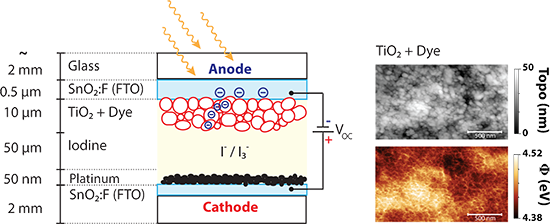
- governed mainly by diffusion and not by drift current (electric field). Preferential trapping of electrons (holes) in defect states of the TiO2 network leads to different diffusion coefficients for electrons and holes. Surface photovoltage under sub-bandgap illumination Figure 6a shows a semilogarithmic
- component of the total recombination time is attributed to an electron diffusion process across the TiO2 network towards the contact, whereas the fast recombination process occurs within single particles [55]. The slow electron diffusion throughout the network is due to trapping and detrapping [46] in


High-resolution electrical and chemical characterization of nm-scale organic and inorganic devices
Beilstein J. Nanotechnol. 2013, 4, 318–319, doi:10.3762/bjnano.4.35

- , threading dislocations, and microtwins that affect the diffusion of dopants and the material mobility (due to scattering). When growth is performed in narrow trenches, dislocations are trapped within the confined volume (aspect-ratio trapping) and, theoretically, defect-free layers can be obtained. However
Near-field effects and energy transfer in hybrid metal-oxide nanostructures
Beilstein J. Nanotechnol. 2013, 4, 306–317, doi:10.3762/bjnano.4.34
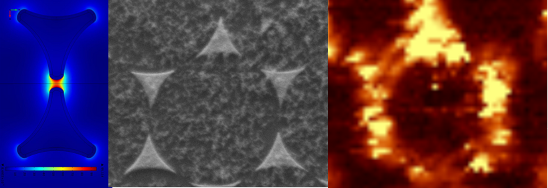
- the absorption, especially in thin-film structures, as well as the exploitation of field enhancements in the near-field region. Another approach reviewed in [6] for “light trapping” in photovoltaics is the excitation of surface plasmon polaritons at the interface between metals and semiconductors








Micro- and nanoscale electrical characterization of large-area graphene transferred to functional substrates
Beilstein J. Nanotechnol. 2013, 4, 234–242, doi:10.3762/bjnano.4.24
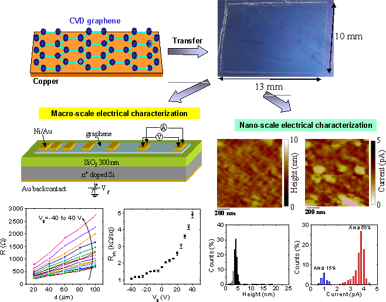
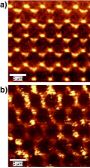
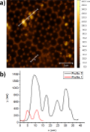
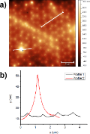
- effect due to carrier trapping, and, consequently, an underestimation of the carrier mobility. Furthermore, the presence of charged traps at the graphene/substrate interface strongly affects the mobility in graphene due to Coulomb scattering [11][26], leading to a degradation with respect to the ideal



Photoresponse from single upright-standing ZnO nanorods explored by photoconductive AFM
Beilstein J. Nanotechnol. 2013, 4, 208–217, doi:10.3762/bjnano.4.21
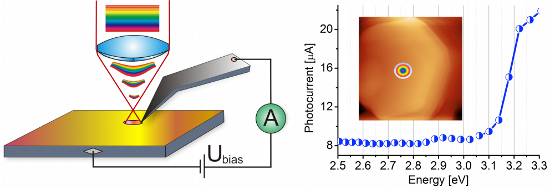
- . The surface conductivity of ZnO is highly dependent on the presence of adsorbates [20][21][22][23]. Such surface defects serve as binding sites for chemisorption processes and may contribute to the scattering and trapping of carriers [24], which lower the intrinsic conductivity of the material
- conduction band contributing to the photocurrent. The existence of the PHS state implies also a trapping of the mobile charge carriers in this state. The transition back to the nonconductive state requires a simultaneous thermal activation of the electrons from the PHS state to the conduction band and