


Search results
Search for "vacancies" in Full Text gives 248 result(s) in Beilstein Journal of Nanotechnology. Showing first 200.
Intercalation of Si between MoS2 layers
Beilstein J. Nanotechnol. 2017, 8, 1952–1960, doi:10.3762/bjnano.8.196
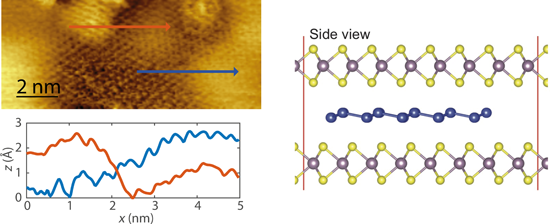
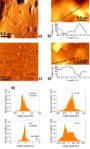
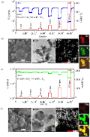
- intrinsic defects, which are visible as dark depressions as indicated by the arrow in Figure 1a. These defects are most probably caused by vacancies or interstitials and have been found to exhibit a metal-like behavior [42][43]. Upon the deposition of 0.2 monolayers of Si, the surface morphology converts to


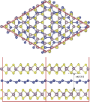
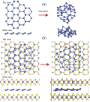
Process-specific mechanisms of vertically oriented graphene growth in plasmas
Beilstein J. Nanotechnol. 2017, 8, 1658–1670, doi:10.3762/bjnano.8.166
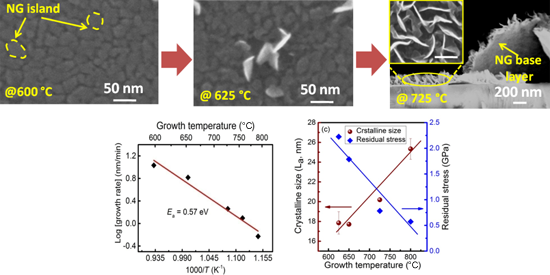
- spectra exhibit D + D″ (ca. 2450 cm−1), G′ (ca. 2705 cm−1), D + D′ (ca. 2948 cm−1) and 2D′ (ca. 3244 cm−1) peaks. The defect-related peaks (D, D′, D″ and the overtones) are attributed to high edge density, structural defects and disorder such as vacancies and strained hexagonal/non-hexagonal (pentagon or


Uptake and intracellular accumulation of diamond nanoparticles – a metabolic and cytotoxic study
Beilstein J. Nanotechnol. 2017, 8, 1649–1657, doi:10.3762/bjnano.8.165
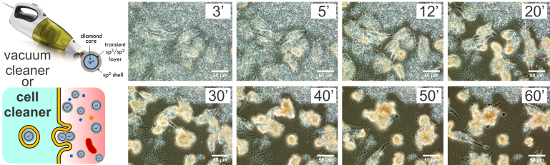
- influencing the bulk of the NDs (formation of vacancies, and N-V sites supported by high-temperature annealing in vacuum) [39]. This was confirmed by the fact that there was no obvious difference in the FTIR spectra between the MR-18 sample and the AR-40 sample. The zeta potential of MR-type NDs were negative


Two-dimensional carbon-based nanocomposites for photocatalytic energy generation and environmental remediation applications
Beilstein J. Nanotechnol. 2017, 8, 1571–1600, doi:10.3762/bjnano.8.159
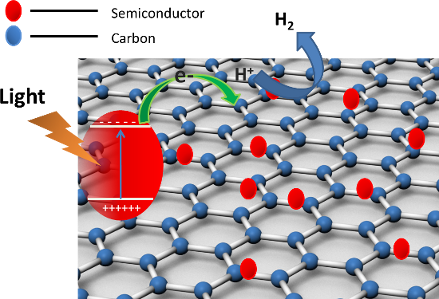
- reactions but mainly hydrogen evolution reactions [67]. The lattice structure of g-C3N4 is composed of C–N with short interlayer distances and amino functional groups with larger periodic vacancies [67]. In addition to this, g-C3N4 possesses excellent chemical and thermal stability, unique surface


Low-temperature CO oxidation over Cu/Pt co-doped ZrO2 nanoparticles synthesized by solution combustion
Beilstein J. Nanotechnol. 2017, 8, 1546–1552, doi:10.3762/bjnano.8.156

- dissolve into the ZrO2 lattice and thus creates oxygen vacancies due to lattice distortion and charge imbalance. High-resolution transmission electron microscopy (HRTEM) results showed Cu/Pt co-doped ZrO2 nanoparticles with a size of ca. 10 nm. X-ray diffraction (XRD) and Raman spectra confirmed cubic
- structure and larger oxygen vacancies. The nanoparticles showed excellent activity for CO oxidation. The temperature T50 (the temperature at which 50% of CO are converted) was lowered by 175 °C in comparison to bare ZrO2. Further, they exhibited very high stability for CO reaction (time-on-stream ≈ 70 h
- ). This is due to combined effect of smaller particle size, large oxygen vacancies, high specific surface area and better thermal stability of the Cu/Pt co-doped ZrO2 nanoparticles. The apparent activation energy for CO oxidation is found to be 45.6 kJ·mol−1. The CO conversion decreases with increase in




Formation of ferromagnetic molecular thin films from blends by annealing
Beilstein J. Nanotechnol. 2017, 8, 1469–1475, doi:10.3762/bjnano.8.146
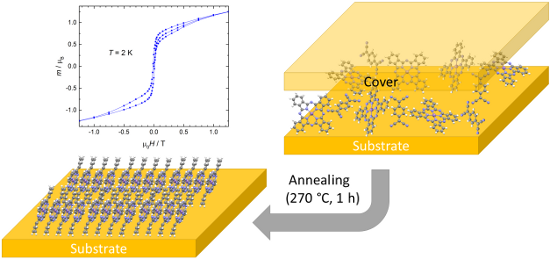
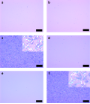
- vacancies in the mixed films generate sufficient free volume around the MnPc molecules for a rearrangement to the thermodynamically stable β-phase (Figure 1c), which normally forms above 300 °C [7][8]. Film morphology, structure and composition Optical micrographs in Figure 2 reveal the surface morphology



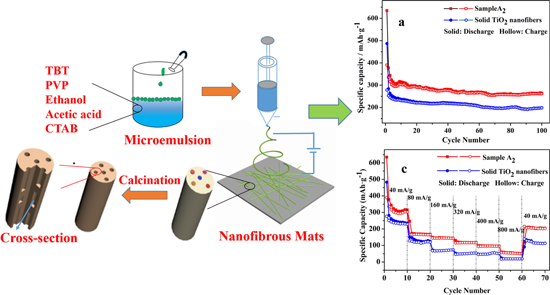
Fabrication of hierarchically porous TiO2 nanofibers by microemulsion electrospinning and their application as anode material for lithium-ion batteries
Beilstein J. Nanotechnol. 2017, 8, 1297–1306, doi:10.3762/bjnano.8.131
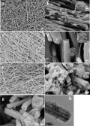
- diameters of tens of nanometers. It meant that the axially aligned pores were the vacancies of paraffin oil. Thermogravimetry (TG) and differential thermogravimetry (DTG) curves of as-spun sample A1 are shown in Figure 2a. It can be seen that the total weight loss was approximately 35%, and whole
- the number of channels in each nanofiber decreased as the content of paraffin oil increased. This is because the pores stemmed from the vacancies of oil droplets after calcination, and a larger oil droplets were formed when more paraffin oil was added into the microemulsion [31]. The SEM image of




Metal oxide nanostructures: preparation, characterization and functional applications as chemical sensors
Beilstein J. Nanotechnol. 2017, 8, 1205–1217, doi:10.3762/bjnano.8.122
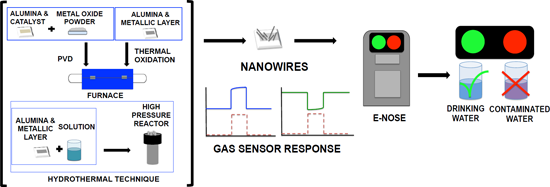
- NO2. At lower temperatures (100 °C), NiO devices are too resistive to be measured in our test chamber. NiO has hardly been studied as a material for chemical sensors. Hence, there are only few reports about a tentative NO2 sensing mechanism. Zhang et. al. [24] pointed out that nickel vacancies could


Stable Au–C bonds to the substrate for fullerene-based nanostructures
Beilstein J. Nanotechnol. 2017, 8, 1073–1079, doi:10.3762/bjnano.8.109
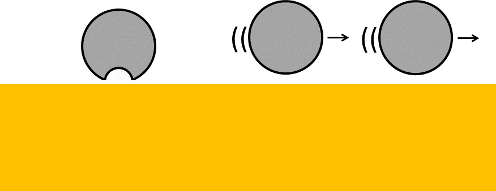
- tunneling microscope. These features are stable at room temperature against diffusion on the surface. We carry out DFT calculations of fullerene molecules having one missing carbon atom to simulate the vacancies in the molecules resulting from the sputtering process. These modified fullerenes have an
- vacancies. This provides a pathway for the formation of fullerene-based nanostructures on Au at room temperature. Keywords: Au–C bonds; density functional theory (DFT); fullerenes; scanning tunneling microscopy (STM); sputtering; Introduction In single-molecule electronics, the active element in an
- observed, which we show to be adsorbed fullerenes with defects created by the sputtering process. The sputtering process is expected to result in the formation of vacancies in the fullerene molecules, where C atoms are knocked out. A series of fullerene fragments can be formed in the collision with high


Structural properties and thermal stability of cobalt- and chromium-doped α-MnO2 nanorods
Beilstein J. Nanotechnol. 2017, 8, 1032–1042, doi:10.3762/bjnano.8.104
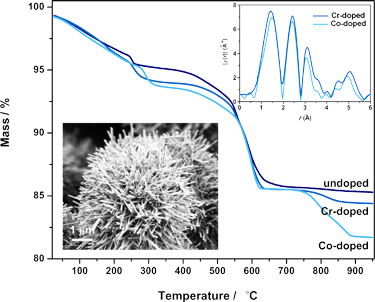
- , causing no structural distortion. The latter would lead to lower symmetry, from tetragonal to monoclinic, which means also a lower thermal stability. (II) Dopant ions of lower valence lead to the formation of octahedral vacancies to maintain the charge balance, with or without the additional incorporation
- of K+ into tunnels. Vacancies cause structural distortion and lower the thermal stability. When ions of higher valence are incorporated, the content of K+ ions is reduced or more Mn4+ ions are transformed to Mn3+ [14]. Recently, a few different strategies of doping of different MnO2 structures with


Study of the correlation between sensing performance and surface morphology of inkjet-printed aqueous graphene-based chemiresistors for NO2 detection
Beilstein J. Nanotechnol. 2017, 8, 1023–1031, doi:10.3762/bjnano.8.103
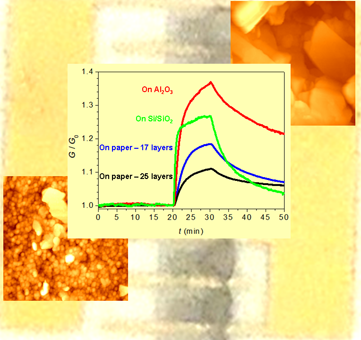
- the case of graphene the active sites are represented by sp2 carbon atoms (low interaction energy) and defects such as vacancies, dangling bonds, coordination defects and functionalizations (high interaction energy). In the specific case of our LPE graphene, defects are mostly ascribed to edge defects


CVD transfer-free graphene for sensing applications
Beilstein J. Nanotechnol. 2017, 8, 1015–1022, doi:10.3762/bjnano.8.102
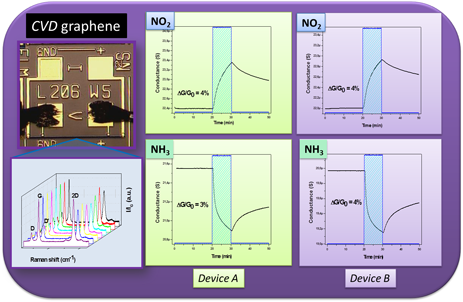
- , namely I(D)/I(D′), can be related to the preponderant typology of defects in the different graphene samples [25]. In particular, the I(D)/I(D′) ratio exhibits its maximum value, around 13, for sp3-like defects, it decreases down to about 7 in the case of vacancies and it is minimum for edge defects (ca


Synthesis of graphene–transition metal oxide hybrid nanoparticles and their application in various fields
Beilstein J. Nanotechnol. 2017, 8, 688–714, doi:10.3762/bjnano.8.74
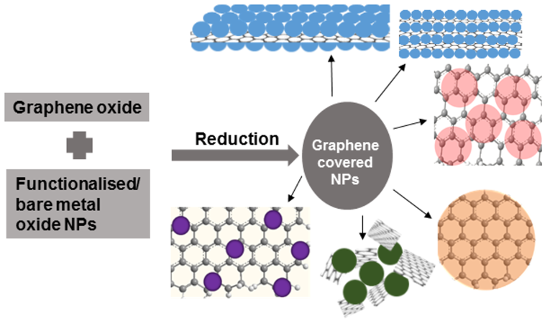
- photoluminescence (PL) band at 373 nm, which is due to the exciton recombination corresponding to the band edge emission, and a green emission peak is most commonly observed that arises from the defect of ZnO NPs such as oxygen vacancies, zinc vacancies, oxygen interstitials, and zinc interstitials [241]. Graphene






Diffusion and surface alloying of gradient nanostructured metals
Beilstein J. Nanotechnol. 2017, 8, 547–560, doi:10.3762/bjnano.8.59
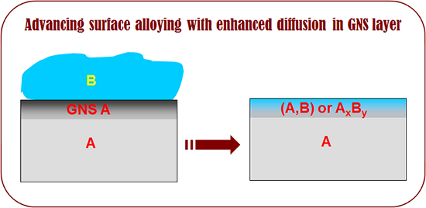
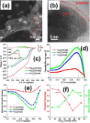
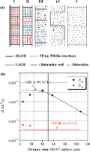
- higher binding energy between Mn and vacancies, of which the concentration was much larger in the GNS sample than in the CG sample, also contributed to the quicker formation of Mn-enriched oxide scale [45][96][97]. Conclusion Due to the importance of understanding the diffusion and surface alloying




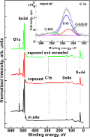
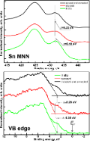
Impact of air exposure and annealing on the chemical and electronic properties of the surface of SnO2 nanolayers deposited by rheotaxial growth and vacuum oxidation
Beilstein J. Nanotechnol. 2017, 8, 514–521, doi:10.3762/bjnano.8.55
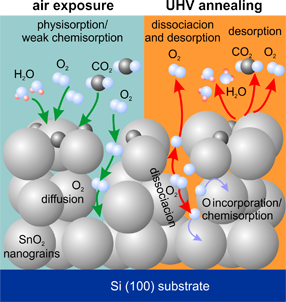
- to its high and variable electrical conductivity in the range of 100 Ω−1·cm−1 to 102 Ω−1·cm−1 due to the existence of free electrons in oxygen vacancies. This effect has been widely applied for the construction of prototypical gas sensors devices with both thick and thin films [3][4][5][6][7][8]. The



Nanocrystalline ZrO2 and Pt-doped ZrO2 catalysts for low-temperature CO oxidation
Beilstein J. Nanotechnol. 2017, 8, 264–271, doi:10.3762/bjnano.8.29
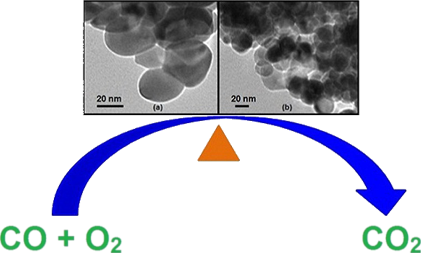
- conversion at 240 °C, which is the highest conversion rate reported for ZrO2 in literature to date. It is found that through solution combustion, Pt2+ ions replace Zr4+ ions in the ZrO2 lattice and because of this, oxygen vacancies are formed due to charge imbalance and lattice distortion in ZrO2. 1% Pt was
- oxygen mobility and oxygen vacancies and improves the activity and stability of the catalyst. The effects of gas hourly space velocity (GHSV) and initial CO concentration on the CO oxidation over Pt(1%)-ZrO2 were studied. Keywords: CO oxidation; nanomaterials; platinum; solution combustion method
- CO oxidation by different researchers [13][14][15][16]. The addition of precious metals such as Pd, Pt and Rh increased the reactivity of the support by increasing its oxygen mobility and number of oxygen vacancies (the source of oxygen in CO oxidation) [10][11][12]. In recent years, ZrO2 has been


Nanocrystalline TiO2/SnO2 heterostructures for gas sensing
Beilstein J. Nanotechnol. 2017, 8, 108–122, doi:10.3762/bjnano.8.12
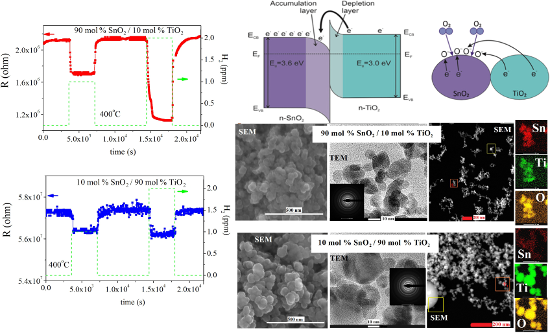
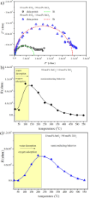
- which the semiconducting behavior begins to prevail over water desorption/oxygen adsorption depends on the TiO2–SnO2 composition. The higher Tmax for TiO2-rich heterostructures can be explained on the basis of the higher ionic defect concentration (mainly oxygen vacancies) at the surface of TiO2. It is
- well known that oxygen vacancies act as water adsorption centers. Moreover, in the case of SnO2 water adsorption takes place because of the formation of weak van der Waals bonds between water dipoles and lattice ions (Sn4+ and O2−) [19]. This facilitates water desorption from the surface of SnO2-rich
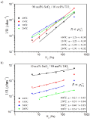
- of oxygen vacancies VO, the following reaction could be proposed: The condition of lattice electroneutrality requires that: where k = 1 or 2 corresponds to singly or doubly ionized defects, respectively. Applying the law of mass action to Equation 11 (with k = 1 or 2) gives power-law coefficients of




Ordering of Zn-centered porphyrin and phthalocyanine on TiO2(011): STM studies
Beilstein J. Nanotechnol. 2017, 8, 99–107, doi:10.3762/bjnano.8.11
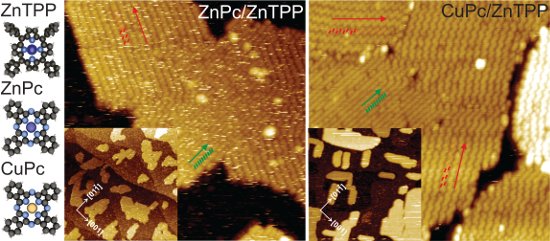
- investigation of molecular adsorption is titanium dioxide [11][12]. The most stable and the most studied face of TiO2 is the rutile (110) surface. In the context of adsorption studies, it is important to note that the (110) face of rutile usually contains numerous oxygen vacancies, often filled with hydroxy


Obtaining and doping of InAs-QD/GaAs(001) nanostructures by ion beam sputtering
Beilstein J. Nanotechnol. 2017, 8, 12–20, doi:10.3762/bjnano.8.2
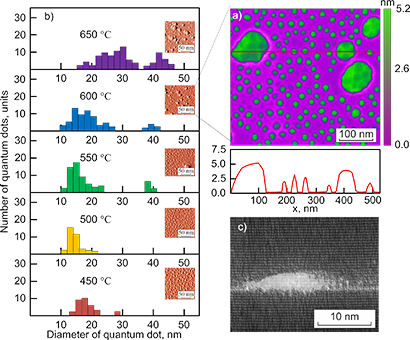
- occupy Ga vacancies in the course of GaAs layer growth and behave as an acceptor-type impurity partially compensating the concentration of Te+ donors. The formation of neutral SnTe complexes results in a decrease in electrically active donors Sn+ + Te+ incorporated in the GaAs layer. We consider that


Annealing-induced recovery of indents in thin Au(Fe) bilayer films
Beilstein J. Nanotechnol. 2016, 7, 2088–2099, doi:10.3762/bjnano.7.199
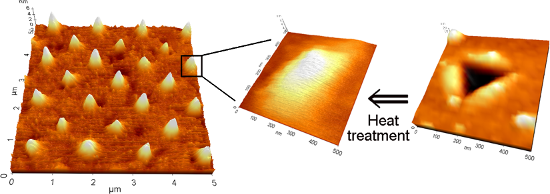
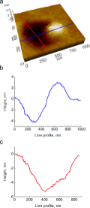
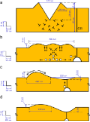
- dislocation loops is non-conservative, it generates a flux of excess vacancies. The vacancies can reach the film-substrate interface and the nearby grain boundary, which both can serve as vacancy sinks. The annihilation of vacancies at the film-substrate interface leads to the slight decrease of the film
- thickness [21], whereas annihilation of vacancies at the grain boundaries helps to relax compressive stresses in the film formed during heating due to the mismatch of thermal expansion coefficients between the film and the substrate. The rim-less shape of the dewetting holes observed far from the indented
- region (see Figure 6) confirms that the film-substrate interface is indeed a potent sink and source of vacancies; the vacancies that originated at the interface are consumed by the expanding hole. Some fraction of the vacancy flux generated by annihilating dislocation loops may lead to the nucleation of





Zigzag phosphorene nanoribbons: one-dimensional resonant channels in two-dimensional atomic crystals
Beilstein J. Nanotechnol. 2016, 7, 1983–1990, doi:10.3762/bjnano.7.189

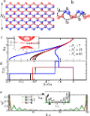
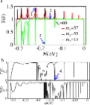
- present work, edge-confined states are supported only by zigzag edges and are absent in armchair or bearded edges [11][12]. Therefore, introducing perturbations to a zigzag edge, such as edge vacancies, would locally destroy these 1D states. The consequences of these perturbations are very relevant in the
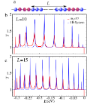
- transmission probability as a function of the energy as well as the LDOS associated to selected resonances in the presence of vacancies. Defects are normally seen as mechanisms that hinder the observation of transport properties associated to shape modulation of nanoscopic low-dimensional systems. Indeed, the
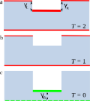
- resonance spectra are also dramatically modified in the present case. However, the issue can be seen from an entirely different point of view. The vacancies change locally the character of the edge. Thus, they actually introduce small barriers and further divide the system into smaller segments. The system



Nanostructured TiO2-based gas sensors with enhanced sensitivity to reducing gases
Beilstein J. Nanotechnol. 2016, 7, 1718–1726, doi:10.3762/bjnano.7.164
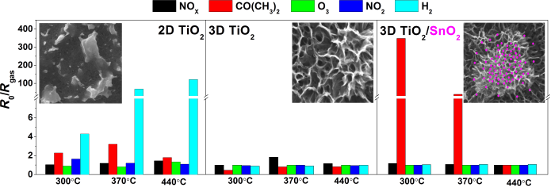
- ], there are several possible explanations for this phenomenon. The first is related to formation of titanium vacancies, VTi, in the flower-like structure during synthesis. Upon Ti foil oxidation by H2O2, a mesoporous hierarchical structure is formed. The three-step process includes, inter alia


Scanning probe microscopy studies on the adsorption of selected molecular dyes on titania
Beilstein J. Nanotechnol. 2016, 7, 1642–1653, doi:10.3762/bjnano.7.156
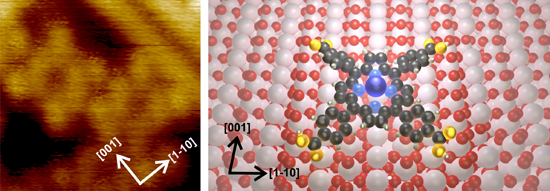
- either by the formation of oxygen vacancies [36], which are point defects commonly found in TiO2(110) surfaces, or by doping [37], and are redistributed among multiple Ti lattice sites in the subsurface layers [36][37][38][39][40][41]. Thus, a defect state in the band gap is formed. Such delocalized
- to the oxide takes place, and an interface dipole is formed. To further understand the energy level alignment between a semiconducting substrate and an organic adsorbate, Lackinger, Janson and Ho [59] studied interactions between zinc(II) etioporphyrin (ZnEP) and oxygen vacancies, which are point
- defects commonly found in TiO2(110) surfaces. The energy level alignment is of crucial importance for DSSC applications of titania. The authors took special care to prepare a sample with unsaturated oxygen vacancies [59] because it is known that they can be easily passivated even at very low partial


Influence of hydrothermal synthesis parameters on the properties of hydroxyapatite nanoparticles
Beilstein J. Nanotechnol. 2016, 7, 1586–1601, doi:10.3762/bjnano.7.153
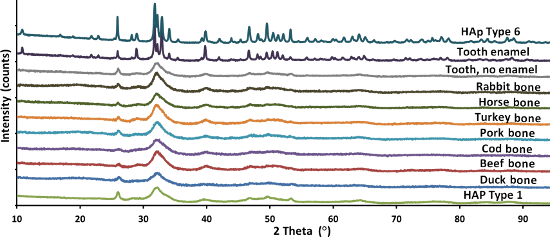
- of crystalline structure defects, caused by calcium ion vacancies, increases, diminishing material stability, and as a result, enhancing its solubility [20][21]. A range of various methods have been developed in order to produce HAp powder, among others, combustion preparation [22], and numerous wet


Three-gradient regular solution model for simple liquids wetting complex surface topologies
Beilstein J. Nanotechnol. 2016, 7, 1377–1396, doi:10.3762/bjnano.7.129

- approximation) we can evaluate the mixing interaction energy in the system by Umix = NχφV, where we ignored boundary effects and φV = NV/M is the volume fraction of vacancies. The entropy of mixing can be evaluated when we assume once more that the sites are randomly filled by solvent. The total number of ways
- to arrange the fluid and the vacancies is given by and the mixing entropy is found by Smix = −kB·lnΩ = −kB(N·ln φ + NV·ln φV) with φ = N/M and kB the Boltzmann constant. The free energy of mixing is given by Fmix = Umix – T·Smix. Introducing the dimensionless free energy density f = Fmix/(Mb3kBT
- obey scaling relations with respect to the difference to the critical point Δχ = χ − 2. Interestingly, near the critical point there is an analytical route to optimise the free energy F [40]. In short, near the critical point the density of the liquid (and thus also for the vacancies) is never far from


![[Graphic 10]](/bjnano/content/inline/2190-4286-7-129-i31.png?max-width=637&scale=1.18182) and standard deviation as a function of the cavity diameter d (in...
and standard deviation as a function of the cavity diameter d (in...

![[Graphic 20]](/bjnano/content/inline/2190-4286-7-129-i41.png?max-width=637&scale=1.18182) and the corresponding fluctuations (measured along the x-direction) indica...
and the corresponding fluctuations (measured along the x-direction) indica...

![[Graphic 28]](/bjnano/content/inline/2190-4286-7-129-i49.png?max-width=637&scale=1.18182) and the corresponding standard deviation as measure of variation in the ...
and the corresponding standard deviation as measure of variation in the ...

![[Graphic 39]](/bjnano/content/inline/2190-4286-7-129-i60.png?max-width=637&scale=1.18182) and standard deviation as function of cut-off fraction c for fixed ...
and standard deviation as function of cut-off fraction c for fixed ...



