Search results
Search for "charging" in Full Text gives 217 result(s) in Beilstein Journal of Nanotechnology. Showing first 200.
The influence of molecular mobility on the properties of networks of gold nanoparticles and organic ligands
Beilstein J. Nanotechnol. 2014, 5, 1664–1674, doi:10.3762/bjnano.5.177
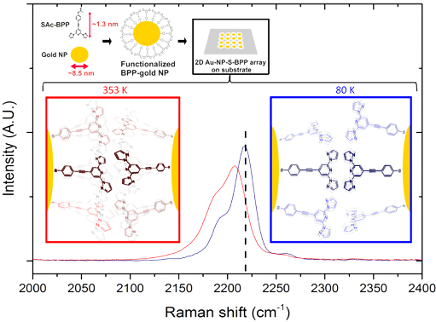
- provides additional experimental insight into the question of thermal stability of the nanoparticles architecture. Here, not only the S-BPP molecules, but also the nanoparticles are expected to play a role. At low temperatures, the thermal energy kBT becomes comparable to their charging energy EC = e2/2C
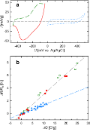
- estimated typical Coulomb-blockade charging energies of around 14–17 meV [5], in correspondence with temperature- and voltage-dependent transport measurements. Hence, in alkanethiol and OPE-based networks Coulomb blockade dominates below 200–250 K, whereas around room temperature, the current–voltage (I–V
- -NP–S-BPP network sample exhibits a very different behaviour for higher temperatures, showing a clear upturn in the Arrhenius plot (i.e., at lower 1/T values in Figure 5b). A first explanation for a deviation might be that the charging energy EC = e2/2C C−1 is actually higher for the Au-NP–S-BPP




Silica nanoparticles are less toxic to human lung cells when deposited at the air–liquid interface compared to conventional submerged exposure
Beilstein J. Nanotechnol. 2014, 5, 1590–1602, doi:10.3762/bjnano.5.171
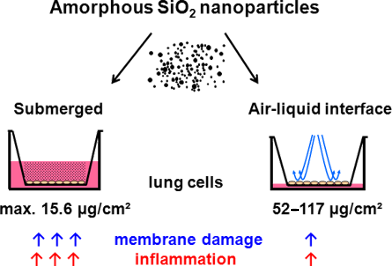
- deposition efficiencies of up to 100% for charged particles [11]. de Bruijne et al. [21] used a corona charger for efficient charging of aerosol particles and did not observe adverse effects on A549 cells by the trace gases formed in the corona. However, for particle sizes below 50 nm, the probability to be


Ionic liquid-assisted formation of cellulose/calcium phosphate hybrid materials
Beilstein J. Nanotechnol. 2014, 5, 1553–1568, doi:10.3762/bjnano.5.167
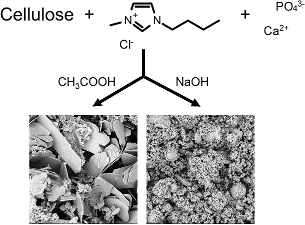
- inspection shows that the particles and fragments appear to have a layer-like architecture. Finally, the precipitates appear composed of small subunits, possibly of particles with diameters in the nanometer range, but this is, due to significant charging of the samples in the SEM, difficult to evaluate
- ) SEM images of the precipitates. High magnification imaging of CPNaOH24 led to rapid sample charging and very poor imaging conditions even after sputtering; no image is thus shown. SEM images of as-received microcrystalline and regenerated cellulose. Low (top row) and high magnification (bottom row


Microstructural and plasmonic modifications in Ag–TiO2 and Au–TiO2 nanocomposites through ion beam irradiation
Beilstein J. Nanotechnol. 2014, 5, 1419–1431, doi:10.3762/bjnano.5.154
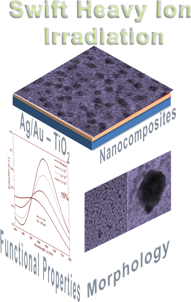
- deposited by the DC planar magnetron source ION’X 2UHV (Thin Film Consulting). A similar-type RF magnetron source was used for sputtering the copper-bonded titanium dioxide (Williams Advanced Materials) to prevent charging of the target. The deposition rates from both targets were in situ monitored by two


Magnesium batteries: Current state of the art, issues and future perspectives
Beilstein J. Nanotechnol. 2014, 5, 1291–1311, doi:10.3762/bjnano.5.143


Electron-beam induced deposition and autocatalytic decomposition of Co(CO)3NO
Beilstein J. Nanotechnol. 2014, 5, 1175–1185, doi:10.3762/bjnano.5.129
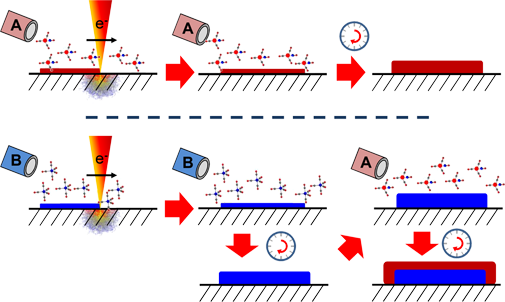
- comparable structures on SiOx/Si(100) (not shown); note that severe charging prevents Auger electron spectroscopy on the Si3N4 membrane samples. Figure 7 shows the optical density (left vertical axis) at the Co L3 edge and average apparent Co thickness dA (right vertical axis) of CoOxNyCz layers grown on




The study of surface wetting, nanobubbles and boundary slip with an applied voltage: A review
Beilstein J. Nanotechnol. 2014, 5, 1042–1065, doi:10.3762/bjnano.5.117
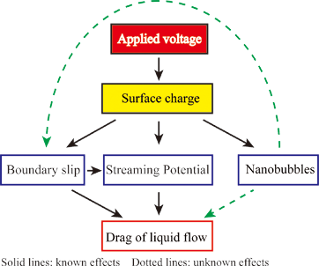
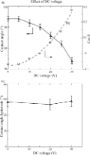
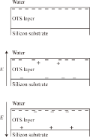
- coating and DI water. The interface of the layers will have a tendency to be electrostatically charged. When the applied voltage has an opposite polarity, the charging is additive. As a result, there will be a discharge current [77] which may lead to a damage of the brittle PS coating. To avoid the damage










A nanometric cushion for enhancing scratch and wear resistance of hard films
Beilstein J. Nanotechnol. 2014, 5, 1005–1015, doi:10.3762/bjnano.5.114
- measurements the data were collected by the fixed Silicon-Charge Particle Detector (ULTRATM, ORTEC) with detector scattering angle of 2.7 msr. A normal incidentbeam was used in all measurements. All samples were mounted on the holder by double sided, self-adhesive carbon tape. Charging effect on the kapton was



Shape-selected nanocrystals for in situ spectro-electrochemistry studies on structurally well defined surfaces under controlled electrolyte transport: A combined in situ ATR-FTIR/online DEMS investigation of CO electrooxidation on Pt
Beilstein J. Nanotechnol. 2014, 5, 735–746, doi:10.3762/bjnano.5.86
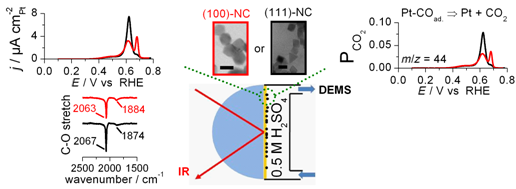
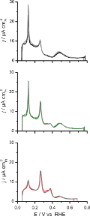
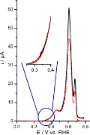
- indicates that another Faradaic process occurs, while COad is removed by potentiodynamic oxidation. This difference is mainly attributed to (bi)sulfate anion re-adsorption and progressive double layer charging, which occurs while COad is removed by potentiodynamic oxidation. Note that this direct procedure
- spectrometric) current from CO2 detection and the Faradaic current from COad electro-oxidation reflects the current associated with (bi)sulfate anion re-adsorption and double layer charging, while COad is increasingly removed from the surface. Plots of the current associated to (bi)sulfate anions re-adsorption
- (and capacitive double layer charging) during potentiodynamic COad oxidative removal are displayed in Figure 6 for the three samples of shape-selected nanoparticles investigated. To the best of our knowledge, this is the first time that these currents have been measured directly. The charge which is




Hole-mask colloidal nanolithography combined with tilted-angle-rotation evaporation: A versatile method for fabrication of low-cost and large-area complex plasmonic nanostructures and metamaterials
Beilstein J. Nanotechnol. 2014, 5, 577–586, doi:10.3762/bjnano.5.68
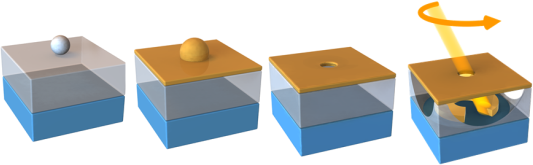
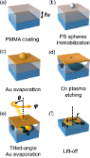
- adjust the coverage of the evaporated structures. The details will be discussed below. After charging the PMMA layer with the PDDA solution, a droplet of the PS spheres solution is dripped onto the sample. After 1 min, it is rinsed away with deionized water and the sample is placed in a hot water bath at


Neutral and charged boron-doped fullerenes for CO2 adsorption
Beilstein J. Nanotechnol. 2014, 5, 413–418, doi:10.3762/bjnano.5.49
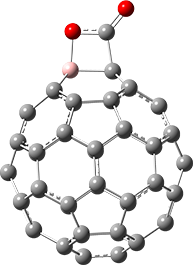
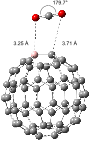
- than 350 K. Therefore we suggest a method of manipulating the charge state and the temperature of the system for adsorbent recycling. Charging the system can be achieved by electrochemical methods, electrospray, and electron beam or gate voltage control methods [8]. Conclusion By using DFT calculations



Extracellular biosynthesis of gadolinium oxide (Gd2O3) nanoparticles, their biodistribution and bioconjugation with the chemically modified anticancer drug taxol
Beilstein J. Nanotechnol. 2014, 5, 249–257, doi:10.3762/bjnano.5.27

- eV) at a power of 200 watts was used. The binding energy of Au (4f7/2) at 84.0 ± 0.1 eV was used to calibrate the binding energy scale of the spectrometer. Any charging shift produced in the spectrum was corrected by referencing to the C (1s) position (284.6 eV) Background correction of core level


Fabrication of carbon nanomembranes by helium ion beam lithography
Beilstein J. Nanotechnol. 2014, 5, 188–194, doi:10.3762/bjnano.5.20
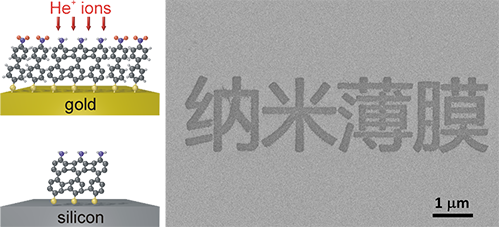
- CNM is supported by a holey carbon film on a grid. The holey carbon film appears brighter and the CNM slightly darker due to the charging effect. To identify the CNM, its three corners are marked with arrows. Figure 2b shows the higher magnification HIM micrograph of the CNM in Figure 2a. It is


Manipulation of nanoparticles of different shapes inside a scanning electron microscope
Beilstein J. Nanotechnol. 2014, 5, 133–140, doi:10.3762/bjnano.5.13
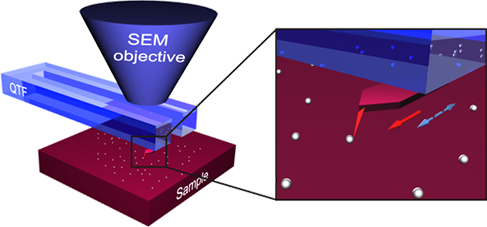
- focused e-beam is capable of introducing significant amounts of energy and causing a partial melting of the nanostructures. Additional effects can be an activation of the substrate surface or an electrostatic charging, which can also influence the results of nanotribological experiments [36]. Conclusion


Synthesis and electrochemical performance of Li2Co1−xMxPO4F (M = Fe, Mn) cathode materials
Beilstein J. Nanotechnol. 2013, 4, 860–867, doi:10.3762/bjnano.4.97
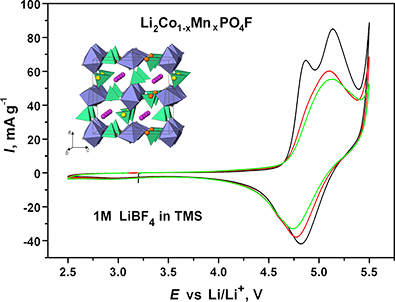
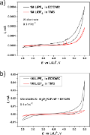
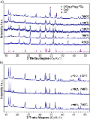
- processes. We related them to the structure transformation upon deintercalation of Li, followed by a further removal of Li from the transformed structure. This irreversible structure transformation, which occurs upon first charging, was investigated by ex-situ XRD studies and described in detail in our



Simulation of electron transport during electron-beam-induced deposition of nanostructures
Beilstein J. Nanotechnol. 2013, 4, 781–792, doi:10.3762/bjnano.4.89
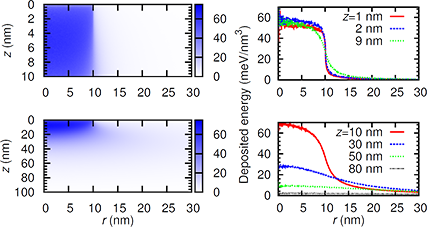
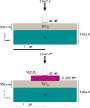
- intervals of these parameters). This can be best observed in the case of the sample with thickness dWCO = 200 nm for z = 50–150 nm. In practice, sample charging effects in the EBID process cause only a minor repulsion of the electron beam (observed as a slight drift in the monitoring images), which can be



Ellipsometry and XPS comparative studies of thermal and plasma enhanced atomic layer deposited Al2O3-films
Beilstein J. Nanotechnol. 2013, 4, 732–742, doi:10.3762/bjnano.4.83
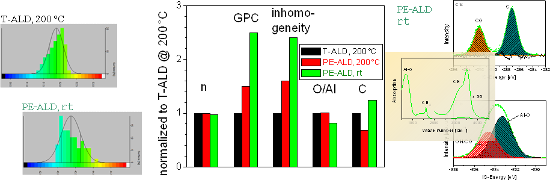
- comprised Al2O3 on Si-substrate and the layer was modelled over the wave number range of 600 cm−1 to 4500 cm−1. Additionally, EDX was applied on these samples (≈50 nm). For XPS measurements Al2O3 films with a thickness of about 10 nm were prepared in order to avoid charging of the samples. XPS measurements


Influence of particle size and fluorination ratio of CFx precursor compounds on the electrochemical performance of C–FeF2 nanocomposites for reversible lithium storage
Beilstein J. Nanotechnol. 2013, 4, 705–713, doi:10.3762/bjnano.4.80
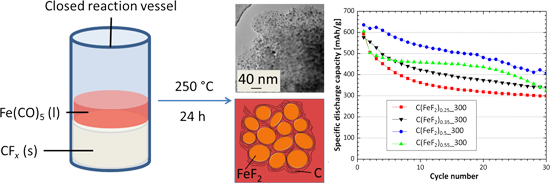
- material in the matrix is a precondition for its electrochemical activity [17][18]. In addition, volume changes that result from phase conversion of the active material during charging and discharging may lead to cracks in the particles and result in poor cyclic stabilities. For this reason, mostly carbon


Electrochemical and electron microscopic characterization of Super-P based cathodes for Li–O2 batteries
Beilstein J. Nanotechnol. 2013, 4, 665–670, doi:10.3762/bjnano.4.74
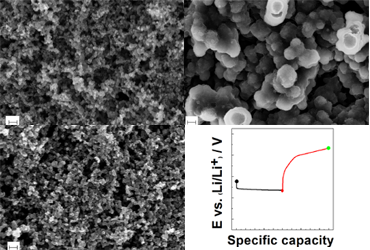
- a stepwise fashion leading to the formation of LiO2 and Li2O2 as shown in the chemical reactions below. Conversely, upon charging, the oxygen evolution reaction (OER) gives O2 and Li+ back via a 2-electrons reaction. The unsuitability of commonly used electrolytes for Li-ion batteries (e.g
- charge–discharge cycles) of the Li–O2 cells [10][15]. The shape of the galvanostatic curve is characterized by a flat discharge plateau at ≈2.7 V, whereas upon charging the potential of the cell rapidly increases to 3.2 V, then proceeding up to 3.9 V in a sloped manner and finally approaching the end of
- charge-transfer resistance. The observed behavior can be explained on the basis of a growing insulating phase at the cathode side and more specifically directly related to the formation of Li2O2 upon discharge, as demonstrated by the XRD results that will be discussed later on. After charging (Figure 2


Preparation of electrochemically active silicon nanotubes in highly ordered arrays
Beilstein J. Nanotechnol. 2013, 4, 655–664, doi:10.3762/bjnano.4.73
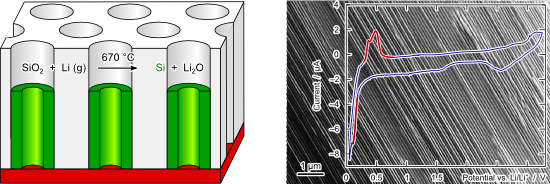
- with Li, and which are associated with the concomitant phase transitions, severely constraint the practical exploitation of this very large capacity [5]. In bulk silicon, one does not limit oneself to charging and discharging a small fraction of the theoretically available lithium, the mechanical
- electrolyte to the vicinity of the current collector should allow for a ‘lateral’ expansion of the electrode material upon charging, whereas direct ‘vertical’ transport paths are maintained for the charge carriers in the solid electrode (for the electrons) and in the electrolyte (for the Li+ ions). The
- in a Li+-containing electrolyte. The cyclic voltammetry of the lithium/silicon system is typically characterized by a sharp reduction between +0.1 and +0.2 V (vs Li/Li+) on the charging curve and a broader double oxidation peak situated between +0.3 and +0.7 V upon discharge [6][7][8]. Upon inclusion





AFM as an analysis tool for high-capacity sulfur cathodes for Li–S batteries
Beilstein J. Nanotechnol. 2013, 4, 611–624, doi:10.3762/bjnano.4.68
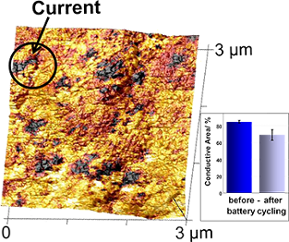
- battery, which depends mainly on the type of binder that is used [5][6][7]. Related to the morphology and volume changes of the cathodes, it was found that the sulfur cathodes expand while discharging and shrink while charging. The thickness change of the electrode was measured to be approximately 22% [8
- present in most parts of the surface with high stiffness. These transient currents indicated surface regions where fast charging processes occurred even before contact of that sample to lithium species. Therefore, the transients were not associated with an ionic charging process. An electronic charge
- transfer is present and a charging of carbon agglomerates on insulating sulfur particles (indicated by the high stiffness of this region) with the tip is assumed. The size of the underlying sulfur particles retrieved from the high stiffness region is about 0.5 µm and presumably they are too large for a



Novel composite Zr/PBI-O-PhT membranes for HT-PEFC applications
Beilstein J. Nanotechnol. 2013, 4, 481–492, doi:10.3762/bjnano.4.57
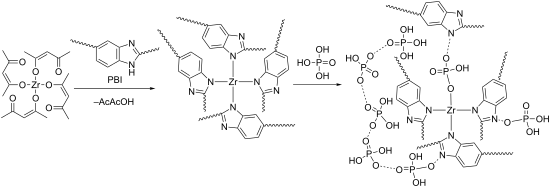
- of the AL and models the following processes: charge-transfer during the oxygen reduction reaction, double layer charging and ohmic losses due to finite proton conductivity of the AL. The following parameters were obtained as a result of the impedance spectra approximation: the undistributed ohmic


In situ monitoring magnetism and resistance of nanophase platinum upon electrochemical oxidation
Beilstein J. Nanotechnol. 2013, 4, 394–399, doi:10.3762/bjnano.4.46
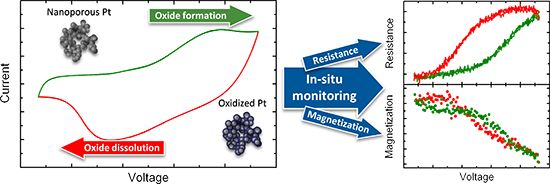
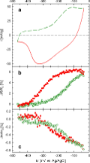
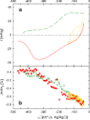
- amount of deposited oxygen, is considered to be primarily caused by charge-carrier scattering processes at the metal–electrolyte interfaces. In comparison, the decrease of the magnetic moment upon positive charging appears to be governed by the electric field at the nanocrystallite–electrolyte interfaces
- combination to provide a deeper understanding of the underlying charge-related processes since both properties are expected to respond differently on charging and chemical modification. The studies make use of a specifically designed electrochemical cell that allows in situ magnetic studies in a SQUID
- contacts similar to our previous work [5], improved by adding a fifth wire providing an independent contact for electrochemical charging (further referred to as sample PtER). For magnetic measurements, 17.8 mg of the powder were compacted to a cylindrical pellet, which was carefully wrapped by a gold wire

Influence of the solvent on the stability of bis(terpyridine) structures on graphite
Beilstein J. Nanotechnol. 2013, 4, 269–277, doi:10.3762/bjnano.4.29
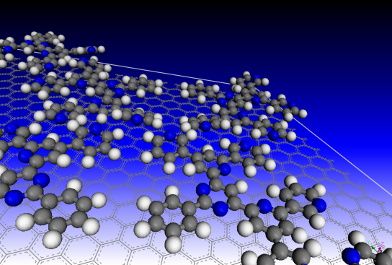
- ultrafine settings of the program. Partial charges of the atoms are assigned with the Gasteiger [25] and QEq [26] methods for UFF and Dreiding, whereas charging methods are already included in the CVFF and Compass force fields. As mentioned in the introduction, the theoretical treatment of liquids requires
- molecular dynamics trajectory range from 0.07 g/cm3 for UFF with Gasteiger charging, up to 1.01 g/cm3 for Dreiding with QEq charges. A value of 0.997 g/cm3 would have been expected [33]. With UFF, the deviation from the experiment is particularly high with both charging methods. Dreiding performs well with
- QEq charging, but not with Gasteiger charges. Compass and CVFF also show a deviation from experimental values of less than 5%. Further Compass calculations with varying system size could show that the solvent density does not change noticeably over a wide range of system sizes. Starting from a system


Functionalization of vertically aligned carbon nanotubes
Beilstein J. Nanotechnol. 2013, 4, 129–152, doi:10.3762/bjnano.4.14
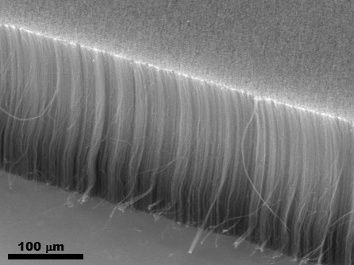
- used, and inversely when charging. Their current limitation comes from their poor performance in terms of energy and power densities, safety and lifetime. Much attention is focused on the electrodes and electrolyte technology. Lu et al. [101] developed vertically aligned carbon nanotubes with and