Search results
Search for "crystallites" in Full Text gives 201 result(s) in Beilstein Journal of Nanotechnology. Showing first 200.
Nanoglasses: a new kind of noncrystalline materials
Beilstein J. Nanotechnol. 2013, 4, 517–533, doi:10.3762/bjnano.4.61
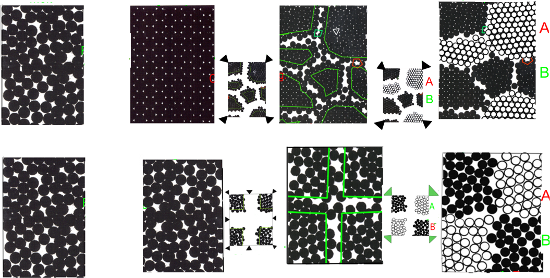
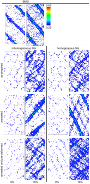
- consists of nanometer-sized glassy regions (corresponding to the nanometer-sized crystallites in Figure 3c) connected by interfaces with an enhanced free volume due to the misfit between the atoms at the surfaces of adjacent glassy clusters. Due to the analogy of the nanometer-sized microstructures of both
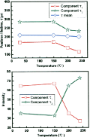
- the nanoglass (Figure 12) the ferromagnetism is associated with the glass–glass interfaces. The results of the Mössbauer spectroscopy (Figure 12) seem to rule out crystallites of bcc-Fe or Fe-oxide crystallites as the origin of the ferromagnetism. Only small amounts (<10%) of nanometer-sized bcc-Fe
- crystallites were revealed in the low temperature Mössbauer spectra [17]. These crystallites are superparamagnetic at ambient temperature. Plastic deformation of nanoglasses Experimental observations: By using microcompression experiments [43], the deformation behaviors of the following two kinds of glasses






A nano-graphite cold cathode for an energy-efficient cathodoluminescent light source
Beilstein J. Nanotechnol. 2013, 4, 493–500, doi:10.3762/bjnano.4.58
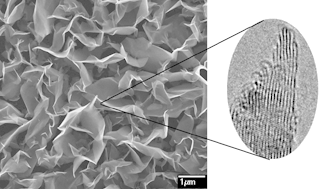
- emission intensity [13]. Starting to grow immediately on the Si substrate, these graphite crystallites have an excellent adhesion and electrical contact with the substrate. The mechanical strength and the excellent electrical conductivity at the contact between the nano-graphite flakes and the substrate
- perpendicular to the substrate surface. The top edge of the nano-graphite crystallites has a special atomic arrangement providing connections between neighboring graphene layers. This arrangement is responsible for the significant improvement of the mechanical stability of the nano-graphite crystallites as well
- as for modifications of their electronic properties. Moreover, the special atomic arrangement of the nano-graphite crystallites also results in the formation of a heterogeneous structure with a double potential barrier for the electrons which escape from the graphite to the vacuum under the influence


Novel composite Zr/PBI-O-PhT membranes for HT-PEFC applications
Beilstein J. Nanotechnol. 2013, 4, 481–492, doi:10.3762/bjnano.4.57
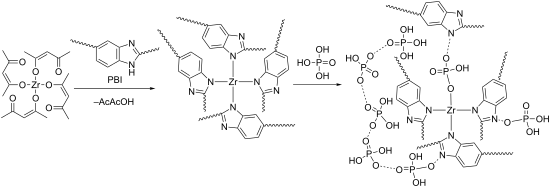
- the series. The absence of any noticeable structural changes in the composite membranes is quite expectable since we added only very small amounts of Zr compounds. According to the obtained data, Zr-based crystallites are not formed (the samples are amorphous), so that Zr atoms should be uniformly


Structural and thermoelectric properties of TMGa3 (TM = Fe, Co) thin films
Beilstein J. Nanotechnol. 2013, 4, 461–466, doi:10.3762/bjnano.4.54
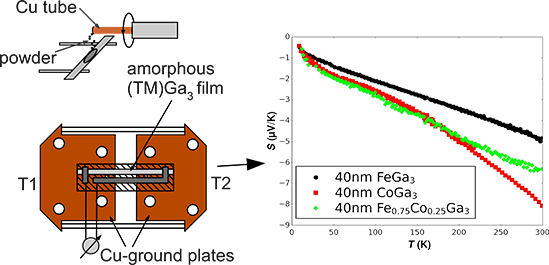
- only at relatively low deposition temperatures. As a consequence, films of all the above compositions were found to be X-ray amorphous with no indications for the presence of crystallites larger than 5 nm. These new metallic glasses displayed transport properties quite distinct from their crystalline


Grain boundaries and coincidence site lattices in the corneal nanonipple structure of the Mourning Cloak butterfly
Beilstein J. Nanotechnol. 2013, 4, 292–299, doi:10.3762/bjnano.4.32
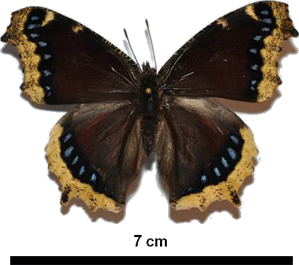
- current investigation the type and nature of these high-angle grain boundaries was studied in more detail. It will be shown that these boundaries have preferential misorientation angles, such that adjacent crystallites are arranged in specific coincidence site lattices (CSLs). A comparison to similar CSLs


Plasticity of Cu nanoparticles: Dislocation-dendrite-induced strain hardening and a limit for displacive plasticity
Beilstein J. Nanotechnol. 2013, 4, 173–179, doi:10.3762/bjnano.4.17
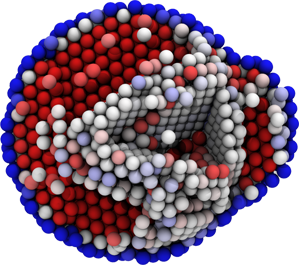
- behaviour of individual Cu crystallites under nanoextrusion is studied by molecular dynamics simulations. Single-crystal Cu fcc nanoparticles are embedded in a spherical force field mimicking the effect of a contracting carbon shell, inducing pressure on the system in the range of gigapascals. The material


Catalytic activity of nanostructured Au: Scale effects versus bimetallic/bifunctional effects in low-temperature CO oxidation on nanoporous Au
Beilstein J. Nanotechnol. 2013, 4, 111–128, doi:10.3762/bjnano.4.13
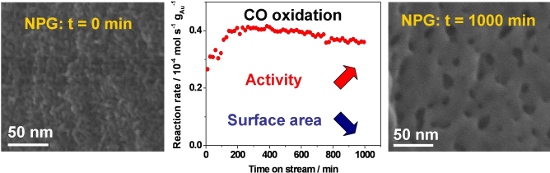
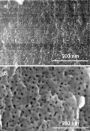
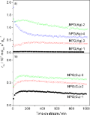
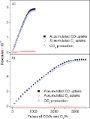
- of the X-rays, and β the FWHM. In the idealized case of nanoscale crystallites that are free of strain, DScherrer approximates the crystal size. NPG consists of crystals with a size on the order of 10 to 100 µm, which are porous on the much smaller nanometer scale [39][42]. The width of the
- , indicate that the crystallites are significantly strained, possibly due to a large density of lattice dislocations. On NPG(Ag)-1, the diffraction peaks are significantly sharper, indicating a lower defect density. This goes along with a significantly lower specific surface area of sample NPG(Ag)-1 as


Plasmonics-based detection of H2 and CO: discrimination between reducing gases facilitated by material control
Beilstein J. Nanotechnol. 2012, 3, 712–721, doi:10.3762/bjnano.3.81
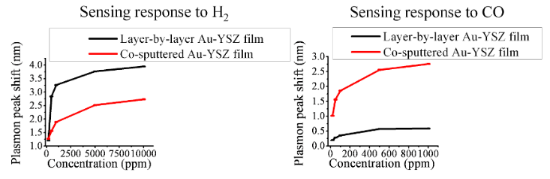
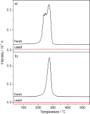
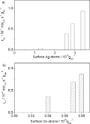
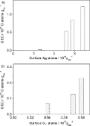
- spherical particles of gold. The particle (crystallite) diameters for all the samples are tabulated in Table 2. Figure 10a,b and Figure 11a,b show ESEM images of the small-, medium- and large-particle samples, and the thinner gold sample, respectively. From the ESEM images the Au crystallites can be clearly
- fact that the deposition rate during the sample preparation of the former film was three times higher than the latter, thereby possibly changing the morphology of the YSZ film and allowing an increased sintering of the Au crystallites during annealing. XRD analyses were performed on the samples with a





Revealing thermal effects in the electronic transport through irradiated atomic metal point contacts
Beilstein J. Nanotechnol. 2012, 3, 703–711, doi:10.3762/bjnano.3.80
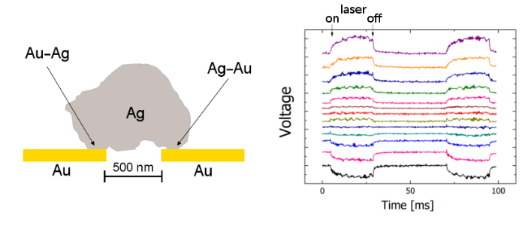
- detail. The contact can be repeatedly opened and closed, and well-defined conductance values can be achieved with this “gate-controlled quantum switch” (GCQS). By applying proper potentials, Ag crystallites were deposited and the contact was established. The area of the working electrodes that was
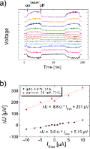
- crystallites than the other one, due to the slightly different potentials applied to the two electrodes. The illumination experiments of these electrodes were carried out with a pulsed Nd:YAG laser (second harmonic, wavelength λ = 532 nm). The laser focus had a diameter of 10 µm, much smaller than the active
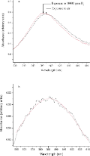
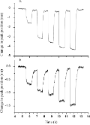
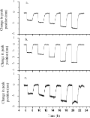
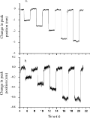
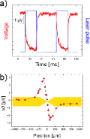
- blown dry under a gentle flow of nitrogen. SEM image of the Au electrodes; the gap between the two segments, distinguishable by the border of the region covered by Ag crystallites, is somewhat left from the middle (size of the image 200 × 150 µm2). (a) Red: Light-induced signal of a gold electrode under





Dimer/tetramer motifs determine amphiphilic hydrazine fibril structures on graphite
Beilstein J. Nanotechnol. 2012, 3, 658–666, doi:10.3762/bjnano.3.75
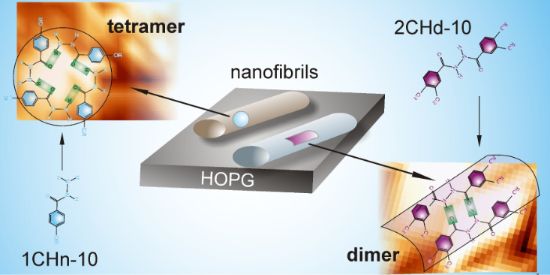
- : around 2.4 wt % for 2CHd-10 and 2.8 wt % for 1CHn-10. Albeit 2CHd-10 possessing a particularly favourable geometry for column formation in the bulk, its morphology on the graphite surface is that of fibrillar crystallites of varied lengths rather than pure fibrils, as shown in Figure 2a. Intrigued by the
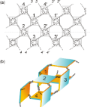
- crystallites, as the axial growth mechanism is basically the same as that for a closed net, i.e., through van der Waals interactions. It can also be conjectured that a closure is most plausible for nets with a small diameter, whereas large nets may lie flat on the surface and grow as crystallites. It is worth
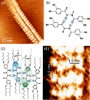
- . Structure models of 2CHd-10 (inversion symmetry) and 1CHn-10 (asymmetric). The coloured region represents the "wedge"-shaped nature of the molecules. The molecular dimensions given for 2CHd-10 are derived from [14][15]. AFM images of randomly oriented (a) 2CHd-10 crystallites and (b) 1CHn-10 fibril bundles




Focused electron beam induced deposition: A perspective
Beilstein J. Nanotechnol. 2012, 3, 597–619, doi:10.3762/bjnano.3.70
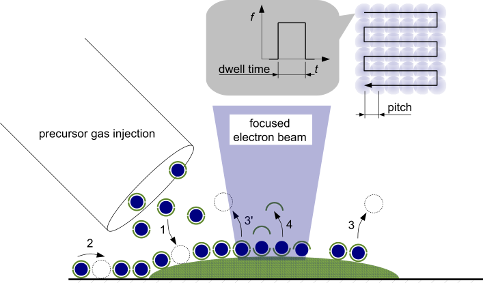
- dielectric matrix, which are subject to an intergranular electronic coupling due to a finite tunneling probability between the crystallites or grains. The binary systems Pt–Si and Pt–Co discussed previously fall into this class. For nanogranular materials the semiclassical approach of Boltzmann transport


Imaging ultra thin layers with helium ion microscopy: Utilizing the channeling contrast mechanism
Beilstein J. Nanotechnol. 2012, 3, 507–512, doi:10.3762/bjnano.3.58
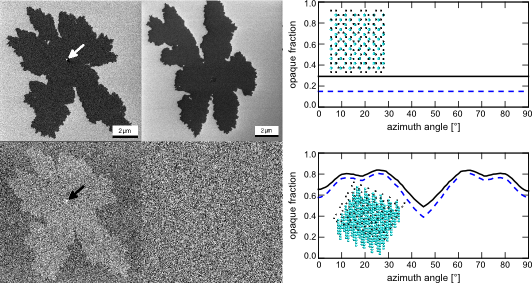
- clusters of interstitial atoms. In fact the contrast mechanism has been successfully applied to the Co on Ge system. In this case the new contrast mechanism reveals the different structural nature of the Co-containing nanocrystals on top of the Ge{001} substrate. The fact that the crystallites can only be
- seen under incident beam angles that allow channeling into Ge{001} is a sign of their different structural properties. The Co in the crystallites influences the position of the atoms sufficiently to block the channels in the covered part of the Ge{001} surface. This independently supports the scanning
- tunneling spectroscopy results, which show that the crystals are cobaltgermanides [10]. Due to the small size of these crystallites, this information is difficult to obtain by other techniques such as diffraction methods or transmission electron microscopy. Finally, we wish to stress the point that this is


Channeling in helium ion microscopy: Mapping of crystal orientation
Beilstein J. Nanotechnol. 2012, 3, 501–506, doi:10.3762/bjnano.3.57
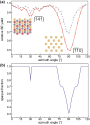
- intensity and data for the individual grains has been aligned by using the position of the strongest peak. We can understand the angular dependence of the SE yield if we view it as a direct result of the fcc structure of the crystallites in the Au{111} film. The insets in Figure 4a are models of the Au
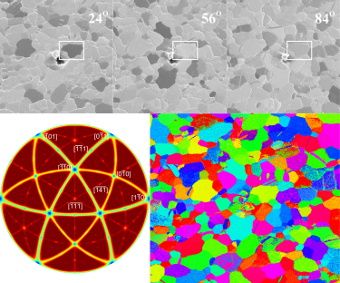
- result, a strong grain contrast can be achieved [10][11], in which dark grains are viewed along a channeling direction, while bright crystallites have a blocking orientation. For the marked grain in Figure 1 the stage rotation angles correspond to the azimuthal angle around [111] measured with respect to
- orientation of all gold crystallites in the FoV. The effect is observed in both types of HIM images. It is, however, particularly useful with SE images. Because of the limited information depth of SE ion-channeling contrast images, crystallographic data from thin adlayers can be obtained. BSHe ion-channeling




Effect of deposition temperature on the structural and optical properties of chemically prepared nanocrystalline lead selenide thin films
Beilstein J. Nanotechnol. 2012, 3, 438–443, doi:10.3762/bjnano.3.50
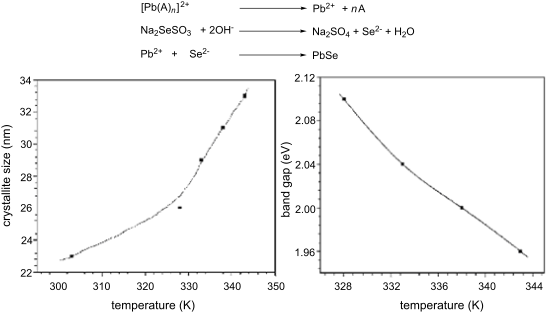
- from 303 to 343 K, as shown in Figure 2. The rate of the deposition reaction increases at higher temperature and the crystallites grow faster resulting in a larger size. Lattice constant The lattice parameter “a” for cubic structure was determined by using the relation where “d” is the spacing between
- were homogenous, without any voids or cracks. The crystallite size obtained by XRD is equivalent to the mean size of the domains that scatter X-rays coherently [22]. The grain size measured from SEM images is the surface morphology of grains that are agglomerated crystallites, leading to larger values
- nanocrystalline PbSe thin films. Similar changes in the band gap energy “Eg” for PbSe thin films with smaller crystallite sizes have been reported for chemically deposited PbSe thin films by Gorer et al. [24]. The value of the band gap was found to vary from 0.55 to 1.55 eV, depending on the crystallites size, by




Functionalised zinc oxide nanowire gas sensors: Enhanced NO2 gas sensor response by chemical modification of nanowire surfaces
Beilstein J. Nanotechnol. 2012, 3, 368–377, doi:10.3762/bjnano.3.43
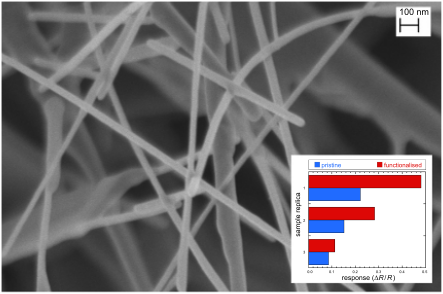
- crystallites into larger masses tends to reduce the gas permeability through the matrix [14]. It also increases the influence of the interagglomerate contact resistance on the gas response of the sensors. Analysis of transmission electron microscope images of these ZnO materials reveals that the primary
- that could be obtained through the use of small ZnO grains (crystallites) with these sensors. In the case of ZnO nanoparticle sensors in the size regime used here, it has been demonstrated previously that a significant response to low (2–10 ppm) NO2 concentrations requires an operating temperature of


Dipole-driven self-organization of zwitterionic molecules on alkali halide surfaces
Beilstein J. Nanotechnol. 2012, 3, 285–293, doi:10.3762/bjnano.3.32
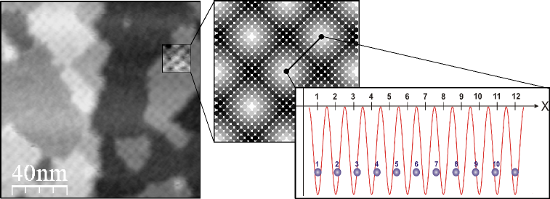
- -)electronic devices. As has been shown by Loppacher et al. [6], large and ordered structures are obtained if either the MM or the MS interaction dominates. In the former case, the structures mostly grow in three-dimensional crystallites [7][8][9][10]. Only for systems in which the MM interaction was


Mesoporous MgTa2O6 thin films with enhanced photocatalytic activity: On the interplay between crystallinity and mesostructure
Beilstein J. Nanotechnol. 2012, 3, 123–133, doi:10.3762/bjnano.3.13
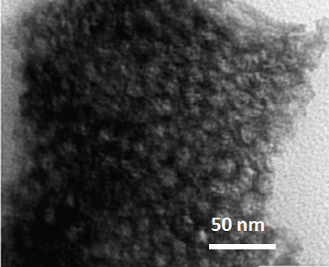
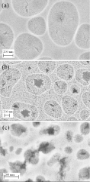
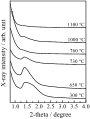
- measure of crystal anisotropy. It is obvious that the nonporous crystallites appear with a larger anisotropy (larger grains in [103] direction) compared to their mesoporous counterparts. When the calcination temperature was increased from 760 to 1100 °C the grain size of MgTa2O6 in the mesoporous film






Electron-beam patterned self-assembled monolayers as templates for Cu electrodeposition and lift-off
Beilstein J. Nanotechnol. 2012, 3, 101–113, doi:10.3762/bjnano.3.11
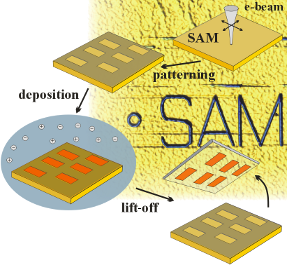
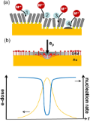
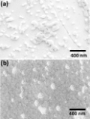
- studied in more detail. For this purpose substrates with different degrees of roughness were compared. Besides Au/Si whose morphology is determined by small crystallites of different orientations, Ag/mica and Au/Ag/mica substrates were used because Au and Ag can be grown epitaxially on mica [57][58], and
- this results in less corrugated films with a well-defined (111) orientation of the crystallites and much larger terraces. The reason for using Ag either as a substrate directly, or as interlayer, is that Au adheres poorly to mica. While the poor adhesion of Au has been taken advantage of for the





Template-assisted formation of microsized nanocrystalline CeO2 tubes and their catalytic performance in the carboxylation of methanol
Beilstein J. Nanotechnol. 2011, 2, 776–784, doi:10.3762/bjnano.2.86
- properties, including surface area and porosity. Although nanocrystalline ceria is known to be more active than amorphous ceria [6], it tends to agglomerate into larger crystallites under conditions of high-temperature catalysis. In this context, the preparation of high-surface-area ceria films by using a


Nanostructured, mesoporous Au/TiO2 model catalysts – structure, stability and catalytic properties
Beilstein J. Nanotechnol. 2011, 2, 593–606, doi:10.3762/bjnano.2.63
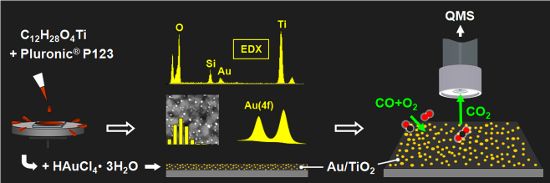
- P123, are applied [32]. Nevertheless, a porous material was obtained, built up from anatase crystallites of 9 nm diameter (calculated from the Scherrer equation) with specific surface areas (after calcination at 350 °C) of 175 m2·g−1 and a monomodal, narrow, pore-size distribution with an average pore
- (~280 nm at 4000 rpm) and typical TiO2 crystallites of 10–20 nm. The observation of very small Au NPs agrees well with earlier findings for DP prepared Au/TiO2 catalysts, which generally yielded Au NPs with small sizes and a relatively uniform particle-size distribution [35]. Based on the TEM analysis






Investigation on structural, thermal, optical and sensing properties of meta-stable hexagonal MoO3 nanocrystals of one dimensional structure
Beilstein J. Nanotechnol. 2011, 2, 585–592, doi:10.3762/bjnano.2.62
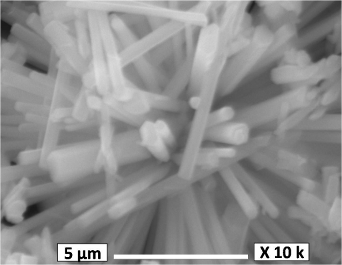
- crystallites aggregate and promote rapid growth of the particle. Hence, crystallite size in the nanometer range is difficult to control in the case of α-MoO3. The present work demonstrates the synthesis of metastable h-MoO3 material through a solution-based chemical precipitation technique. The structure


Platinum nanoparticles from size adjusted functional colloidal particles generated by a seeded emulsion polymerization process
Beilstein J. Nanotechnol. 2011, 2, 459–472, doi:10.3762/bjnano.2.50
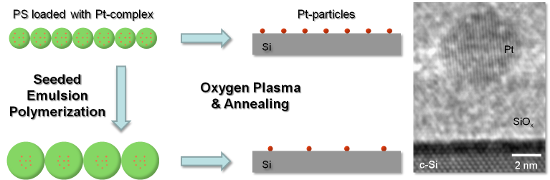
- on the observation that the saturated state after etching contains tiny platinum oxide crystallites, it is reasonable to assume that the precursor-complex platinum acetylacetonate has an influence on the saturation. Therefore, colloids were investigated that were prepared by emulsion polymerization
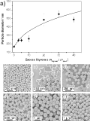
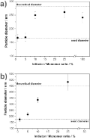
- 35 nm. b) Magnified HRSTEM image of one of the particles demonstrates that they consist of an agglomeration of ca. 1–2 nm Pt-rich crystallites. Diameter of Pt-precursor loaded or unloaded PS particles prepared with the surfactants SDS or Lutensol AT50 versus oxygen plasma exposure time. Only



Room temperature synthesis of indium tin oxide nanotubes with high precision wall thickness by electroless deposition
Beilstein J. Nanotechnol. 2011, 2, 119–126, doi:10.3762/bjnano.2.14
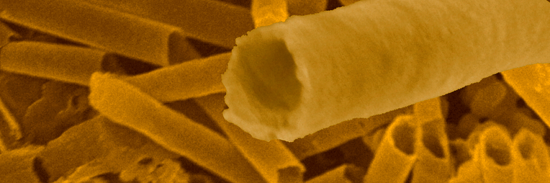
- palladium clusters placed on the surface prior to deposition. As the reaction proceeds, more ITO crystallites appear in the solution, and the nanotubes are formed. The conditions of the aqueous solutions can be controlled by adjusting the concentrations, temperature, pH and the quantities and type of


Synthesis of LiNbO3 nanoparticles in a mesoporous matrix
Beilstein J. Nanotechnol. 2011, 2, 28–33, doi:10.3762/bjnano.2.3
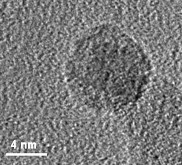
- crystallites in the template was minimized. The determination of particle size, as calculated from the Scherrer equation, leads to a value of about 10 nm which corresponds well with the pore diameter of the ordered mesoporous silica SBA-15 (10.5 nm in diameter), verifying that the mesoporous silica is a useful


Review and outlook: from single nanoparticles to self-assembled monolayers and granular GMR sensors
Beilstein J. Nanotechnol. 2010, 1, 75–93, doi:10.3762/bjnano.1.10
- left for 15 to 28 days to allow for crystal growth. The nanoparticles obtained can be divided into Co2FeO4 and CoFe2O4 particles, Figure 4(b,c), which consist of small phase separated crystallites, Figure 4(d). The majority of larger particles is hexagonally or truncated hexagonally shaped and