


Search results
Search for "dispersion" in Full Text gives 709 result(s) in Beilstein Journal of Nanotechnology. Showing first 200.
Micro- and nanotechnology in biomedical engineering for cartilage tissue regeneration in osteoarthritis
Beilstein J. Nanotechnol. 2022, 13, 363–389, doi:10.3762/bjnano.13.31
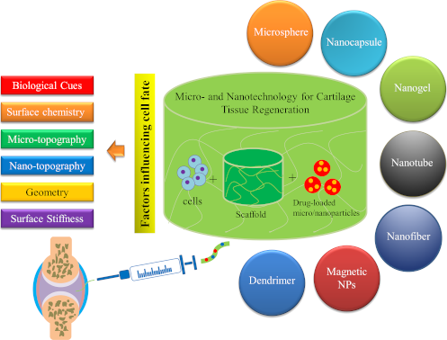
- CNTs with the material context should not be ignored. Functionalized CNTs can physically interact with some of the chemical groups on polymers and facilitate the dispersion of CNTs in composites. For example, it has been reported that COOH-functionalized SWCNTs are readily embedded into type-I collagen


Interfacial nanoarchitectonics for ZIF-8 membranes with enhanced gas separation
Beilstein J. Nanotechnol. 2022, 13, 313–324, doi:10.3762/bjnano.13.26
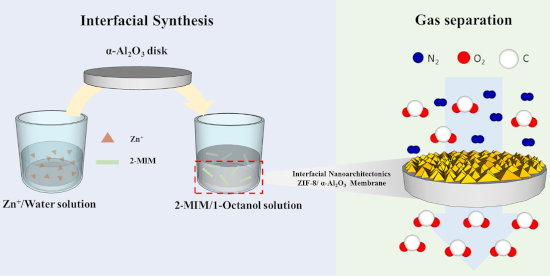
- dispersion, while the counter-diffusion synthesis, using water as the solvent, offered less control over ZIF-8 formation. The film was about 1.5 μm thick, on top of the surface of α-Al2O3 disk rather than embedded into the disk (Figure 7b). Compared to the immiscible solvents in interfacial synthesis, the


Investigation of a memory effect in a Au/(Ti–Cu)Ox-gradient thin film/TiAlV structure
Beilstein J. Nanotechnol. 2022, 13, 265–273, doi:10.3762/bjnano.13.21
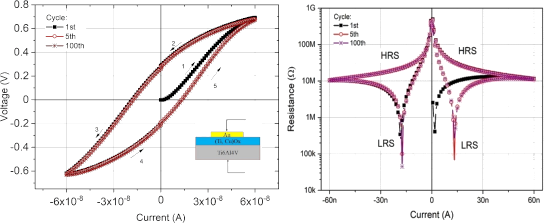
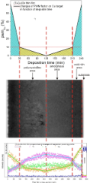
- using a scanning electron microscope (FEI Inspected S50) with an electron dispersion spectrometer (EDS) and the cross-sectional analysis of the prepared thin film structures using a transmission electron microscope (TEM) with X-ray probe. With respect to the programmed U-shape of the magnetron powering



Photothermal ablation of murine melanomas by Fe3O4 nanoparticle clusters
Beilstein J. Nanotechnol. 2022, 13, 255–264, doi:10.3762/bjnano.13.20
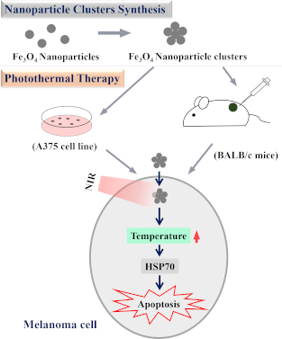
- and lower hyperthermia efficiency [11]. Indeed, other researchers find that the temperature increase by magnetic hyperthermia is much lower than that of NIR-induced heating, presumably due to the coating layers needed for biological dispersion [12]. Yu et al. first discovered strong photothermal
- with the oleic acid and oleylamine ligands present on the surface of Fe3O4 nanoparticles through van der Waals forces to facilitate the dispersion of nanoparticles in aqueous solution. Further addition of ethylene glycol weakened the van der Waals interaction, causing decomposition of nanoparticle
- 59.4 emu/g (Figure 1c) and stronger absorption intensities at the NIR wavelength of 808 nm than individual nanoparticles [17]. In addition, the dynamic light scattering (DLS) analysis of NPCs suspended in aqueous culture medium reflected good dispersion (Figure 1d). The colloidal stability of our


Impact of device design on the electronic and optoelectronic properties of integrated Ru-terpyridine complexes
Beilstein J. Nanotechnol. 2022, 13, 219–229, doi:10.3762/bjnano.13.16
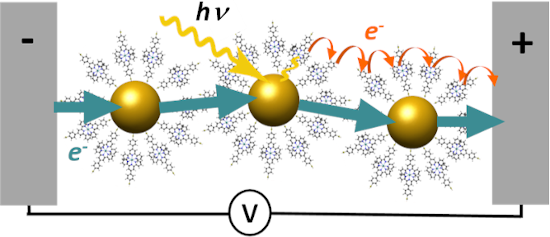
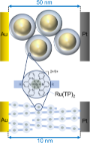
- solution followed by alternately employing Ru-PF6 and BTP solution. Nanoelectrode samples with 20 to 50 nm gaps were used to assemble devices based on multiple Ru(MPTP)2–AuNP building blocks. For this purpose, a droplet of the Ru(MPTP)(MPTP-SAc)–AuNP dispersion was deposited onto the nanoelectrode


Low-energy electron interaction and focused electron beam-induced deposition of molybdenum hexacarbonyl (Mo(CO)6)
Beilstein J. Nanotechnol. 2022, 13, 182–191, doi:10.3762/bjnano.13.13
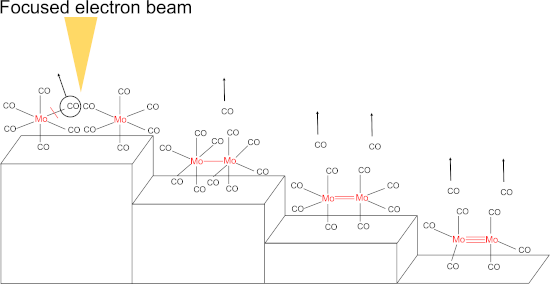
- potential [44] for the molybdenum core electrons was used, including the D3(BJ) dispersion correction by Grimme and co-workers [45][46]. The PBE0 functional was chosen as it has been reported to be among the best performers in thermochemical studies on transition metal compounds [47][48][49]. Harmonic


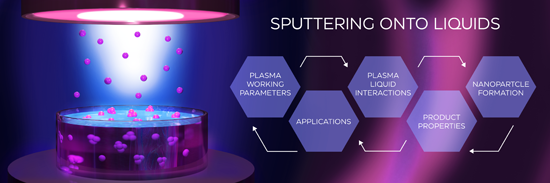
Sputtering onto liquids: a critical review
Beilstein J. Nanotechnol. 2022, 13, 10–53, doi:10.3762/bjnano.13.2






Biocompatibility and cytotoxicity in vitro of surface-functionalized drug-loaded spinel ferrite nanoparticles
Beilstein J. Nanotechnol. 2021, 12, 1339–1364, doi:10.3762/bjnano.12.99
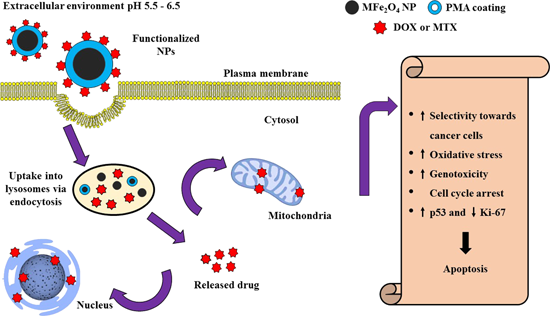
- electrolytes on the stability of NPs [29], and DMEM was used as a representative of biological assays. All NPs (MFe2O4-PMA, MFe2O4+DOX, and MFe2O4+MTX) indicated high zeta potential values (−35 to −26 mV) in all dispersion media except DMEM (−17 to −10 mV) as shown in Table 4. The reason behind lower zeta
- applications [30]. All samples have lower PDI values (0.13–0.33) which indicates a uniform distribution of NPs in different dispersion media (Table 5). pH-dependent drug-loading and drug-release kinetics The UV–vis-based confirmation of drug (DOX and MTX) attachment to PMA-coated MFe2O4 (M = Fe, Co, Zn, Ni


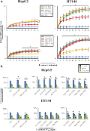
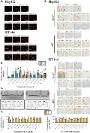

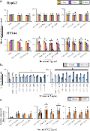


Identifying diverse metal oxide nanomaterials with lethal effects on embryonic zebrafish using machine learning
Beilstein J. Nanotechnol. 2021, 12, 1297–1325, doi:10.3762/bjnano.12.97
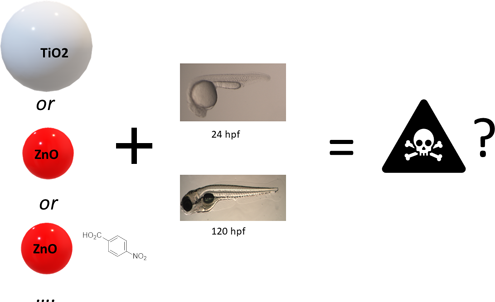


Cantilever signature of tip detachment during contact resonance AFM
Beilstein J. Nanotechnol. 2021, 12, 1286–1296, doi:10.3762/bjnano.12.96
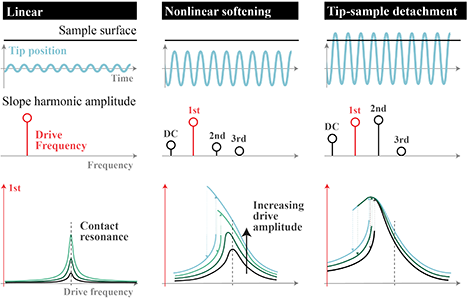
- dispersion relation for wave number and frequency is given as: where βn and fn are the wavenumber and resonance frequency of the nth mode, respectively [38]. Note that this is also valid for the cantilever in contact with the sample using the contact wavenumber and contact resonance frequency of the nth


Electrical, electrochemical and structural studies of a chlorine-derived ionic liquid-based polymer gel electrolyte
Beilstein J. Nanotechnol. 2021, 12, 1252–1261, doi:10.3762/bjnano.12.92
- (εr) and the dielectric loss (εi) as a function of frequency at different temperatures for a polymer gel electrolytes system. It can be seen from Figure 6a that there is a large dielectric dispersion with increasing frequency values at a given temperature. Dielectric dispersion which appears at higher
- temperatures is a measure of the dielectric relaxation which occurs due to the lagging time of rotation with respect to an external alternating field of side groups associated with the main chain. On the other hand, low-temperature dielectric dispersion is a measure of β-relaxation and is related to the micro
- dielectric constant with increasing frequency is the most expected phenomenon of dielectric materials which mostly arises due to the dielectric relaxation that causes an anomalous dispersion. The orientational polarization, which depends on the molecular arrangement of dielectric materials, is the major



Self-assembly of amino acids toward functional biomaterials
Beilstein J. Nanotechnol. 2021, 12, 1140–1150, doi:10.3762/bjnano.12.85
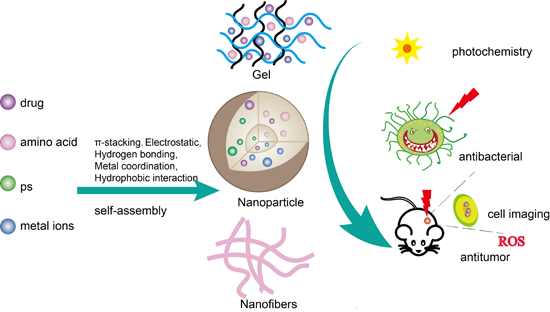
- -assembled amino acid molecules to exhibit stimulation responsiveness to the environment, which has exciting prospects for use in drug delivery. The advantages of low production costs, easy dispersion in aqueous media, mild and rapid synthetic setup and simple functionality facilitate their use as future

pH-driven enhancement of anti-tubercular drug loading on iron oxide nanoparticles for drug delivery in macrophages
Beilstein J. Nanotechnol. 2021, 12, 1127–1139, doi:10.3762/bjnano.12.84
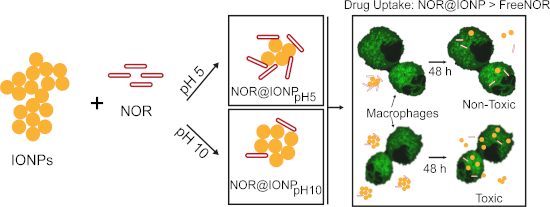
- potential of UIONPs was found to be dependent on the pH of the dispersion media, varying from positive to negative, as the pH was changed from acidic to alkaline (Figure 2d). The standard deviation for zeta potentials at pH of 8 and 9 was negligible and therefore not discernable in Figure 2d. This is due to
- stable in aqueous dispersion, due to electrostatic repulsion from the existing charge on their surfaces. We find that, compared to pH 10, an acidic pH of 5 enhances the drug coating on IONPs, in the range of 4.7 to 5.7 times, achieving a NOR loading efficiency almost equivalent to polymeric nanoparticles
- and reaction was continued for 20 min more, at 80 °C. The dispersion was then allowed to cool, and the nanoparticles were magnetically separated out and washed with milliQ water. IONPs synthesized from 100 mL reaction was dispersed in 100 mL milliQ water and coating of NOR was carried out with a



First-principles study of the structural, optoelectronic and thermophysical properties of the π-SnSe for thermoelectric applications
Beilstein J. Nanotechnol. 2021, 12, 1101–1114, doi:10.3762/bjnano.12.82
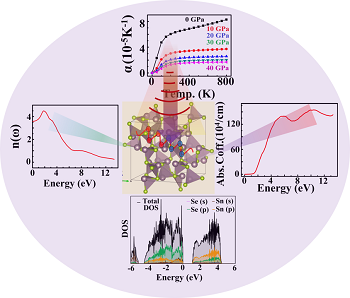
- [79]. No dispersion or scattering is observed in L(ω) as the curve is linear between 0 and 1.4 eV. The real optical conductivity σ(ω) is a valuable tool to evaluate the concentration of electrons that participate in optical transitions. The optical conductivity plot for the π-SnSe alloy is presented


Use of nanosystems to improve the anticancer effects of curcumin
Beilstein J. Nanotechnol. 2021, 12, 1047–1062, doi:10.3762/bjnano.12.78
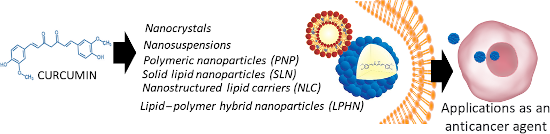
- produced as a powder or as an aqueous suspension containing only the drug [46]. Some authors refer to nanocrystals as indistinguishable from nanosuspensions [47], which may be due to subtle differences between them (Figure 2). Strictly speaking, a nanosuspension is a colloidal dispersion of pure particles
- advantages of these systems have been evidenced by the significant increase in the in vivo performance of drugs administered in this way [47]. For instance, CUR nanocrystals obtained by solution-enhanced dispersion via supercritical CO2 showed increased internalization and apoptotic effects in colorectal


Revealing the formation mechanism and band gap tuning of Sb2S3 nanoparticles
Beilstein J. Nanotechnol. 2021, 12, 1021–1033, doi:10.3762/bjnano.12.76
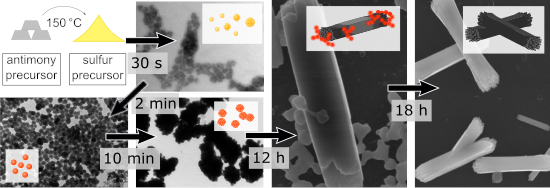
- product contained nanoparticles with a diameter of 33 ± 5 nm (a summary of the evolution of the particle size throughout the synthesis can be found in Table 1). The nanoparticles were irregularly formed but, in general, spherically shaped. With increasing reaction time, the dispersion turned darker and
- Information File 1). As the reaction continued, a dark red dispersion was obtained. While the average particle size (210 ± 30 nm) remained unchanged 30 min after the reaction had been started (Figure 1c), the aggregated type I nanoparticles now appeared to have merged as the type II nanoparticles preserved
- after 30 min. There were still type III structures found consisting of type II particles. After 8 h, the dispersion started to turn brownish in color. The amorphous, spherically shaped type II nanoparticles (see X-ray diffraction spectrometry, XRD in Figure 2 below) began to form the first crystalline


Progress and innovation of nanostructured sulfur cathodes and metal-free anodes for room-temperature Na–S batteries
Beilstein J. Nanotechnol. 2021, 12, 995–1020, doi:10.3762/bjnano.12.75
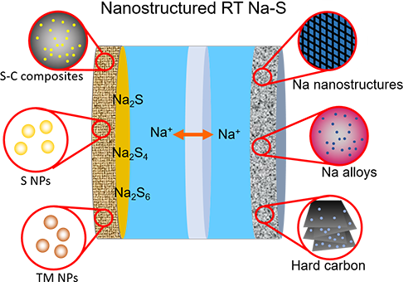
- retention during cycling and higher active material utilization when compared with traditional sulfur–carbon composites. Additionally, using sodium polysulfides facilitates the dispersion and homogeneous distribution of sulfur into the nanostructured MWCNT matrix, which acts as a high-surface current




The role of deep eutectic solvents and carrageenan in synthesizing biocompatible anisotropic metal nanoparticles
Beilstein J. Nanotechnol. 2021, 12, 924–938, doi:10.3762/bjnano.12.69
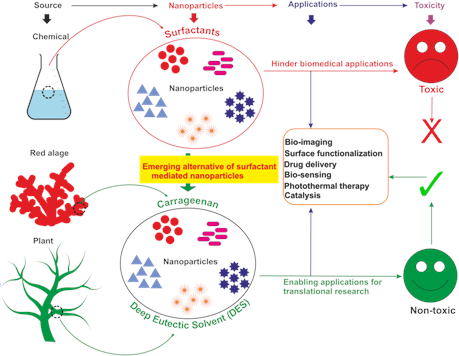
- reducing agent in the dispersion phase [33]. Furthermore, a stabilizing/capping agent is used for enhanced stability and functionalization for the intended application. The wet chemical route allows for a high degree of controllability and reproducibility in synthesizing anisotropic nanomaterials
- the dispersion phase is a commonly encountered challenge. The stability of the nanoparticles is preserved by introducing various capping/stabilizing agents. The capping agent determines the surface chemistry of the nanoparticles deviating from the innate characteristics of the material. However, DESs
- when used as a solvent yield colloidally stable nanoparticles in the absence of capping/stabilizing agents. Also, the function of DESs is not limited to nanoparticle stabilization in their dispersion phase. They also act as a template, determining shape, size, and surface chemistry for the intended


Comprehensive review on ultrasound-responsive theranostic nanomaterials: mechanisms, structures and medical applications
Beilstein J. Nanotechnol. 2021, 12, 808–862, doi:10.3762/bjnano.12.64


Silver nanoparticles nucleated in NaOH-treated halloysite: a potential antimicrobial material
Beilstein J. Nanotechnol. 2021, 12, 798–807, doi:10.3762/bjnano.12.63
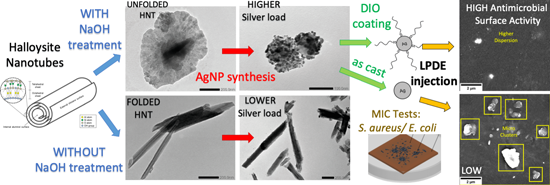
- the potential of the Ag-NPs for industrial application by dispersing them into low-density polyethylene (LDPE) and evaluating the chemical compatibility between matrix and additive by testing a dodecanethiol (DIO) coating to improve the dispersion of the Ag-NPs into LDPE. The resulting composites were
- again at 37 °C for 24 h. The minimal inhibitory concentration was determined examining bacterial growth at each nanoparticle concentration. Dispersion of Ag/HNT-8 in a LDPE polymer matrix Ag/HNT-8 was also tested as an antimicrobial additive to LDPE and the biocide properties of the resulting composite
- , displaying fewer particle clusters and far more nanoscaled dots, suggesting a better dispersion of particles in the LDPE matrix. The antimicrobial properties of Ag-NPs are associated with the release of Ag+ ions [39] and this release is correlated with the surface energy of nanoparticles. Thus, the higher




Recent progress in magnetic applications for micro- and nanorobots
Beilstein J. Nanotechnol. 2021, 12, 744–755, doi:10.3762/bjnano.12.58
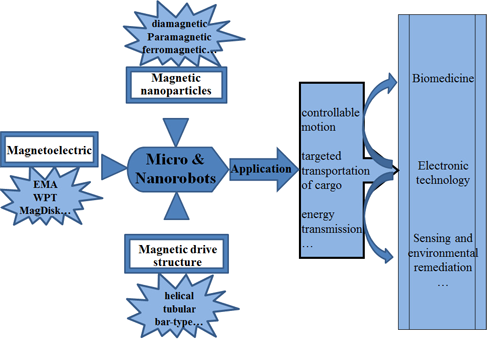
- low-level radiation shielding sheet with diamagnetic nanoparticles and wanted to develop a medical radiation fiber shielding, which is harmless to the human body. The uniform dispersion of magnetic nanoparticles into a polymer resin can not only reduce the weight of the material, but also avoid harm


Physical constraints lead to parallel evolution of micro- and nanostructures of animal adhesive pads: a review
Beilstein J. Nanotechnol. 2021, 12, 725–743, doi:10.3762/bjnano.12.57
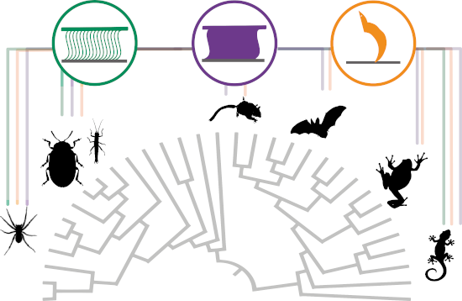
- exploration of many evolutionary aspects, especially convergence. Limited spatial dispersion and extensive adaptive radiation led to a high degree of convergent traits in Phasmatodea, (e.g., in terms of visual camouflage [184][185][186][187], oviposition techniques [109][188][189][190][191][192][193][194


Electromigration-induced formation of percolating adsorbate islands during condensation from the gaseous phase: a computational study
Beilstein J. Nanotechnol. 2021, 12, 694–703, doi:10.3762/bjnano.12.55
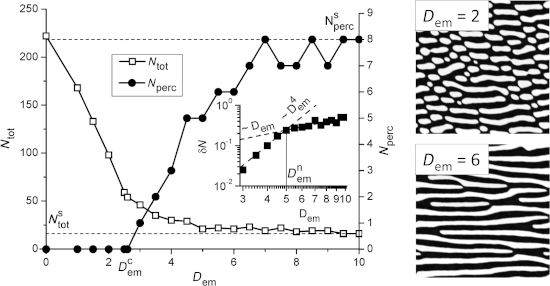
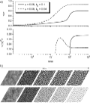
- panel) and the dispersion ⟨(δx)2⟩ (bottom panel). The dispersion ⟨(δx)2⟩ = ⟨x2⟩ − ⟨x⟩2 is an order parameter for pattern formation. If ⟨(δx)2⟩ ≃ 0 then the field x(r) is homogeneously distributed and no patterns are possible. The growing dynamics ⟨(δx)2⟩(t) indicates ordering of the field x(r) with
- follows that during the initial stages of the condensation process the mean adsorbate concentration ⟨x⟩ increases, and after the transient regime it attains a constant value, which depends on the system parameters (see top panel in Figure 3a). The dispersion ⟨(δx)2⟩ takes values close to zero at the
- initial stage meaning a quasihomogeneous distribution of adsorbate on the substrate (see the bottom panel in Figure 3a and the first snapshots in Figure 3b). After the incubation period dispersion starts to grow fast, leading to the formation of small adsorbate islands on a substrate (see the second




![[Graphic 29]](/bjnano/content/inline/2190-4286-12-55-i36.svg?max-width=637&scale=1.18182) on the adsorption coefficient α ...
on the adsorption coefficient α ...

Fate and transformation of silver nanoparticles in different biological conditions
Beilstein J. Nanotechnol. 2021, 12, 665–679, doi:10.3762/bjnano.12.53
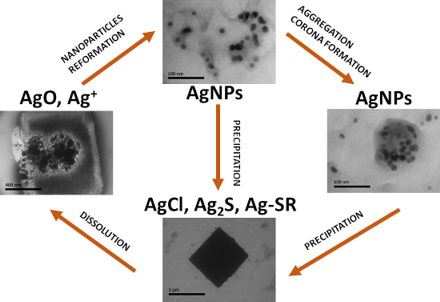
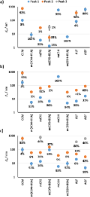
- Supporting Information File 1, Table S2. Although differences in the agglomeration behaviour among different AgNPs were observed depending on the dispersion media, an increase in agglomeration was generally observed in media with a higher ionic strength (CCM, mCYS, mGSH, ALF, and AGF, see Table 1). Such
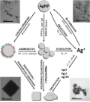
- interaction between the nanoscale surface with complexing agents, such as biothiols, the dispersion of AgNPs into acidic or chloride-rich media, oxidative actions on the nanoscale surface mediated by ROS or catalysed by biomolecules may lead to Ag+ release [25]. Moreover, AgNP degradation and dissolution may




A review of defect engineering, ion implantation, and nanofabrication using the helium ion microscope
Beilstein J. Nanotechnol. 2021, 12, 633–664, doi:10.3762/bjnano.12.52
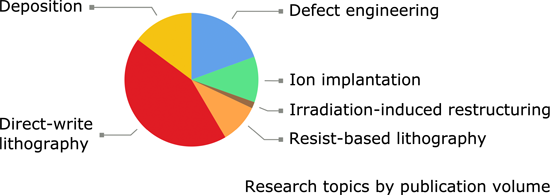
- during deformation. Other materials of interest for nuclear reactor design that have been the subject of HIM irradiation studies include silicon carbide grains in a pyrolytic carbon matrix [79], α-LiAlO2 pellets [80], tristructural-isotropic fuel particles [81], oxide dispersion-strengthened steels [82





