Search results
Search for "impedance" in Full Text gives 197 result(s) in Beilstein Journal of Nanotechnology.
Mechanical properties of MDCK II cells exposed to gold nanorods
Beilstein J. Nanotechnol. 2015, 6, 223–231, doi:10.3762/bjnano.6.21
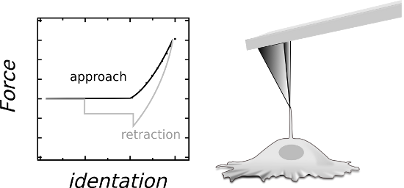
- enzymes. More advanced techniques, like electric cell-substrate impedance sensing (ECIS) or quartz crystal microbalance measurements monitor the vertical cell motility, i.e., dynamic changes of the cell-substrate distance, as a reporter for cell viability [1][10][11][12][13][14][15]. Mechanical properties
- epithelial cells was shown to be corrupted by gold-nanoparticle exposure in these previous publications, we decided to monitor viscoelastic changes and metabolically driven shape fluctuations in real-time by means of acoustic and impedance-based sensors like QCM and ECIS; the latter furthermore enabled us to


Kelvin probe force microscopy in liquid using electrochemical force microscopy
Beilstein J. Nanotechnol. 2015, 6, 201–214, doi:10.3762/bjnano.6.19
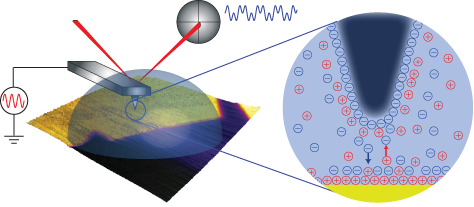
- effects, which cannot be obtained using linear bias sweeps (e.g., CV measurements), ultimately requiring either pulsed electrochemical or impedance measurements [57]. To achieve this goal, a multidimensional spectroscopic strategy was implemented, which is capable of probing both the bias- and time
- electronic charge and z is the ion valence. At low biases (Vdc < kT/e ≈ 25 mV) and in the absence of Faradaic reactions, this RC time is the relevant timescale of the transient response, e.g., in high-frequency impedance spectroscopy experiments or induced charge electrokinetics, where high-frequency


![[Graphic 6]](/bjnano/content/inline/2190-4286-6-19-i11.png?max-width=637&scale=1.18182) response collected 200 nm above a grounded Au electrode in (a, b, c) air, (d, e, f) decane an...
response collected 200 nm above a grounded Au electrode in (a, b, c) air, (d, e, f) decane an...


![[Graphic 22]](/bjnano/content/inline/2190-4286-6-19-i27.png?max-width=637&scale=1.18182) spectra [bias-on] collected 500 nm above HOPG in aqueous solutions of increasing salt concent...
spectra [bias-on] collected 500 nm above HOPG in aqueous solutions of increasing salt concent...

![[Graphic 25]](/bjnano/content/inline/2190-4286-6-19-i30.png?max-width=637&scale=1.18182) spectra [bias-on] collected 500 nm above (a) HOPG and (b) Au in milli-Q water (vertical color...
spectra [bias-on] collected 500 nm above (a) HOPG and (b) Au in milli-Q water (vertical color...

![[Graphic 27]](/bjnano/content/inline/2190-4286-6-19-i32.png?max-width=637&scale=1.18182) spectra [bias-on] recorded 500 nm above a HOPG/Au boundary in milli-Q water. T...
spectra [bias-on] recorded 500 nm above a HOPG/Au boundary in milli-Q water. T...

Mammalian cell growth on gold nanoparticle-decorated substrates is influenced by the nanoparticle coating
Beilstein J. Nanotechnol. 2014, 5, 2479–2488, doi:10.3762/bjnano.5.257
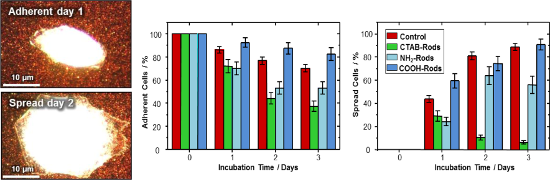
- polymer induced a reduction by 30% and 40%, respectively, which is absent for the carboxy-terminated polymer. Furthermore, interface-sensitive impedance spectroscopy (electric cell–substrate impedance sensing, ECIS) was employed in order to investigate the micromotility of cells added to substrates
- nanorods, which were applied to the basolateral side of the cells, has a recognizable influence on the growth behavior and thus the coating should be carefully selected for biomedical applications of nanoparticles. Keywords: basolateral application; cytotoxicity; electric cell–substrate impedance sensing
- properties of the coating agent and its reactive group. The impact on surfactant-induced cell behavior was investigated in more detail by interface-sensitive impedance spectroscopy (electric cell–substrate impedance sensing, ECIS). Studies on the uptake and influence on metabolic activity with respect to


High-frequency multimodal atomic force microscopy
Beilstein J. Nanotechnol. 2014, 5, 2459–2467, doi:10.3762/bjnano.5.255
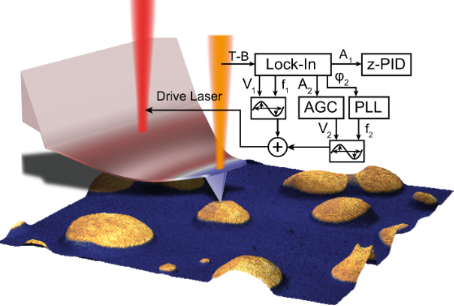
- mirror based readout has two major advantages over a conventional, purely operational amplifier based readout. The large increase in speed is achieved by the very low input impedance of current mirrors, thus countering the negative impact of diode parasitics on the total bandwidth. Additionally, the


Gas sensing properties of nanocrystalline diamond at room temperature
Beilstein J. Nanotechnol. 2014, 5, 2339–2345, doi:10.3762/bjnano.5.243
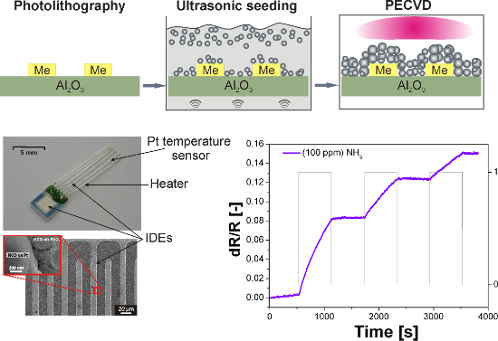
- Figure 5, exposure of the sensor elements to 100 ppm of ammonia gas led to increased impedances from 4.4 to 5.4 MΩ and from 3.9 to 5.4 MΩ for the samples nucleated for 1 min and 5 min, respectively. It should be noted that a variation (shift) in the starting impedance value was observed. The starting
- impedance varied by nearly an order of magnitude in some cases. The origin for this difference can be attributed to several factors, for example, low quality ohmic contacts or memory effects of the surface state of NCD. It was concluded that technological optimization is still required for achieving better
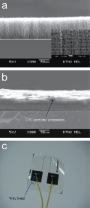
- conductive electrodes (Figure 7, cross-sectional view). Moreover, the impedance measurements showed that the gap between the interdigitated electrodes is one of the most important geometric parameters of the sensor and should carefully be considered when enhancing the sensing response (Figure 3 and Figure 5


Low cost, p-ZnO/n-Si, rectifying, nano heterojunction diode: Fabrication and electrical characterization
Beilstein J. Nanotechnol. 2014, 5, 2216–2221, doi:10.3762/bjnano.5.230
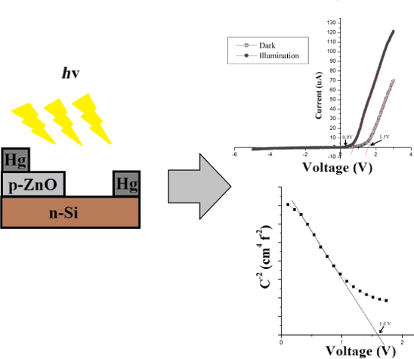
- Equations 4–6 [9][10] as follows: where Vbi is the built-in voltage, Xn and Xp are the depletion width for the n- and p-side, and εn and εp are the dielectric constants of n-Si and p-ZnO, respectively. The dielectric constants εp and εn were found to be 7 and 11.7, respectively, as derived from impedance
- crystalline phase of the p-ZnO nanoparticles. The Hall effect measurement system (ECOPIA, model HMS-3000) was used for electrical characterization of the sample. An electrometer (KEITHLEY, 6517B) was used for the current–voltage (I–V) measurements of the diode and an impedance analyzer (WAYNE KERR, 6500B) was


Effect of channel length on the electrical response of carbon nanotube field-effect transistors to deoxyribonucleic acid hybridization
Beilstein J. Nanotechnol. 2014, 5, 2081–2091, doi:10.3762/bjnano.5.217
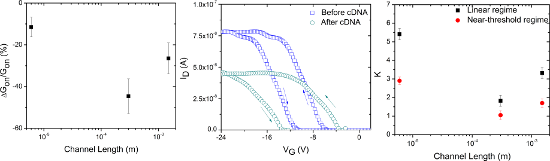
- contribution of charge-trapping mechanism to the observed behavior [27][28]. Similar DNA detection studies using CNTs based on the principle of impedance exhibited detection limits as low as 100 aM [29]. To verify whether the source of the signal is from the CNT channel, ID–VG curves of FETs with only the


Carbon-based smart nanomaterials in biomedicine and neuroengineering
Beilstein J. Nanotechnol. 2014, 5, 1849–1863, doi:10.3762/bjnano.5.196
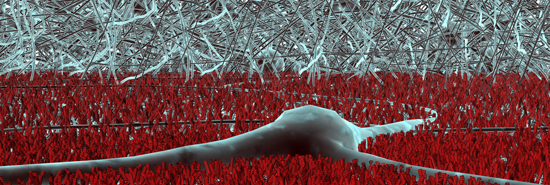
- smaller microelectrodes, reducing the electrode surface exposed to the electrolyte or in close proximity to neuronal cell membranes, has been shown to lead to a significant electrochemical impedance of the interface, decreased injected charge limits and poor S/N properties. CNTs, by their excellent
- ionic and electronic conductivity of poly(3,4-ethylenedioxythiophene) (PEDOT), a conductive polymer, with the high mechanical stability of CNTs. This combination, employed as a coating layer of conventional MEAs, resulted in reduced impedance, and thus in improved performances not only when compared


Experimental techniques for the characterization of carbon nanoparticles – a brief overview
Beilstein J. Nanotechnol. 2014, 5, 1760–1766, doi:10.3762/bjnano.5.186
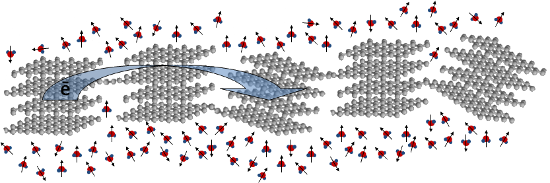
- be attributed to the strained nano-graphite appearing in the sample. There are also other ways to determine the dimensions of the CNs. Among them are impedance measurements [32] and the EPR technique performed on the conducting electrons [33]. A more detailed analysis is provided in the next section


Growth and structural discrimination of cortical neurons on randomly oriented and vertically aligned dense carbon nanotube networks
Beilstein J. Nanotechnol. 2014, 5, 1575–1579, doi:10.3762/bjnano.5.169
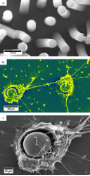
- stimulate neural activity. CNTs do have a high capacity and low impedance, e.g., compared to IrO2 which is widely used as electrical interface for cells, as has been manifested by cyclic voltammetry and impedance spectroscopy [9]. Thus CNTs allow to minimise the stimulation voltage as well as the electrode


Methods for rapid frequency-domain characterization of leakage currents in silicon nanowire-based field-effect transistors
Beilstein J. Nanotechnol. 2014, 5, 964–972, doi:10.3762/bjnano.5.110
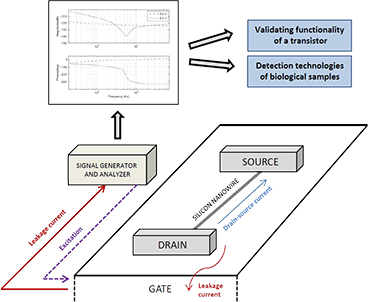
- -response measurements of switched-mode power supplies, and applied the IRS to analyze the output impedance. The design steps of the excitation sequence can also be applied for the application in this paper. Results and Discussion The presented methods were applied, and the leakage current was characterized
- amplifier. The upper operational amplifier in the schematic works as an excitation voltage buffer, which drives the ground-referred unknown impedance Zx through a current sense resistor Rsense. The measured current causes a voltage drop in this resistor, which is then amplified with the lower
- instrumentation amplifier. Cc and Rc are added to prevent oscillation in case Zx is highly capacitive. Excitation voltage scaling, power supplies, filtering, and additional amplifier stages are not included. The amplifier has a selectable gain of −1.1 mV/nA or −4.5 mV/nA. The bandwidth depends on the impedance to


Optical modeling-assisted characterization of dye-sensitized solar cells using TiO2 nanotube arrays as photoanodes
Beilstein J. Nanotechnol. 2014, 5, 895–902, doi:10.3762/bjnano.5.102
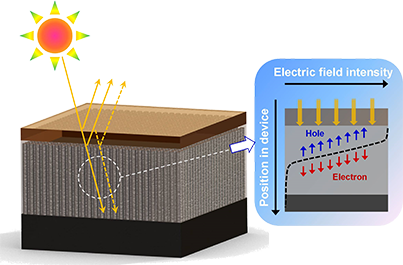
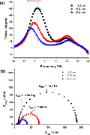
- parameters of the DSSCs, electrochemical impedance spectroscopy (EIS) offers valuable information. Figure 4 shows the Bode phase plots and the Nyquist plots obtained from electron transfer at the TiO2 and electrolyte interface under a solar simulator of AM 1.5. Figure 4a shows the negative shift of the
- for about 40 min. The absorbance measurement was performed using UV–vis spectrophotometer (Cary 300, Varian). The electrochemical impedance spectroscopy (EIS) measurements were performed by illuminating the DSSCs with a AM 1.5 solar simulator calibrated at 100 mW·cm−2 at open-circuit conditions


Enhancement of photocatalytic H2 evolution of eosin Y-sensitized reduced graphene oxide through a simple photoreaction
Beilstein J. Nanotechnol. 2014, 5, 801–811, doi:10.3762/bjnano.5.92
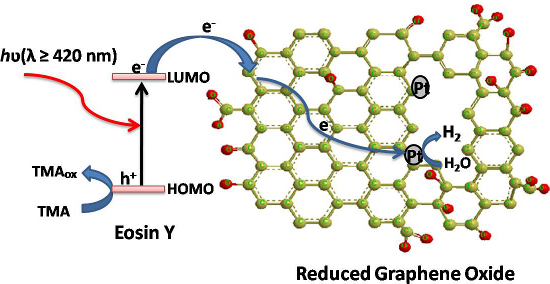
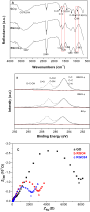
- photoreaction. This further indicates the restoration of the sp2 π-conjugated network for RGO after the photoreaction. Due to restoration of the sp2 π-conjugated network in RGOx, its conductivity is expected to increase [42]. To verify this enhancement, the electrochemical impedance spectroscopy (EIS) of GO
- -resolution TEM (HRTEM) images were taken on a JEOL JEM-2010 (TEM) equipped with an energy dispersive spectrometer (EDS). Electrochemical impedance spectroscopy (EIS) was measured on an IVIUMSTAT electrochemical workstation (Netherlands). The electrochemical experiments were performed in a 3-compartment cell





Electrochemical and electron microscopic characterization of Super-P based cathodes for Li–O2 batteries
Beilstein J. Nanotechnol. 2013, 4, 665–670, doi:10.3762/bjnano.4.74
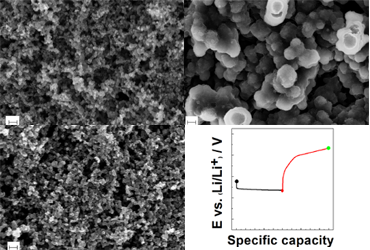
- (trifluoromethane)sulfonimide lithium salt (LiTFSI)/tetraglyme electrolyte were investigated by galvanostatic cycling and electrochemical impedance spectroscopy measurements. Ex-situ X-ray diffraction and scanning electron microscopy were used to evaluate the formation/dissolution of Li2O2 particles at the cathode
- side during the operation of Li–O2 cells. Keywords: aprotic electrolyte; impedance spectroscopy; Li–O2 batteries; scanning electron microscopy; Introduction The development of new types of electrochemical power sources is nowadays considered a key factor for further development of hybrid and fully
- electrolyte. The electrochemical behaviors of the batteries were investigated by galvanostatic cycling and electrochemical impedance spectroscopy. The physico–chemical investigation of the lithium-oxide phases that form and dissolve at the cathode side upon discharge and charge of Li–O2 batteries has been


Novel composite Zr/PBI-O-PhT membranes for HT-PEFC applications
Beilstein J. Nanotechnol. 2013, 4, 481–492, doi:10.3762/bjnano.4.57
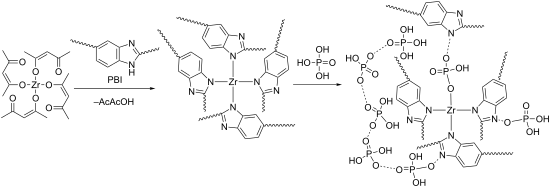
- were examined by means of SAXS, thermomechanical analysis (TMA), and were tested in operating fuel cells by means of stationary voltammetry and impedance spectroscopy. The new membranes showed excellent stability in a 2000-hour fuel cell (FC) durability test. The modification of the PBI-O-PhT films
- reduced conductivity due to an excessively high degree of crosslinking. Keywords: composite; high temperature polymer-electrolyte fuel cells (HT-PEFC); impedance spectroscopy; polybenzimidazole (PBI); zirconium; Introduction Polymer-electrolyte fuel cells (PEFC) based on polybenzimidazole (PBI
- . The current step was 2 mA·cm−2. After setting each current value the system was allowed to reach a steady state for about 10 s before measuring the voltage. Impedance measurements The impedance of the fuel cells with membranes of different types was measured in a galvanostatic mode at frequencies from


Zeolites as nanoporous, gas-sensitive materials for in situ monitoring of DeNOx-SCR
Beilstein J. Nanotechnol. 2012, 3, 667–673, doi:10.3762/bjnano.3.76
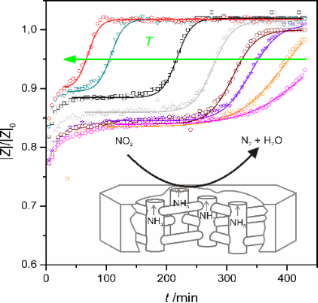
- sensor at the same time. By means of temperature-dependent impedance spectroscopy we found that the thermally induced NH3 desorption in H-form and in Fe-loaded zeolite H-ZSM-5 follow the same process, while a remarkable difference under DeNOx-SCR reaction conditions was found. The Fe-loaded catalyst
- elementary catalytic process promoting a full description of the NH3-SCR reaction system. Keywords: DeNOx-SCR; gas sensing; in situ; impedance spectroscopy; zeolite; Introduction Zeolites are crystalline, nanoporous aluminosilicates composed of [TO4] tetrahedra (T = Si, Al). In H-form zeolites protons
- also applied in gas sensors [12][13][14][15][16][17]. They are proton conductors due to the mobility of the charge-compensating protons. By means of impedance spectroscopy (IS) [18][19][20][21] and quantum chemical calculations on H-ZSM-5 [22][23], we showed in previous works that protons can move


A facile approach to nanoarchitectured three-dimensional graphene-based Li–Mn–O composite as high-power cathodes for Li-ion batteries
Beilstein J. Nanotechnol. 2012, 3, 513–523, doi:10.3762/bjnano.3.59
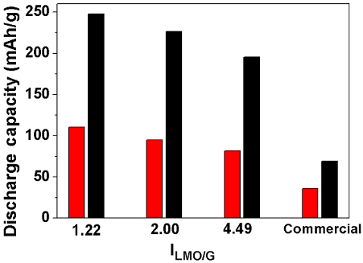
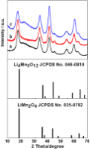
- high current densities are supported by the impedance studies. The electrodes at the fifth fully discharged state are tested under identical conditions. Figure 7 shows the Nyquist plots of the LMO/G and pure LMO electrodes. The pure LMO electrode displays a larger semicircular diameter than that of LMO
- hybrid sample helps to reduce the dissolution of Mn into the electrolyte further. The superior electrochemical performance of LMO/G electrodes is ascribed to three aspects. First, the LMO/G exhibits fast kinetics of Li-ion and electron diffusion, as examined by the electrochemical impedance spectroscopy
- theoretical capacity of 148 mAh·g−1. The electrochemical impedance was performed on the aforementioned CR2032 coin cells with lithium foil as the counter and reference electrode. All cells were measured at the fifth fully discharged state. INPHAZETM EIS system was employed to measure the electrochemical




Reduced electron recombination of dye-sensitized solar cells based on TiO2 spheres consisting of ultrathin nanosheets with [001] facet exposed
Beilstein J. Nanotechnol. 2012, 3, 378–387, doi:10.3762/bjnano.3.44
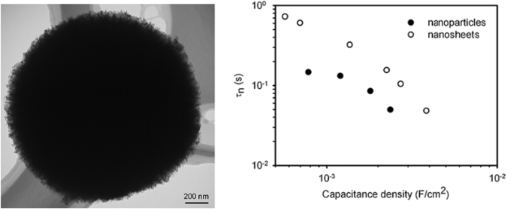
- consisting of ultrathin nanosheets with 100% of the [001] facet exposed was employed to fabricate dye-sensitized solar cells (DSCs). Investigation of the electron transport and back reaction of the DSCs by electrochemical impedance spectroscopy showed that the spheres had a threefold lower electron
- also observed after TiCl4 treatment. The synergistic effect of the variation of the TiO2 conduction band and the electron recombination determined the open-circuit voltage of the DSC. Keywords: dye-sensitized solar cells; electrochemical impedance spectroscopy; electron recombination; TiO2 [001] facet
- transport and back reaction of the DSCs with the spheres were investigated by electrochemical impedance spectroscopy. In addition, the effect of treatment by an aqueous solution of TiCl4 on the performance of the DSCs with the TiO2 spheres was discussed. Experimental Synthesis of TiO2 nanosheet particles


Functionalised zinc oxide nanowire gas sensors: Enhanced NO2 gas sensor response by chemical modification of nanowire surfaces
Beilstein J. Nanotechnol. 2012, 3, 368–377, doi:10.3762/bjnano.3.43
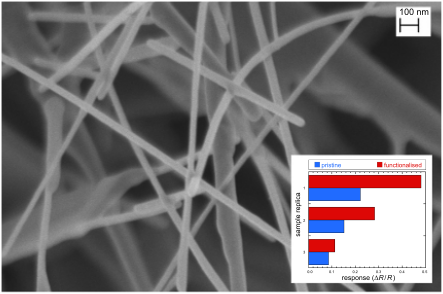
- innovations in the semiconductor gas-sensing field are still in demand [1][2][3]. Impedance-semiconductor gas sensors typically operate at temperatures greater than 200 °C [4][5]. High operating temperatures are generally required to maximise the sensor response to target gases, either to activate the
- of detail. Coating of the semiconductor with a sensitising molecule layer could enhance surface reactions or modify the surface chemistry and, hence, improve sensor sensitivity and specificity to a particular gas. Although such chemical functionalisation of impedance-based gas sensor surfaces is


Junction formation of Cu3BiS3 investigated by Kelvin probe force microscopy and surface photovoltage measurements
Beilstein J. Nanotechnol. 2012, 3, 277–284, doi:10.3762/bjnano.3.31
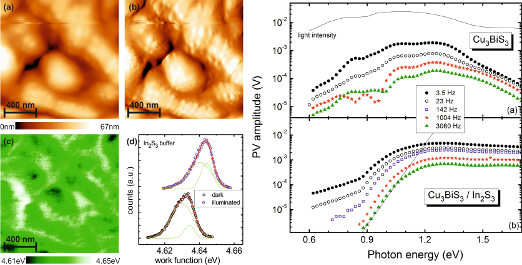
- -impedance buffer with a dual-phase lock-in amplifier. Spectral SPV experiments were performed on untreated Cu3BiS3 samples. XPS measurements on Cu3BiS3 and Cu3BiS3 etched in NH3. (a) Overview spectrum showing that Na, oxides, and C contamination are effectively reduced by the NH3 etch. (b) Detailed spectrum


Schottky junction/ohmic contact behavior of a nanoporous TiO2 thin film photoanode in contact with redox electrolyte solutions
Beilstein J. Nanotechnol. 2011, 2, 127–134, doi:10.3762/bjnano.2.15
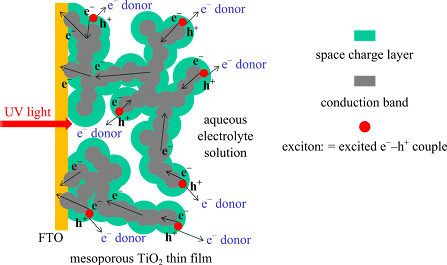
- are low for such mesoporous TiO2 thin film as investigated by an alternating current impedance spectroscopy. The electron conductivity of TiO2 itself is not high. However, the carrier density N of 6.96 × 1019 cm−3 obtained from Figure 4 was high, in the order as that of graphite, indicating that the




Microfluidic anodization of aluminum films for the fabrication of nanoporous lipid bilayer support structures
Beilstein J. Nanotechnol. 2011, 2, 104–109, doi:10.3762/bjnano.2.12
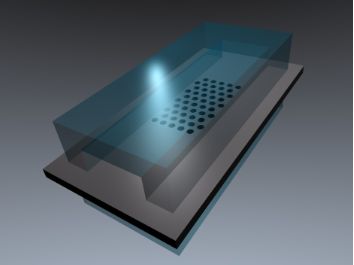
- monitored by impedance spectroscopy across the nanoporous alumina membrane in real-time. Our approach offers a simple and efficient methodology to investigate the activity of transmembrane proteins or ion diffusion across membrane bilayers. Keywords: anodization; lipid bilayer; microfluidics
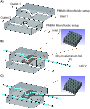
- formation of lipid bilayers on top of the nanoporous membrane which is monitored using impedance spectroscopy. Experimental The experimental setup for the microfluidic anodization approach is shown schematically in Figure 1. The aluminum substrate, either a 30 µm thick aluminum foil or a thin aluminum film
- the nanoporous membrane. The dissolution of the barrier layer was monitored via impedance spectroscopy (10 Hz to 10 kHz) across the nanoporous alumina membrane by a modular electrochemical system [Autolab (PGSTAT 100/FRA2), Eco Chemie Utrecht, The Netherlands] using silver/silver chloride electrodes