Search results
Search for "room temperature" in Full Text gives 1452 result(s) in Beilstein Journal of Nanotechnology. Showing first 200.
On the mechanism of piezoresistance in nanocrystalline graphite
Beilstein J. Nanotechnol. 2024, 15, 376–384, doi:10.3762/bjnano.15.34
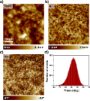
- smaller grain sizes and diminishes with larger grains. The mechanism has been proposed as a cause of plastic deformation in metals. Wang et al. showed for a platinum nanocrystalline film [42] that the rotation due to strain at room temperature does not occur because of cross-grain gliding, GB sliding, or


Investigating ripple pattern formation and damage profiles in Si and Ge induced by 100 keV Ar+ ion beam: a comparative study
Beilstein J. Nanotechnol. 2024, 15, 367–375, doi:10.3762/bjnano.15.33
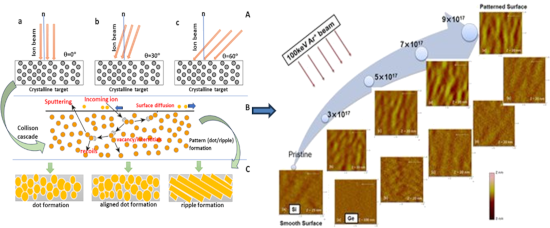
- simultaneously irradiated, keeping the experimental conditions the same. The experiment was performed at high vacuum ≈5 × 10⁻⁶ Torr and at room temperature. Argon ions (100 keV) have been used to irradiate the samples at an incident angle of θ ≈ 60° with respect to the surface normal [16]. The area in which the


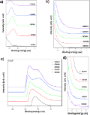
Determining by Raman spectroscopy the average thickness and N-layer-specific surface coverages of MoS2 thin films with domains much smaller than the laser spot size
Beilstein J. Nanotechnol. 2024, 15, 279–296, doi:10.3762/bjnano.15.26


Vinorelbine-loaded multifunctional magnetic nanoparticles as anticancer drug delivery systems: synthesis, characterization, and in vitro release study
Beilstein J. Nanotechnol. 2024, 15, 256–269, doi:10.3762/bjnano.15.24
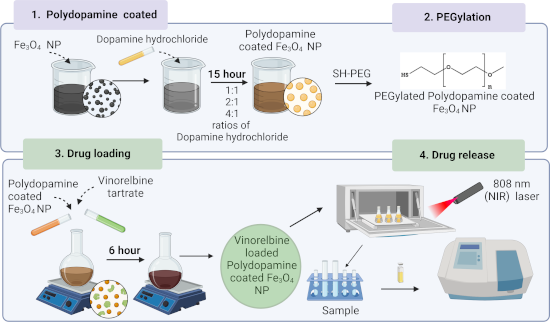
- amounts: 100, 200, and 400 mg; dopamine hydrochloride/Fe3O4 ratios: 1:1, 2:1, and 4:1) and stirred at room temperature for 15 h at 1000 rpm. Following this stage, the obtained PDA-coated Fe3O4 NPs were separated from the solution using a magnet. Subsequently, unreacted material was removed by washing
- -polyethylene glycol was added to the prepared mixture to homogenize the solution. Subsequently, 0.2 mL of ammonium hydroxide (NH4OH, 28–30%,) was added, and the mixture was stirred at room temperature for 70 min [37]. SH-PEG-modified PDA/Fe3O4 NPs were separated from the solution using a magnet, and unreacted


Design, fabrication, and characterization of kinetic-inductive force sensors for scanning probe applications
Beilstein J. Nanotechnol. 2024, 15, 242–255, doi:10.3762/bjnano.15.23
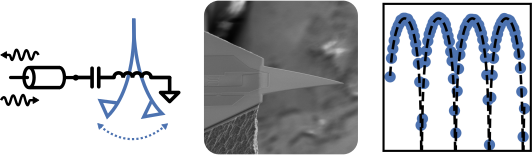
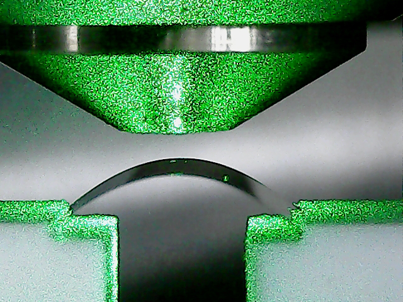
- , gravitational waves acting on a 40 kg mirror in LIGO [3], or atomic-scale tip–surface forces acting on a 40 pg cantilever in an atomic force microscope (AFM). For AFM cantilevers operating at room temperature close to their fundamental resonant frequency in the kilohertz-to-megahertz range, optical
- was verified both at room temperature and in a cryogenic environment. Thus, the deposited material is suitably conductive for STM and various electrostatic AFM techniques that require applying a low-frequency voltage to the tip. Mechanical mode Our chips were the same size as an AFM cantilever chip
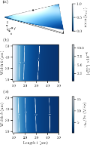
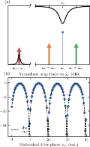
- 60 chips from one wafer, detecting the thermal fluctuations at room temperature under ambient conditions and fitting them to a Lorentzian lineshape. We found that ωm decreases with the increasing radial distance D from the center of the wafer, as shown in Figure 7, probably because of non-uniform



Ion beam processing of DNA origami nanostructures
Beilstein J. Nanotechnol. 2024, 15, 207–214, doi:10.3762/bjnano.15.20
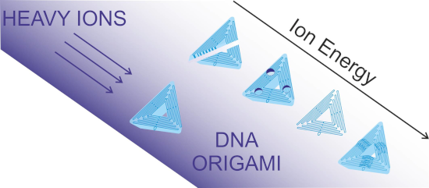
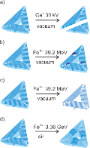
- heat and accumulated charges). The samples were irradiated facing the beam inside a vacuum chamber (10−8 mbar) at room temperature. The projectile flux was deduced from the current measured continuously during irradiation on the four slits used to limit and define the irradiation field. Before


Nanocarrier systems loaded with IR780, iron oxide nanoparticles and chlorambucil for cancer theragnostics
Beilstein J. Nanotechnol. 2024, 15, 180–189, doi:10.3762/bjnano.15.17
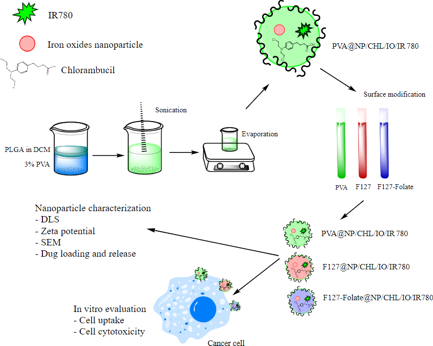
- and allowed to evaporate overnight in a dark area at room temperature. In the next day, the nanoparticles were centrifuged at 12,000 rpm for 30 min, then resuspended in 600 µL of distilled water. The nanoparticles were then separated into three 200 μL suspension tubes. Then, 2 mg of F127-folate or 2


Modification of graphene oxide and its effect on properties of natural rubber/graphene oxide nanocomposites
Beilstein J. Nanotechnol. 2024, 15, 168–179, doi:10.3762/bjnano.15.16
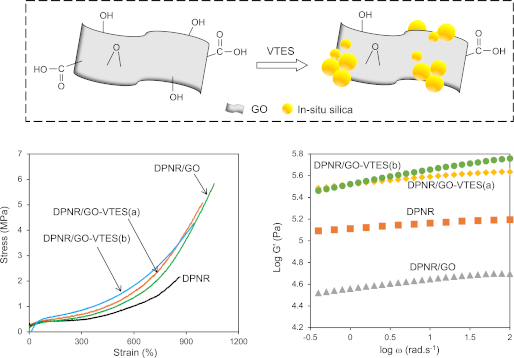
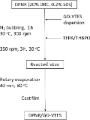
- , 200 g of DPNR (DRC 20%, SDS 0.2%), and with the same amount of TEPA/TBHPO as in the preparation of DPNR/GO-VTES. Characterizations X-ray diffraction patterns of graphite and GO were acquired by using a Panalytical X'Pert Pro X-ray diffractometer. The measurements were performed at room temperature
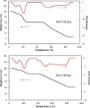
- gravimetric analysis (TGA) of the samples was performed on a TA Q500 instrument. The temperature was increased at a heating rate of 10 °C /min from room temperature to 900 °C in air atmosphere. The morphology of the DPNR/GO-VTES was observed with field-emission scanning electron microscopy (FE-SEM) performed
- with HITACHI S-4800. The measurement was performed at room temperature. The tensile properties of the composite samples were measured with a Tokyo Instron 5300 (Japan). The graft copolymer films (thickness of 1 mm) were cut in a dumbbell shape described in JIS K6251. Tensile measurements were done at






CdSe/ZnS quantum dots as a booster in the active layer of distributed ternary organic photovoltaics
Beilstein J. Nanotechnol. 2024, 15, 144–156, doi:10.3762/bjnano.15.14
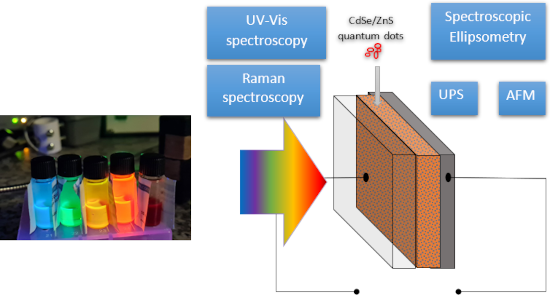
- determined in a wide frequency range from 10−1 to 106 Hz at room temperature. The amplitude of the alternating current signal was set to 0.1 V. The ZView software was used to analyze the recorded impedance spectra. Results and Discussion UV–vis spectroscopy The pure quantum dots exhibit absorption in the




Assessing phytotoxicity and tolerance levels of ZnO nanoparticles on Raphanus sativus: implications for widespread adoptions
Beilstein J. Nanotechnol. 2024, 15, 115–125, doi:10.3762/bjnano.15.11
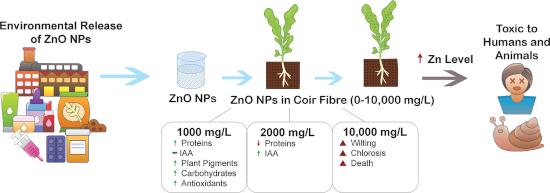
- in the dark. It was then centrifuged at 3500 rpm at 4 °C and 1 mL of the supernatant was mixed with 2 mL of Salkowski reagent and incubated in the dark at room temperature for 30 min. Then, the absorbance was measured at 530 nm [19][59]. The effect of ZnO NPs on carbohydrates, plant pigments, and
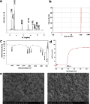


Development and characterization of potential larvicidal nanoemulsions against Aedes aegypti
Beilstein J. Nanotechnol. 2024, 15, 104–114, doi:10.3762/bjnano.15.10
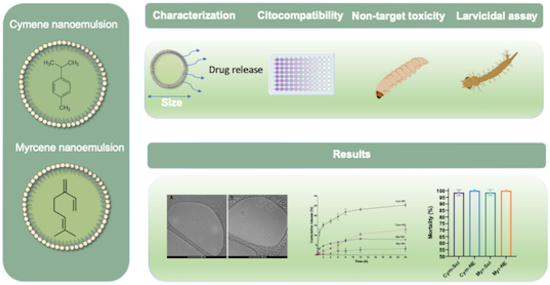
- range of 10.0–16.7, and the rHLB was the one in which the formulation had the best colloidal stability (Table S1, Supporting Information File 1). Characterization of the nanoemulsions Visual appearance The formulations obtained were maintained at room temperature and evaluated visually 24 h and 7, 14
- . The samples were diluted (1:1000 v/v) in ultrapure water. The NEs were injected into the sample chamber with sterile syringes until the liquid extended to the tip of the injector. The measurements were performed in triplicate at room temperature (25 °C) and the data were represented as mean ± standard
- for the experiment, and the samples were administered (10 µL/larva) on the left side of the last proleg using a 10 µL Hamilton syringe. The larvae were then kept in the dark at room temperature and observed after 24, 48, and 72 h to evaluate their behavior, including physical aspects such as color


New application of bimetallic Ag/Pt nanoplates in a colorimetric biosensor for specific detection of E. coli in water
Beilstein J. Nanotechnol. 2024, 15, 95–103, doi:10.3762/bjnano.15.9
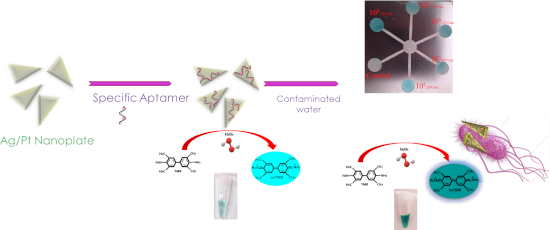
- room temperature using a Zetasizer Nano-ZS90 Malvern. The elementary compositions of the samples were determined using EDS on a Tescan energy-dispersive spectrometer. The ImageJ software was used to determine the gray intensity of the blue color of the paper-based microfluidic device. Synthesis of Ag
- (10–108 CFU·mL−1) were combined with the aptamer-Ag/Pt NPL solution and gently shaken at room temperature. The peroxidase activity of NPLs in the presence of TMB and H2O2 was evaluated using a UV–vis spectrophotometer after the incubation period was shortened. Analysis in real samples Tap water and


Study of the reusability and stability of nylon nanofibres as an antibody immobilisation surface
Beilstein J. Nanotechnol. 2024, 15, 83–94, doi:10.3762/bjnano.15.8
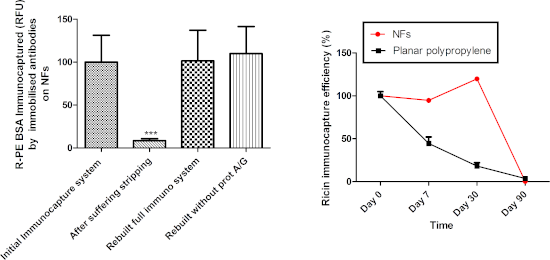
- NF sample) and incubated at room temperature for 10 min two times. The stripping buffer was removed from the nanofibers, and the NFs were washed with PBS (adding and incubating for 10 min two times). The two stripping buffer steps were repeated and three 5 min PBS wash steps took place after them
- /mL) against ricin was incubated for 1 h at room temperature. Then, biotin-labelled ricin (1 µL 1 mg/mL in blocking buffer) was immunocaptured by the anchored antibodies over 1 h of incubation. Biotin-ricin was added to both NF and microplate immunocapture systems at different times: day 0
- (immediately after antibody anchoring; it is considered the reference value) and 7 days, 30 days, and 90 days after antibody anchoring, bringing the immunocapture systems to room temperature only covered by aluminum foil. Washing steps were carried out between each step above in order to remove non-linked


Berberine-loaded polylactic acid nanofiber scaffold as a drug delivery system: The relationship between chemical characteristics, drug-release behavior, and antibacterial efficiency
Beilstein J. Nanotechnol. 2024, 15, 71–82, doi:10.3762/bjnano.15.7
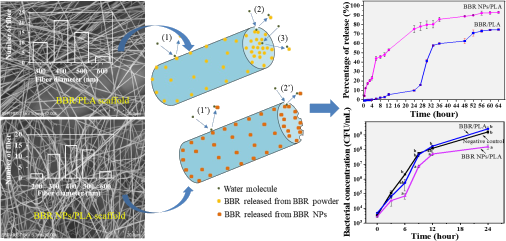
- /PLA, and BBR NPs/PLA were fabricated through the electrospinning of the aforementioned prepared solutions. After the solutions were cooled down to room temperature, they were transferred to a 5 mL syringe with a 22-gauge stainless-steel needle. The needle was linked to a high-voltage power supply
- Multi-function shaker at room temperature with constant agitation at 40 rpm. At each time interval, 2 mL of each solution was withdrawn, the UV–vis absorbance at 421 nm was measured, and then the amount of BBR release based on the standard calibration curve was calculated. The percentage of released BBR


Curcumin-loaded nanostructured systems for treatment of leishmaniasis: a review
Beilstein J. Nanotechnol. 2024, 15, 37–50, doi:10.3762/bjnano.15.4
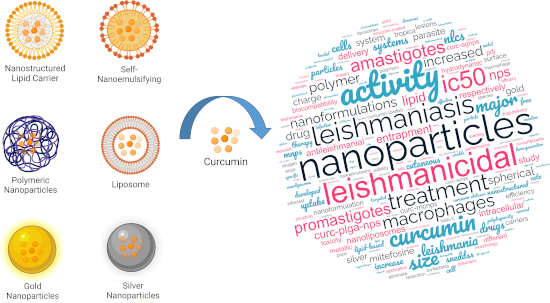
- following the Ambisome® path. Nanostructured lipid carriers Nanostructured lipid carriers (NLCs) are lipid-based formulations with a solid matrix at room temperature that differ from solid lipid nanoparticles when it comes to their matrix organizational level. Nanostructured lipid carriers offer advantages


Measurements of dichroic bow-tie antenna arrays with integrated cold-electron bolometers using YBCO oscillators
Beilstein J. Nanotechnol. 2024, 15, 26–36, doi:10.3762/bjnano.15.3
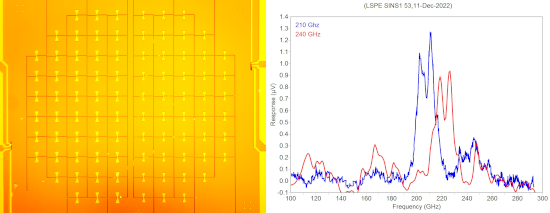
- measured in the current bias mode with a readout scheme based on AD745 low-noise JFET operational amplifiers working at room temperature of 300 K. The estimated NEP for this measurement setup is about 5 × 10⁻¹⁶ W/√Hz with further improvement down to 1 × 10⁻¹⁶ W/√Hz in the voltage bias mode [24]. Discussion


TEM sample preparation of lithographically patterned permalloy nanostructures on silicon nitride membranes
Beilstein J. Nanotechnol. 2024, 15, 1–12, doi:10.3762/bjnano.15.1
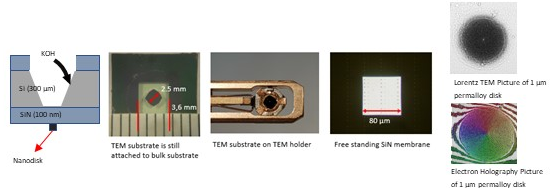
- magnetron sputtering through the resist aperture. We used DC magnetron sputtering in a pure Ar environment at a pressure of 1 Pa to deposit Py at room temperature. The effective permalloy target had a diameter of 8 mm. The sputtered material almost forms a parallel beam when it approaches the substrate at a


unDrift: A versatile software for fast offline SPM image drift correction
Beilstein J. Nanotechnol. 2023, 14, 1225–1237, doi:10.3762/bjnano.14.101
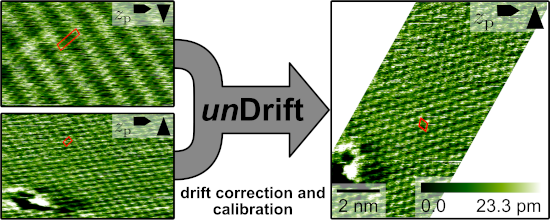
- ]. Hence, many processes relevant at room temperature or elevated temperatures are impossible to study in a cryogenic environment. The same applies to SPM studies at the solid–liquid interface. For these measurements, the effect of thermal drift needs to be compensated. A variety of different strategies


Fluorescent bioinspired albumin/polydopamine nanoparticles and their interactions with Escherichia coli cells
Beilstein J. Nanotechnol. 2023, 14, 1208–1224, doi:10.3762/bjnano.14.100
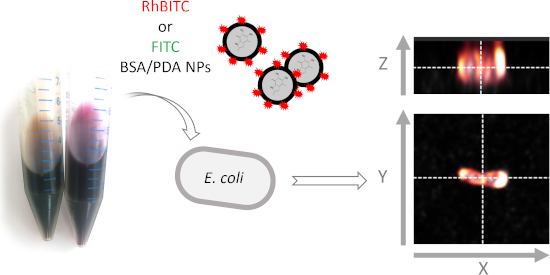
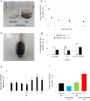
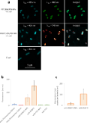
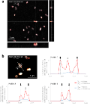
- . Compared to the quantum yields of FITC, RhBITC, and DAPI bound to DNA, which are in the range of 40–90% at room temperature [31][32][34], Ox-BSA/PDA NPs reveal low emission efficiency. However, even if the quantum yield of Ox-BSA/PDA NPs is low, it is significantly higher than the quantum yield of non
- am Harz, Germany) for 48 h to provide lyophilized foam, which was stored at room temperature and protected from light before use. Fluorescent BSA/polydopamine nanoparticles Fluorescent BSA/PDA nanoparticles with a BSA/DA ratio of 10 were synthesized by using two different ways: (i) by oxidation of
- 2 mL of H2O2 solution (30 wt %) were stirred at room temperature in the dark for 24 h. Residual H2O2 was removed from the reaction medium by dialyzing about 8 mL of the suspension against 1 L Milli-Q® water using a Spectra/Por® dialysis membrane with a molecular weight cut-off at 8–10 kDa. The



Determination of the radii of coated and uncoated silicon AFM sharp tips using a height calibration standard grating and a nonlinear regression function
Beilstein J. Nanotechnol. 2023, 14, 1200–1207, doi:10.3762/bjnano.14.99
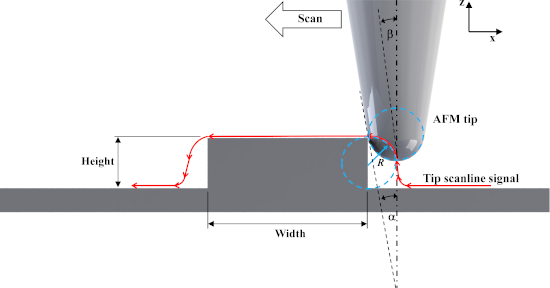
- calibration grating Linewidth scanning in contact mode using each of the selected tips with an applied constant normal load of 0.01 nN perpendicular to the calibration grating was carried out at room temperature and 40% humidity. The scanning frequency of the tips was 0.03 Hz. The tips were moved from right


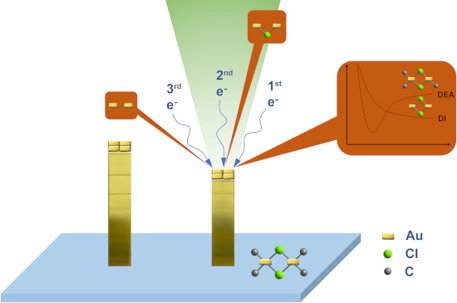
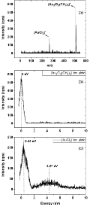
A combined gas-phase dissociative ionization, dissociative electron attachment and deposition study on the potential FEBID precursor [Au(CH3)2Cl]2
Beilstein J. Nanotechnol. 2023, 14, 1178–1199, doi:10.3762/bjnano.14.98



Hierarchically patterned polyurethane microgrooves featuring nanopillars or nanoholes for neurite elongation and alignment
Beilstein J. Nanotechnol. 2023, 14, 1157–1168, doi:10.3762/bjnano.14.96
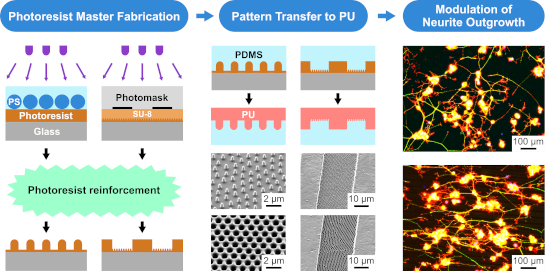
- , 150 °C for 15 min, 170 °C for 1 h, and 195 °C for 1 h. Afterwards, the sample was allowed to cool down to room temperature (RT), and then the PDMS was peeled off (Figure 1A(iv)). To form the “reinforced” SU-8 nanohole mold, a nanohole template was first formed on the positive photoresist AZ1518, which


Elasticity, an often-overseen parameter in the development of nanoscale drug delivery systems
Beilstein J. Nanotechnol. 2023, 14, 1149–1156, doi:10.3762/bjnano.14.95
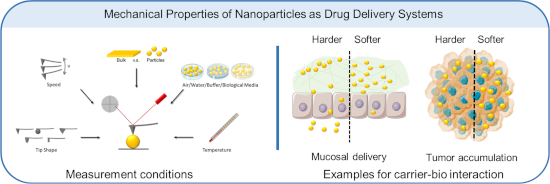
- elasticity of nanomaterials. Even though the exact temperature of the particles is not known, it is assumed to be equal to the surrounding temperature after a sufficient equilibration time. Many studies are performed at room temperature or at 25 °C instead of at the temperature in which biologic studies are


Curcumin-loaded albumin submicron particles with potential as a cancer therapy: an in vitro study
Beilstein J. Nanotechnol. 2023, 14, 1127–1140, doi:10.3762/bjnano.14.93
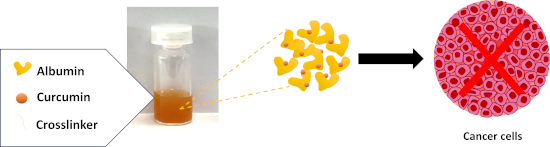
- solution produced by reverse engineering, and make quality control more challenging [19]. Additionally, the degummed silk tends to aggregate when stored for long periods in an aqueous solution, typically for weeks at room temperature and for months at 4 °C [20]. Amongst various carriers, albumin seems to
- mixed with 20 mL of 0.25 M Na2CO3 under constant vigorous stirring for 30 s at room temperature (RT). HSA solution (0.1%) was subsequently added to the mixture under stirring for 5 min to avoid particle aggregation. The obtained particle suspension was separated by centrifugation (6,000g for 3 min




Dual-heterodyne Kelvin probe force microscopy
Beilstein J. Nanotechnol. 2023, 14, 1068–1084, doi:10.3762/bjnano.14.88
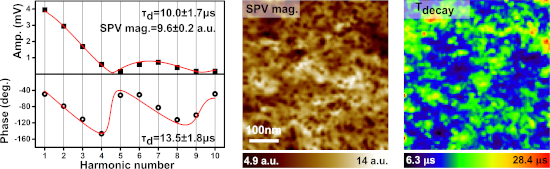
- ) illumination. An SPV image can eventually be recalculated as the difference between both sets of data [1]. The inherent drawback of this dual-pass method is that the source images used for the SPV calculation may feature misalignments, which is especially unavoidable at room temperature (RT) due to thermal
- kHz (demodulation at the second eigenmode) for its heterodyne counterpart. Dual-Heterodyne Kelvin Probe Force Microscopy: Implementation Non-contact AFM (nc-AFM) and KPFM experiments are performed with a VT-beam AFM system (Scienta-Omicron) at room temperature (RT) under ultra-high vacuum (UHV