


Search results
Search for "surface charge" in Full Text gives 250 result(s) in Beilstein Journal of Nanotechnology. Showing first 200.
Functionalized platinum nanoparticles with surface charge trigged by pH: synthesis, characterization and stability studies
Beilstein J. Nanotechnol. 2016, 7, 1822–1828, doi:10.3762/bjnano.7.175
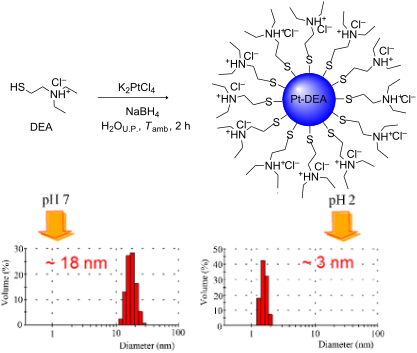
- bond on the PtNP surface. The DLS characterization demonstrated the long-term stability of the colloidal system up to three months and the possibility to tune the aggregation phenomenon of the PtNPs by varying the pH due to modulation of the metal surface charge. Experimental Instrumentation UV–vis


Nano- and microstructured materials for in vitro studies of the physiology of vascular cells
Beilstein J. Nanotechnol. 2016, 7, 1620–1641, doi:10.3762/bjnano.7.155
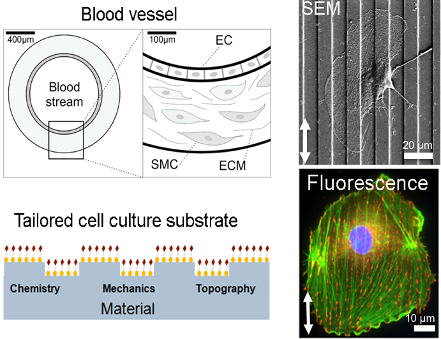
- functionalization. It will be beyond the scope of this review to give a detailed account; only a few examples can be depicted. One simple and often used way to functionalize a surface non-specifically with molecules is by simple physisorption, often after enhancing the surface charge of hardly adhesive surfaces



Viability and proliferation of endothelial cells upon exposure to GaN nanoparticles
Beilstein J. Nanotechnol. 2016, 7, 1330–1337, doi:10.3762/bjnano.7.124
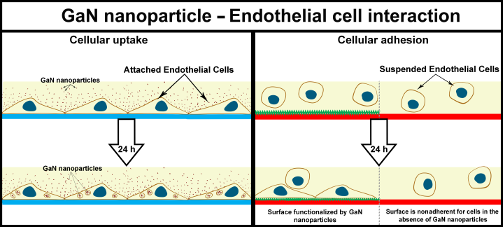
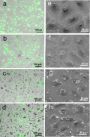
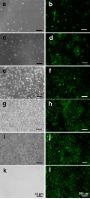
- living cells and different types of nanoparticles of specific shape, surface charge, and chemical composition [4]. For example, elongated, rod-like gold (Au) nanoparticles affect the viability of endothelial cells more than spherical ones, which have better biocompatibility [5]. However, multiwalled



On the pathway of cellular uptake: new insight into the interaction between the cell membrane and very small nanoparticles
Beilstein J. Nanotechnol. 2016, 7, 1296–1311, doi:10.3762/bjnano.7.121
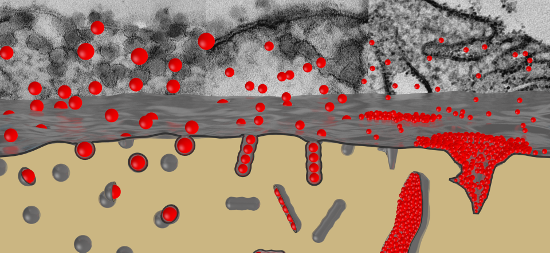
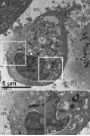
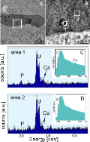
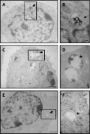
- specific cellular endocytic mechanisms depending on the material, surface charge or size of the applied nanoparticle [32][33]. So far, less is known about the modes of uptake mediated by physical properties of nanoparticles in the diameter range below 25 nm. With our morphological observations we clearly




Straightforward and robust synthesis of monodisperse surface-functionalized gold nanoclusters
Beilstein J. Nanotechnol. 2016, 7, 1278–1283, doi:10.3762/bjnano.7.118
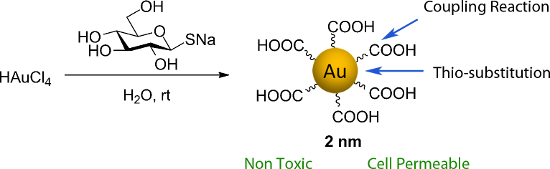
- polydisperse nanoclusters in terms of both size and shape (data not shown). The absorbance profile of THPC-NCs did not show a plasmon band after the synthesis. However, after three days, a plasmon band appeared, revealing particle aggregation. The surface charge did not change upon dialysis for any sample as


Improved biocompatibility and efficient labeling of neural stem cells with poly(L-lysine)-coated maghemite nanoparticles
Beilstein J. Nanotechnol. 2016, 7, 926–936, doi:10.3762/bjnano.7.84
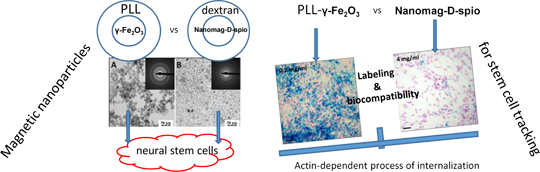
- , Great Britain). The agglomeration properties and the surface charge properties of PLL-γ-Fe2O3 nanoparticles in biological cell culture medium with and without addition of common serum protein were previously described [26]. The crystal structure of both types of nanoparticles was investigated using the




Tight junction between endothelial cells: the interaction between nanoparticles and blood vessels
Beilstein J. Nanotechnol. 2016, 7, 675–684, doi:10.3762/bjnano.7.60
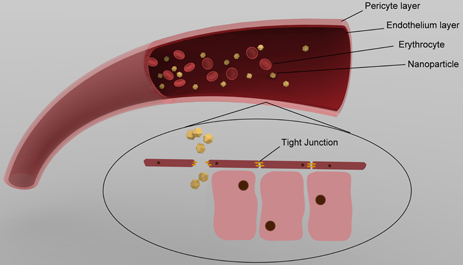
- exposure to NPs (polystyrene nanoparticles, quantum dots, single-wall carbon nanotubes) results in the disruption of the alveolar epithelial barrier, the extent of which also depends on the composition, shape and surface charge of the NPs [31]. Carbon nanotubes also show their capacity to penetrate the

Antibacterial activity of silver nanoparticles obtained by pulsed laser ablation in pure water and in chloride solution
Beilstein J. Nanotechnol. 2016, 7, 465–473, doi:10.3762/bjnano.7.40
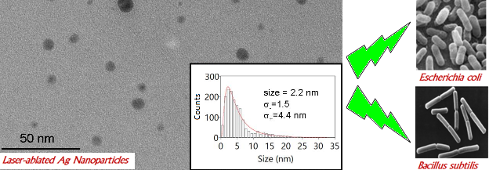
- months, we repeated the same tests previously performed with fresh samples. The MIC values were confirmed, indicating good stability of the antimicrobial properties. As previously reported in the literature, AgNPs toxicity depends on various factors, such as size, surface charge, shape, and capping agent
- . In the current study, all our colloids fall in this size range, thus supporting the observed antimicrobial activity. Beyond size effects, surface charge is considered an important parameter for AgNP activity and colloidal stability. The zeta-potential values of our colloids were always very negative


Surface coating affects behavior of metallic nanoparticles in a biological environment
Beilstein J. Nanotechnol. 2016, 7, 246–262, doi:10.3762/bjnano.7.23
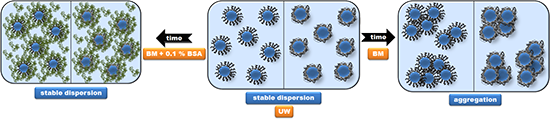
- regardless of their chemical composition, surface structure and surface charge. In addition, an assessment of AgNP and SPION behavior in real biological fluids, rat whole blood (WhBl) and blood plasma (BlPl), revealed that the composition of a biological medium is crucial for the colloidal stability and type
- uptake and toxicity of metallic NPs [41][42], whereas differences in surface coatings influence cytotoxicity and surface charge [43]. However, it is still unclear how different surface coatings affect the interaction of NPs with biological environments and the formation of the protein corona. Because
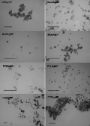
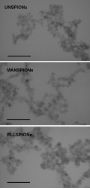
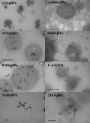
- with a slightly negative surface charge. Agglomeration behavior of different AgNPs and SPIONs in biological media The DLS and ELS methods were used to quantify the agglomeration of differently coated AgNPs and SPIONs in DMEM, a model biological media (BM), while TEM provided a visual presentation of




Characterisation of thin films of graphene–surfactant composites produced through a novel semi-automated method
Beilstein J. Nanotechnol. 2016, 7, 209–219, doi:10.3762/bjnano.7.19
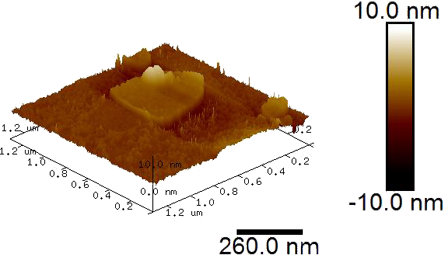
- significant cause of this was poor adhesion of the first graphene layer to hydrophilic substrates. This could be improved in future work through the use of substrates with surface modifications that either enhance the surface charge or make the surface more hydrophobic. Much better results were obtained using




Chemical bath deposition of textured and compact zinc oxide thin films on vinyl-terminated polystyrene brushes
Beilstein J. Nanotechnol. 2016, 7, 102–110, doi:10.3762/bjnano.7.12
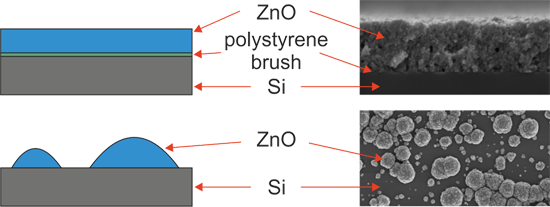
- [36] as organic templates are known, which can modify the surface charge on the substrates for ZnO precipitation under moderate conditions. Based on these studies, we investigated the ZnO film formation on silicon wafers modified with vinyl-terminated polystyrene (PS) brushes. Those brushes consist of
- point (IEP), measured in water, of the plasma-cleaned SiOx surface and the PS brushes is 1.5 (extrapolated) and 6.3, respectively (Figure 2). At pH 9 of the reaction solution, the ζ-potential of the Si wafer is much lower (ca. −100 mV) than that of the brushes (ca. −50 mV). This means that the surface
- charge of the SiOx is highly negative whereas under the same conditions, the PS brush is much less negatively charged. It is noteworthy that the reaction takes place in methanol instead of water. For mixtures of water and alcohol it is known, that the ζ-potential is decreasing with higher alcohol content


pH-Triggered release from surface-modified poly(lactic-co-glycolic acid) nanoparticles
Beilstein J. Nanotechnol. 2015, 6, 2504–2512, doi:10.3762/bjnano.6.260
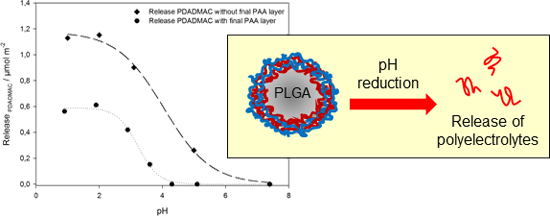
- compensation, required to compensate the charge density of the terminating layer, determines the surface charge density of the subsequently adsorbing layer. Thus, an adsorbing charge-diluted chain requires a larger amount of mass, yielding thicker films [21][38]. At pH 3, PAA is weakly charged, and therefore
- directly correlated to the pH of PAA during adsorption. In case of the titration curves obtained for PAA adsorbed at pH 5 and pH 7, respectively, a decrease of surface potential is observed after reaching its maximum value (see Figure 2). This can be attributed to surface charge compensation effects
- . Successive adsorption of PDADMAC as a cationic compound was accomplished, illustrating the importance to choose adsorption conditions allowing an overcompensation of the nanoparticle surface charge. Furthermore, adsorbed PDADMAC was successfully released after application of an appropriate pH-stimulus


Two step formation of metal aggregates by surface X-ray radiolysis under Langmuir monolayers: 2D followed by 3D growth
Beilstein J. Nanotechnol. 2015, 6, 2406–2411, doi:10.3762/bjnano.6.247
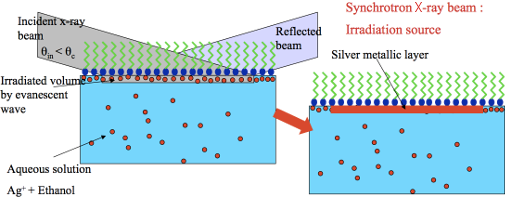
- -assembly properties of surfactant molecules in solution. By the choice of the organic molecule, we can tune the surface charge of the formed self-assembly in order to attract the ions in their vicinity. Therefore, we expect that during the irradiation process, the aggregation of the reduced atoms takes


Fabrication of hybrid graphene oxide/polyelectrolyte capsules by means of layer-by-layer assembly on erythrocyte cell templates
Beilstein J. Nanotechnol. 2015, 6, 2310–2318, doi:10.3762/bjnano.6.237
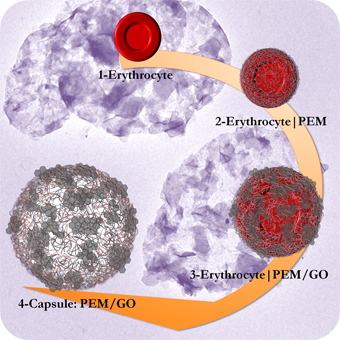
- lead to materials with properties more like G than GO [12][13][14][15]. The derivatization of G to form GO leads to easily dispersible and stable systems containing GO with an overall surface charge while exfoliated, for example, in water [16]. The use of GO sheets in the formation of hierarchical
- structures and assemblies is a subject of current interest, and if done by procedures involving wet chemical techniques, offers much potential for the development of advanced and composite layered materials. The assembly of GO in thin films on the basis of its surface charge can be accomplished using the


Electroviscous effect on fluid drag in a microchannel with large zeta potential
Beilstein J. Nanotechnol. 2015, 6, 2207–2216, doi:10.3762/bjnano.6.226
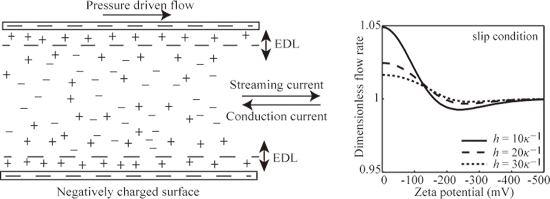
- /bjnano.6.226 Abstract The electroviscous effect has been widely studied to investigate the effect of surface charge-induced electric double layers (EDL) on the pressure-driven flow in a micro/nano channel. EDL has been reported to reduce the velocity of fluid flow and increase the fluid drag
- . Nevertheless, the study on the combined effect of EDL with large zeta potential up to several hundred millivolts and surface charge depenedent-slip on the micro/nano flow is still needed. In this paper, the nonlinear Poisson–Boltzmann equation for electrical potential and ion distribution in non-overlapping
- EDL is first analytically solved. Then, the modified Navier–Stokes equation for the flow considering the effect of surface charge on the electrical conductivity of the electrolyte and slip length is analytically solved. This analysis is used to study the effect of non-overlapping EDL with large zeta


Temperature-dependent breakdown of hydrogen peroxide-treated ZnO and TiO2 nanoparticle agglomerates
Beilstein J. Nanotechnol. 2015, 6, 1897–1903, doi:10.3762/bjnano.6.193
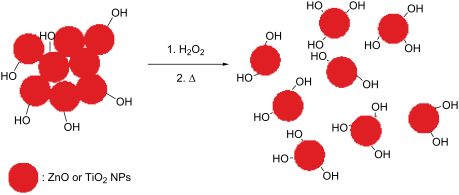
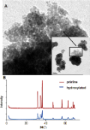
- Figure 1. As can be seen, both types of NPs are composed of NPs with a range of sizes. The average size of the ZnO and TiO2 NPs were 98 and 18 nm, respectively. Change in zeta potential after NP hydroxylation The zeta potential (ζ) of the NPs provides information about the surface charge of the particle
- in a solvent. The surface charge of a particle can vary with respect to the change in environment or any change in the surface chemistry. The proper treatment process of metal oxide NPs with H2O2 can reduce the activation energy of H2O2 resulting in the decomposition into H2O and O2, causing the




Predicting cytotoxicity of PAMAM dendrimers using molecular descriptors
Beilstein J. Nanotechnol. 2015, 6, 1886–1896, doi:10.3762/bjnano.6.192
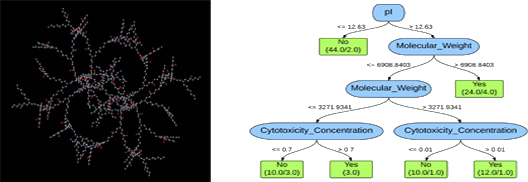
- . In spite of all the desirable properties of dendrimers, there is a significant setback for their use in biomedicine due to their potential toxicological effects, which depend on the structure that is used. It has been shown that cationic PAMAM dendrimers can have surface charge-, generation-, and


NanoE-Tox: New and in-depth database concerning ecotoxicity of nanomaterials
Beilstein J. Nanotechnol. 2015, 6, 1788–1804, doi:10.3762/bjnano.6.183
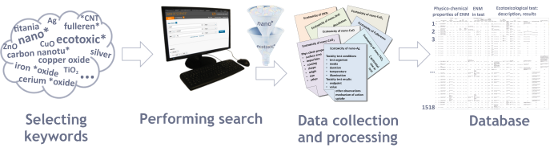
- ENMs generally include chemical composition, purity, primary particle size, shape, surface area, coating, agglomeration and/or aggregation, hydrodynamic size in the aqueous test medium, surface charge, stability and solubility of ENMs. For the current NanoE-Tox database (Supporting Information File 2
- environment the following information was registered: test medium, hydrodynamic size of NPs in the test environment (including the method used for analysis), dissolution (if applicable), and surface charge (ζ-potential). Concerning the toxicity testing, we tabulated the following information: test organism
- functionalised with different coatings, polyvinylpyrrolidone (PVP) and citrate being the most widely used. A parameter closely related to NP surface properties is surface charge. It has been shown that positively charged ENMs tend to attach to the cellular surface that is negatively charged and these


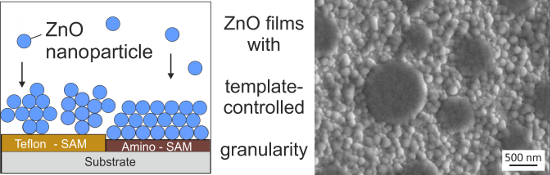
Template-controlled mineralization: Determining film granularity and structure by surface functionality patterns
Beilstein J. Nanotechnol. 2015, 6, 1763–1768, doi:10.3762/bjnano.6.180
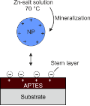
- agglomerates grow together (j–n) resulting in a rough surface for the final morphology. Deposition mechanism of mineralized ZnO nanoparticles on amino SAMs. The negative charges represent counterions attached to the positive surface charge (Stern layer) provided by protonated amino groups (–NH3

Synthesis, characterization and in vitro biocompatibility study of Au/TMC/Fe3O4 nanocomposites as a promising, nontoxic system for biomedical applications
Beilstein J. Nanotechnol. 2015, 6, 1677–1689, doi:10.3762/bjnano.6.170
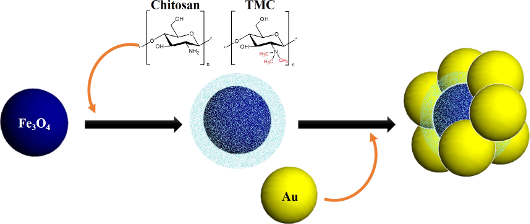
- , noble metals such as gold, or oxide layers such as silica or alumina) not only prevents their aggregation due to the change in surface charge, but also protects them from oxidation [12][20][21]. Additionally, proper surface coverage increases the stability and half-life of the magnetic nanoparticles
- , the final Au nanoparticles with a desirable diameter of 10 ± 2 nm (Figure 2a,b) and negative surface charge were obtained. The UV–vis absorption spectrum of a ruby-red colloidal solution of Au nanoparticles is presented in Figure 2c. Due to the excitation of surface plasmon vibrations, a strong peak
- nanoparticles is clearly visible in Figure 4a. The Fe3O4 nanoparticles are encapsulated by a contrasting layer of TMC, which inhibited aggregation due to the change in surface charge. In contrast, the polymer shell was not visibly recognizable in the TEM image of the chitosan/Fe3O4 nanoparticles (Figure 4c). It




The eNanoMapper database for nanomaterial safety information
Beilstein J. Nanotechnol. 2015, 6, 1609–1634, doi:10.3762/bjnano.6.165
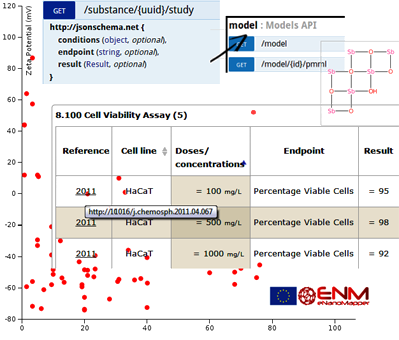
- distribution and zeta potentiometry to estimate the pH-dependent surface charge. Biological identity With the expanding insight into the factors determining toxicity, the list of measurable effects is growing increasingly long. The need for validated in vitro tests has been advocated since 2006 [1]. It is


Using natural language processing techniques to inform research on nanotechnology
Beilstein J. Nanotechnol. 2015, 6, 1439–1449, doi:10.3762/bjnano.6.149
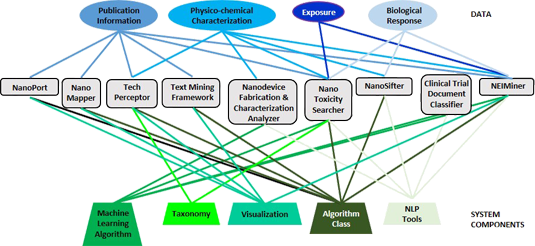
- , surface charge and molecular weight data beyond the core composition, which was fixed to PAMAM [15]. Incorporating almost 80% of the minimum characterization data, the NEIMiner appears to be the most comprehensive with regards to extraction of physico-chemical characterization properties. When assessing
Peptide-equipped tobacco mosaic virus templates for selective and controllable biomineral deposition
Beilstein J. Nanotechnol. 2015, 6, 1399–1412, doi:10.3762/bjnano.6.145
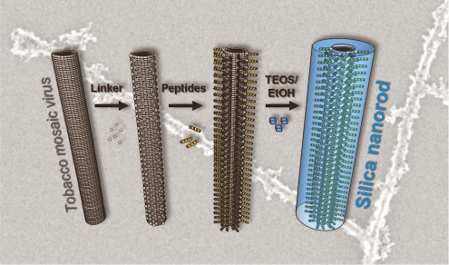
- outer TMV–CP surface charge and the introduction of specific amino acid motifs, guiding the nucleation and growth of mineral coatings around the TMV core. This is in analogy to natural biomineralization-directing protein domains identified for various organisms [55][56][57][58][59]. Direct genetic




Surface excitations in the modelling of electron transport for electron-beam-induced deposition experiments
Beilstein J. Nanotechnol. 2015, 6, 1260–1267, doi:10.3762/bjnano.6.129
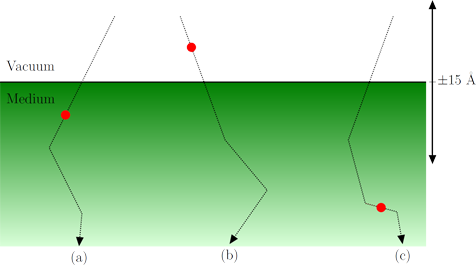
- features and trends of the surface excitation probability: Surface energy losses can be undergone by the charged projectile on either side of the interface, at the solid side or at the vacuum side. Indeed, a surface charge can be induced regardless of the side at which the projectile is moving on and, thus


Scanning reflection ion microscopy in a helium ion microscope
Beilstein J. Nanotechnol. 2015, 6, 1125–1137, doi:10.3762/bjnano.6.114
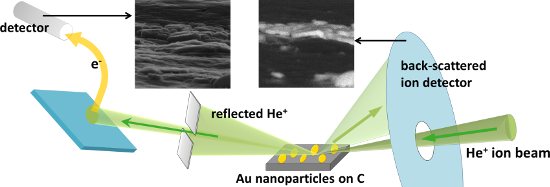
- in the SE and in RI images, the origin of their mechanisms are quite different. Effect of a surface charge The RI image formation mechanisms described above originate from the ion scattering by the geometrical specimen relief and do not take into account the possible impact of surface charging
- , the influence of surface charge on their trajectories might not be negligible, and the question regarding possible image distortion arises. Under the action of the electric field of the positively charged sample surface, the trajectories of the primary ions become curved as schematically shown in
- accumulated surface charge plays te role of positive sample bias. The impact of the charging on the height of the surface steps is negligible. Conclusion In summary, we investigated the capabilities of a scanning reflection helium ion microscopy technique that was realized in a helium ion microscope for the





