


Search results
Search for "titanium" in Full Text gives 304 result(s) in Beilstein Journal of Nanotechnology. Showing first 200.
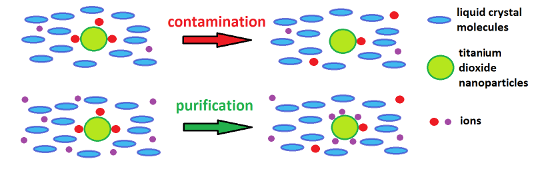
Impact of titanium dioxide nanoparticles on purification and contamination of nematic liquid crystals
Beilstein J. Nanotechnol. 2017, 8, 2766–2770, doi:10.3762/bjnano.8.275
- Dmitrii Pavlovich Shcherbinin Elena A. Konshina Department of Optical Physics and Modern Natural Science, ITMO University, Kronverkskiy pr. 49, Saint Petersburg 197101, Russia 10.3762/bjnano.8.275 Abstract We have investigated the impact of titanium dioxide nanoparticles on the ionic
- contamination of liquid crystals. Nematic liquid crystals with high and low initial ionic contamination have been examined. It has been shown that titanium dioxide nanoparticles reduced the ion density of liquid crystals with high initial ionic contamination from 134.5 × 1012 cm−3 to 63.2 × 1012 cm−3. In the
- case of liquid crystals with low initial ionic contamination, the nanoparticles led to an insignificant increase of ion density from 19.8 × 1012 cm−3 to 25.7 × 1012 cm−3. Keywords: ionic impurities; liquid crystals; nanoparticles; titanium dioxide; Findings Nowadays, liquid crystals (LCs) are widely
CdSe nanorod/TiO2 nanoparticle heterojunctions with enhanced solar- and visible-light photocatalytic activity
Beilstein J. Nanotechnol. 2017, 8, 2741–2752, doi:10.3762/bjnano.8.273
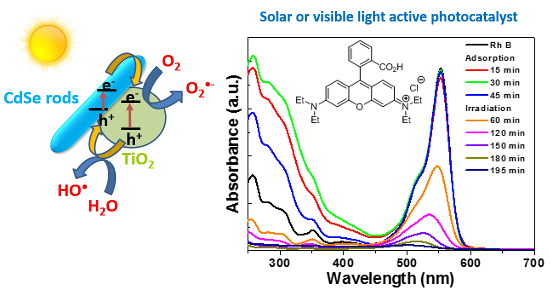
- conversion of solar energy to chemical energy, for example, via water splitting to produce hydrogen, is the topic of numerous current research projects. Titanium dioxide (TiO2) has been widely investigated over the last three decades and has been demonstrated to be of high potential [1][2]. However, TiO2


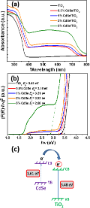

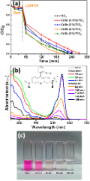
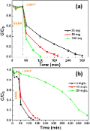

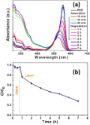


Patterning of supported gold monolayers via chemical lift-off lithography
Beilstein J. Nanotechnol. 2017, 8, 2648–2661, doi:10.3762/bjnano.8.265
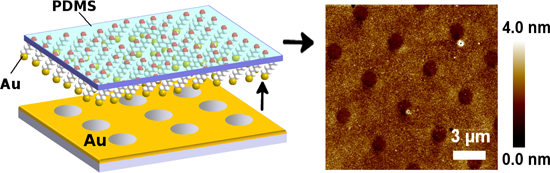
- . After degassing again, the PDMS stamps were cured in an oven at 60 °C for 12 h. The PDMS stamps were separated from the silicon masters carefully and cut into desired sizes. Patterning Au-on-silicon masters Silicon wafers with 100 nm Au and 5 nm titanium adhesion layers (Platypus, Madison, WI, USA) were


Refractive index sensing and surface-enhanced Raman spectroscopy using silver–gold layered bimetallic plasmonic crystals
Beilstein J. Nanotechnol. 2017, 8, 2492–2503, doi:10.3762/bjnano.8.249
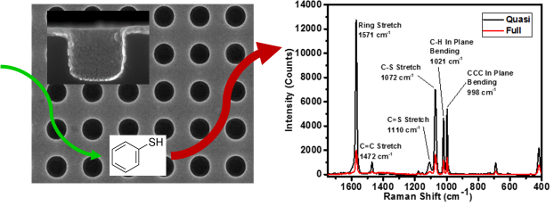
- frequencies. A ≈5 nm titanium dioxide adhesion layer was deposited using atomic layer deposition (Cambridge nanotech) on the embossed SOG nanostructure followed by deposition of a ≈50 nm metallic film (Au, Ag or both) via one of the various methods. Sputter deposition in a 5 mTorr argon atmosphere (AJA


Laser-assisted fabrication of gold nanoparticle-composed structures embedded in borosilicate glass
Beilstein J. Nanotechnol. 2017, 8, 2454–2463, doi:10.3762/bjnano.8.244
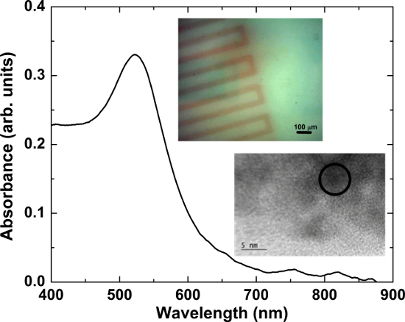
- ., silicate, phosphate and borate glasses, titanium and aluminum oxides, and polymers) are processed by laser radiation with appropriate parameters. Metal nanoparticles are formed within the irradiated area after a subsequent thermal annealing. This photoreduction process has been achieved by using CW lasers


Involvement of two uptake mechanisms of gold and iron oxide nanoparticles in a co-exposure scenario using mouse macrophages
Beilstein J. Nanotechnol. 2017, 8, 2396–2409, doi:10.3762/bjnano.8.239
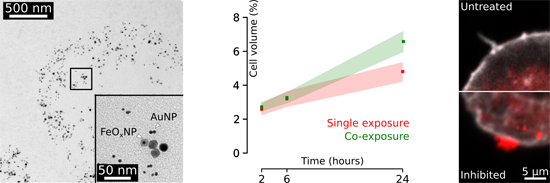
- ], potentially reflecting different agglomeration states. The uptake mechanism for one and the same NP into different cell types may even vary [10]. For instance, the uptake of fetal bovine serum-treated titanium dioxide NPs (TiO2NP) into A549 and H1299 cells, two human lung cell lines, is different, and it was



Tailoring the nanoscale morphology of HKUST-1 thin films via codeposition and seeded growth
Beilstein J. Nanotechnol. 2017, 8, 2307–2314, doi:10.3762/bjnano.8.230
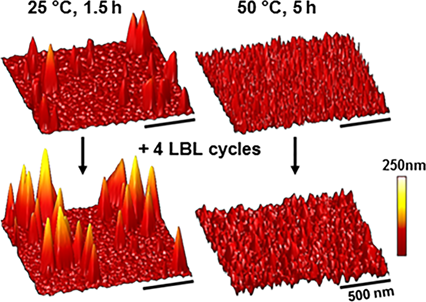
- attained from Pharmco-Aaper (Shelbyville, KY, USA). All chemicals were used as received, unless otherwise noted. Gold substrates were obtained from Platypus Technologies (New Orleans, LA) in the form of silicon wafers with a 5 nm titanium adhesion layer and 100 nm of gold. Methods Substrate Preparation


Hydrothermal synthesis of ZnO quantum dot/KNb3O8 nanosheet photocatalysts for reducing carbon dioxide to methanol
Beilstein J. Nanotechnol. 2017, 8, 2264–2270, doi:10.3762/bjnano.8.226
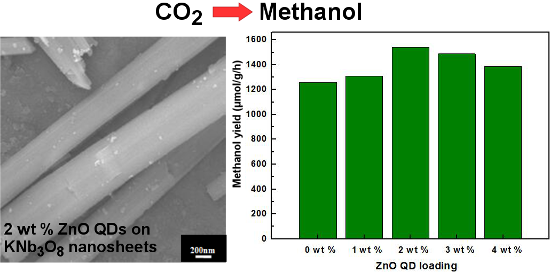
- much higher than that of the commercial Degussa P25 [10]. Zhou et al. synthesized porous K4Nb6O17 microspheres with large surface area via a homogeneous precipitation method, which showed not only two times higher photocatalytic activity than that of the commercial Degussa P25 (the titanium dioxide




Evaluating the toxicity of TiO2-based nanoparticles to Chinese hamster ovary cells and Escherichia coli: a complementary experimental and computational approach
Beilstein J. Nanotechnol. 2017, 8, 2171–2180, doi:10.3762/bjnano.8.216

- precursors, variations of the initial experimental conditions, and/or various endpoints of environmental and human health relevance will be necessary. Experimental Materials Titanium(IV) isopropoxide (TIP, 97%), palladium(II) chloride (5 wt % in 10 wt % HCl) and HAuCl4 (Au ≈ 52%) were purchased from Sigma
- microemulsion containing the reducing agent (hydrazine). Titanium isopropoxide was added into the microemulsion system containing Au and Pd nanoparticles. The microemulsions were mixed and purged with nitrogen for 24 h and the obtained precipitate was washed, dried and calcined for 3 h at different temperatures


In situ controlled rapid growth of novel high activity TiB2/(TiB2–TiN) hierarchical/heterostructured nanocomposites
Beilstein J. Nanotechnol. 2017, 8, 2116–2125, doi:10.3762/bjnano.8.211
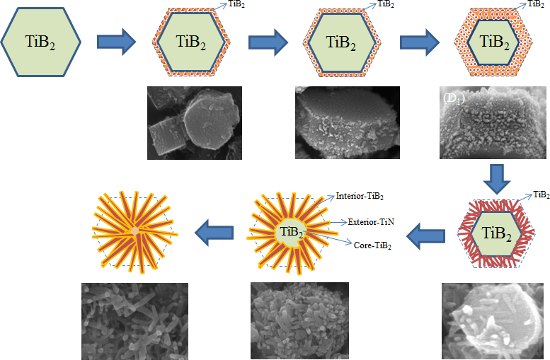
- and carbides have attracted great attention for advanced engineering applications due to their exceptional hardness, thermal and chemical stability at high temperatures [1][2][3]. For example, titanium diboride (TiB2) processes high hardness and a high melting point, good chemical and metallurgical
- stability, as well as excellent electrical and thermal conductivity [4][5][6]. On the other hand, titanium nitride (TiN) has some attractive properties, such as high hardness, low electrical resistivity, excellent wear and corrosion resistance [1][2][7]. Therefore, it is expected that these unique


Synthesis and characterization of noble metal–titania core–shell nanostructures with tunable shell thickness
Beilstein J. Nanotechnol. 2017, 8, 2083–2093, doi:10.3762/bjnano.8.208
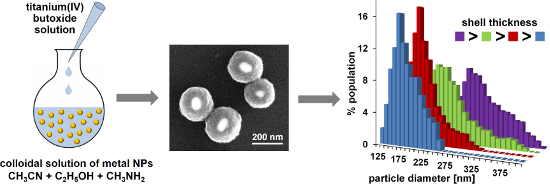
- characterization of metal–metal oxide core–shell nanostructures. Keywords: Ag@TiO2; Au@TiO2; core–shell nanostructures; titania coating; titanium dioxide; tunable resistive pulse sensing; Introduction In recent years, core–shell nanostructures (CSNs) have become one of the most widely studied hybrid structures
- ][5][6][7][8][9][10][11]. For many applications, however, the use of titanium dioxide in CSNs would be of much greater interest. Useful physicochemical properties of titanium dioxide in its crystalline forms, rutile and anatase, such as high refractive index and photocatalytic activity have led to its
- and Au@TiO2 structures could be their rather difficult synthesis process [21][22]. The main problem in coating various particles (including metal colloids) with titania is the very fast hydrolysis rate of its most commonly used precursors, titanium alkoxides, which makes the coating process hard to


Advances and challenges in the field of plasma polymer nanoparticles
Beilstein J. Nanotechnol. 2017, 8, 2002–2014, doi:10.3762/bjnano.8.200
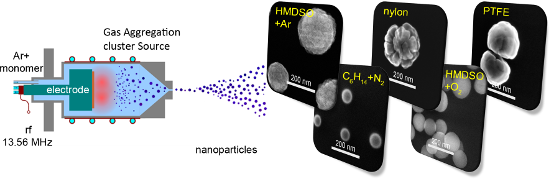
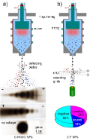
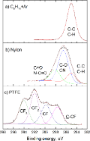
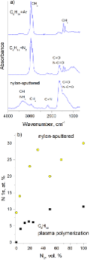
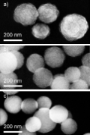
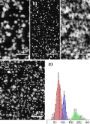
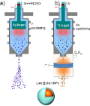
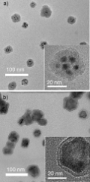
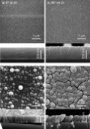
- prove advantageous, especially if more reactive metals are considered. For example, titanium is known to form strong TiC bonds when sputtered in organic plasma [74]. Carbidization of titanium atoms may hinder metal–polymer phase separation and it may even change the properties of titanium inclusions






Fabrication of carbon nanospheres by the pyrolysis of polyacrylonitrile–poly(methyl methacrylate) core–shell composite nanoparticles
Beilstein J. Nanotechnol. 2017, 8, 1897–1908, doi:10.3762/bjnano.8.190

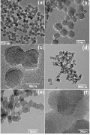
- adhesion between the carbon nanoparticles. As a result, an agglomerated carbon bulk instead of discrete carbon nanoparticles was obtained [33][34]. To solve this problem, Wu et al. [33] coated a protective layer of inorganic salt, titanium phosphate (TP), on the surfaces of the PAN nanoparticles. The



Micro- and nano-surface structures based on vapor-deposited polymers
Beilstein J. Nanotechnol. 2017, 8, 1366–1374, doi:10.3762/bjnano.8.138
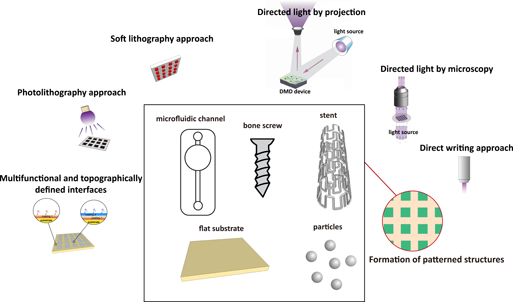
- ) surface and a poly(4-ethynyl-p-xylylene-co-p-xylylene) surface, respectively. Various substrates were successfully verified for the coating and patterning modifications: metal (silver, titanium, stainless steel), polystyrene (PS), poly(methyl methacrylate) (PMMA), silicon, glass, poly(dimethylsiloxane


Fabrication of hierarchically porous TiO2 nanofibers by microemulsion electrospinning and their application as anode material for lithium-ion batteries
Beilstein J. Nanotechnol. 2017, 8, 1297–1306, doi:10.3762/bjnano.8.131
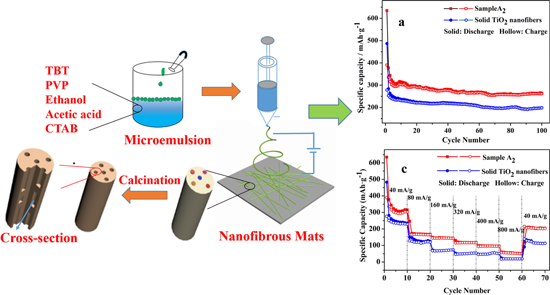
- China 10.3762/bjnano.8.131 Abstract Titanium dioxide (TiO2) nanofibers have been widely applied in various fields including photocatalysis, energy storage and solar cells due to the advantages of low cost, high abundance and nontoxicity. However, the low conductivity of ions and bulk electrons hinder
- density [5][6][7][8]. So far, among all the commercial lithium-ion batteries, graphite plays an extremely important role in anode materials; nevertheless, structural deformation, electrical disconnection and the initial loss of capacity hinder its further development [9][10]. Titanium dioxide (TiO2) is
- considered to be an alternative anode material to graphite, which can be attributed to the superior advantages of titanium dioxide such as low-cost, eco-friendliness, nontoxicity and high abundance [10]. Furthermore, safety and stability of titanium dioxide are higher than those of graphite, because since Li




Nanotopographical control of surfaces using chemical vapor deposition processes
Beilstein J. Nanotechnol. 2017, 8, 1250–1256, doi:10.3762/bjnano.8.126
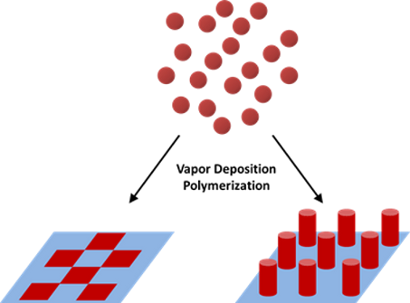
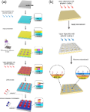
- of polymer growth was found on transition metals. For this reason, attractive interactions between the metal and the heteroatoms were suggested. The patterned deposition of a reactive PPX derivative could be realized for PPX–vinyl on titanium, and its reactivity in cross-metathesis reactions was




High photocatalytic activity of Fe2O3/TiO2 nanocomposites prepared by photodeposition for degradation of 2,4-dichlorophenoxyacetic acid
Beilstein J. Nanotechnol. 2017, 8, 915–926, doi:10.3762/bjnano.8.93
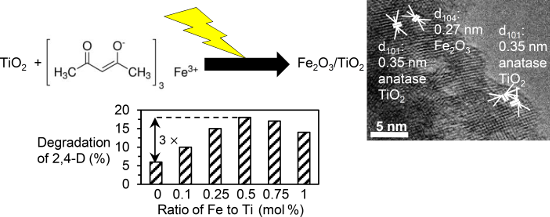
- , titanium dioxide (TiO2) has been the foremost established material for degradation of organic pollutants [1][2]. In addition to its nontoxicity, abundance and relatively low cost, TiO2 also shows excellent photocatalytic activity in many degradation reactions. Unfortunately, the photocatalytic performance


Triptycene-terminated thiolate and selenolate monolayers on Au(111)
Beilstein J. Nanotechnol. 2017, 8, 892–905, doi:10.3762/bjnano.8.91
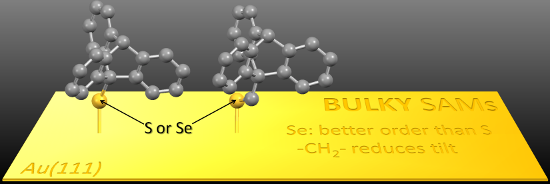
- vaporisator (Leybold Univex 300). Gold (Chempur, 99.995%) layers with a thickness of 150 nm were deposited at a rate of 1 nm/s. An 8 nm titanium (Chempur, 99.8%) layer was deposited at a rate of 0.15 nm/s as an adhesion layer between the Si substrate and the Au layer. The deposition rate and thickness were




Functional dependence of resonant harmonics on nanomechanical parameters in dynamic mode atomic force microscopy
Beilstein J. Nanotechnol. 2017, 8, 883–891, doi:10.3762/bjnano.8.90
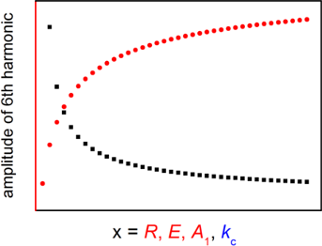
- evolution of A6 for discrete values of Young’s modulus from different materials, namely PDMS (E = 0.0025 GPa), LDPE (E = 0.1 GPa), PS (E = 2.7 GPa), fused silica (E = 72.9 GPa), titanium (E = 110 GPa) and sapphire (E = 345 GPa), using a 10.9 N/m cantilever, as determined with the thermal tune method and
- samples have to be changed, a variation of the tip radius cannot be excluded. The sample with the highest wear was titanium, because of its higher roughness as compared to the rest of the samples, and for this reason it was measured at the end of the cycles. From the figure it can be clearly observed that
- A6 for the titanium sample shows the larger values. Dependence of the amplitude of the 6th harmonic on free oscillation amplitude Figure 7a shows the evolution of A6 as a function of the free oscillation amplitude as determined experimentally with nominally 26 N/m cantilevers. The experimental points


3D Nanoprinting via laser-assisted electron beam induced deposition: growth kinetics, enhanced purity, and electrical resistivity
Beilstein J. Nanotechnol. 2017, 8, 801–812, doi:10.3762/bjnano.8.83
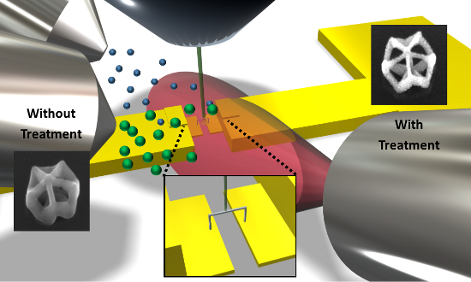
- combination of photolithography and electron beam lithography (EBL) were used to produce the two-contact pads with a spacing of 500 nm. An initial set of gold electrical contacts were patterned using photolithography and deposited with a thickness of 100 nm. A 3 nm titanium adhesion layer was deposited, prior
- 600 dual beam. The contact spacing was reduced to 500 nm using EBL. The EBL contact extensions were 20 nm thick gold with a 3 nm titanium adhesion layer. After patterning, the substrate was cleaned via sonication for 5 minutes in an acetone bath. EBID was then used to construct a 3D bridge across the


Synthesis of graphene–transition metal oxide hybrid nanoparticles and their application in various fields
Beilstein J. Nanotechnol. 2017, 8, 688–714, doi:10.3762/bjnano.8.74
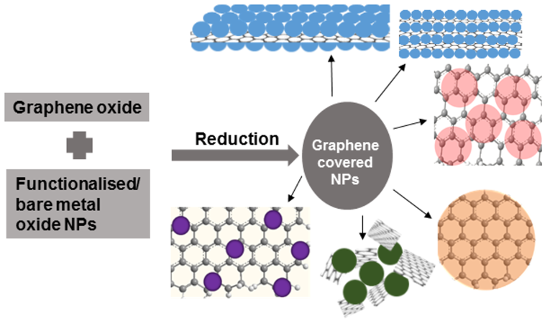
- scalable and relatively cost effective [14][15][16]. In particular, among all the TMO NPs, titanium dioxide [17], manganese oxide [18], iron oxide [19] and zinc oxide [20] have attracted the most attention due to their particular interesting and advantageous properties. By changing the reaction conditions
- precise, in the following, we categorise the graphene–TMO semiconductor NP hybrids on the basis of their counterpart material oxide (from titanium to zinc) following the periodic table. Titanium dioxide (TiO2)–graphene hybrids Nanocrystalline TiO2 is an interesting material because of its unique optical






Diffusion and surface alloying of gradient nanostructured metals
Beilstein J. Nanotechnol. 2017, 8, 547–560, doi:10.3762/bjnano.8.59
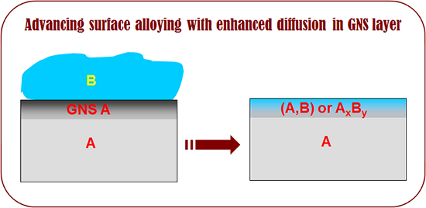
- amorphous titania. Furthermore, the formed titania showed an increased crystallinity and retained the nanoporous structure even after calcination at 600 °C [94]. These works indicated the possibility to improve the bioactivity of titanium bone implants and to accelerate osseointegration by introducing a




Functionalized TiO2 nanoparticles by single-step hydrothermal synthesis: the role of the silane coupling agents
Beilstein J. Nanotechnol. 2017, 8, 304–312, doi:10.3762/bjnano.8.33
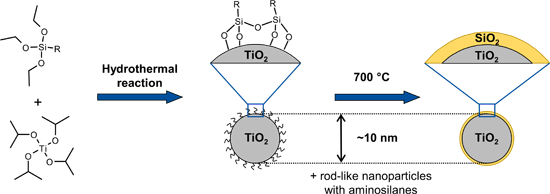
- versatile hydrothermal synthesis route to in situ functionalized TiO2 nanoparticles was developed using titanium(IV) isopropoxide as Ti-precursor and selected silane coupling agents (3-aminopropyltriethoxysilane (APTES), 3-(2-aminoethylamino)propyldimethoxymethylsilane (AEAPS), and n-decyltriethoxysilane
- Because of the high surface-to-volume ratio, the intrinsic properties of titanium dioxide (TiO2) nanoparticles have led to exploitation in many fields such as in photocatalysis [1], solar cells [2], and in biomedical applications [3]. The naturally occurring phases of TiO2 are rutile (thermodynamically
- ]. Typically used precursors are titanium alkoxides where the formation of anatase nanocrystals occurs through hydrolysis and condensation [22]. To our knowledge there is only one work where in situ functionalization of TiO2 nanoparticles using solvothermal synthesis is reported. Koziej et al. used trimethoxy



Performance of natural-dye-sensitized solar cells by ZnO nanorod and nanowall enhanced photoelectrodes
Beilstein J. Nanotechnol. 2017, 8, 287–295, doi:10.3762/bjnano.8.31
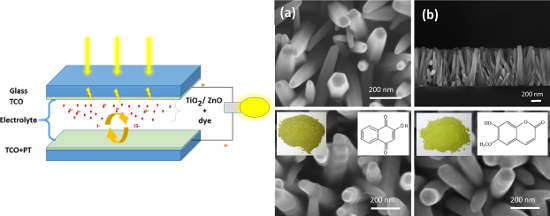
- represents the photoelectrode, composed of a wide band gap semiconductor thin layer coated on transparent conducting oxide (TCO) films. A mesoporous film layer is used as a semiconductor in the photoelectrode. Because of its stability and easy synthesis, titanium dioxide (TiO2) is mostly used as the


Photocatalysis applications of some hybrid polymeric composites incorporating TiO2 nanoparticles and their combinations with SiO2/Fe2O3
Beilstein J. Nanotechnol. 2017, 8, 272–286, doi:10.3762/bjnano.8.30
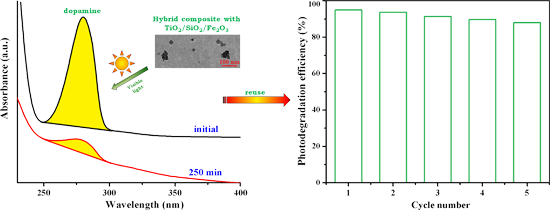
- Andreea Laura Chibac Tinca Buruiana Violeta Melinte Emil C. Buruiana Petru Poni Institute of Macromolecular Chemistry, 41 A Gr. Ghica Voda Alley, 700487 Iasi, Romania 10.3762/bjnano.8.30 Abstract Polymer nanocomposites containing titanium oxide nanoparticles (TiO2 NPs) combined with other
- , Li-ion batteries, sensors, photodynamic cancer therapy or in biomaterials [1][2][3][4][5][6][7]. Since 1972, when Fujishima and Honda published their seminal work [8], much work has been focused on investigating the photocatalytic properties of TiO2 [9]. Titanium dioxide catalysts proved to be better
- the catalytic activity of titanium(IV) oxide in the range of visible light (λ > 430 nm) can be attained by doping the TiO2 network with non-metals [16][17][18], lanthanide ions [19][20], transitional metal ions [21][22][23], noble metals [24][25] or metallic oxides [26]. Other strategies can be





