


Search results
Search for "Bessel beam" in Full Text gives 4 result(s) in Beilstein Journal of Nanotechnology.
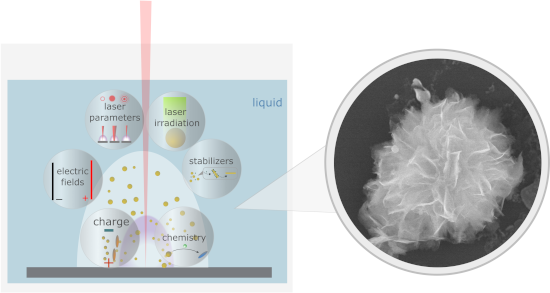
Beam shaping techniques for pulsed laser ablation in liquids: Unlocking tunable control of nanoparticle synthesis in liquids
Beilstein J. Nanotechnol. 2026, 17, 309–342, doi:10.3762/bjnano.17.22
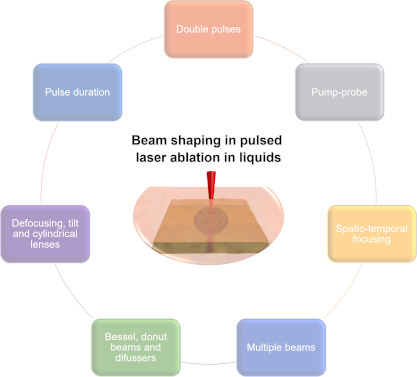
- profile into a non-Gaussian beam (Bessel beam, doughnut beam, and speckle pattern). Conventional spatial beam control. Although the determination of the focused laser beams in air can be done directly from the ablated spots at different lens–target distances, in liquids and with ultrashort laser pulses
- ), which generate interference of an incoming Gaussian laser beam along the optical axis, thus forming a long focal line. The radial distribution of intensity in a zeroth-order Bessel beam represents a central bright spot surrounded by rings of much smaller intensities so that their spacing can be
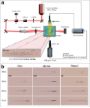
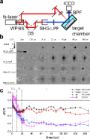
- approximated by the Bessel function J0 [145]. The anatomy of the quasi-Bessel beam propagation in space is shown in Figure 8 with a detailed view of its spatiotemporal shape including the evolution of the cross-sectional structure [146]. Two laser beams, one continuous wave (CW) and a femtosecond pulsed laser







Laser ablation in liquids for shape-tailored synthesis of nanomaterials: status and challenges
Beilstein J. Nanotechnol. 2025, 16, 1963–1997, doi:10.3762/bjnano.16.137


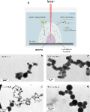
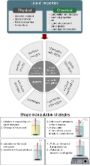


Influence of laser beam profile on morphology and optical properties of silicon nanoparticles formed by laser ablation in liquid
Beilstein J. Nanotechnol. 2025, 16, 1533–1544, doi:10.3762/bjnano.16.108
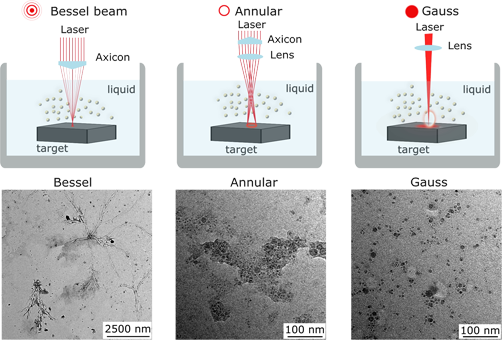
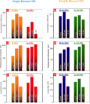
- ultraviolet–visible spectroscopy, high-resolution transmission electron microscopy, and Raman and photoluminescence spectroscopies, and the correlation of the NP properties with the laser beam profile was studied. Three different beam profiles were selected, namely, a Bessel beam produced using an axicon, an
- as an ablation source. The beam profile has been shown to be a crucial factor significantly influencing morphology and composition of the nanostructures produced. Namely, the conditions generated using a Bessel beam profile favored the production of nanostructures having elongated filament-like
- -uniform energy distribution, which will affect plasma generation and confinement, the hydrodynamic trajectory of the ejected target material and pressure relaxation, as well as plasma and cavitation bubble propagation and temporal evolution. In the case of a Bessel beam, the focusing with an axicon


Fabrication of phase masks from amorphous carbon thin films for electron-beam shaping
Beilstein J. Nanotechnol. 2019, 10, 1290–1302, doi:10.3762/bjnano.10.128
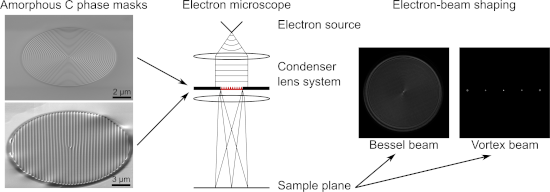
- ; Bessel beam; electron-beam shaping; nanofabrication; vortex beam; Introduction The possibility to shape electron beams has gained much interest since the first observation of electron vortex beams, i.e., beams that carry a defined orbital angular momentum [1][2][3]. Various other beam shapes, e.g., non
- deviations from the desired form because the ideally sharp edges are significantly rounded due to the finite diameter of the ion beam. Application of phase masks Bessel beam phase mask in object plane PMs were first investigated as conventional samples in the object plane of a TEM which allows for a detailed



Other Beilstein-Institut Open Science Activities



